When Programming Concepts Become Flirtatious Banter
Why is this DevCommunities meme funny?
Level 1: Smart Is Sexy
Imagine you’re watching someone do something they really love and are good at – like solving a big puzzle or building an awesome LEGO castle. They’re super focused, totally in their element, and you can see the passion in their eyes. It’s kind of cool to watch, right? You start thinking, “Wow, they’re really awesome at this!” You might even feel a bit of admiration or a little crush because seeing someone being clever and dedicated is attractive in its own way. That’s what’s happening in this meme: a guy is working on his computer, coding away, and his girlfriend finds it captivating (even if coding just looks like typing gibberish to the rest of us!).
Now, add a funny twist: another person jokingly uses a bunch of computer words to sound romantic – almost like they’re speaking a secret love language made of tech terms. It’s totally silly because words like “pointer” or “call stack” are usually stuff you hear in a computer class, not on a date. It would be as if someone who loves trains started flirting by saying, “Baby, you make my locomotive go choo-choo!” 😄 It’s unexpected and goofy. The heart of the joke is that nerdy things can be loveable and funny at the same time. Even though most people wouldn’t think coding jargon is romantic, in this meme it’s used in a playful, over-the-top way to make us laugh. It shows that being really into something – even something super geeky like computer code – can actually be endearing. In plain terms: sometimes smart is sexy, and there’s always room to be a little goofy with the ones you care about.
Level 2: Sexy Syntax 101
Let’s break down all that spicy code talk into plain English. The meme’s humor comes from using common programming terms as cheeky innuendos. For newer developers (or anyone who’s not fluent in C or Java), here’s what those terms mean and why they’re so core to our daily dev lives:
Pointer – In programming (especially C/C++), a pointer is a variable that stores a memory address, essentially “pointing” to where data lives in memory. It’s like a signpost to a specific box in the computer’s storage. Pointers are powerful but tricky; use them wrong and you might point to the wrong place, causing crashes or weird behavior. Early in your coding journey, pointers can feel like mystical creatures – you hear tales of segmentation faults (crashes) and memory leaks caused by pointer mistakes. Nevertheless, mastering them is a rite of passage for many coders. So when someone says “Show me your pointer!”, they’re literally referencing this little indicator to a memory location. The meme twists it into flirty territory because, well, “pointer” could humorously refer to something else in a suggestive way. It’s a classic nerdy pickup line format: only funny (or sensical) if you know the tech meaning of the word.
Run me until you reach my breakpoint – A breakpoint is a debugging tool. You set a breakpoint in your code to pause execution at a certain line so you can check what’s happening at that moment (variables, program state, etc.). It’s akin to putting a bookmark in a process and saying “stop here for a second.” When you’re learning to debug, setting your first breakpoint and seeing the program halt exactly where you wanted is almost magical. It gives you control to inspect and understand code flow. Now, in the meme, “run me all you want until you reach my breakpoint” sounds like someone saying “keep going until I say stop.” In a coding sense, it’s just running a program until a pause; in a romantic sense, it implies “go on until I can’t take it anymore.” 😅 For a junior dev, the technical part to know is: breakpoints = pause markers in debugging. It’s not usually something you’d mix up with romance, which is exactly why it’s funny when it is mixed up.
Buffer (and buffer overflow) – A buffer is simply a chunk of memory set aside to hold some data, like an array of characters for a string. If you imagine memory as a series of buckets, a buffer is a row of buckets reserved for your data. For example, you might allocate a buffer for 100 characters to store a username. A buffer overflow happens when you try to put more data into the buffer than it can hold – like pouring 120 characters into that 100-character buffer. The extra data “overflows” into adjacent memory, which can corrupt data or crash the program. It’s a common bug, and also a common security hole (overflowing buffers is how many hacks were done in the early days!). New programmers often first encounter this in C when forgetting to limit input sizes or miscounting array indices. It’s a big oops. Now, the line “Fill my buffer with your data” is deliberately suggestive: in normal terms it means “write data into my storage space,” but here it’s, well, very amorous sounding. 😳 The joke is even richer if you know that overfilling a buffer is bad – the commenter is basically saying “give me everything, I don’t care if it’s too much!” To someone learning programming, just remember: normally, you do not want to overflow a buffer… but in this tongue-in-cheek scenario, that riskiness is played for humor.
Private members (without any encapsulation) – In Object-Oriented Programming (OOP), a class often contains data or functions that are marked private, meaning they cannot be accessed from outside the class. These are your private members – think of them as the secrets or personal data of an object. Encapsulation is the principle of bundling data with methods that operate on that data, and restricting direct access to some of the object’s components (the private parts). It’s like putting a protective shell or capsule around the object’s insides so other code can’t mess with it willy-nilly. As a beginner, you encounter this in languages like Java, C#, or C++ and learn about access modifiers (
private,public,protected). You’re taught that good design respects boundaries: you interact with an object through its public interface, not by reaching in and tweaking its internals. Now, the comment “Access all my private members, baby, without any capsulation!” breaks all those rules in a lusty way. The phrase “without any capsulation” is a playful way (with a slight typo) of saying “without any encapsulation” – meaning no protective barriers at all. To decode the innuendo: “private members” is a wink at private parts (parts of one’s body one doesn’t usually show or share), and “without encapsulation” implies no protection or hiding of those parts. It’s basically saying “I’m an open book, do whatever you want.” For a junior dev, just recognize how these OOP terms are being bent: normally, accessing private members freely is terrible practice (and often impossible without reflection or friend classes), but in this joke, doing the naughty thing (breaking encapsulation) is the whole point.Push and pop me like a call stack in a recursive function – This is perhaps the most technically dense line, so let’s unpack it. A call stack is a structure that keeps track of active function calls in a running program. Think of it as a stack of plates: each time a function is called, a new plate (stack frame) gets pushed onto the stack with information like local variables and the return address. When a function returns, you pop that plate off the stack. Now, in normal operation, you push and pop as functions are called and return. A recursive function is a function that calls itself. For example, a simple recursive function for factorial:
int fact(n) { if(n <= 1) return 1; else return n * fact(n-1); }. Every time it calls itself (fact(n-1)), a new frame is pushed. When it eventually hits the base case, the calls start returning and the frames pop one by one. New programmers often learn recursion as a concept and sometimes get tripped up by it (if the recursion never ends, you keep pushing frames until the program crashes with a stack overflow!). It’s a nifty concept that can solve certain problems elegantly, but it requires a careful base case and understanding of the stack. Okay, back to the meme: “Push and pop me like a call stack” is borrowing this push/pop imagery. Non-technically, push me and pop me definitely sounds suggestive — as if it’s describing some rhythmic movement. In pure tech terms, it’s referencing the way stack frames are added and removed. For a junior, just picture the stack of plates analogy, and pushing a new one on or popping one off repeatedly. Now imagine someone using that as a metaphor for an intimate back-and-forth… It’s absurd, which is why it’s funny! It’s the kind of joke you only encounter in programmer humor circles: mixing serious CS lingo with bedroom talk. If you’re new to coding, you might not have ever thought the words call stack and romance could appear in the same sentence – and you’d be right, except in a crazy joke like this.Watching a dev at work can be attractive? – This part might not be a tech term, but it’s part of the meme’s setup. The original poster is a software developer whose girlfriend loves watching him code. As a newcomer, you might wonder, “What’s there to watch? It’s just typing and staring at a screen full of text!” But there’s a relatability here: when someone is passionate and focused on what they’re doing, it can be intriguing (even if the watcher has no clue what all those
ifstatements and pointers on screen mean). Maybe the girlfriend finds the concentration or the expertise hot – like how watching a skilled artist paint or a musician practice can be mesmerizing even if you’re not an expert in those arts. In developer culture, there’s a bit of tongue-in-cheek pride about this: we often joke that our non-tech partners find our bug-fixing superpowers impressive. After all, in movies, hacking is depicted with dramatic flair – fingers flying over the keyboard, code reflecting in the hero’s glasses… Perhaps there’s a grain of truth that proficiency can be sexy. At the very least, this line sets the stage for the comedic reply, and it’s something even beginners can chuckle at: apparently coding = irresistible charm for some! (Who knew our hours of studying algorithms might double as romance points?)
All together, these terms represent a crash course in CS_Fundamentals: pointers, breakpoints, buffers, encapsulation, call stacks, recursion – it’s like a checklist from an intro to systems or programming class. What makes the meme click is turning each of those dry, exact concepts into a steamy joke. As a new dev, you’re learning that programmers have a very unique humor. We take the concepts that usually cause headaches (like debugging pointer errors or avoiding overflow bugs) and we make light of them. It’s a coping mechanism and a cultural quirk. Jokes like these are inside jokes – if you’ve written a recursive function or struggled with C pointers, you suddenly feel like you’re part of the club when you get the joke. The next time you hear someone mention their “private members,” you might just snicker remembering this meme. And hey, you’ve also learned something: behind each innuendo here lies a real technical meaning that’s useful to know as a developer. Consider this meme a fun, slightly risqué study guide to basic programming concepts. 😁
Level 3: Buffer Overflow of Desire
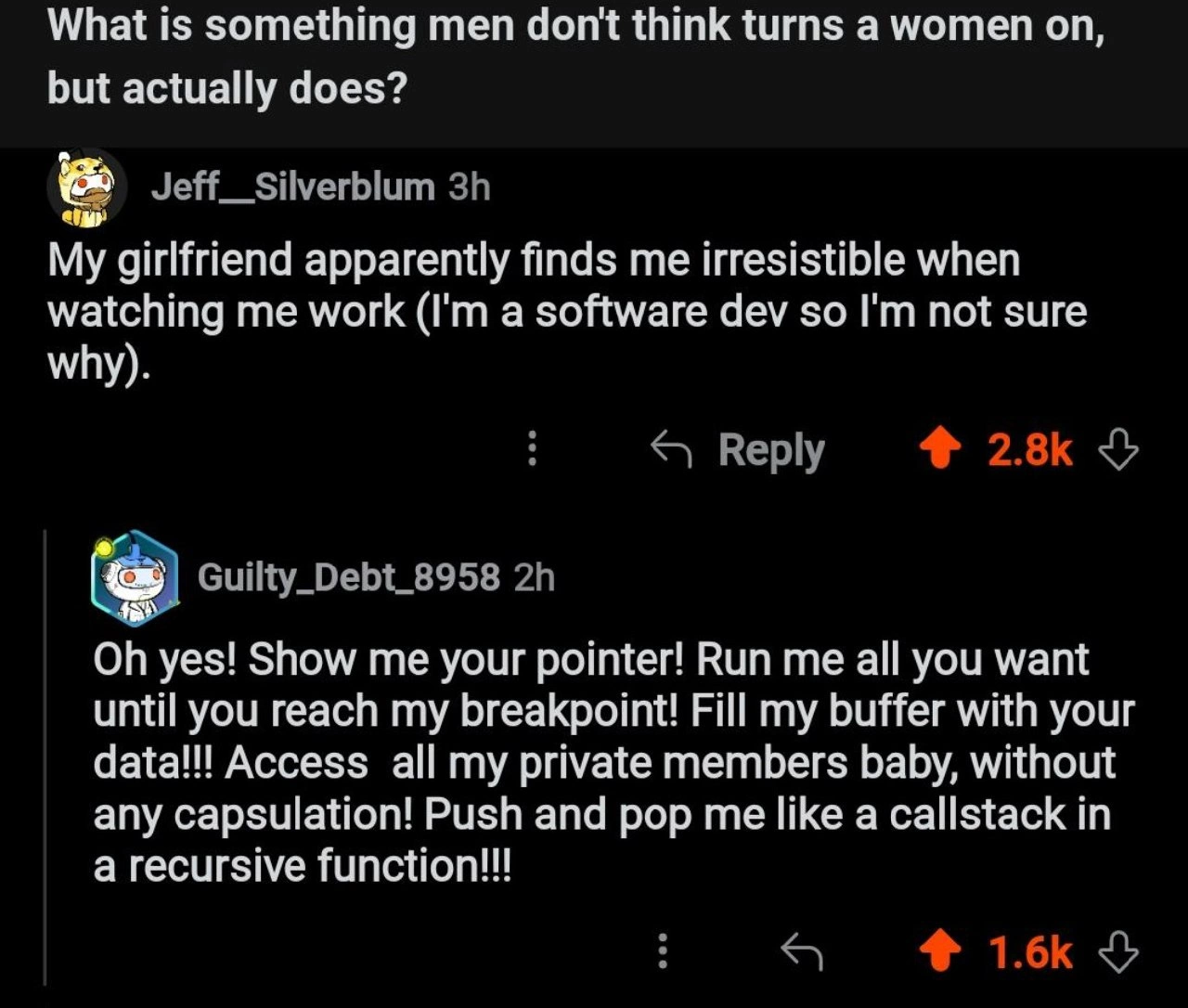
In this meme, a seemingly innocent AskReddit question takes a hilariously nerdy turn that only a seasoned developer could fully appreciate. What starts as a boyfriend noting his girlfriend finds him attractive while coding quickly escalates into an overclocked barrage of double entendres using core CS fundamentals. The top reply reads like a sultry excerpt from Coding After Dark:
Guilty_Debt_8958: "Oh yes! Show me your pointer! Run me all you want until you reach my breakpoint! Fill my buffer with your data!!! Access all my private members baby, without any capsulation! Push and pop me like a callstack in a recursive function!!!"
For an experienced programmer, every line here is pure gold. It’s riffing on concepts we’ve wrestled with in real life, now repurposed as programming innuendo. Why is this so funny to us long-time devs? Because it juxtaposes the frustration of debugging with the thrill of flirtation in a completely absurd way. Each phrase name-drops a notorious element of low-level programming or software design:
Pointers are those tricky variables in languages like C/C++ that hold memory addresses. Seasoned devs know that misusing a pointer can lead to catastrophic bugs (hello, segmentation faults!). Seeing “Show me your pointer” elicits a smirk, because it’s basically turning a nerdy brag about memory addresses into a bold come-on. It’s like the comment is flirting with danger – any dev who has dereferenced a
NULLpointer at 3 AM knows how perilous pointers can be. Here, though, that danger is played for laughs and passion. An old joke in dev circles goes: “I’d show you my pointer, but it’s wild!” – and this meme cranks that up to eleven.Breakpoints are what we slam into our code when debugging: markers that pause execution so we can inspect the program state. Hitting a breakpoint is normally a moment of intense focus (or anxiety, if you’re tracing a heisenbug). So when the commenter moans “Run me... until you reach my breakpoint,” they’re cheekily equating a climax with a debugging pause. It’s a perfect example of debugging_as_foreplay. To a veteran developer, the imagery is ridiculous and glorious: imagine if every time you hit F5 in the IDE, some steamy saxophone music started playing. 🕵️♀️🎷
“Fill my buffer with your data” is perhaps the naughtiest line to a senior dev’s ears. A buffer is a reserved block of memory meant to hold data, and it has a finite capacity. Writing more data to it than it can handle causes a buffer overflow, one of the classic security vulnerabilities that have plagued software for decades (think of the infamous exploits that inject malicious code via unchecked buffers). We’ve spent countless code reviews yelling “Don’t overflow the buffer!” Yet here, the commenter is provocatively inviting just that. It’s a sensational subversion: turning a dreaded error into a saucy request. A grizzled C programmer might jokingly respond, “Careful, if I really fill your buffer, we might crash this process 😉.” This is buffer_overflow_pickup_lines at its finest, and it hits home because we all remember the chaos a real overflow can cause. The phrase suggests overflowing with desire, and that double meaning is the punchline only our tribe truly gets.
Then comes the object-oriented twist: “Access all my private members baby, without any encapsulation!” In proper software design, encapsulation is sacrosanct – it means keeping an object’s inner data (private members) hidden and safe from outside interference, accessible only through well-defined interfaces. Breaking encapsulation by directly fiddling with private variables is a big no-no, often likened to peeking under the hood without permission. But here our amorous commenter throws all that out the window. They’re basically saying “take me, I’m wide open, no safeguards” – or as one might quip in dev terms, an encapsulation kink. 😂 It’s the equivalent of telling your partner “I trust you completely, do whatever you want” — except said in pure coder lingo. An experienced dev can’t help but chuckle: we spend our days enforcing access modifiers and data hiding, so hearing someone beg for violated encapsulation is hilariously brazen. It’s the stuff of fantasy – quite literally, since in reality that would raise every red flag in a code review. (Imagine a PR comment: “Please remove
friend class Benefits– accessing private members like this is only acceptable in your bedroom, not in our codebase.”)And finally, the pièce de résistance: “Push and pop me like a call stack in a recursive function!!!” This one dives deep into computer science fundamentals with reckless abandon. A call stack is that behind-the-scenes structure that keeps track of active function calls. Every time a function is invoked, a new stack frame is pushed onto the stack; when the function returns, that frame is popped off. In a recursive function (one that calls itself), this push-pop action happens repeatedly, stacking frames higher and higher, then unwinding them. Now, no one has ever described recursion as sexy… until now. 😅 The comment essentially likens an intimate act to the repetitive in-and-out action of stack frames being added and removed. It’s a ridiculously technical metaphor to describe something very human. For senior devs, this is side-splitting because it’s so overly specific. It reads like a horny computer science textbook. Plus, there’s a wink to the notorious StackOverflow (the site and the error): too much recursion and you literally overflow your call stack, crashing the program. The implicit joke is that this romance might be so heated it risks a “stack overflow” of its own. It’s a recursive_callstack_romance turned up to 100. Seasoned engineers recall struggling through recursion examples (factorial! Fibonacci! the dreaded Stack Overflow error when you forget a base case), so seeing it invoked for lusty literature is just absurdly funny.
Overall, the humor works because it’s hyper-targeted to developer culture. It’s an inside joke extravaganza: every reference — from pointers to private members — is a secret handshake for those of us in the programming world. The second commenter basically wrote a mini parody of a romance novel using only tech jargon, turning dry documentation lingo into fiery foreplay for debuggers. The DevCommunities tag fits perfectly: this is the kind of thing that flourishes in programmer forums and subreddits, where people riff on shared pain points (cough buffer overflows) and turn them into comedy. We laugh because we’ve been there: maybe not literally seducing someone with a debugger 😅, but certainly wrestling with these concepts daily. This meme captures that shared experience and twists it — it reminds us how ridiculously deep we are in our nerd world that we can find this mix of terms both familiar and hilarious. It’s a celebration of DeveloperHumor: only in our culture will you find a sentence like “without any capsulation!” both intelligible and uproarious.
On a meta level, it’s also saying something sweet: apparently, being a passionate coder can be attractive to others. 💻❤ The original poster was baffled that his girlfriend enjoys watching him code. Experienced devs might nod knowingly or be equally surprised — either way, it’s endearing. We spend so much time buried in abstract problems that hearing someone finds it appealing is like finding out your keyboard clacking is music to their ears. Perhaps that’s why this thread resonated: it’s both very funny and a tiny ego boost for every programmer who suspects their intense bug-fixing face might actually be kinda hot. As a senior engineer, you survive endless nights of debugging, countless code reviews, and maybe even some production fires. Seeing those very trials (pointers, overflows, etc.) turned into a playful romantic fantasy is the ultimate in-group joke. It’s the CS_fundamentals_double_entendre we never knew we needed. And let’s be honest, after surviving memory leaks and call stack overflows in real life, we’ll take our laughs (and our compliments) wherever we can get them! 😜
Description
This image is a screenshot of a Reddit thread that takes a humorous and nerdy turn. The initial post asks, 'What is something men don't think turns a women on, but actually does?'. A software developer replies that his girlfriend finds him irresistible while he works. The highlight of the meme is the subsequent reply, which is a series of sexually suggestive puns written entirely using programming terminology. The comment enthusiastically uses concepts like pointers, breakpoints, buffers, private members, encapsulation, and the call stack in a recursive function as flirtatious innuendos. The humor is aimed squarely at a tech-savvy audience who understands these specific, often low-level, computer science concepts, creating a risqué but clever developer inside joke
Comments
18Comment deleted
Forget REST, this API has some very exposed endpoints. Just be careful with concurrent requests to those private members, you wouldn't want a race condition
After two decades of worrying about dangling pointers, I never expected “show me your pointer” to become a non-functional requirement
After 20 years in tech, I've learned that the real stack overflow happens when you try to explain to your partner why deploying to production on Friday is more terrifying than any horror movie - but apparently watching us debug race conditions at 2am is somehow romantic
Ah yes, the classic scenario where your significant other watches you debug a segfault at 2 AM and suddenly finds you irresistible - probably because they're witnessing the raw determination of someone who's been chasing a dangling pointer for six hours. The reply perfectly captures the absurdity of translating programming concepts into romantic language: 'access my private members without encapsulation' is essentially asking for a security vulnerability in production. Though I must say, anyone who finds recursive callstack operations romantic has clearly never experienced a stack overflow in a critical system - nothing kills the mood quite like 'Maximum call stack size exceeded' at 3 AM on a Friday deployment
Only in dating can violating encapsulation be called a love language; in prod it’s a CVE and an incident bridge
Violating encapsulation for 'direct access'? In legacy codebases, it's a lawsuit; in the bedroom, apparently the ultimate turn-on
Consent plus bounds-checking: push/pop is fine, but skip encapsulation and the relationship segfaults at runtime
I wouldn't mind sitting under a table of a software guy Comment deleted
*another software dev* Comment deleted
No, you don't support human ethics Comment deleted
I don't remember writing this comment Comment deleted
Delete this post Comment deleted
Come on babe log in and oit of me Comment deleted
Horny Memes!!! Comment deleted
Nasty Comment deleted
He sould be a writer instead of a swe lol Comment deleted
She loves money Comment deleted
Funny thing, she regained interest in me after I started my journey in IT, but then she dropped me for an actual IT guy(website creator) Comment deleted