Skip to content
DevMeme
3466 of 7435
YouTube Tutorial Career Lifeline
Learning Post #3801, on Oct 11, 2021 in TG

YouTube Tutorial Career Lifeline

Why is this Learning meme funny?

Level 1: Help From a Video

This is funny because it is like falling down during a race and being helped up by someone you have never met, except the helper is a person on YouTube explaining homework slowly enough that you can finally keep going. The career is tired, and the video gives it a hand.

Level 2: Learning in Public

Learning to code means building both concepts and habits. You learn syntax, but also debugging, reading errors, searching effectively, breaking problems down, and recognizing patterns. A tutorial can help because it shows the whole flow, not just the final answer.

An online course is structured learning, often with lessons and exercises. A YouTube tutorial is usually looser, but it can be more immediate: "Here is how to install this tool," "Here is why your code fails," or "Here is a small project from start to finish." For many beginners, seeing someone type the code and explain the mistakes is easier than reading a reference manual alone.

Developer community means the wider group of programmers who share knowledge. That includes open-source maintainers, bloggers, Stack Overflow users, Discord helpers, coworkers, and video creators. The meme shows one form of mentorship: a stranger online helping someone's career stand up again.

The pop-culture scene makes the feeling dramatic. In the image, the career is not calmly studying; it is barely staying in the game. That exaggeration is what makes the meme relatable. Programming can feel brutal when every answer reveals three new things you do not know yet.

Level 3: Distributed Mentorship Network

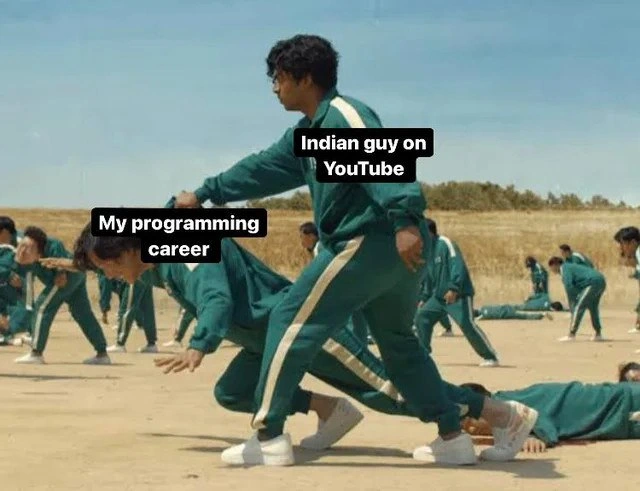
The image shows a Squid Game still where one player is physically helping another across the field. The helper is labeled:

Indian guy on
YouTube

The struggling person is labeled:

My programming
career

The joke works because many developers have a deeply practical memory of being saved by a tutorial video at exactly the moment formal learning failed them. Documentation may be accurate but dense. University courses may teach fundamentals but not the cursed build error in front of you. Corporate onboarding may explain the company values while omitting the part where the local dev environment requires six undocumented flags and a prayer. Then a calm YouTube instructor appears with a screen recording, a code editor, and the sentence every stuck programmer longs to hear: "First, open your terminal."

The label specifically points at a familiar internet trope: Indian programming educators who publish direct, patient, implementation-focused explanations for topics ranging from C pointers to React state, Java inheritance, SQL joins, Android setup, Docker basics, and algorithms. The meme is not really about nationality as much as gratitude for a recognizable teaching style: minimal production value, maximum usefulness, and a willingness to explain the thing from the beginning without making the viewer feel stupid.

That is why it fits Learning, DevCommunities, Mentorship, and LearningToCodeJourney. Modern programming careers are not built only through official textbooks or internal training. They are patched together from docs, forum answers, blog posts, walkthroughs, conference talks, source code, issue threads, and tutorial videos made by strangers. It is informal education at internet scale: a distributed mentorship network held together by search boxes and generous people recording their screens after dinner.

There is also a career anxiety layer. "My programming career" is not labeled as thriving; it is down on the ground, being dragged back into motion. That captures the beginner experience of constantly feeling one concept away from quitting: recursion, Git conflicts, async behavior, environment setup, object-oriented design, CSS layout, database joins, or why undefined is not a function has chosen today to become personal. The helper label turns that panic into relief. Sometimes the difference between "I cannot do this" and "I understand enough to continue" is a twelve-minute video with a thick accent, clear examples, and zero corporate polish.

Description

A still from Squid Game shows one green-tracksuited player stepping over and helping another player who is down on the ground. The helper is labeled "Indian guy on YouTube," while the struggling person is labeled "My programming career." The joke frames free tutorial creators, especially the familiar developer trope of practical Indian YouTube instructors, as the last-minute support that keeps a software career moving when formal learning or documentation is not enough.

Comments

28
Anonymous ★ Top Pick Half the industry runs on distributed systems; the other half runs on one patient YouTube instructor explaining pointers with Notepad.
  1. Anonymous ★ Top Pick

    Half the industry runs on distributed systems; the other half runs on one patient YouTube instructor explaining pointers with Notepad.

  2. @JoeNightMan 4y

    I never watched one single video of programming from a Indian guy, maybe I am a unicorn, oh no.

  3. Deleted Account 4y

    Wait WHAT

  4. Deleted Account 4y

    It should be 156????

    1. @Abolfazl153 4y

      it converted the whole result to string 😂

      1. Deleted Account 4y

        Why

        1. @ZgGPuo8dZef58K6hxxGVj3Z2 4y

          Because its JavaScript

          1. @Abolfazl153 4y

            ye

          2. @Abolfazl153 4y

            it's even more funny in js it returned 156 for console.log(1+2+3+4+5+"6"); 😂

            1. @ZgGPuo8dZef58K6hxxGVj3Z2 4y

              And in C? Or C#?

              1. @Abolfazl153 4y

                156 in both java and c#

                1. @ZgGPuo8dZef58K6hxxGVj3Z2 4y

                  Perfect so thankfully the operator order stays as it should

                  1. @Abolfazl153 4y

                    i didn't get it its like ignoring 2,3,4 🤔

                    1. @ZgGPuo8dZef58K6hxxGVj3Z2 4y

                      No its not

                    2. @mxkrsv 4y

                      int i = 1; while (i < 5) { ++i; } printf("%d%s", i, "6");

                      1. @Abolfazl153 4y

                        Thanks

                    3. @ZgGPuo8dZef58K6hxxGVj3Z2 4y

                      Add 1 + 2 + 3 + 4 + 5 together then glue the result and "6" like a string together Basically ((((1 + 2) + 3) + 4) + 5)

                      1. @Abolfazl153 4y

                        got it thanks guys

                        1. @ZgGPuo8dZef58K6hxxGVj3Z2 4y

                          Welcome

              2. @zherud 4y

                c tells you to fuck off if its "6" and if it's '6' uses its char code

                1. @ZgGPuo8dZef58K6hxxGVj3Z2 4y

                  Haha right i forgot the first one

        2. @Abolfazl153 4y

          im going to test it :D

    2. dev_meme 4y

      Yes, it shoud be 156, you're right

  5. @ZgGPuo8dZef58K6hxxGVj3Z2 4y

    Wait this is incorrect or is it?

    1. @Abolfazl153 4y

      maybe its js

  6. Ievgen 4y

    Durgasoft vibes

  7. @zherud 4y

    In Python i think its 156.

  8. dev_meme 4y

    Just not a correct one meme

Use J and K for navigation