Gollum Calls Frodo Main Instead of Master to Avoid Supporting Slavery
Why is this VersionControl meme funny?
Level 1: Words Matter, Even for Gollum
Imagine you and your friends have a game where one person is the leader and you used to call that person “Master.” Now one day, everyone realizes that calling someone “Master” might remind people of very bad, hurtful times in history (like times of slavery). So you all decide to stop using that word and instead call the leader “Main” or “Captain” or something nicer. It’s a small change to the word you use, but you do it to be respectful and make sure no one feels upset.
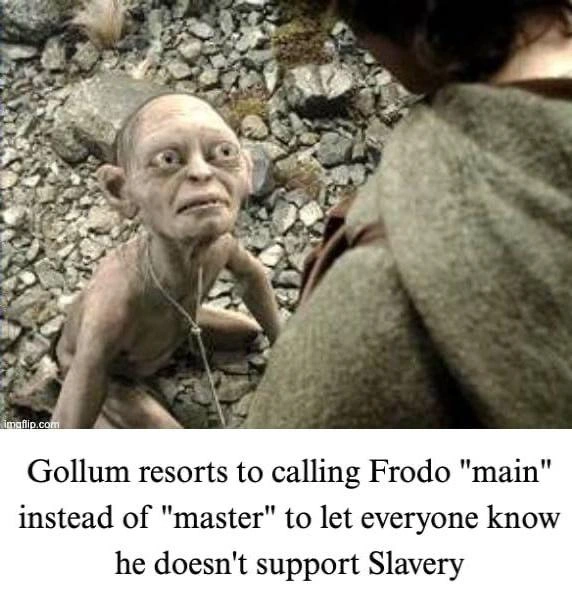
This meme makes a joke out of that idea by showing Gollum (a creature from a fantasy story who always called his friend Frodo “Master”) trying to use the new nice word. Gollum is tied up with a rope and is used to saying “Yes, master” because Frodo is in charge. But now Gollum calls him “main” instead, which is really silly because in a medieval fantasy world nobody would say that! It’s like seeing a character from a fairy tale suddenly act like he’s aware of modern polite language rules. The reason it’s funny is the mixed-up contrast: we don’t expect Gollum, a scruffy cave-dwelling creature obsessed with a magical ring, to care about not offending anyone with his word choice. By having him use the word “main” instead of “master,” the joke shows how this idea of using kinder words has become so widespread that even make-believe characters might do it. In simple terms, the meme is poking fun at how much attention we give to the words we use. It reminds us that words do matter – calling someone “master” can carry baggage – but it does so in a playful way, by showing even poor Gollum is trying to be polite and up-to-date. It’s as if he’s saying, “I’ll call you Main now, because I want to be good and not support anything bad.” That mix of serious and silly is what makes it humorous and easy to understand.
Level 2: Branch Names and Inclusivity
Stepping back from the epic humor, let’s break down what’s going on in simpler technical terms. Git is a popular distributed version control system that developers use to track changes in code. In Git (and platforms like GitHub that host Git repositories), the code history lives in branches. A branch is like a timeline of changes. There’s usually one primary branch where the main development happens – traditionally, this was called the master branch. When you start a new project with git init, for many years Git would create a branch named master by default. Developers might create other branches (for example, to build a new feature or fix a bug), but eventually those changes get merged back into the master branch, which serves as the official code base.
However, around 2020, the tech community started re-evaluating a lot of common terminology to make sure it was inclusive and respectful. The term “master/slave” was identified as problematic across different areas of tech because it directly references slavery. For instance, databases and hardware setups often used to refer to a primary node as “master” and secondary nodes as “slaves.” Similarly, terms like “whitelist/blacklist” (allowing or blocking access) were seen as having racially charged connotations. The movement for InclusiveLanguage led companies and open-source projects to replace such terms with neutral alternatives. Some examples of changes that came out of this movement include:
- Replacing master/slave terminology with primary/replica (or leader/follower) in databases and network systems.
- Changing whitelist/blacklist to allowlist/denylist to describe approved vs. blocked items.
- Renaming Git’s default master branch to main in repositories.
The meme specifically targets that last example – the Git branch renaming. By 2020-2021, platforms like GitHub, GitLab, and others all switched their defaults so that when you create a new repo, the first branch is named main instead of master. This was done to avoid any association with the concept of a "master" and "slave." It’s important to note: in Git’s context, the word master was not originally meant in the master/slave sense – it may have meant “master copy.” Git itself doesn’t have an official concept of a slave branch. Nevertheless, to keep consistency and avoid any unintended offense, the change was made universally.
For developers, especially those newer to the field (perhaps you started after this change became standard), all you might have known is a default main branch. But if you work with older projects, you might still encounter a branch called master. They’re the same kind of thing (the primary branch), just with different names depending on when or how the repo was set up. Changing a branch name in Git is technically straightforward: you can run a command like git branch -m master main on your local repository to rename the branch, and then push the new name to the remote server. The tricky part is what comes after the rename – updating all the references to that branch name elsewhere.
What kind of references? Think about a DevOps pipeline or CI/CD configuration – these are the automated processes that run tests, build your application, or deploy it whenever you push new code. Often, those pipelines are configured to listen to a specific branch (usually the main/master branch) to know when to trigger. If the pipeline is looking for a branch called master but now all new code is going into main, the pipeline won’t fire because it’s watching the wrong place. For example, if a GitHub Actions workflow or Jenkins job is defined to run on updates to “master”, you’d have to go into that config and change it to “main.” Similarly, documentation might say “clone the repo and check out the master branch” – all those instructions needed an update too. Many teams had scripts, deployment infrastructure, or even GitHub Pages settings that assumed the name master. So, a simple rename could cause a lot of small breaks until everything was aligned with the new name.
Now, about the meme’s content: it shows Gollum, a character from The Lord of the Rings, who in the movies always addresses Frodo as “Master” (e.g., "Master Frodo") because Gollum is sort of servile toward Frodo. The image even has Gollum tied with a rope held by Frodo, emphasizing that power dynamic. The text of the meme jokes that Gollum has started calling Frodo “main” instead of “master” to make it clear he doesn’t support slavery. This is a funny exaggeration connecting the tech world to a fantasy story. In plain terms, it’s saying: we used to use the word master (which can remind people of slavery), and now we use main to be more considerate. So even Gollum – a fictional creature who has nothing to do with computers – is shown adopting this new naming convention to be on the right side of history. The humor comes from the absurd mix of contexts: imagine a scrawny creature in a medieval-esque fantasy worrying about politically correct terminology! But by exaggerating like this, the meme highlights just how widespread the push for inclusive language in tech tools has become – it’s so widespread that it’s as if even characters from completely unrelated worlds are aware of it.
For junior developers, it’s worth understanding both sides of this change. On one hand, it’s about doing the right thing: making our tech terminology more welcoming and mindful of historical context. On the other hand, it does introduce some practical work: renaming branches and updating configurations. The phrase “NamingThings” is a common shorthand joke in programming referring to the idea that choosing good names (for variables, functions, or branches) is one of the hardest parts of programming. Here we literally had to rethink a long-established name. If you join an existing team, don’t be surprised when someone corrects a reference from master to main – it’s not just pedantic, it’s to keep things consistent with modern standards and to avoid using a term that people have decided is better left out. The good news is that most of the industry has adapted by now, and tools have been improved to make this easier (for example, new repos default to main so you don’t have to change anything). But the meme captures that period of change when everyone was updating their habits and code to replace the old term.
Level 3: The Fellowship of Renaming
In the chronicles of software development, few naming debates have escalated into an IndustryTrend as pervasive as the Git default branch rename. Much like a council of Elrond convening to rename an ancient sword, the tech community in 2020 banded together to purge insensitive terminology from code. The word "master" – historically the default branch name in Git repositories – became a prime target for change due to its connotation of master/slave relationships. Major platforms like GitHub led the charge, announcing that new repositories would use "main" as the default branch name. This meme humorously casts Gollum as part of that grand refactoring fellowship on "Mount Commit," emphatically showing even a cringing creature of Middle-earth adopting InclusiveLanguage in version control. The caption explicitly spells out the joke: Gollum resorts to calling Frodo main instead of master to signal he “doesn't support Slavery.” It's a tongue-in-cheek way to highlight how far-reaching (and at times absurd) the push for sensitive NamingConventions has become – extending its reach all the way to fantasy characters.
From a senior developer’s perspective, the humor cuts deep because we’ve lived through the "master to main" migration and its ripple effects in real projects. On the surface, changing a branch name is trivial – just a single label swap. But experienced devs know that naming things is never that simple in practice. In Git’s early days, nobody anticipated that one day the default branch name would be seen as a cultural issue. (In fact, older version control systems like Subversion used terms like “trunk” for the main line of development, and Mercurial simply called it “default.” Git chose “master” by convention, likely in the sense of a master copy, not as part of a master/slave pair. But in an era scrutinizing terminology, master had to go.) The result? A mass renaming campaign across countless repositories – a quest undertaken by practically the entire developer community at once. And like any grand refactor, it came with DevOps dragons to slay and CI pipeline snares to untangle.
Why seasoned devs find this meme painfully spot-on: because the change wasn’t just social virtue signaling; it had very real technical fallout. Branch names are hardcoded in all sorts of places. Continuous integration pipelines, deployment scripts, and DevOps tooling often had assumptions baked in about a branch named master. When that name changed, anything not updated would break or quietly stop working. Picture an early-morning stand-up where a team discovers that their overnight build never ran – all because the CI system was configured to only trigger on pushes to a branch named "master", which no longer exists. It’s the kind of unexpected friction that gives VersionControl veterans flashbacks. This meme’s Middle-earth framing exaggerates the scenario: a pitiful Gollum, bound by a rope (much like legacy code bound to old defaults), awkwardly changing his terminology to survive the new order. We laugh, but only because we’ve been there – scrambling to update master references in dozens of files, or explaining to a confused teammate why git push origin master suddenly returns an error.
To illustrate the nitty-gritty, consider a simple CI configuration snippet that many projects had before the change:
# Before: CI pipeline triggers only on pushes to the 'master' branch
on:
push:
branches:
- master
(After renaming, this config had to include main instead – otherwise, pushes wouldn’t trigger any builds!) The first day back to work after a mass rename, plenty of senior engineers were digging through YAML like this, updating branch filters, deployment scripts, and badge links. Repositories with protected branch rules and hard-coded references needed careful adjustments. GitHub did roll out tooling to ease the transition – for instance, renaming the default branch in the repo settings would automatically retarget open pull requests from "master" to "main" and update branch protection settings. But despite such help, any custom tooling or external integrations that assumed the name “master” had to be found and fixed manually. It's no surprise that an ostensibly simple change turned into a mini Y2K-style effort for many DevOps teams. As the saying goes (with a wink to a classic tech joke): “There are only two hard things in Computer Science: cache invalidation, naming things, and off-by-one errors.” Changing the NamingConventions of the most important branch in every repo at once proved just how hard naming things really is — even renaming them.
The meme lands its punch by cross-referencing this dry engineering challenge with a vividly opposite domain: Gollum from Lord of the Rings, groveling and raspy-voiced, is the last character you'd expect to care about politically correct terminology. In the film scene, Gollum calls Frodo “Master” out of habit and subservience (he says "Yes, master, precious" in his slavish way). The image has Frodo holding Gollum’s rope-leash, visually reinforcing a master/servant dynamic. Mapping that onto the Git controversy is darkly humorous: it’s as if even Gollum — a wretched creature obsessed with “his precious” — has attended a modern tech diversity training and now conscientiously calls his boss “Main” instead of “Master.” 😅 This absurd mental image captures the TechCulture moment perfectly. It satirizes both the earnestness of the inclusive language movement and the awkwardness that ensues in practice. For seasoned devs, there’s an added layer of knowing chuckle: we recall the all-hands emails and internal wiki pages with titles like “Repository Default Branch Renaming Guide.” We remember debating with colleagues whether changing a word in our Git workflow was a meaningful positive step or just an empty gesture. We appreciate the good intention (nobody actually wants terminology that even hints at endorsing slavery), yet we can’t ignore the irony that this noble change caused commit chaos for weeks. The meme’s brilliance is in merging these disparate contexts — an epic fantasy world and the mundane mechanics of Git — to highlight how even the smallest linguistic choices in tech can become grand, almost theatrical endeavors. It’s a laugh born of hindsight: we survived the great master-to-main exodus, and now we can jokingly imagine Gollum himself struggling to keep up with the latest VersionControl hype.
Description
A meme using a still from The Lord of the Rings showing Gollum looking up at Frodo from a rocky surface. The caption below reads: 'Gollum resorts to calling Frodo "main" instead of "master" to let everyone know he doesn't support Slavery'. An imgflip.com watermark is visible. The joke references the Git branch renaming movement where the default branch was changed from 'master' to 'main' across the industry, satirically applying this politically-correct naming convention to Tolkien's fantasy world where Gollum addresses Frodo as 'master'
Comments
22Comment deleted
git checkout -b main && git branch -D master -- Gollum's precious commit history is now politically correct, but his merge conflicts with Sauron remain unresolved
Gollum is now trying to rebase his entire existence onto 'main', but he keeps running into merge conflicts between his Sméagol and Gollum branches
Somewhere in Mordor, the Orc release engineer is frantically updating every CI script that still points to 'origin/master'
After 15 years of muscle memory typing 'git checkout master', we're now debugging our own fingers while Gollum debates whether 'precious' should be renamed to 'valued-artifact' for better semantic versioning
When your PR gets blocked because you forgot to update 50 CI/CD configs, 200 documentation references, and every developer's muscle memory after the great master→main migration of 2020
Gollum's PR: 'feat(version-control): mv master main (closes #slavery-connotations)' - approved by the One Ring reviewer
Nice optics - until your GitOps manifests, Jenkinsfiles, and CI bots still target origin/master and you learn how many regexes were inclusive of exactly one branch
Changing from "master" to "main" is literally kinkshaming Comment deleted
Whitelist -> Allowlist Blacklist -> Denylist WTF Comment deleted
I will be honest, I never liked the terminology master-slave. But not for political reasons or social but for technical. It simply makes no sense. Master-slave is usually used for primary-fallback, primary-replica and primary-secondary least those from the top of my head. None of these have anything to do with a master-slave relationship, neither in slavery nor bdsm. The master does not tell the slave what to do or takes the work while not giving anything useful in return. Usually the master is the one doing all the work and the slave sits there, keeps updated and springs into the role of master when needed. The closest we do have to master-slave is probably CI/CD where the master is the build server and the agent is the slave, but I never came across it in this kind of scenario. Whitelist and blacklist on the other hand usually has one consistent meaning. Blacklist = blocked, forbidden or denied. While Whitelist = allowed. Comment deleted
I find that in communication protocols it makes rather sense, and alternative are rarely as clear. Some protocols are client-server, where many clients send requests to one server. Other are master-slave, where one master send requests to many slaves. Typical examples are SPI and I2C Comment deleted
Don't fuck with the terminology that has worked for generations at this point. Comment deleted
So never make things clearer for newcomers? I mean we also speak not the same language like 100 years ago. Comment deleted
You make things clearer for newcomers by confusing everyone else, making legacy code and documentation harder to understand. I say newcomers can figure it out. Comment deleted
So we should also never change language at all? Have tried to read original Shakespeare you won't understand it Comment deleted
That's a dumb comparison. Language changes organically over decades. Comment deleted
But terminology IS language. And exactly that is my point if you get confused by more descriptive terminology that is a definitely a you issue. Master slave is vauge as hell and has nothing to do what it actually does. Words mean things. I don't like the reason it was changed but the change itself was good imho Comment deleted
You know, whatever. My main gripe is that shit got changed for political reasons anyway. Comment deleted
That I agree with 100%. Like I said, I like the change just how (rather rushed) and why is something I find kind of not thought through. Terminology changes in most fields all the time but to make things clearer. Which is the reason wanted it to change since I am in it. I started like 2007 and was always confused for the first years what IDE drives have in common with databases or server hierarchies. Comment deleted
Since I am not that deep in hardware/embedded protocols. The master sends commands the slaves should execute right? At least that is how I would guess it works based on stepper drivers and displays Comment deleted
At least commands that the slaves respond to. It's really about who initiates communication. Then yes, that may be commands to execute, but it can also be the master requesting info, e.g. from a sensor Comment deleted
But then my point stands. It has nothing to do how master slave works in slavery, neither form there is. Just for US readers, there are WAY more forms than yours. Or bdsm slavery Comment deleted