Skip to content
DevMeme
6577 of 7435
Reddit Aged Like Milk: Photorealistic AI Video Was Declared Impossible 3 Years Ago
AI ML Post #7207, on Oct 4, 2025 in TG

Reddit Aged Like Milk: Photorealistic AI Video Was Declared Impossible 3 Years Ago

Why is this AI ML meme funny?

Level 1: The Future Came Early

Imagine your big brother laughs at you when you say you’re going to win a big school race. He says, “Yeah, right. Maybe when you’re a grandparent you’ll win a race, but not now!” He’s super sure that it won’t happen anytime soon. But then, surprise – just a short time later, you actually win the race! 🏅 Your brother’s jaw drops because he was so confident you couldn’t do it, and yet you did it almost immediately. It’s funny and satisfying because he was really wrong, really fast.

This meme is like that. One person said an AI would only be able to make a real-looking video from a description in the far, far future (like when our great-grandkids are grown up). But just a few years later, an AI actually did it! The thing that was called “impossible” happened while that person was still around to see it. Everyone finds it funny because it’s like someone said “never ever,” and then it happened right away. It’s a big surprise that makes people smile, and it reminds us that sometimes the future arrives much sooner than we expect.

Level 2: From Sentence to Scene

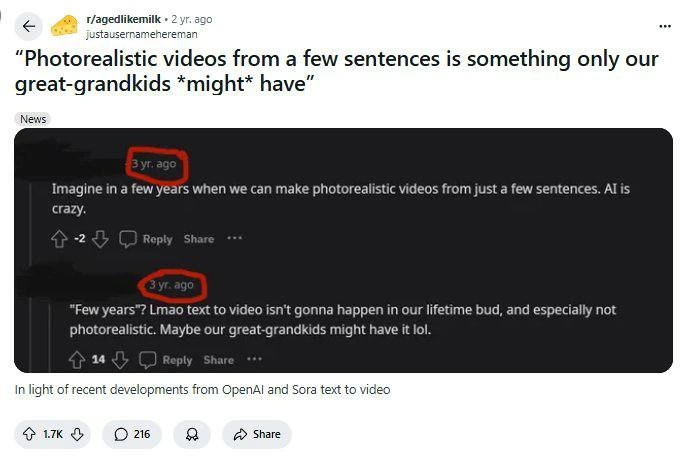
Let’s break down what’s happening in this meme in simpler terms. It’s a screenshot of two Reddit comments from a few years ago, and they’re debating an AI idea:

  • The first comment is from someone who’s excited about AI. They say something like: “Imagine in a few years when we can make photorealistic videos from just a few sentences. AI is crazy.”

    • They’re amazed by how quickly AI is advancing and are guessing that maybe in the next few years, we’ll have an AI that can create a whole video just from a written description.
    • Text-to-video is exactly what it sounds like: you give the computer a piece of text (for example, “A dog surfing on a wave at sunset”), and the AI generates a video clip that matches the text. This person is imagining a future where you don’t need a camera or actors – you just type what you want to see, and the AI creates a generative video for you.
    • They specifically said “photorealistic videos”, which means videos that look as real as a normal video or movie (not cartoonish or fake, but like real life). That’s an even tougher task, because getting AI to generate something that looks real is very challenging.
    • When they say “AI is crazy,” it’s showing their amazement at recent AI progress. Around that time, AI had started doing some surprising things (for instance, making art from text prompts with tools like DALL·E). So this person is basically saying “Wow, AI is developing so fast that in a few years we might even get it to do this super advanced thing!”
  • The second comment is a reply that’s much more skeptical (doubting). They essentially laugh and respond: “‘Few years’? Haha no, text-to-video isn’t going to happen in our lifetime, buddy, especially not photorealistic. Maybe our great-grandkids will have it, lol.”

    • This person firmly believes the first commenter is way too optimistic. “Not in our lifetime” means they think none of us alive today will get to see that happen. In other words, they’re saying the technology is so far off that we’ll all be long gone by the time it’s possible.
    • The mention of “great-grandkids” is an exaggerated way to say really far in the future. Your great-grandkids would be the generation after your grandkids – that’s many decades away, maybe a century. So the skeptic is joking that maybe in a hundred years or more, people might have that tech, but definitely not anytime soon.
    • They also emphasize “especially not photorealistic.” This means the skeptic might believe that even if an AI could make some kind of video eventually, the chance it would look truly real and high-quality is basically zero in the foreseeable future.
    • The tone is mocking: they even start with “Lmao” (internet slang for “Laughing My Ass Off”), indicating they find the idea laughable. Calling the other person “bud” is a bit patronizing, like they’re patting them on the head for being naive. The “lol” at the end reinforces that they think this prediction is a joke.
    • In summary, the second commenter is utterly confident that text-to-video AI isn’t coming any time soon. They’re treating the first person’s dream as pure science fiction. This was their timeline prediction: “not in our lifetime” (so, many dozens of years at least before it could happen, if ever).

Now, these comments were posted 3 years before the meme was made (the screenshot shows “3 yr. ago”). At that time, a lot of people reading it agreed with the skeptic. On Reddit, users can upvote/downvote comments, and you can see the skeptic’s comment had a bunch of upvotes (and the first comment might have even been downvoted a bit). That means the community thought the skeptical view was the more reasonable one back then. And honestly, it did sound reasonable in 2022: AI creating a whole realistic video was a huge leap. We had just seen AI make realistic images, but video is a much bigger deal (since a video is many images per second, and everything has to stay consistent). So, plenty of tech-savvy folks were saying “Cool idea, but let’s not get carried away – that’s far off.”

Here comes the twist: the meme is showing this because in just three years, that “far-off” thing actually happened! The caption underneath references OpenAI and Sora and “text to video.” OpenAI is a leading AI company (the folks behind ChatGPT and other breakthroughs). Sora is the name of a new AI model/system they introduced that can do text-to-video generation. By 2025, OpenAI demonstrated an AI that lets you input a short scene description (a few sentences about what you want to see) and it will generate a short video clip that matches the description, and it looks pretty realistic. In other words, the exact capability that the first commenter was dreaming about – and that the second commenter said wouldn’t happen in our lifetime – was achieved just a few years later.

This turned the second person’s confident statement into a classic “aged like milk” moment. “Aged like milk” is a saying that means something got bad or wrong very quickly (because milk left out of the fridge can spoil in a day or two). In internet culture, people use it to joke about predictions or claims that proved wrong fast. There’s even a whole subreddit called r/agedlikemilk devoted to that. This meme is literally from that subreddit, highlighting how the skeptic’s claim aged poorly. In only three years, their “no way” turned into “oh, it’s here.” That’s like someone in 1900 saying “Heavier-than-air flying machines are impossible,” and then the Wright brothers fly a plane in 1903 – oops, that statement aged like milk!

For a newcomer to this kind of meme, what makes it funny is the irony and the speed of change. The ironic part is that the person who laughed and said “not gonna happen” was wrong – and not just wrong, but wrong really fast. They predicted it might take till their great-grandkids’ time, but it actually happened while they might still be young enough to remember their own comment. The speed part is astonishing too: three years is a short time in technology development. So it’s amusing and a bit absurd that something deemed almost century-level hard got done in a few trips around the sun.

From a learning perspective:

  • This shows how fast technology can advance. Especially in AI, things that seemed like distant dreams a few years ago can suddenly become real. It’s a case of reality catching up with ambition quickly. That’s why the community often jokes about how timeline predictions can be tricky.
  • It’s also a gentle poke at overconfidence. The skeptic was very sure of themselves, so now, with hindsight, it’s a little funny seeing such certainty proven wrong. It reminds everyone (even experienced folks) not to be too smug about what the future will or won’t bring.
  • For instance, as a junior developer, you might have heard seniors dismissing some new technology as a fad or “not practical.” Sometimes they’re right, but sometimes the tech matures faster than expected. This meme is basically one big “gotcha!” where the new tech surged ahead and surprised the skeptics.
  • In terms of the AI hype vs. reality theme: Usually we worry about hype being too high. Here, the “hype” (the hopeful prediction) turned out to be true, and the “reality check” turned out to be off. It’s a reversed scenario that people find refreshing and humorous. It’s the community collectively saying, “Remember that thing we all thought was way off? Well, guess what – it’s here and it works!”

So, putting it simply: The first person said “AI is moving so fast, we might get this amazing thing in a few years!” The second person said “No way, not gonna happen even in a lifetime.” And the joke is on the second person, because just a few years later, that amazing thing exists thanks to actual AI progress. The meme highlights this to get a laugh out of how wrong we can be with our tech guesses. It’s a bit of nerdy humor (or machine learning humor) for those who follow AI news, and it also captures a genuine awe at how quickly things are evolving. Even if you’re not deep into AI, you can understand the “egg on face” moment: someone confidently said “never!” and reality replied, “Here it is, sooner than you thought.” And that’s a pretty relatable kind of funny, especially in the fast-paced world of technology.

Level 3: Spoiled Predictions

The meme sets up a classic clash of perspectives in a Reddit thread. The top comment excitedly imagines:

"Imagine in a few years when we can make photorealistic videos from just a few sentences. AI is crazy."

This optimistic poster is clearly amazed by recent advances (think GPT-3 writing stories or DALL·E generating art) and is speculating about the future of AI. In their mind, the trajectory of progress suggests that maybe, in just a few years, we’ll hit another mind-blowing milestone: text-to-video generation, where you can feed an AI a description and it pops out a realistic video. They’re basically saying “AI is moving so fast, it’s crazy – who knows, we might soon do this next!”

But right underneath, a more jaded reply pours cold water on the idea:

"'Few years'? Lmao text to video isn’t gonna happen in our lifetime bud, and especially not photorealistic. Maybe our great-grandkids might have it lol."

Seasoned developers recognize this dynamic instantly. It's the archetypal forum argument: the excited visionary vs. the cynical veteran. The second user’s tone drips with “I’ve seen some hype, kid, and I’m not buying it” energy. They’re essentially responding: “Slow down. That is science fiction – we won’t live to see it.” The phrase “not gonna happen in our lifetime” is a very strong dismissal, and adding “maybe our great-grandkids might have it” cranks the snark up to 11. It implies the tech is so out-of-reach that perhaps in 100 years or more it could exist (with a figurative eye-roll, as if the first commenter is utterly naive). The casual "bud" and "Lmao" (laughing) make it a bit condescending. This skeptic is playing the role of the experienced engineer who’s seen too many over-hyped promises and is now defaulting to disbelief.

Back when these comments were made (the screenshot shows the 3 yr. ago timestamp, so around 2022), this conservative stance resonated with a lot of folks. You can tell because the skeptic’s comment had a higher score (upvotes) than the original, meaning the Reddit community leaned towards “Yeah, that’s not happening anytime soon” as well. This reflects a common sentiment in tech: experienced people often push back against AI hype, recalling past predictions that failed. And honestly, in 2022, the idea of photorealistic video from a short text prompt did sound pretty far-fetched. We had just gotten AI to reliably generate images; doing the same for high-quality video (with motion, consistency, and realism) felt like a huge leap. So the second commenter’s confidence wasn’t purely trolling – it was grounded in the prevalent skepticism of the time. It’s the kind of thread many of us have seen or taken part in: someone says “Wouldn’t it be cool if AI does X soon?” and someone else replies “X is much farther away than you think, trust me.”

Then reality decided to play a trick on the skeptics. Fast forward a mere three years, and we have exactly what the first commenter envisioned. The meme’s caption mentions “recent developments from OpenAI and Sora text to video” – in other words, OpenAI (the company behind breakthroughs like GPT-4 and DALL·E) and perhaps a project named Sora actually delivered a working text-to-video system. So by 2025, you can input a few sentences into an AI and get a short, photorealistic video in return. In developer terms, the impossible feature got implemented and shipped while the nay-sayer was still confident it couldn’t be done. This makes the skeptic’s definitive statement a complete prediction fail. They wrote a hard “won’t happen” verdict, but the timeline proved them utterly wrong. And not in 50 years, but in just three! That contrast – a grandkids-scale timeline versus a reality of a few years – is the punchline of the joke.

The meme’s title frames it perfectly: “Reddit doubters scoffed at text-to-video; Sora casually ships three years later.” The phrasing “casually ships” is dripping with irony. It’s as if to say, The future arrived with zero fanfare, proving the doubter wrong so easily it’s almost casual. For those of us in the industry, there’s a mix of laughter and “wow” in that. We’re laughing because the second commenter’s smug certainty aged about as well as milk left in the sun. In fact, this post was made on r/agedlikemilk, which is a subreddit specifically for spotlighting declarations that didn’t age well. The entire format of the meme – showing the old Reddit comments with the red-highlighted “3 yr. ago” labels, and adding a caption about current events – is a textbook aged like milk format. The meme is basically shouting: “Remember this confident claim? Well, look at it now!”

For seasoned developers, this is both highly amusing and a little cathartic. We’ve all been in debates about tech timelines, and many of us have gotten it wrong (on either side). It’s funny because the doubter was so emphatic, essentially betting their reputation that even their descendants wouldn’t see this tech, and now they’re probably staring at a Sora demo video, scratching their head. You can almost hear the slow clap or the cartoon “womp-womp” sound for the skeptic’s grand pronouncement. The community finds it hilarious how reality just dunked on this guy’s certainty. One day he’s lecturing an optimist with “Lmao, not gonna happen, bud,” and the next (in historical terms) he’s seeing a news headline, feeling the sudden need to wipe egg off his face.

Beyond the individual scenario, this meme taps into a broader AI industry trend: the extreme volatility of progress and the perils of playing the prophet. AI has been advancing in unpredictable spurts, so much so that even experts have been caught flat-footed. There’s almost a folklore now of notorious bad tech predictions (like “640KB of memory is enough for anyone” or “the iPhone will never catch on”), and this Reddit comment joins that club, at least in the eyes of the meme community. It’s a mini history lesson: TechHistory has a sense of humor, and nothing delights engineers more than seeing an overly confident claim get spectacularly debunked by reality. Especially in AI, where we’ve had years of both hype and disillusionment, moments like these stand out. They remind us that sometimes progress surprises on the upside. Sure, we all know tales of over-hype (like self-driving cars taking longer than expected), but here we have the opposite – under-hype, if you will – which is more rare and thus meme-worthy.

Another layer to the humor is the community self-recognition. The senior folks who upvoted the skeptic might see this now and chuckle nervously, thinking “Yep, got that one wrong.” The junior folks or enthusiasts who dared to dream might feel a bit vindicated (“See, crazy ideas sometimes pan out!”). It’s a wholesome embarrassment for the doubter, but in a way that the whole dev community can laugh at, because it encapsulates a shared experience: technology humbling us. The next time someone declares with absolute certainty that “such-and-such won’t happen,” you can bet a few people will reference this exact meme: “Remember the guy who said text-to-video was for great-grandkids? 😅 Let’s not be that guy.” It has become a cautionary tale wrapped in a joke.

In the end, the meme’s comedic zing comes from the speed and magnitude of how wrong the prediction was. It’s one thing to be a little off; it’s another to say “not in a hundred years” and see it happen on a Tuesday afternoon just three laps around the sun later. Developers find that contrast hilarious. It’s a reminder that in tech, especially in the fast-evolving world of AI, even the “wise skeptics” sometimes eat humble pie. In this case, the pie was served extra quick. And let’s be honest, seeing a know-it-all prognosis get deflated by reality is oddly satisfying — it’s the universe’s way of saying “Surprise!” The timeline prediction went SPLAT, the AI hype became real, and the whole thing turned into a bit of folk humor among techies. So we laugh, we shake our heads, and we keep it in mind the next time someone says “never gonna happen.” Because as this meme shows, never might arrive a lot sooner than you think.

Level 4: Telescoping Timelines

At the cutting edge of AI/ML, this meme underscores how telescoping timelines can catch even seasoned experts off guard. The technical leap from text prompts to generating photorealistic video is enormous in principle: video frames are essentially dozens of high-resolution images per second strung together, with stringent temporal consistency requirements. Each frame must not only be a high-fidelity image, but also align with the next to avoid jitter or weird flickering. Three years ago, achieving this via AI seemed like science fiction – a goal that might require solving multiple AI-hard problems in one go. The skeptical Reddit commenter was thinking in terms of linear progress: if it took until 2022 to get AI to make a good single image (think DALL·E 2 or Stable Diffusion), then making entire realistic videos would be orders of magnitude harder, likely many decades away. They assumed the complexity would scale up so much that our current model capability curves and compute resources simply wouldn’t cut it in the near term.

What that view missed is how rapidly generative video research was evolving, and how nonlinear AI progress can be. Under the hood, new architectures like diffusion models and advanced transformers were changing the game. Diffusion models (which drove a lot of the 2022 image-generation breakthroughs) turned out to be surprisingly extensible to video. Researchers realized that if you can generate a high-quality image with AI, you can generate a series of images and enforce coherence between them. Imagine a model that not only paints a picture from noise (via iterative refining) but does so for every frame while keeping an internal memory of the previous frame’s details – that’s one approach to text-driven video synthesis. By 2025, labs like OpenAI had figured out how to add a time dimension to these image generators. One major hurdle was preserving consistency (so that, say, the blue car you described stays the same shade of blue and doesn’t morph shape between frame 1 and frame 60). Solutions involved innovative techniques: cross-frame attention mechanisms, 3D convolutional neural nets spanning time, and transformer models that treat video as a sequence of images (frames) to maintain continuity. Essentially, the models learned to treat a video like a stack of slightly varying images that all need to tell one coherent story as dictated by the text prompt.

There’s also the matter of raw computing power and data. Photorealistic video generation demands enormous computation – significantly more than single images – and a ton of training data (imagine training on thousands of hours of video clips paired with descriptions). Three years ago, many assumed we wouldn’t have the necessary hardware or datasets any time soon. But thanks to the continuing march of Moore’s Law (and its modern accelerators like massive GPU clusters and TPUs), those barriers started falling fast. OpenAI and other top research groups aggressively scaled up their models from millions to billions (and even trillions) of parameters, and they leveraged neural scaling laws: the empirically observed patterns that as you throw more data and parameters at a neural network, it can unlock emergent capabilities. Text-to-video went from a speculative idea to something multiple teams were prototyping. By incrementally building on image-generation and adding clever tricks for motion, they compressed what looked like a multi-decade journey into a few high-impact research papers and training runs.

Historically, we’ve seen AI timelines compress like this in other domains. An analogy is how experts once thought mastering the game of Go was at least 10 years out, until AlphaGo came along and achieved it in 2016, stunning the field. Similarly, many believed truly human-like language generation was far off, until GPT-3 (2020) and GPT-4 (2023) blew past those expectations. These leaps often come from a combination of theoretical breakthroughs and brute-force scaling. In the case of generative video, a pivotal shift was treating video synthesis not as an entirely new problem, but as an extension of image synthesis with temporal coherence. Once the theory (like diffusion in latent space) and the infrastructure (huge clusters, vast video datasets) aligned, progress went into overdrive.

The humor in the meme is rooted in this AI hype vs reality inversion, but the underlying reason is technical: the doubter expected slow, incremental progress constrained by known limits, while in reality AI progress accelerated exponentially. It’s a textbook example of how timeline predictions can fail when they don’t account for exponential growth curves. The redditor’s “great-grandkids” comment assumed a certain pace of innovation, but fundamental advances in algorithms (e.g., better generative modeling techniques) and hardware proved that assumption dramatically low. In theoretical terms, once the diffusion model paradigm proved it could generate sharp, detailed images, the remaining gap was “just” to enforce consistency across time – a hard but tractable problem. Academic papers from 2023-2025 likely showed methods to do exactly that, and presumably OpenAI’s Sora model built on those methods. By the time Sora was revealed, it was clear that what was thought to be a distant futurism was now an engineering reality.

In summary, on a deep technical level this meme highlights an instance of AI progress acceleration where the usual constraints were overcome much faster than expected. It’s a story of how a seemingly unreachable goal (“photorealistic video from a text prompt”) became reachable through a mix of smarter algorithms and scaling might. The “telescoping” of the timeline – bringing a far-future capability into the present – happened because in the domain of AI, improvements can compound quickly. For those of us who follow the theoretical and research side, it’s a remarkable convergence of ideas: what once would have required solving computer vision, natural language understanding, and realistic rendering in one package got handled by a single, giant model that absorbed these facets through training. And when theory, compute, and data all align, yesterday’s impossible can become today’s demo – catching any skeptic flat-footed.

Description

A screenshot from the Reddit subreddit r/agedlikemilk posted by user justausernamehereman. The title reads: '"Photorealistic videos from a few sentences is something only our great-grandkids *might* have"'. The embedded discussion shows two comments from 3 years ago: one person says 'Imagine in a few years when we can make photorealistic videos from just a few sentences. AI is crazy.' (downvoted to -2), and the reply smugly states '"Few years"? Lmao text to video isn't gonna happen in our lifetime bud, and especially not photorealistic. Maybe our great-grandkids might have it lol.' (upvoted to 14). The post caption notes 'In light of recent developments from OpenAI and Sora text to video.' The post has 1.7K upvotes and 216 comments

Comments

18
Anonymous ★ Top Pick The most upvoted comments in tech subreddits age like milk left in a server room -- confidently wrong and increasingly sour with every passing GPU generation
  1. Anonymous ★ Top Pick

    The most upvoted comments in tech subreddits age like milk left in a server room -- confidently wrong and increasingly sour with every passing GPU generation

  2. Anonymous

    The fastest way to look like a fool in tech is to say something is impossible. The second fastest is to give a timeline

  3. Anonymous

    Those commenters forgot that Moore’s Law now measures transformer layers per quarterly earnings call

  4. Anonymous

    The same developer who said text-to-video won't happen in our lifetime is probably still waiting for their COBOL-to-Rust migration tool while GPT-5 is already refactoring their legacy codebase and generating the unit tests they never wrote

  5. Anonymous

    Nothing captures the AI hype cycle quite like confidently predicting something won't happen in our lifetime, only to be proven wrong before your comment even leaves the Reddit cache. The commenter's 'great-grandkids' timeline got compressed to 'next quarterly earnings call' faster than you can say 'transformer architecture.' It's the technical equivalent of declaring 'we'll never need more than 640K of RAM' - except now the feedback loop is measured in months, not decades. At this rate, by the time you finish reading this, there's probably a new foundation model that makes Sora look like Windows Movie Maker

  6. Anonymous

    Turns out 'not in our lifetime' was just two model doublings, a diffusion-transformer, and someone else's GPU budget

  7. Anonymous

    AI timelines: obsolete before the next checkpoint save, turning 'great-grandkids tech' into today's fine-tune prompt

  8. Anonymous

    Apparently won’t happen in our lifetime translates to about two GPU procurement cycles

  9. @ercolebellucci 9mo

    This comment will be seem only by bot, human will cease to exist

  10. @RiedleroD 9mo

    only happened because venture capital decided it's the new big thing that will fix everything (read: make them lots of money) - if it weren't for that, we could be working on actual problems instead of feeding the machine that makes magic with money

    1. アレックス 9mo

      Hey, if we get ASI from it we might get a cancer cure or something

      1. @RiedleroD 9mo

        cancer is 100 different things and some of those things are already gradually being cured. "a cure for cancer" is like saying "a cure for virus" anyway I don't think medical AI has much to do with where the money is flowing currently

    2. @SamsonovAnton 9mo

      And because AI companies shamelessly disregarded copyright laws when doing their ML homework.

      1. @RiedleroD 9mo

        one lead to the other. this is more effect than cause I think

    3. dev_meme 9mo

      Why do you say it like it’s something bad tho 🌚

      1. @RiedleroD 9mo

        🌚 I'm not explaining that bro

  11. @mrYakov 9mo

    I think its more easy to just grow new organs then cure cancer organs.

  12. @adm877 9mo

    Reminds me how in 2013 i was told no way computers gonna recognize Russian internal passport scans and fill the database. Now it's possible even with the old ones in cursive.

Use J and K for navigation