Skip to content
DevMeme
6576 of 7435
Dev Meme Tweet: Showed Her Python Then C++ with K8s Deployment
DevCommunities Post #7206, on Oct 4, 2025 in TG

Dev Meme Tweet: Showed Her Python Then C++ with K8s Deployment

Why is this DevCommunities meme funny?

Level 1: Different Ideas of Fun

Imagine you tell a friend you need help with your homework, but really you just wanted an excuse to hang out and play. Your friend comes over and immediately starts a long, serious homework session. They pull out a big textbook and begin a complicated lesson, while you sit there thinking, "This isn't what I wanted at all!"

It's funny because you and your friend had completely different ideas of what "hanging out" meant. You wanted one thing (to relax and have fun together), but your friend misunderstood and did something totally opposite (made it all work and no play). In the meme's story, the neighbor hoped for a friendly, personal kind of fun, but the IT guy took her request literally and gave her a bunch of computer stuff instead. It's silly and amusing because he totally missed what she really meant, so both of them ended up on completely different pages about what was supposed to happen.

Level 2: From Python to Kubernetes

In simpler terms, this meme is funny because it shows a huge misunderstanding followed by an even bigger jump in technical complexity. The neighbor said she wanted to become an "IT pro," so the developer started off in a normal way: he gave her a little coding lesson.

He began by showing her how to write a basic program in Python. Python is a popular programming language that's known for its easy-to-read syntax. It's often recommended for beginners because you can do a lot with just a few lines of code. Teaching someone to code a small game like Snake in Python is a pretty common and gentle introduction to programming. Snake is that classic game where you control a line (the snake) to eat bits of food, and each time it eats, it grows longer. Many new programmers try making a Snake game early on, because it's fun and not too hard to understand. So at first, the developer's approach made sense: start simple and engaging.

However, things took an awkward turn when the neighbor clarified why she was really there. She twirled her finger near her temple (the "you're crazy" gesture) and outright said, "I came over to fuck." In plain language, that means she was actually interested in being physically intimate, not in learning about coding. This was her way of saying, "I didn't literally come here for a programming lesson; I was using that as an excuse to spend time with you for something romantic." That one sentence completely changed the situation — or it should have, if the developer had caught on.

Here's where the big joke comes in: instead of recognizing that his "student" wasn't interested in tech at all, the developer stays in teacher mode. In fact, he goes even further down the tech rabbit hole, showing her things that are far more advanced than a Python game. It’s as if he interpreted her saying "I want something else" as "oh, she must want an even deeper technical challenge now!" The meme then rattles off the crazy technologies he introduced next:

  • C++ project – C++ is a much more complex programming language than Python. Where Python is beginner-friendly and handles a lot for you, C++ is lower-level and requires you to manage many details yourself (like memory and system resources). It's powerful and fast, used in things like game engines or operating systems, but it’s definitely not something you start with when teaching a newbie. By jumping to a C++ project, the developer essentially skipped from a tricycle to a high-performance motorcycle. If Python was a gentle intro, C++ is like, "hope you’re ready for hardcore coding."

  • Deployment to k8s (Kubernetes) – Kubernetes (k8s for short) is a technology used to run and manage applications in containers across a cluster of machines (often servers in the cloud). Think of it this way: if you have a web app and lots of people need to use it, you might run many copies of your app on different computers; Kubernetes helps organize and automate that process. "Deploying to Kubernetes" means packaging the application (often using Docker containers) and writing configuration files to tell Kubernetes how to launch those containers (how many to run, how to connect them, etc.). This is advanced stuff usually handled by experienced developers or DevOps engineers. A beginner would typically have no idea what Kubernetes is, aside maybe from hearing the buzzword. So him dragging Kubernetes into the mix means he’s now teaching her how modern cloud deployment works – a huge leap from a simple Python script!

  • YAML infrastructure on Crossplane – Now we’re in deep DevOps/cloud territory. YAML is a format for writing configuration files (it stands for "YAML Ain't Markup Language"). It’s basically a way to list settings and options in a structured text form that's easy for humans to read and machines to parse. Developers use YAML for all sorts of config, especially with Kubernetes (to define what to deploy and how). Crossplane is an even more specialized tool. It extends Kubernetes so you can manage infrastructure (like databases, networks, cloud services) by writing YAML config files. In other words, with Crossplane, you describe the entire setup of not just your app but the cloud resources it needs, in files, and let the system create those resources for you. This concept is known as Infrastructure as Code — treating servers and networks with the same approach as writing code. It's pretty cutting-edge and not something even intermediate programmers touch, unless they go into cloud engineering. By saying he showed her YAML infrastructure on Crossplane, the meme implies he went all the way to demonstrating how to programmatically set up complex cloud systems. For most people (especially a beginner), that would sound like pure gibberish.

To put it plainly, he went from a simple, fun programming exercise to a full-blown industrial tech demo. It’s the kind of stuff you usually only learn after years in IT, suddenly dumped on someone in one sitting. If you imagine a first-time learner being exposed to complex C++ code, then shown how to deploy that code on a Kubernetes cluster, and then being walked through cloud infrastructure definitions in YAML... it's overwhelming just to describe, let alone for a newbie to absorb. No wonder the neighbor gave him that look like, "What on earth are you doing?" She expected a completely different kind of evening. And even if she had truly wanted to learn about tech, this would still be way too much information all at once.

For someone early in their tech journey:

  • Python is a common starting point – you might learn basic coding concepts and make small programs.
  • C++ is something you might encounter later, perhaps in a computer science course or specific projects, because it's more complicated.
  • Kubernetes is an advanced topic that you typically only tackle once you understand how apps run and need to deploy them at scale; many developers never touch Kubernetes until they're working on big projects or at companies with large systems.
  • YAML and Crossplane are specialized tools/skills for managing cloud infrastructure, which you might never deal with unless you go into a DevOps or cloud engineering role.

So the meme is highlighting how the developer completely overshot the target in terms of teaching. It's funny (and a bit cringe-y) because he delivered a tidal wave of tech jargon when none was wanted. The phrase "I'm an experienced man" in this context meant he was confident in his ability to handle advanced IT stuff, but socially he totally misread the situation. For a junior developer or any onlooker, the lesson is: this is not how you share knowledge with a beginner (and certainly not how you handle a romantic cue!). The humor comes from just how extreme the misunderstanding is: one person wanted personal attention, and the other dumped an encyclopedia of computer knowledge on them instead. It’s an exaggeration that makes us laugh and maybe nod, remembering times when enthusiasm made someone go way too far off-track.

Level 3: Full Stack Miscommunication

This meme presents a classic case of mismatched intentions blown to comedic extremes. It starts innocently: a neighbor expresses interest in becoming an "IT pro," so our developer narrator eagerly begins with a friendly coding lesson. He picks a classic beginner project – coding the Snake game in Python – which is a pretty reasonable and fun starting point. So far, so good: he's in his element, sharing a simple programming exercise.

But then comes the twist. The neighbor wasn't actually interested in variables or game loops at all. She makes the universal "you're out of your mind" gesture (twirling a finger at her temple) and bluntly clarifies, "I came over to fuck." In other words, her visit had a completely non-technical, romantic motive. For most people, this would be the giant neon sign to drop the code editor. However, instead of picking up on the cue, our dev either utterly misses the point or decides to intentionally double down on the tech. His response to "I came over to hook up" is essentially, "No problem, let's take this to the next level... in coding!"

At this moment, he shifts from a simple coding demo into full-blown enterprise architect mode. He jumps from Python straight into C++, and not just coding in C++ – he goes all the way to showing her how to deploy a C++ project onto Kubernetes (often abbreviated k8s). Then, as if that weren't overkill enough, he brings in YAML infrastructure configurations on Crossplane. In one fell swoop, he's escalated the tech stack through multiple orders of magnitude in complexity. It's like someone asked for a bike riding lesson and you responded by bringing out a fighter jet for them to pilot.

To break down the insanity of this escalation:

  • Python Snake game – a beginner-friendly coding task (making a little snake move and grow on screen). Python is a simple, readable language, great for newbies. A nice first taste of programming.
  • C++ project – a big step up. C++ is a lower-level, compiled language known for its complexity (manual memory management, pointers, the works). This is not what you introduce casually to someone on day one.
  • Deploying to Kubernetes (k8s) – this is advanced DevOps territory. Kubernetes is a system for running software in clusters of containers (think many machines working together). Even seasoned developers find k8s tricky at times. It's definitely not a "let's have some fun coding" kind of topic.
  • Infrastructure via YAML on Crossplane – here we're at the cutting edge of cloud infrastructure management. YAML is a text format for configuration, and Crossplane is a tool that lets you define cloud resources (databases, servers, etc.) as YAML files, using Kubernetes as a control plane. It's powerful stuff, used for serious infrastructure-as-code in large systems. Dropping this on a newbie is like handing them an airplane cockpit manual written in hieroglyphs.

For experienced developers, this stack is hilarious because it's complete overkill. The guy basically went from "Hello World" to "Hello, here's the entire cloud" in one go. It's the kind of absurd one-up that makes you both laugh and cringe. We've all seen a version of this in tech: someone asks a simple question and gets an answer involving a laundry list of frameworks and tools way beyond the scope. (Ask how to host a website, get a lecture on Kubernetes operators and multi-cloud load balancing... sound familiar?)

There's also the underlying social humor: the stereotype of the socially oblivious programmer. Instead of recognizing the blatant come-on, he treats her statement as if she literally wanted a more hardcore IT lesson. "Came over to fuck?" – Sure, he thinks, maybe she means F as in "Fortify my brain with deeper technical knowledge." It's an extreme parody of an engineer who is more comfortable spinning up servers than making out on the sofa. The line "No problem, I'm an experienced man" is tongue-in-cheek; he equates being "experienced" with being able to handle advanced tech, not the ahem other kind of experience she was expecting.

The humor lands because it's so exaggerated yet rooted in truth. Many of us in development have been guilty of geeking out at the wrong moment, or we've seen colleagues try to impress others with technobabble. (Nothing sets the mood like a well-configured Kubernetes cluster, right?) The meme plays on that disconnect. The poor neighbor came for affection, and our dev answered with infrastructure. It's the ultimate nerd misfire: instead of Netflix and chill, he's like "let me show you C++ and Kubernetes." For seasoned devs, this scenario is a perfect storm of tech obsession and social cluelessness – painfully funny because, given the right (or wrong) person, it's almost plausible. In short, it's a joke about how an IT professional can be so deep in their tech world that they hilariously misinterpret real-world signals, deploying code when they should maybe just deploy some charm.

Description

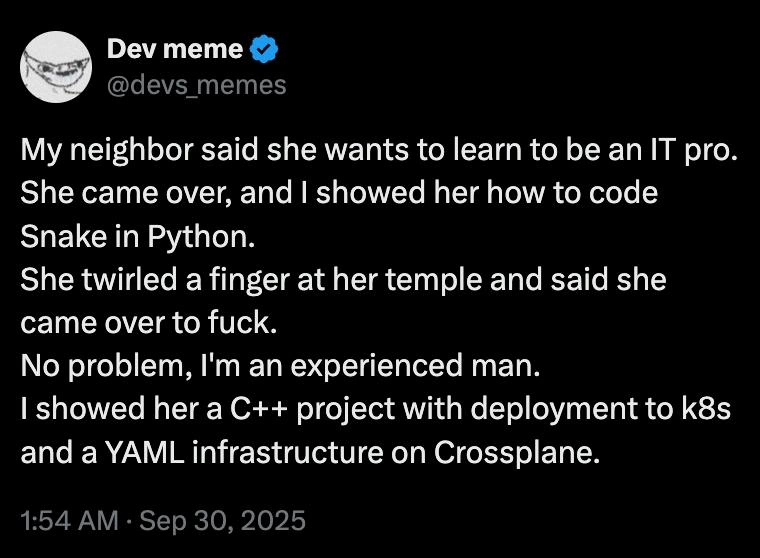
A screenshot of a tweet from Dev meme (@devs_memes) posted at 1:54 AM Sep 30, 2025. The joke reads: 'My neighbor said she wants to learn to be an IT pro. She came over, and I showed her how to code Snake in Python. She twirled a finger at her temple and said she came over to fuck. No problem, I'm an experienced man. I showed her a C++ project with deployment to k8s and a YAML infrastructure on Crossplane.' The humor is a double entendre where 'came over to fuck' is misinterpreted -- instead of the implied meaning, the developer escalates to showing increasingly complex infrastructure, interpreting 'fuck' as 'fuck with your mind' via overwhelming tech complexity

Comments

9
Anonymous ★ Top Pick She said she came over to fuck, and he delivered -- nothing fucks you harder than debugging a C++ project with a Crossplane YAML infrastructure that's 500 lines deep and still fails on kubectl apply
  1. Anonymous ★ Top Pick

    She said she came over to fuck, and he delivered -- nothing fucks you harder than debugging a C++ project with a Crossplane YAML infrastructure that's 500 lines deep and still fails on kubectl apply

  2. Anonymous

    Of course he reached for the C++ and k8s project. When someone suggests a high-risk, high-consequence activity, you bring out the stack with no memory safety and a million points of failure

  3. Anonymous

    The real deployment failure here wasn't the k8s cluster - it was missing the signals in the human interaction layer. Classic case of focusing so hard on horizontal pod autoscaling that you completely miss the vertical scaling opportunity right in front of you

  4. Anonymous

    Ah yes, the classic developer move: someone asks to learn programming, so naturally you skip 'Hello World' and go straight to showing them a polyglot microservices architecture with GitOps, service mesh, and declarative infrastructure management. Because nothing says 'welcoming to beginners' quite like explaining CRDs, reconciliation loops, and why your YAML has YAML that generates YAML. At least he didn't start with the Helm charts

  5. Anonymous

    Peak senior move: translate flirting into a CRD, ship a C++ binary to k8s via Crossplane, and let the only thing getting intimate be YAML indentation with RBAC

  6. Anonymous

    Senior translation: “I came to F” means “kubectl apply -f” - cue 600 lines of Crossplane CRDs and a cluster you can’t delete without a change request

  7. Anonymous

    IT pro dreams die quick when Crossplane YAML hits: her career got pruned faster than a misapplied kustomize patch

  8. @kirisoraa 9mo

    always relevant

  9. @DavidGarciaCat 9mo

    What a pro 😂😂😂

Use J and K for navigation