Skip to content
DevMeme
6578 of 7435
Sora Rejects Every Video: Endless Wall of Content Violation Failures
AI ML Post #7210, on Oct 4, 2025 in TG

Sora Rejects Every Video: Endless Wall of Content Violation Failures

Why is this AI ML meme funny?

Level 1: Crying Wolf, Again

Imagine a fire alarm in your house that keeps going off every single minute, even though there’s no fire – just because you burned a piece of toast once. At first, you’d be startled: “Oh, an alarm!” But after it blares the same warning over and over, you’d get frustrated and probably cover your ears, right? You might even stop believing there’s any real danger because it just won’t shut up about the same thing. This meme is showing exactly that kind of situation, but on a computer.

It’s like a buddy who keeps tapping you and saying, “Hey, your video didn’t upload... Hey, your video didn’t upload... Hey, your video didn’t upload...” non-stop. After the first time, you’re like, “Got it, thanks.” After the tenth time, you’re groaning, “I KNOW! Please, enough!” It’s funny in a silly way because the computer is basically panicking and repeating itself unnecessarily. But it’s also easy to feel the user’s annoyance: the app is so broken that it’s stuck in a loop telling you the same bad news again and again.

In the end, it’s a bit like the boy who cried wolf over and over. The first “wolf!” (or in this case, “failure!”) gets your attention. By the dozenth time, you just roll your eyes. The meme makes us laugh because we see how absurd it is for a system to act this way – it’s a machine having a goofy freak-out, and anyone can understand how that’s both funny and irritating.

Level 2: Alert Fatigue 101

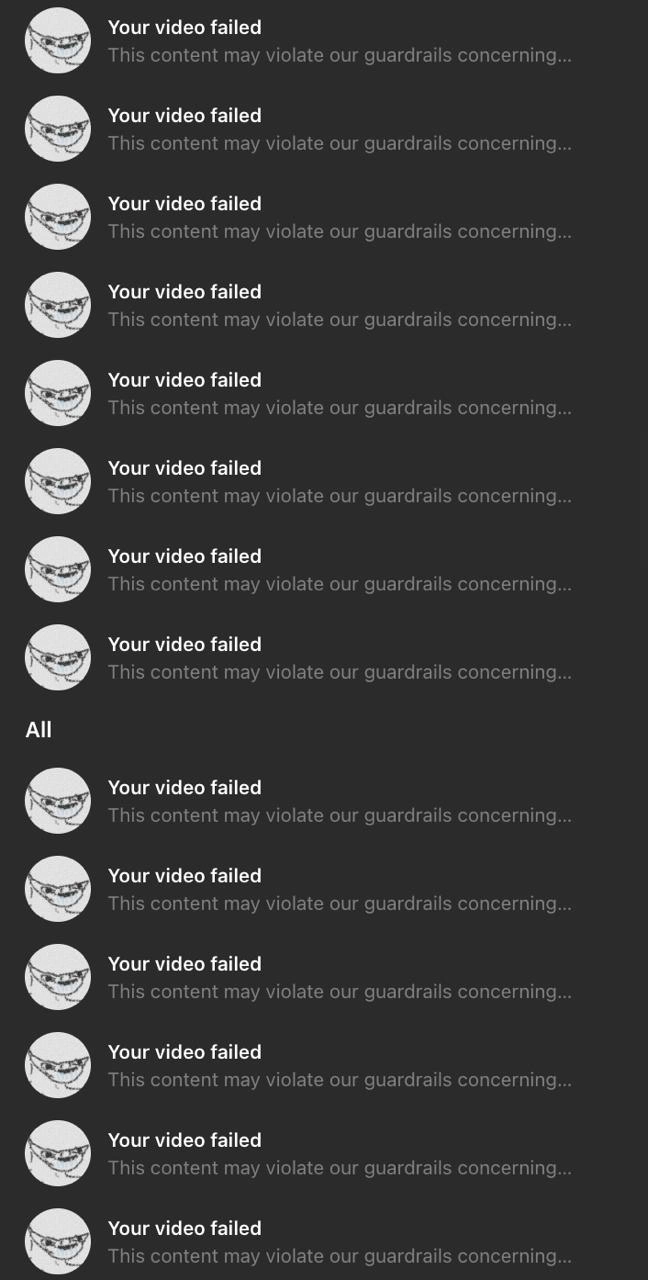
Let’s step back and explain what’s going on in simpler terms. The meme shows a list of notifications where every single entry says "Your video failed" and then some standard explanation about violating guardrails. In normal language: the person tried to upload a video, and the system’s automatic rules (the guardrails) rejected it, likely thinking the video breaks some content rule. But the weird part is it didn’t just happen once – it happened over and over, flooding the screen with the same message.

A few key concepts are highlighted here:

  • Bug: A bug is an error or flaw in software. In this scenario, there’s definitely a bug (or a whole collection of bugs). Software isn’t supposed to tell you the same failure a dozen times in a row; one time should be enough. The fact that it’s repeating suggests something went wrong in the code or system design. Perhaps the code that handles a failed upload is inadvertently running multiple times or not stopping when it should.

  • Observability & Monitoring: These are big words in system management. Monitoring means keeping an eye on a system (like a website or app) and sending alerts if something is wrong. Observability is a broader term that means the system is designed in a way that you can understand its internal state from the outside – typically through logs, metrics, and alerts. Good observability would mean if a video fails, you get a clear alert saying why, and maybe just one alert or a summarized alert. Here, the monitoring is overactive: it’s producing an alert every single time the failure happens. That’s an observability issue – it’s not helping the engineers, it’s just creating noise.

  • On-call & Production Issues: On-call is when a developer or IT person is rostered to respond to problems on a live system (production) at any time – even at 2 AM. A production issue is a problem occurring in the live app or service that real users use. This meme references on-call life because an on-call engineer would get an alert for each failure. If the system is alerting for every single one of those "video failed" events, the poor engineer’s phone might be buzzing non-stop. Alert fatigue is a term for when someone gets so many alerts that they become overwhelmed or start ignoring them. It’s like if your smoke alarm went off every five minutes – eventually you’d either take the batteries out or stop paying attention because you assume it’s a false alarm. In our case, the engineer might start ignoring the alerts because they all say the same thing with no useful info. That’s dangerous, because they might miss a truly important alert among the spam.

  • Error Messages: The notification text "Your video failed" is an error message to the user saying the upload didn’t succeed. A good error message might tell you why or what to do next. But here the subtitle just vaguely says it "may violate our guardrails..." which is pretty generic. And seeing it repeated offers no extra insight – it’s literally the same one-liner. So from a user’s perspective, they’re not learning anything new with the subsequent messages. It’s just adding frustration.

  • AI Guardrails / Content Moderation: Many modern platforms use AI or automated rules to check user content (like videos, images, posts) to ensure they don’t violate policies (for example, no violence, no hate speech, etc.). These rules or models are often called guardrails because they’re meant to keep content within “acceptable” bounds, similar to how guardrails on a road keep cars from going off course. In the context here, the system probably has an AI that scans the video and decided it might be inappropriate or against the rules. Content moderation pipeline is the step-by-step process that the video goes through – maybe first it’s uploaded, then transcoding (which means converting the raw video into formats that can be streamed), then a content check (the AI guardrail), and then publish. If the guardrail flags the video, the pipeline will stop and reject the video. A pipeline failure can occur if any step fails. Here either the moderation step failed (by wrongly flagging the content) or possibly the transcoding step failed and somehow was interpreted as a policy violation – either way, the pipeline didn’t complete successfully.

  • Persistent Notification Flood / Automated Rejection Loop: These terms describe exactly what we see – persistent means it keeps happening, and flood means a large number. So a persistent notification flood is a lot of notifications that just keep coming. An automated rejection loop suggests the system is automatically rejecting the content in a loop. Maybe the user tried uploading the same video multiple times manually (leading to multiple rejections), or the system itself attempted to process it multiple times automatically (some systems will retry an operation if it fails, just in case it was a temporary glitch). Since the meme calls it an "infinite loop," it hints the system might be stuck retrying on its own.

For a newcomer, imagine you wrote a little script that was supposed to send one email when something goes wrong, but you accidentally put that send-email code inside a loop that runs 10 times. You’d end up sending 10 emails for the same issue. That’s essentially a duplication bug. In a real production scenario, that translates to lots of redundant notifications. If you’ve ever accidentally subscribed to a noisy notification system or had an app that sent you the same alert repeatedly (“Reminder: Do X!” four times in an hour), you’ve experienced a milder form of this. It’s annoying, right? Now scale that up: an engineer is getting paged by a server every few seconds with “Error X” – they’re going to be very annoyed and possibly sleep-deprived.

Let’s decode the specific scenario in straightforward terms:

  • User’s point of view: “I tried to upload a video. The app keeps telling me it failed and might violate some rules. I see a ton of ‘Your video failed’ messages. It doesn’t tell me exactly what rule I might be violating, just that something’s wrong. I tried multiple times, or the app retried, but every time it’s the same result. Now my notifications tab is full of these failure messages. This is super frustrating. The feature is basically broken for me – I can’t get my video up, and I’m just getting spammed with failure notices. It’s legit unusable.”

  • Developer’s/Engineer’s point of view: “We have a system in production that’s supposed to stop bad content from being uploaded (that’s the guardrails). But something’s off – it’s flagging possibly everything. And instead of handling that gracefully, it looks like our pipeline keeps trying and failing repeatedly. Our monitoring is sending an alert for every failure without grouping them. So I’m seeing the same alert many times. I have to wake up (if on-call) and deal with this. It’s hard to even see what the real problem is because the alert doesn’t give details beyond ‘it failed the guardrails’. I suspect maybe our new AI model for content filtering is buggy, or someone misconfigured a rule. Also, we probably forgot to configure our job retry settings or alert settings correctly. This is causing a notification flood. We need to fix the root cause (why the video is being rejected wrongly or repeatedly) and also fix the alerting so one problem = one alert.”

In simpler terms, the meme is about too many error messages saying the same thing. It’s highlighting a kind of mistake that can happen in software systems where a failure isn’t handled properly, so the system just keeps complaining non-stop. For a junior dev, an important lesson here is: when you design alerts or error handling, make sure you’re not shouting the same message a thousand times. Not only will it annoy users, but it also doesn’t help anyone solve the problem. One clear message or a few distinct messages are far more useful.

Also, learn about back-off and retry logic: if something fails, sometimes the best approach is to wait a bit before trying again, or limit how many times you retry. If you don’t, your program might go into a frenzy, which looks exactly like what happened here. It’s like if you couldn’t open a door and you just kept rattling the handle furiously non-stop – you’d make a lot of noise and maybe alert everyone in the house, but the door still wouldn’t open if it’s truly locked. Better to try a couple of times and then look for another solution (or call for help) rather than cause a ruckus.

Finally, this scenario touches on content moderation in tech. Companies use automated systems to enforce rules, but those systems can make mistakes. A smart design involves checking “Is the system sure? If it’s flagging everything, maybe turn it off or have a human review.” Without those checks, you get situations like these guardrails that basically block everything and spam out alerts. It’s both a technical bug and a design/policy oversight.

In summary, at a newbie-friendly level: the meme is showing a broken system that’s yelling the same error over and over. It’s funny in a facepalm way because clearly someone goofed up in the coding or configuration. And it’s a gentle reminder that as developers, we have to be careful with how we handle errors and alerts – otherwise we end up flooding our users (and ourselves) with useless, repetitive messages just like this.

Level 3: Guardrail Groundhog Day

For the battle-worn developer, this image triggers immediate déjà vu. It’s that classic scenario where a system failure doesn’t just happen – it happens on repeat until you can practically hear your pager buzzing in phantom vibration. The humor (tinged with horror) comes from the sheer overkill: one video upload fails, yet the user (and likely the on-call engineer) is hit with a dozen identical “Your video failed” messages. It’s like the movie Groundhog Day, but for alerts – the same incident replaying over and over with no resolution in sight.

Why is this funny to an experienced dev? Because it’s painfully relatable. We’ve all seen some component go haywire and flood the system with redundant errors. Maybe it was an email notification sent in a tight loop (“oops, sent the same email to the customer 50 times”), or a monitoring alert configured without a cooldown (“CPU usage high!” every second on the second). After the initial “Uh oh” moment, it crosses into absurdity as your phone will not stop chirping. At 3 AM, you either laugh deliriously or cry – or both. This meme captures that absurdist humor: the system isn’t just failing, it’s over-enthusiastically failing.

Let’s break down the scene. The dark-themed notification panel shows identical entries repeated incessantly. Each one says "Your video failed" with the subtext "This content may violate our guardrails concerning...". In the middle of this cascade, there’s a small heading labeled "All" – presumably the UI indicating these are all notifications. The fact that "All" appears smack in the middle underscores that every notification is the same kind of failure. It’s the app’s polite way of saying: “In case you were wondering, yes – all your notifications are just this failure message.” The poor user’s entire feed is one giant monotone chant of failure.

From a senior engineer’s perspective, several anti-patterns and pitfalls are on display here:

  • Alert Fatigue: This refers to the desensitization that happens when you receive too many alerts. The first “Your video failed” might be alarming. By the twelfth, you’re numb and annoyed. In on-call terms, this is dangerous: if your system cries wolf nonstop, you eventually stop taking it seriously. That’s how real issues get missed. Seasoned ops teams dread this, and they strive to configure alerts that are signal, not noise. Clearly, these guardrail alerts are pure noise after the first occurrence.

  • Poor Observability Hygiene: Observability is about being able to understand system health, and part of that is sending clear, useful notifications. Good hygiene means deduplicating repeated events and providing context. Here, we see a lack of deduplication or aggregation – the system should have combined these into one notification like “Your video failed (12 similar events)”. Instead, it’s spamming identical copies. That hints that either the developers didn’t think to handle repeated errors gracefully, or the monitoring system is naively forwarding every event as-is. It’s a bit like logging inside a for loop without a break – a rookie move that seniors double-check during code reviews.

  • Rogue Policy Engine: The phrase “guardrails concerning ...” suggests an automated policy or content moderation rule. A policy engine is running checks on the video (for disallowed content, compliance, etc.). The fact that every attempt triggers the guardrail implies the policy might be misconfigured or overly strict. There’s a whiff of an infamous scenario: an AI moderation filter turned up to 11, where even innocent content gets flagged. It could be a bug — maybe the model or rule mistakes normal video data as a violation due to a coding error (e.g., interpreting silence as “forbidden audio” or a filename glitch). Alternatively, if the content truly violates something (say the user is persistently uploading disallowed material), the system should block it once and call it a day. Spamming multiple identical notices is just bad UX. It’s as if the system itself isn’t confident, so it keeps repeating, “No really, it failed… seriously!”

  • Retry Storm: The visual of a dozen back-to-back failures hints that the system tried the same operation repeatedly in quick succession. In production environments, automated retries are common – networks glitch, services timeout, so you try again. But here it looks like a failure loop with no back-off. Perhaps the video processing service kept restarting or the upload was automatically re-submitted multiple times by an unwitting script. A senior dev sees that and immediately suspects a missing exponential backoff or a misbehaving queue consumer. It’s Monitoring 101 that if something fails 10 times in 1 second, you either throttle it or aggregate the errors. No one wants 10 separate phone alerts for what is essentially one problem. Yet, that’s exactly what happened. We’re basically looking at an alert design that says “more = better” – which every ops veteran knows is not true.

Now, consider the human side. The post comment “Legit unusable tho” tells us the person is exasperated. If this is a user, they’re saying the platform is effectively unusable because every video gets rejected. If it’s an engineer or admin, they mean the barrage of alerts makes the system impossible to manage. Either way, it’s a facepalm moment: something that was supposed to be a safety feature (guardrails) ended up crippling the entire experience. Guardrails, ironically, shouldn’t be so rigid or loud that you can’t drive on the road at all.

Think about being the on-call engineer here. Your notification panel is filled with the same message. You’re probably scrolling, looking for any hint of which video or which rule was violated, but all you see is the exact same generic text. No unique identifiers, no timestamps differences except maybe seconds. It’s a nightmare of observability anti-patterns:

  • The alerts are not actionable (what do I do with "Your video failed" x100? Which service? What cause?).
  • They lack context (no specific error code or detail visible, just a vague “may violate guardrails…”).
  • They have no suppression (the system didn’t stop after the first few or escalate in a smarter way).

As a result, the engineer’s likely reaction oscillates between frustration and grim laughter. It’s the kind of bug you screenshot and share in Slack with a caption: “Well, this is new… our alert system has become a DDoS attack on itself.” Meanwhile, a product manager somewhere is also pulling their hair out because user metrics are plummeting – “Why is every upload failing?!”.

Historically, the industry has learned these lessons the hard way. Incidents where monitoring floods the team are not unheard of. There’s the term “alert storm” that gets tossed around in post-mortems. It means exactly what it sounds like: a storm of alerts that overloads humans and systems. Causes can be many: a flapping service (going up and down rapidly), a misconfigured threshold, or a single failure mode triggering alerts in multiple systems (like one video failure generating a user notification, an error log alert, a metric alert for high error rate, etc., all concurrently). Our meme likely depicts such a multi-system pile-on – the user sees one notification per failure, the internal dashboards probably lit up with the same error count.

In essence, why this meme resonates with senior devs is because it’s a caricature of real production mishaps. It’s taking a legitimate concern (alert fatigue and poor monitoring practices) and cranking it to absurd levels (literally an endless scroll of identical failures). We laugh, maybe a bit nervously, because we’ve been on the wrong end of that phone alert or that user complaint. It reminds us of the importance of getting these things right:

  • Build guardrails that catch bad stuff, but don’t go haywire on false positives.
  • Implement retries for robustness, but with limits and delays.
  • Alert on issues, but don’t spam – make each alert meaningful.
  • And for the love of all that is holy in DevOps, if something does go berserk, have a kill-switch or a filter. Otherwise you end up in an infinite loop of doom, just like Groundhog Day, waiting for someone to finally break the cycle.

To summarize in a tongue-in-cheek way, here’s how the best practices vs. reality played out:

What You Should Do (Best Practice) What Actually Happened (Oops)
Limit retries and use exponential back-off on failures. Retried immediately on every failure with no limit, creating a rapid-fire loop.
Deduplicate or aggregate repeated alerts into one. Fired an alert for each identical failure, flooding the feed with clones.
Tune content AI guardrails to avoid false positives; allow some margin. Set guardrails so strict or buggy that they flagged everything as a violation.
Provide informative, unique error messages with context. Showed a generic failure message each time, with no new info (just copy-paste spam).
Have a fail-safe (dead-letter queues, manual review) for persistent failures. No fail-safe: the bad job cycled endlessly, no escalation to a different path.

It’s a perfect exhibit of how not to do Observability and Monitoring. The meme is funny to us now, but only because we’re not the ones firefighting this issue in real-time. You can bet whoever was on-call for this felt the pain – and then probably fixed the notification logic the very next day. Live and learn (and add a darn alert throttle next time!).

Level 4: Poison Pill Pipeline

At the deepest level, this meme exposes a system design failure reminiscent of the classic poison message problem in distributed systems. Imagine a video processing pipeline where each upload is processed through multiple microservices (transcoding, content analysis, policy enforcement). Here, one video likely trips a guardrail rule every single time it’s processed – essentially a toxic input that the system can’t handle but also won’t give up on. In a robust design, a job that fails repeatedly would be shunted to a dead-letter queue or aborted after a max retry count. Instead, we have a feedback loop with no escape hatch: the video is queued, fails the guardrails check, triggers a “failure” notification, then gets re-queued or retried ad infinitum.

This runaway loop suggests missing exponential backoff and retry limits. Normally, retry algorithms use backoff (delays that grow longer) to avoid rapid-fire repetition, and they cap the number of attempts. Here, it’s as if someone set the pipeline to while(true) { tryUpload(); notifyFailure(); } – a recipe for an alert storm. Each failure isn’t acknowledged properly, so the system just keeps screaming. It’s a positive feedback loop gone rogue: failure leads to an immediate retry which leads to failure… on and on, saturating logs and inboxes. In control theory terms, there’s no damping mechanism or negative feedback to stabilize things. The guardrails have literally gone off the rails, causing oscillation between "attempt upload" and "auto-reject" at machine speed.

On top of that, consider the AI guardrails themselves. Likely an automated content moderation model flags the video as violating policy (maybe falsely). Such models operate on probabilities and thresholds. If mis-calibrated (say, threshold set too low), the model could classify every video as unsafe. Fundamentally, this touches on ML concepts of precision vs. recall: an overzealous model minimizes false negatives (catching every bad video) at the cost of a tsunami of false positives (flagging perfectly fine videos). Here the precision might be near zero – the guardrail cries “violation” on all content. Combine this with an automated enforcement loop, and you get a system that deterministically fails every time. It’s a digital example of the halting problem’s naughty sibling: the system can’t reach a success state, yet it doesn’t halt attempts. The result? Infinite failure notifications.

From an observability standpoint, this is a worst-case scenario: the monitoring/notification system isn’t aggregating or deduplicating events. Modern alert systems have features to group identical events (e.g., “Video processing failed x100 times”) or suppress noise after the first few alerts. Here, those safeguards either weren’t configured or were overwhelmed. Every identical failure is treated as a separate incident, triggering a fresh alert. The on-call dashboards and user notifications get spammed with carbon-copy messages. In essence, the observability tools are amplifying the failure literally, creating a denial-of-service on the poor engineer’s attention span.

To put it succinctly in pseudo-code, the situation probably looks like:

attempt = 0
while True:  # Infinite loop of failure
    attempt += 1
    try:
        process_video(upload)
        break  # success (never reached in this case)
    except PolicyViolation as e:
        notify_user(f"Your video failed: {e.reason}")
        # No back-off, no limit – just try again immediately

The above loop never breaks because process_video keeps throwing the same PolicyViolation every time. The notify_user line executes on each iteration, bombarding the user (and likely the ops team’s alert channel) with the same error. Without a conditional break or a circuit breaker pattern to stop retrying after a few failures, this loop is infinite. Such “poison pill” scenarios are well-known in messaging systems: a malformed message can get redelivered endlessly if you don’t quarantine it after repeated failures. The lack of a dead-letter queue here means the toxic video keeps circulating in the pipeline, and every cycle produces yet another identical error event.

Even from a data perspective, if this system uses an event queue or service bus, that queue is probably churning the same message repeatedly, saturating the network or CPU with redundant work. It’s a cascading failure: not only is the content rejected, but the rejection itself causes system strain by spamming logs and alerts. We’re seeing a form of alert cascade – a small bug (a guardrail misfire) triggers an amplification cascade (retries + notifications) that multiplies its impact. This is why seasoned engineers design guardrails and alerting with idempotency and throttling in mind: one problem should result in one clear alert, not a machine-gun burst of identical warnings.

In summary, the meme’s infinite guardrail loop is a perfect storm of algorithmic zealotry (an unforgiving content filter) and systemic mis-design (no retry backoff, no alert suppression). It’s a stark reminder that automated guardrails need guardrails of their own. Without them, an innocent upload can turn into an infinite nightmare for both user and engineer, as the system gleefully self-sabotages in an endless loop.

Description

A screenshot of OpenAI's Sora notification feed showing an endless wall of identical failure messages. Every single entry reads 'Your video failed - This content may violate our guardrails concerning...' with a trollface-style avatar icon next to each. The list repeats at least 12+ times in the visible area, split into two sections. This captures the frustrating experience of users trying to generate videos with Sora only to have every single attempt rejected by overly aggressive content moderation filters

Comments

12
Anonymous ★ Top Pick Sora's content moderation has a 100% recall rate -- it successfully catches all content, including the content you actually wanted to generate. Precision? We don't talk about precision
  1. Anonymous ★ Top Pick

    Sora's content moderation has a 100% recall rate -- it successfully catches all content, including the content you actually wanted to generate. Precision? We don't talk about precision

  2. Anonymous

    I've seen more permissive IAM policies on a production FedRAMP environment. These AI 'guardrails' feel less like safety features and more like a denial-of-service attack on creativity

  3. Anonymous

    Root cause analysis: someone merged `while(true){ reject(upload); }` behind the moderation service without a feature flag - PagerDuty now has a personal vendetta

  4. Anonymous

    After 15 years of building ML systems, I've learned that 'guardrails' is just enterprise-speak for 'we trained our model on Reddit comments and now it thinks everything is offensive, including its own error messages.'

  5. Anonymous

    When your CI/CD pipeline has 99.9% uptime but your content moderation AI has a 99.9% false positive rate. At least the deployment succeeded - the video just got deployed straight to /dev/null. Classic case of 'guardrails' becoming 'guard walls' where the safety feature is so aggressive it blocks legitimate traffic. It's the digital equivalent of a firewall that drops all packets because technically, that's the most secure configuration. The real kicker? Each rejection probably triggered a webhook, logged an event, sent a notification, and updated three different dashboards - all functioning perfectly to tell you that nothing is working

  6. Anonymous

    Trust & Safety shipped a model with 0.99 recall, 0.01 precision, and the only log line is “Your video failed” - MLOps complete; users optional

  7. Anonymous

    Someone tuned the moderation threshold for 99.99% recall and shipped it behind a feature flag - congrats, we’ve implemented reject_all() as a service

  8. Anonymous

    YouTube's violation renderer hit an infinite loop - async warnings without await

  9. dev_meme 9mo

    guardrailoroad tycoon

    1. dev_meme 9mo

      Pasta is coming

  10. @BEST8OY 9mo

    You're basically violating the guardrails

  11. @beton_kruglosu_totchno 9mo

    rest in pepperoni

Use J and K for navigation