Skip to content
DevMeme
4057 of 7435
AI years feel like dog years since GPT-3 landed on arXiv
AI ML Post #4423, on Jun 7, 2022 in TG

AI years feel like dog years since GPT-3 landed on arXiv

Why is this AI ML meme funny?

Level 1: Time Flies in Tech

Have you ever had a day at school or a vacation that was so full of new things that it felt much longer than just a day or a week? Sometimes, when a lot happens in a short period, it feels like time stretched out. This meme is making a joke about that feeling in the world of technology, specifically AI (Artificial Intelligence).

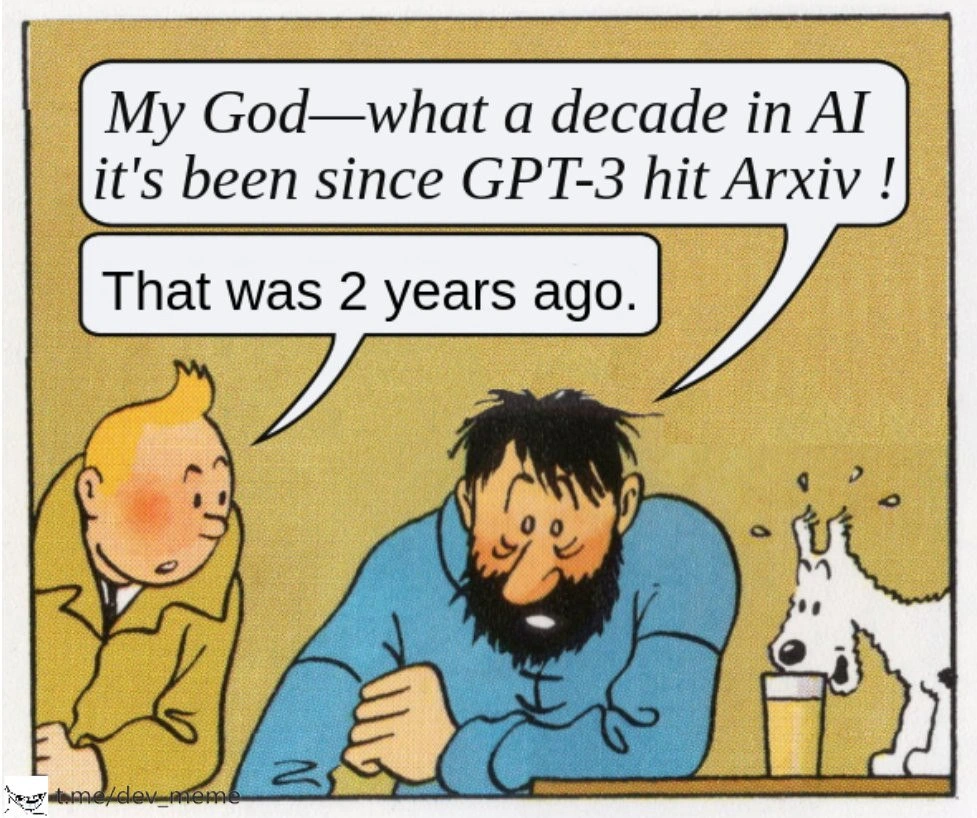
Imagine you got a new puppy and in just two human years, that puppy becomes an adult dog – that’s because dogs grow up fast. People say one dog year is like seven human years. In a similar way, technology, and especially AI, is changing so fast that one year in AI feels like many years in normal life. In the picture, the bearded man is basically saying: “Wow, so many things have happened in AI, it feels like ten years have gone by since we first saw GPT-3!” GPT-3 is the name of a very smart computer program that can write and talk like a person; it was introduced not too long ago (in reality, just two years before this meme was made). The young friend (Tintin) replies with a reality check: “That was 2 years ago.” He’s pointing out that it hasn’t actually been that long – it only feels like a long time because so much has happened.

The joke is funny because we don’t usually hear someone call two years a “decade”. It’s an exaggeration to make the point that time felt like it sped up. In simple terms, “time flies” in the AI tech world – or maybe it’s the opposite: so many changes happened that two years felt packed with experiences, almost like time was moving faster for AI folks. It’s like reading a whole series of books in one weekend; you did so much that when you’re done, it feels like more time must have passed. Here the “series of books” is all the new AI developments that came out one after another.

Even the little dog in the picture (Tintin’s dog, Snowy) is a playful clue: it reminds us of the saying about dog years. In two actual years, a dog gets a lot older – and in two years of AI, the technology got a lot “older” or more advanced, very quickly. So, the big idea is: technology, especially AI, has been moving incredibly fast recently, so it feels like we packed a decade’s worth of progress into just two years. That’s exciting, and a bit overwhelming, and that’s why techies find this meme both funny and true. In everyday terms, it’s like saying, “Wow, so much happened, I can’t believe it’s only been a short time!” – which is something we all say when life suddenly gets very busy or full of changes.

Level 2: AI Dog Years

In this meme, a comic scene is used to illustrate how fast things are moving in AI. On the left, we have Tintin – a famous comic book character known for his adventures – and on the right is his friend Captain Haddock (the bearded man in the blue sweater), plus Tintin’s loyal dog Snowy. They’re at a bar, and Captain Haddock is exclaiming, “My God—what a decade in AI it’s been since GPT-3 hit arXiv!” Tintin replies, “That was 2 years ago.” The humor comes from Haddock thinking so much has happened that it feels like ten years have passed, when in reality only two years went by. It’s an exaggerated way to say: “Wow, AI progress has been so rapid that time feels stretched out!”

Let’s break down the terms and references to understand why tech folks find this funny:

  • GPT-3: This stands for Generative Pre-trained Transformer 3. It’s the name of a very advanced AI model released in 2020 by a company called OpenAI. It’s essentially a Large Language Model (LLM) – a type of AI trained on huge amounts of text (think: almost all of the internet’s written text) so that it can generate human-like writing. You give GPT-3 a prompt (like “Write a poem about the sea” or “Explain what a database is”), and it continues the text in a surprisingly coherent way. In 2020, GPT-3 was state-of-the-art for natural language generation and caused a huge buzz because it could do things like answer questions, write code, and create articles, all without being specifically programmed for each task. For many developers and researchers, GPT-3 was a landmark – it demonstrated a big leap in what AI could do.

  • arXiv: Pronounced “archive”, arXiv is an online repository where scientists and researchers publish papers before they’ve gone through formal peer review. It’s a place to quickly share new findings with the community. In fields like Machine Learning (ML), arXiv is where all the hot new research appears first. The GPT-3 research paper was posted on arXiv in mid-2020. When Captain Haddock says “since GPT-3 hit arXiv,” he’s referring to the moment the GPT-3 paper became public. It’s a bit like saying “since the world found out about GPT-3.” In tech circles, we often mark time by major publications or product launches, and here GPT-3’s arXiv debut is one of those milestone moments.

  • “What a decade in AI it’s been”: Obviously, a literal decade is ten years. Captain Haddock is using a metaphor – he feels like the amount of change and progress in AI since GPT-3 came out is what you’d normally see in ten years. Why would someone feel that way? Because from 2020 to 2022, so many things happened in the AI/ML world:

    • New models were introduced one after another. For example, after GPT-3 amazed everyone, other AI models quickly followed that could do different magic tricks: models that could generate images from text descriptions (imagine typing “a puppy riding a skateboard” and the AI paints it for you), models that could help write programming code, and models that learned to converse or answer questions more naturally.
    • There was also a big jump in the scale of AI models. GPT-3 was huge in terms of its “brain” (175 billion parameters, which you can think of as settings the model learned). That was far bigger than previous models. After that, companies began building even larger models (some even surpassing GPT-3 in size) in just a year or so.
    • The AI industry reacted very quickly. Suddenly many startups and projects sprang up claiming to use “GPT-3-like” AI to do all sorts of tasks (like writing marketing copy, generating game dialogue, answering customer support questions, etc.). Big tech companies (Google, Microsoft, etc.) also started investing heavily in similar Large Language Models and integrating AI capabilities into their products. For instance, by 2021–2022, we saw things like GitHub Copilot, which is a coding assistant powered by an AI model related to GPT-3, being offered to developers. All this happened in just a couple of years, which is incredibly fast.
  • Tech moves fast / Industry hype: The meme is categorized under IndustryTrends_Hype for a reason. “Hype” in this context means lots of excitement and buzz around a new technology, sometimes with people having unrealistic expectations. When GPT-3 came out, media headlines were calling it a giant step towards true artificial intelligence, and some even mused about whether we were nearing human-like AI. This generated a hype cycle: initially, everyone’s extremely excited (the peak of inflated expectations), and people imagine AI doing everything. Then usually reality sets in: the AI, while impressive, has limitations (for example, GPT-3 can produce incorrect or absurd answers if you prod it the wrong way, and it doesn’t actually understand things like a human, it just predicts likely text). But in those first two years, the hype stayed pretty high because new versions and applications kept appearing to sustain it. Industry trends shifted heavily towards AI – companies that never touched AI before started at least experimenting with it. Developers felt this directly: one day you might be a regular software engineer, and the next day your boss is asking if you can “add an AI feature” or use some machine learning API in your project. This rapid change can be intimidating if you’re new to the field (or even if you’re experienced!).

  • “AI years are like dog years”: This phrase (also echoed in the meme’s title) is a play on a common idiom. People often say “one year of a dog’s life is like seven human years”, because dogs have shorter lifespans and reach maturity quickly. So a 2-year-old dog might be roughly as mature as a 14-year-old human. In tech, we jokingly say something similar: “one year in the tech industry equals several years in a more traditional industry.” Things move so fast in tech that if you leave and come back after a year, a lot might have changed – new programming languages, new frameworks, new best practices. Now, in AI specifically, it’s even more extreme lately. So saying “AI years feel like dog years” suggests that a single year in the AI world brings about roughly seven years worth of changes or progress. It’s exaggeration, but not by a huge margin – really, a lot changes in just a year or two of AI research. Captain Haddock’s line about a “decade” in two years is basically applying that idea: 2 calendar years felt like 10 development years. And having Snowy the dog in the comic panel is a clever visual wink at the “dog years” saying. Snowy looks like he’s panting, possibly from trying to keep up!

  • Tintin’s reply, “That was 2 years ago.”: Tintin here plays the role of the grounded friend who brings reality back into the conversation. It’s a classic comedic setup: one character exaggerates wildly, the other delivers a factual deadpan line. The humor is in the contrast. Tintin’s response emphasizes just how short the actual time span was, highlighting the absurdity of how much happened. If you imagine this in a real conversation among developers: one might say, “Gosh, we’ve seen so much change in AI, it feels like I’ve aged a decade since 2020,” and another might raise an eyebrow and say, “Mate, that was literally two years ago…” with a smirk. It underlines the feeling vs fact difference – emotionally or in terms of workload it feels very long, but on the calendar it’s shockingly short.

For a junior developer or someone new to this area, the meme is basically an exaggeration to say: “AI is advancing super fast right now.” It pokes fun at how people in the field are almost overwhelmed (in a spirited, jaw-dropped way) by the speed of improvements. It’s the kind of thing you start to hear from mentors and senior engineers: “Keep learning, kid, because what you know today might be old news in a couple of years.” That can sound scary, but it’s also part of the excitement of working with cutting-edge technology.

If you’re less familiar with AI, think of it this way: imagine you started learning how to build websites, and in two years the whole approach and tools for web development changed drastically – you’d feel like, “Whoa, so much is different, have I been gone for ages?” That’s what happened with AI folks between 2020 and 2022. They went from a world where certain tasks seemed impossible or far off, to a world where those tasks were not only possible but being demoed routinely. That rapid change can cause anxiety (nobody wants to fall behind) but also excitement (so many new toys to play with!).

In summary, the meme combines a classic comic reference (Tintin and Haddock) with tech commentary: GPT-3’s advent and the flurry of progress that followed kind of warped people’s sense of time. It’s filed under AI_ML because it’s about artificial intelligence and machine learning progress, and under IndustryTrends_Hype because it’s highlighting the trend and hype around AI improvements. The key message for a newcomer: the world of AI has been moving unbelievably fast, to the point that insiders jokingly measure time in “AI years,” much like dog years, to capture how much change they’re experiencing. It’s both a funny and a slightly awed observation of just how rapid the progress has been.

Level 3: A Two-Year Decade

Experienced engineers often joke that tech years are like dog years – things move so quickly that one year of change in tech feels like seven anywhere else. This meme nails that sentiment in the context of AI hype. When the bearded character (a nod to Captain Haddock from the Tintin comics) exclaims, “My God—what a decade in AI it’s been since GPT-3 hit arXiv!”, he’s expressing the whiplash that developers feel trying to keep up with the breakneck pace of AI/ML breakthroughs. The punchline comes from Tintin calmly reminding him, “That was 2 years ago.” In other words, GPT-3’s debut wasn’t ages past – yet to those in the field, it feels as if an entire era has flown by. This humorous exaggeration resonates with anyone who’s seen AI capabilities and industry trends evolve at warp speed.

Why is it so funny (and a little painful)? Because it’s true – since mid-2020, the AI landscape has exploded. Large Language Models (LLMs) like GPT-3 went from cutting-edge research to mainstream conversation. In those two short years, we witnessed what felt like a cascade of “next big things”:

  • 2020: GPT-3’s arXiv paper astonished the community. Suddenly, an AI could generate eerily human-like text, write code snippets, compose emails, even crack jokes, all from plain language prompts. Developers who read the paper or tried the OpenAI API often had a “future shock” moment — it was as if NLP (Natural Language Processing) jumped ahead by a decade overnight.
  • 2021: The ripples of GPT-3 spurred a gold rush in AI. OpenAI refined the model (with variants tuned for coding, like Codex, which powers GitHub Copilot) and other organizations raced to build their own gargantuan models. Every few months, a new headline: “Now AI can do X!” For instance, AI models started generating images from text descriptions (e.g. OpenAI’s DALL·E and its successor DALL·E 2 in early 2022). Entirely new applications — AI design assistants, code generators, content writers — went from demos to real products. Engineers went from discussing “could an AI do this someday?” to “the AI we deployed last summer is already outdated.” It felt like time was fast-forwarded.
  • 2022: By the time of this meme’s post (June 2022), GPT-3 itself was old news in some sense. Many devs were anticipating GPT-4 rumors or experimenting with open-source alternatives (like EleutherAI’s GPT-J). Google unveiled even larger models (like a 540-billion-parameter model named PaLM), and research papers kept appearing weekly with ways to make models more efficient, more accurate, or more creative. The hype cycle was in full swing: startups pitched themselves as “GPT-3, but for customer support” or “AI-as-a-service” platforms, and big tech companies reorganized teams to focus on AI features. If you attended industry conferences or followed tech Twitter, the conversation was dominated by transformers, few-shot learning, model compression, ethical AI – a myriad of discussions hardly imaginable at such a scale just two years prior.

For veteran developers, this situation elicits a mix of excitement and weary déjà vu. On one hand, it’s thrilling to witness genuine breakthroughs – those of us who remember struggling with brittle classical AI algorithms in the 2000s are amazed that you can now literally ask a model in English to solve a coding problem or summarize a document. It genuinely feels like living in the future. On the other hand, the hype can reach comical levels, and experience teaches us to be a bit skeptical. We’ve seen hype cycles before: peak excitement followed by an inevitable reality check. (The term “AI winter” exists because previous booms – in the 1960s with symbolic AI, and again in the 1980s with expert systems – didn’t fulfill sky-high expectations and progress stagnated for years.) With GPT-3, though, the progress is real enough that even cynics had to admit something fundamentally changed in AI. So instead of a collapse, we got an arms race: more models, more funding, more media headlines – all in a compressed timeframe.

This breakneck velocity is exactly what the meme lampoons. The bearded man’s wide-eyed statement and Tintin’s deadpan rebuttal capture an engineer’s anxiety: “If two years felt like ten, how am I ever going to keep up?” Developers are sharing a laugh here, but it’s a laughter that says “yeah, I feel that too.” There’s a shared understanding of the pressure to constantly learn and adapt. One day you finally grasp BERT (a landmark NLP model from 2018), and the next day everyone’s talking about GPT-3’s few-shot learning or some new model that makes BERT look quaint. You get proficient with a framework like TensorFlow, then PyTorch steals the spotlight, and before you know it, you’re reading about JAX or new libraries to deploy 100-billion-parameter models on cloud TPUs. The tools and best practices are evolving in real-time. Even the terminology grows: “prompt engineering,” “foundation models,” “zero-shot,” “RLHF” (Reinforcement Learning from Human Feedback) – none of these were in the average developer’s vocabulary a couple of years ago, and now they’re tossed around in meetings.

It’s both exhilarating and exhausting. Many senior engineers have had that exact bar-counter feeling after a long week of catching up on AI news: “My God – it’s like we’ve aged a decade in the last couple years.” Perhaps with a touch of Captain Haddock’s dramatism (minus the expletives he might’ve added). The inclusion of Snowy the dog in the panel is a cheeky visual pun: in the Tintin comics Snowy is just Tintin’s loyal fox terrier, but here his presence underlines “dog years,” the idea that time for one domain (dogs, or AI progress) runs 7x faster than normal. Snowy panting next to that pint might as well be the exhausted developer’s spirit animal – trying to keep pace and catch his breath while the world moves ridiculously fast around him. 🐕💨

Another reality that seasoned devs grin at is how two years in AI can change the industry narrative entirely. In 2020, many outside the ML field had never heard of GPT-3; by 2022, even non-engineers were name-dropping it as proof of “AI getting smart.” Business folks started asking engineers, “Can’t we just use GPT-3 to do X?”, expecting near-magical outcomes. Industry expectations shot through the roof. If you’re an AI specialist in a company, you probably had meetings where someone essentially said, “GPT-3 can write blogs and code, why do we need content writers or so many developers? Can’t the AI do it now?” – forcing you to gently explain that yes GPT-3 is powerful but it’s not a plug-and-play replacement for entire jobs, it has biases, it can generate incorrect or nonsensical output, it requires careful prompting, etc. Experienced hands have seen this pattern: hype leads to overestimated expectations, which engineers then have to temper with reality. The meme captures that disconnect comically – the dramatic proclamation vs. the sobering factual retort.

The phrase “decade in AI” also hints at how dense those years felt in terms of content. In two years, entire subfields blossomed. MLOps (tools and practices for deploying and maintaining ML models) grew from niche to essential, largely because companies suddenly found themselves serving massive AI models in production. Techniques we hadn’t widely used before – like few-shot learning (making models perform tasks with very little training data) or massive unsupervised pre-training on practically the whole internet – became standard talking points. It’s as if the timeline got crammed: what used to unfold in ten quiet years of gradual research now happens in a frenetic blur of arXiv papers, Twitter demos, and rapid open-source implementations.

For those who love tech history, there’s an irony in referencing a “decade” of AI progress: previous actual decades in AI (say, 2010–2020) did see big leaps (the deep learning revolution started around 2012 with AlexNet for example), but the velocity was still human-scale – you had time to absorb breakthroughs one by one. But from 2020 to 2022, it genuinely felt like we fast-forwarded. GPT-3’s paper alone set into motion a paradigm shift where the size of a model became a feature, and “scaling up” became the name of the game. As a result, engineers jokingly talk about being in an “AI time chamber” where a few months of work feels like years of experience. The meme’s humor lies in that exact collective realization: “Wait, that was only 2 years? Feels like an eternity in tech terms!”

Ultimately, this Tintin parody lets developers laugh at the craziness of the AI hype cycle. It’s a bit of catharsis: acknowledging the developer anxiety of trying to keep up with every new model and framework, and the surreal sense that we’re living through a condensed epoch of technological change. In other words, it’s funny because it’s relatable – if you’ve been along for the ride since GPT-3’s debut, you probably do feel ten years older (and perhaps ten times more jaded or wise) even though the calendar insists it’s only 2022. As Captain Haddock might say with a mix of awe and exasperation, “Billions of blue blistering transistors, what a ride it’s been!” – to which Tintin (ever practical) would remind him: “Steady on, Captain, it’s only been a short trip.”

Level 4: Time Dilation in AI

At the cutting edge of AI research, time can feel strangely elastic. In physics, time dilation refers to how time stretches or contracts at extreme speeds (like near-light travel) – and in the realm of AI, the pace of innovation creates a similar illusion. Since GPT-3 hit arXiv in 2020, the field has been racing so fast that a mere two years of progress can seem like a decade. This isn’t just hyperbole – it’s rooted in the exponential acceleration of AI capabilities. Consider that GPT-3 (Generative Pre-trained Transformer 3) introduced a whopping 175 billion parameters, a model size unheard of just a year prior when GPT-2 had 1.5 billion. That jump (over 100× increase) in such a short span felt like skipping years of gradual improvement. In fact, the computational power used for state-of-the-art AI has been estimated to double every few months, far outpacing Moore’s Law.

If we crudely model this super-exponential trend, doubling every ~4 months, then in 24 months (2 years) you'd get approximately six doubling periods. That’s roughly:

$$ 2^{6} \approx 64 \text{ times more compute in just two years.} $$

Sixty-four-fold growth in resources can yield qualitatively new capabilities – it’s no wonder those immersed in AI research feel like they’ve traversed light-years of progress since 2020. New transformer-based architectures and training techniques unlocked emergent behaviors that previously took entire research careers to achieve. For example, GPT-3 demonstrated surprising few-shot learning (being able to perform tasks with just a couple of examples) that bordered on what many considered science fiction before. Each month brings a flurry of arXiv preprints: improved models, clever fine-tuning methods, faster transformers, larger training datasets. The sheer density of breakthroughs means an AI engineer’s internal clock runs on “AI time” – and one year of real time might pack in what historically took five or more. It’s a temporal illusion created by exponential growth: when progress accelerates, our usual expectations of yearly change get obliterated. If an AI “year” represents the amount of advancement we once expected in a calendar year, we’re racking up so many advancements that each actual year now feels like several.

This phenomenon flirts with futurist Ray Kurzweil’s idea of accelerating returns, and even the sci-fi notion of a technological singularity – where progress becomes so fast and profound that it’s almost a vertical line on the timeline. We’re not at true singularity (where AI would be improving itself beyond human comprehension), but the feeling of a time warp is very real for practitioners. In essence, modern AI progress has entered a regime of such rapid iteration that it warps our perception of time, much like high gravity or near-light-speed travel would in Einstein’s relativistic universe. Developers and researchers aboard this fast-moving “AI spaceship” are experiencing their own form of relativistic time: they witness a decade’s worth of advancements while the rest of the world only spins around the sun twice. It’s both exhilarating and disorienting – a testament to how extraordinary the last two years have been in machine learning history.

Description

Single-panel Tintin - style comic: on the left, Tintin sits blushing at a bar; center, a bearded man in a blue sweater (face blurred) leans on the counter; on the right, Snowy the dog pants beside a half-full pint glass. Large speech bubble from the bearded man reads, “My God - what a decade in AI it's been since GPT-3 hit Arxiv !”. A smaller reply bubble from Tintin states, “That was 2 years ago.” Background is a flat olive color, and the panel is framed with a white border; tiny “meme/dev-meme” watermark appears bottom left. The joke riffs on the breakneck pace and hype of modern AI research - GPT-3’s 2020 arXiv paper already feels ancient, highlighting how quickly model capabilities, tooling, and industry expectations evolve for engineers tracking large language models

Comments

6
Anonymous ★ Top Pick AI moves so fast that by the time procurement signs off on the A100s for our GPT-3 pilot, the model’s considered “legacy” and the PyTorch version it needs has slipped into LTS
  1. Anonymous ★ Top Pick

    AI moves so fast that by the time procurement signs off on the A100s for our GPT-3 pilot, the model’s considered “legacy” and the PyTorch version it needs has slipped into LTS

  2. Anonymous

    Remember when we thought microservices adoption was fast? AI research papers now have a half-life shorter than our sprint cycles, and every standup starts with 'So, which foundation model got deprecated while we were sleeping?'

  3. Anonymous

    In AI years, GPT-3's arXiv release is basically the Cambrian explosion - ancient history where we were still figuring out if 175B parameters was 'too many.' Now we're casually discussing trillion-parameter models while GPT-3 sits in production like COBOL: technically legacy, still running half the internet, and nobody wants to admit how recently it was cutting-edge

  4. Anonymous

    GPT-3 dropped two years back, birthing the LLM era - yet our enterprise monoliths from Y2K still demand COBOL priests

  5. Anonymous

    Two years on the calendar, but in engineering time that’s five SDK rewrites, three eval pipelines, and one deprecation notice the day after GA

  6. Anonymous

    Two years since GPT‑3 and it already feels like a decade: four API renames, three vector DBs, and our “temporary prompt” somehow has an SLA

Use J and K for navigation