Twitter meme rebrands AI as "Automated Incompetence" with Kronk’s approval
Why is this AI ML meme funny?
Level 1: Clumsy Robot Helper
Imagine you have a little robot friend that’s supposed to be really smart. Everyone calls it your “AI helper.” You ask this robot to do your homework or clean your room automatically. That sounds awesome, right? But here’s the funny part: whenever the robot tries to help, it messes things up. It might put your toys in the fridge and your snacks in the closet, or answer “2 + 2” with “5.” In other words, it’s doing things automatically, but doing them wrong – like a helper who is a bit clumsy or not very bright. You expected a genius, but you got a goofball. 😂
Now, one day you ask, “Do you know what ‘AI’ stands for?” (Again, people usually mean AI = Artificial Intelligence, a fancy way to say a smart computer). But your cheeky friend says, “It stands for Automated Incompetence!” That sounds big, but it basically means “automatic silliness” or “robot behaving in a not-smart way.” It’s a joke, because it’s the wrong answer on purpose – but it fits our clumsy robot perfectly! Imagine a cartoon angel pops up on your shoulder – usually this angel encourages you to be positive – and even the angel is nodding and saying, “You know what, he’s right.” 😊 The angel agreeing is like even the nicest part of us has to admit the joke is true: this so-called smart robot really isn’t so smart after all.
Why do we laugh? Because it’s surprising and silly. We expect an “intelligent” machine to be correct and helpful. When it isn’t, it’s like seeing a super serious teacher slip on a banana peel – unexpected and funny. We also laugh a bit out of relief: phew, it’s not just me who makes mistakes, even the fancy AI does too! This meme is basically doing an imaginative name swap. It takes the term for a super-smart computer, “Artificial Intelligence,” and playfully turns it into “Automated Incompetence” – saying the computer is automatically dumb. And a friendly cartoon character is agreeing with that twist. It’s a fun way to tease technology. Even though we know AI is not truly dumb (it can do cool things!), we joke about its bad moments to remind ourselves that even high-tech gadgets can be flawed and funny. It’s like having a laugh at a robot who trips on its own wires – endearing in a way, and it makes the big, scary concept of “AI” feel a lot more human and easy to relate to.
Level 2: Smart Tech, Silly Mistakes
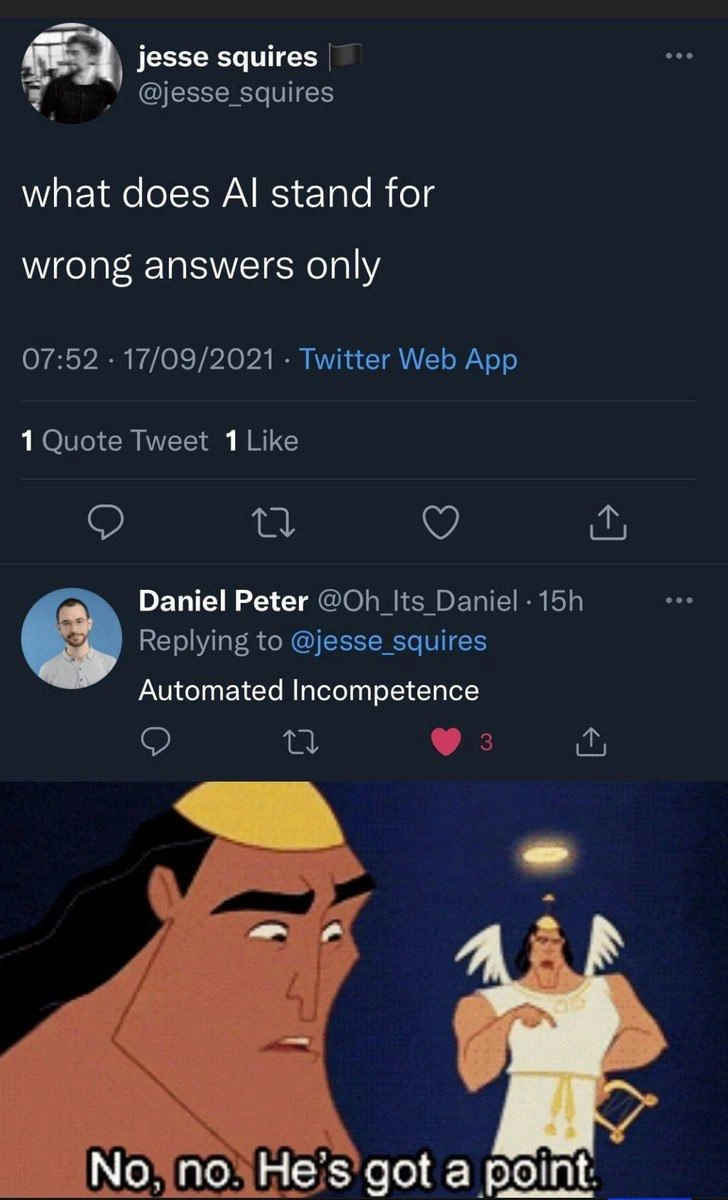
Let’s break down the meme in simpler terms. AI normally stands for Artificial Intelligence, which describes machines or software that try to perform tasks we think require intelligence (like recognizing faces, understanding speech, making decisions). Lately, everyone’s talking about AI as this super smart tech. But developers have noticed that AI can also be super silly at times, making obvious mistakes. That’s where this joke comes in. On Twitter, a user named Jesse Squires posted a fun prompt: “what does AI stand for? wrong answers only.” When someone says “wrong answers only,” they’re asking for funny, made-up definitions rather than the real one. It’s a popular social media game – you intentionally answer incorrectly for laughs. In this case, another user, Daniel Peter, replied with “Automated Incompetence.” That phrase sounds like it could fit the acronym “AI,” even though it’s not the real meaning. Incompetence means lack of ability or skill. So Daniel joked that AI is basically automation of not having a clue.
Why is that funny to tech folks? Well, think of times you’ve seen “smart” technology goof up. For example, have you ever used a voice assistant (like Siri or Alexa) and it completely misunderstood you, doing something wrong or absurd? Or perhaps you’ve seen autocorrect on your phone turn a normal word into something ridiculous. Those are cases of “automated incompetence” – the computer is automatically doing something, but doing it wrong. Developers deal with this a lot when working with AI systems. A machine learning model might get 9 out of 10 things right, but that one mistake can be a real head-scratcher (like calling a cat a dog, or translating a sentence into gibberish). It’s as if the AI sometimes lacks common sense and does exactly the wrong thing with full confidence. So this meme humorously suggests that maybe AI really stands for automating stupidity. It’s poking fun at the gap between the AI hype (“This system is intelligent and will change everything!”) and the AI reality (“Why on earth did it just do that?”). This aligns with the tag AIHypeVsReality – the difference between what we promise AI will do and what it actually does.
Now, look at the bottom half of the meme: it’s a screenshot from Disney’s The Emperor’s New Groove. The character is Kronk, and on his shoulder is an angel version of himself (his conscience). In the subtitle, the angel Kronk says, “No, no. He’s got a point.” People often use this image online to agree with a statement that was supposed to be wrong or controversial. Here, Kronk’s angel is basically saying, “Even though ‘Automated Incompetence’ was a ‘wrong answer’, it actually makes a good point.” This adds an extra layer to the joke. Even the “good guy” conscience agrees that AI can be pretty incompetent! If you’ve ever seen developers talk about tech on Twitter or forums, you’ll know they often share memes and jokes like this – it’s a way to vent and bond over shared experiences. AIHumor is full of examples where engineers joke about robotics, algorithms or programs messing up.
Let’s connect some of the keywords: IndustryTrends_Hype is about how industries sometimes exaggerate what new tech can do. AI has been hyped a lot – companies might say “Our app uses AI!” even if it just follows simple rules. New developers or the general public might believe AI is like a genius in a box. Then when you actually build or use one of these systems, you discover it’s not so magical – it’s fast and can handle a lot of data, but it also makes laughable mistakes. That’s the source of developer_cynicism_ai – developers become a bit cynical (not believing all the hype) because they’ve seen the silly errors firsthand. The term ai_acronym_parody refers to joking about what AI stands for, exactly like “Automated Incompetence.” It’s a parody of the acronym. We do this in tech to deflate buzzwords. Another example: someone might joke that “Cloud” in cloud computing stands for “Someone else’s computer” – not literally true, but pointing out a truth in a funny way.
In simpler words, this meme is saying: People call it Artificial Intelligence, but ha! sometimes it should be called Automatic Dumbness. And Kronk (our cartoon buddy) is there giving a thumbs up, saying that joke actually rings true. If you imagine Kronk’s scenario: he’s almost like the seasoned developer whispering in your ear, “The AI isn’t as smart as they say.” The Emperor’s New Groove reference isn’t about AI specifically, but it’s popular among meme-savvy folks as a way to express agreement. So using Kronk here bridges a fun pop-culture moment with a tech joke. Even if you haven’t seen the movie, you get the gist: the angel is nodding in agreement.
To sum up this level: AI means Artificial Intelligence, but when someone on Twitter asked for a goofy alternative meaning, a developer quipped “Automated Incompetence,” highlighting that these systems can automate tasks incorrectly. The meme resonates because many in tech have witnessed AI’s limitations – those silly, frustrating errors that make you facepalm – and it’s a relief to laugh about it. Even Kronk’s angel agrees that the joke is on point, making everyone who has struggled with a flaky model feel a little less alone and a lot more amused.
Level 3: Overpromised & Undertrained
Seasoned developers have been through the cycle: the CTO declares “We need AI in our product – it’s the future!” and next thing you know, you’re wiring up a half-baked model that does more harm than good. This meme lands perfectly for any engineer who has battled AI hype vs. reality. It starts with a Twitter prompt, “what does AI stand for – wrong answers only.” Experienced devs recognize this as an invitation to snark, and “Automated Incompetence” is a bullseye response. Why? Because we’ve all seen projects where AI was slapped on as a buzzword and promptly started making incredibly dumb mistakes. It’s the kind of bitter humor you develop after debugging a neural network at 3 AM because your “smart chatbot” keeps calling customers by the wrong name or your image classifier thinks every brown object is a dog.
The phrase Automated Incompetence encapsulates the frustration: instead of automating intelligence, sometimes we’ve just automated the mistakes. Take a real scenario: a machine learning system is deployed to scan résumés and automatically pick the best candidates. Sounds smart, right? Until it starts rejecting all candidates named “Alice” due to some bias in training data. The system is confidently incompetent. It’s doing the wrong thing faster and at scale – exactly what a cynical dev would call automation of stupidity. The meme’s second panel, Kronk’s angel saying “No, no. He’s got a point,” adds that extra seasoning of developer cynicism. Kronk is a Disney character known for having a little angel and devil on his shoulders. In the original scene, even Kronk’s good conscience has to agree with a sketchy idea, and here that meme is repurposed: even the angelic voice of reason concedes that calling AI “Automated Incompetence” is valid. It’s like the part of us that wants to believe the AI hype (the angel saying “be positive, AI will work!”) has to admit, yeah, this joke sadly rings true.
What’s genius is that this humor hits multiple layers of our industry experience. Engineers have witnessed AI projects overpromise and underdeliver. Think about all the lofty claims: “Our AI will revolutionize the industry” – and then the thing barely handles edge cases. There’s a saying in tech: If it’s in PowerPoint, it’s “AI”, if it’s in Python, it’s just code. That captures how “AI” gets used as a magic label for investors and marketing, while developers behind the scenes see it’s just a bunch of if-else rules or a shaky machine learning model held together with duct tape. So when Daniel Peter replies with “Automated Incompetence” on that tweet, developers laugh because they’ve lived it. AIHypeVsReality is not just a tag; it’s a lived experience where glossy demo videos meet the brutal truth of production data. We’ve had AIHumor like this since the 1960s, believe it or not – every generation of engineers becomes jaded when the “great AI hope” turns into extra pager duty because the model went haywire at midnight.
Let’s not forget the cultural reference: Kronk’s “No, no. He’s got a point” scene has become a staple reaction meme in tech circles. It’s used when a seemingly wrong or outrageous statement actually hits the nail on the head. By pairing the Twitter joke with Kronk’s approval, the meme creators double-down on the agreement. It’s not just one dev on Twitter saying AI = incompetence, it’s like even the universe (or our collective developer conscience) nods along. Developer_cynicism_ai is fully captured here – even our inner angel, which normally urges patience and optimism, is like “Welppp… the man isn’t wrong.” That’s the voice of every senior engineer who’s been burned by an overhyped “AI-powered” API that turned out to be flaky.
In day-to-day development life, this translates to countless war stories. Maybe you integrated a new machine learning recommendation engine that was supposed to personalize content and instead it started recommending random irrelevant items to users (hello, automated incompetence!). Or that time your AI ops tool falsely flagged half your stable servers as threats and paged the on-call all night – thanks, Automated Incompetence, I really needed less sleep. The humor also hints at IndustryTrends_Hype: AI is in that hype phase where every product claims to have AI, from your toothbrush to your coffee maker. Insiders know many of these claims are superficial. We joke that we’re just adding “AI” as a sticker on the same old algorithms. So when asked “wrong answers only” for what AI stands for, an honest developer joke-answer becomes painfully accurate. The Kronk meme confirming it is the cherry on top – the innocent cartoon angel represents that lingering hope that maybe AI is as great as promised, but even he crosses his arms and says, “Actually… this ‘automated incompetence’ idea isn’t far off.”
In summary, at the senior level this meme is tech industry catharsis. It satirizes how AI hype often outpaces reality, a truth every experienced engineer learns sooner or later. We laugh (maybe a bit darkly) because “Automated Incompetence” is both a wrong answer and the exact right answer to what AI can feel like, especially after you’ve debugged its failures. Even Kronk’s better nature agrees – and so do we, with a knowing, world-weary chuckle.
Level 4: Deep Learning, Shallow Understanding
At the cutting edge of AI/ML research, there's an uncomfortable truth: our so-called intelligent systems are often pretty dumb outside their narrow training. This meme pokes fun at that reality by reframing AI (Artificial Intelligence) as “Automated Incompetence.” Why does this resonate even in theory? Because modern machine learning models excel at specific tasks but lack general understanding. It’s a classic case of deep learning, shallow understanding. We have powerful neural networks that can beat humans at Go or churn out text, yet they fail spectacularly on slightly out-of-distribution inputs. Researchers call these weird failures adversarial examples – tiny tweaks to a stop sign can make a vision model absurdly think it's a speed limit sign. In theoretical terms, there's the “No Free Lunch” theorem in ML which implies that an algorithm that’s great on one type of data will be awful on another. In other words, a super smart model is inevitably an automated idiot once you push it beyond its comfort zone. The joke Automated Incompetence wryly captures this: we’ve automated something, yes, but often we’ve automated the wrong answers at scale.
Historically, the field of AI has gone through cycles of hype and disappointment (so-called AI winters). Each cycle, grand promises are made – “computers that think like humans” – only to discover fundamental barriers. For instance, Moravec’s Paradox observed that tasks easy for humans (like perception and mobility) are hard for AI, while tasks hard for humans (chess, math) can be easier for AI. This paradox means our “smart” programs can do calculus but might not recognize your face if the lighting changes. The meme’s punchline hints at this disconnect between AI’s perceived intelligence and its actual incompetence in context. Academically, it’s a reminder that without true common-sense reasoning or contextual awareness, AI is brittle. We can train a network on millions of images, but it still might call a chihuahua a muffin if the shapes and colors fool its pattern recognition. So when someone jokes that AI stands for “Automated Incompetence,” even a seasoned researcher might smirk – there’s a grain of truth rooted in the very limitations of algorithms and training data. We’ve built models with billions of parameters, yet none of those parameters actually equate to real-world wisdom. The meme lampoons the gap between the marketing term “Artificial Intelligence” and what we often get: artificial confidence with occasional brainless blunders. In short, it’s pointing out an irony that even the theory-minded AI enthusiasts must concede: today’s AI is powerful, but it’s also fundamentally flawed and prone to foolish errors, just as the joke suggests.
Description
A two-part meme combines a Twitter exchange and a reaction image. At the top, a tweet from “jesse squires” (@jesse_squires) reads: "what does AI stand for\nwrong answers only" with the metadata "07:52 · 17/09/2021 · Twitter Web App" and counters showing 1 Quote Tweet and 1 Like. A reply below from “Daniel Peter” (@Oh_Its_Daniel) states "Automated Incompetence" and shows a heart icon with the number 3. The lower half is a still from Disney’s The Emperor’s New Groove featuring the angel version of Kronk pointing upward while the subtitle says, "No, no. He's got a point." The joke satirizes artificial intelligence hype by suggesting that poorly performing ML systems merely automate mistakes, a sentiment familiar to engineers who have wrestled with flaky models and inflated marketing claims
Comments
8Comment deleted
We finally shipped “AI - Automated Incompetence,” and leadership loves it: turns out nothing accelerates our chaos-engineering roadmap like a model confidently wrong at scale
After 20 years of watching 'AI-powered' solutions confidently hallucinate database schemas, reimplement bubble sort as O(n³), and suggest using regex to parse HTML, 'Automated Incompetence' feels less like satire and more like accurate technical documentation
The real AI breakthrough will be when it can confidently admit 'I don't know' instead of hallucinating a plausible-sounding answer with 99.7% confidence. Until then, we're just automating the Dunning-Kruger effect at scale - perfect for generating documentation that's technically wrong but sounds authoritative enough to pass code review
AI: Automated Incompetence - scaling tech debt across clusters faster than any human ever could
AI: softmaxed ignorance, delivered with Distinguished Engineer confidence
Most orgs already shipped Automated Incompetence with a cronjob and if/else; GenAI just makes the blame nondeterministic so the postmortem needs a statistician
This.. Is almost true Comment deleted
Finally, friday night morning Comment deleted