Skip to content
DevMeme
3659 of 7435
When your three-hour coding sprint turns into a 60-second cameo
DeveloperProductivity Post #3998, on Dec 3, 2021 in TG

When your three-hour coding sprint turns into a 60-second cameo

Why is this DeveloperProductivity meme funny?

Level 1: Big Plan, Tiny Focus

Imagine you tell yourself, “I’m going to do homework for three hours without a break!” That’s a really big plan, right? Now imagine what actually happens is you open your book, do about one minute of reading, and then suddenly you get distracted by a toy or a TV show and say, “Eh, that’s enough for today, I’ll continue tomorrow.” It’s silly because your big plan just turned into a tiny effort. This meme is showing exactly that kind of situation, but with coding.

In the picture, the person (a coder) proudly thinks, “I will concentrate and write code for 3 hours straight.” That’s like saying you’ll run a marathon in one go. But then their focus (their ability to pay attention) lasts only a super short time – basically one minute – and then says, “Okay, I’m done, see you tomorrow!” It’s as if their focus is a friend who was supposed to hang out for three hours but left after one minute. The reason it’s funny is because it’s a huge contrast: three hours vs one minute. It’s an example of how we often have good intentions to work hard, but reality doesn’t match and we quickly lose concentration.

Everyone can relate to this feeling. Think about trying to clean your room: you plan to clean everything for a whole afternoon, but a few minutes in, you find an old toy or your phone, start playing, and then cleaning time is over with hardly anything done. You kind of laugh at yourself afterward because you were so determined, and yet you accomplished so little. That’s the joke here. The meme makes us laugh because we recognize ourselves in it – we all sometimes talk big about being productive, and then our attention span (how long we can focus) ends up being much shorter than we hoped.

The phrase at the bottom, “That’s 1 minute, see you tomorrow...”, is like a friendly way of saying “Time’s up, I’m quitting for now!” It makes the situation sound like an episode of a show or a short video that ended. So, the coder’s day of work turned into a super short episode. This is funny in a lighthearted way because it’s poking fun at how easily we can get distracted, even when we truly wanted to stay on track. It’s basically showing the difference between ambition and reality. The ambitious part was thinking we could do something hard for a long time non-stop; the reality part was that we barely got started before our mind said “nope.”

So, the emotional core: we laugh because we’ve all been that person at some point. It’s comforting and humorous to see it captured so clearly. The meme is like a gentle, joking reminder: “Remember that time you said you’d do a huge task and ended up doing almost nothing? Yeah, it happens to all of us. It’s okay to laugh about it.”

Level 2: Focus Disappearing Act

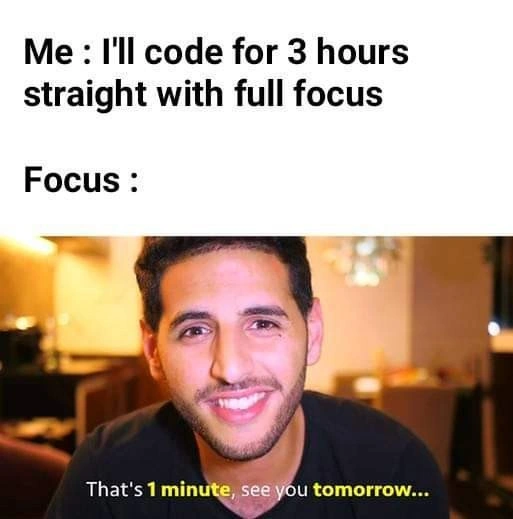
Let’s break down what’s happening in this meme in simpler terms, and explain some of the tech and culture references for those who might not be familiar. The meme has two panels (sections stacked vertically). The top panel is just text on a plain background. It shows a self-motivated statement by a developer: “Me: I'll code for 3 hours straight with full focus.” This means the person (the developer) is telling themselves (or others) that they plan to concentrate and work on coding for three hours without stopping or getting distracted. Three hours is a long stretch for programming continuously, but the person is feeling determined. Full focus implies no checking phones, no browsing Reddit, no side conversations – just pure coding productivity. Essentially, the developer is gearing up for what they hope will be a deep work session, where they’ll be in the zone, writing code efficiently.

Right below that, still in the top panel, it says “Focus:” followed by nothing else in that panel. This sets up an expectation: it’s as if “Focus” (the concept of being concentrated) is a character or another person who is about to respond. This kind of formatting is a common meme setup for dialogues, almost like chat messages or a script. So we have:

  • Me: (followed by my statement of intent)
  • Focus: (as if focus itself is going to reply with its own line)

Now we naturally look to the bottom panel for Focus’s response. The bottom panel is an image of a man in a cozy café-like setting. The man’s face is somewhat blurred (likely for privacy or comedic effect), but you can still recognize he’s smiling and looking at the camera. Across the bottom of this image, there is a subtitle-style text in mixed white and yellow colors that reads: “That’s 1 minute, see you tomorrow...”. This text is presented exactly like a subtitle you’d see in a video, which is no coincidence. It’s actually a direct reference to a popular content creator named Nas Daily. Nas Daily (real name Nuseir Yassin) became famous for creating one-minute-long videos every day on Facebook, and he always ends each video with the catchphrase, “That’s one minute, see you tomorrow!” in text and voice. In fact, the man in the image is Nas (hence the tag nas_daily_reference). So essentially, the meme is borrowing Nas Daily’s signature sign-off line as the “voice” of the developer’s focus.

So, putting it together: Focus’s response to the developer’s grand 3-hour focus plan is Nas’s line: “That’s 1 minute, see you tomorrow.” This implies that the developer’s ability to focus lasted only one minute before it peaced out for the day. It’s as if Focus is saying, “I gave you one minute of concentration, and now I’m done until tomorrow.” The wording “see you tomorrow” suggests that there will be no more focus left for the rest of that day – the developer will have to try again the next day for another chance at concentrating. It’s a humorous exaggeration of those days when you just can’t stay on task.

Let’s define a few terms and ideas here for clarity:

  • Context Switching: In computing, this term describes when a CPU switches from one task (or process/thread) to another. There’s some overhead (time cost) every time it switches because it has to save the state of the old task and load the state of the new task. In human terms, when we talk about context switching for a developer, we mean switching your attention from one thing to another. For example, you’re coding (one context) and then you stop to answer a chat message (second context) and then you go back to coding. Each switch makes you lose a bit of momentum because you have to recall where you left off. The ContextSwitching tag here indicates that the meme is highlighting the pain of such attention shifts – the developer intended not to switch context at all for 3 hours, but in reality they switched (or lost focus) almost immediately.

  • Flow State: Often just called being “in the zone,” this is a term used to describe a mental state where someone is fully immersed and focused on the task at hand, often performing at their best. For a developer, being in flow might mean you’re writing code almost effortlessly, time flies by, and you’re not aware of distractions because you’re so engaged. The tag flow_state_breaks suggests the meme is about how that flow state can be broken. Indeed, in the meme, any chance of entering flow was broken after one minute.

  • Deep Work: This is a concept (and also the title of a popular book) that means working in a state of deep concentration on a challenging task, without distractions. It’s often recommended for tasks like coding. The tag deep_work_fail implies the meme is about failing at deep work – which fits perfectly, since the person tried to do deep work for 3 hours but failed almost immediately.

  • Attention Span: This refers to how long someone can concentrate on something without losing focus. An average adult’s attention span varies, but constant bombardment by technology can shorten it or make continuous focus hard. The meme jokes that this developer’s attention span was basically one minute on that day. The attention_span tag is highlighting that.

  • Nas Daily Reference: As explained, the bottom text is a direct quote of Nas Daily’s famous line. If you didn’t know who that is, you might just interpret it as a random subtitle, but knowing the reference adds another layer (the focus lasted “one daily Nas video long”). It’s a bit of cross-over between developer humor and general internet culture. Nas’s cheerful face saying “see you tomorrow” adds a friendly, but ironically mocking tone to the failure of focus.

  • Three-hour coding sprint: Here “sprint” is used in a general sense, meaning a burst of activity (3 hours of coding in one go). It isn’t referring to a Scrum sprint (which is usually 1-2 weeks of work in Agile methodology). Many developers talk about having a coding sprint as in “I’m going to sprint through this problem,” meaning work intensely for a shorter period. So no Agile meeting here – just an individual’s plan to hustle.

  • Productivity Loss & Time Management: The tags and the scenario point to a common struggle with productivity. The person had a time management plan (3 hours of focused work), but the result was a huge loss of productivity (only 1 minute effectively used). TimeManagement for developers often involves planning such focus blocks, and ProductivityLoss is what happens when those plans go awry due to distractions or lack of focus. This meme resonates because every developer, especially those starting out, quickly learns that managing your time and attention is as important as writing good code. It’s easy to intend to work for hours, but actually doing it without your mind wandering or external interruptions is hard.

Now, why is this meme funny or relatable from a junior developer perspective? It’s basically poking fun at the difference between what we hope to do and what we actually do. Many newcomers to software development (and students, and honestly everyone) experience this: you plan a marathon coding session, perhaps to build your project or finish an assignment. You imagine yourself heroically typing away for hours. But then, maybe you get bored or stuck after a few minutes, and you find yourself checking your phone or going to get a snack. Before you know it, your “marathon” turned into a very short run.

The meme exaggerates this to a comical extreme by saying the focus only lasted one minute. One minute is almost nothing – so it’s a hyperbole (exaggeration for effect). It’s funny because one minute is so far from three hours that it’s absurd, yet on bad days it feels kind of true that our focus disappears that fast. It’s a bit of self-deprecating humor common in DeveloperHumor: we’re laughing at our own inability to do what we set out to do. Developers often feel guilty or frustrated about procrastination and distraction, so making a meme about it helps us feel we’re not alone – it’s a shared joke.

Also, juniors might not immediately get the Nas Daily reference if they haven’t seen those videos, but once it’s explained, the line “That’s 1 minute, see you tomorrow...” is clearly saying “time’s up!”. It gives the meme a unique flair by using that exact wording. For many people active on social media, that line was very recognizable in 2021 (when Nas’s content was trending), so it adds a pop-culture layer to the joke. It’s like the meme is saying even your Focus has become a Youtuber or vlogger that only does a 1-minute video and signs off.

Lastly, from a learning standpoint: this meme indirectly teaches a small lesson about the importance of minimizing interruptions if you want to get serious programming done. Even as a junior, you’ll notice that if you keep switching between coding and other things, you never make real progress. It’s common advice to, for example, close your social media tabs, silence your phone, maybe use the Pomodoro technique (where you focus for 25 minutes, then take a 5-minute break) to train yourself to focus longer. The humor here arises from focus drift – the way your concentration can drift away quickly if you’re not careful. So while laughing, you might also reflect: “Hmm, maybe I should actually try to focus better than this meme character, at least more than one minute!” It’s both a funny and cautionary scenario that almost anyone – not just developers – can relate to (who hasn’t sat down to work or study and then immediately opened YouTube?).

In summary, the meme shows: ambitious plan meets short attention span. The developer’s intention for prolonged focus is subverted by the comedic reality of a vanishing act of concentration. It’s a lighthearted way to say, “Yeah... sometimes our brain just taps out early. Oops.” Every developer, junior or senior, has experienced a day like this, which is why this little joke hits home across the experience spectrum.

Level 3: 60-Second Sprint

Every seasoned engineer reading this meme has likely cringed and chuckled at the same time. It captures a too-real scenario in developer productivity: the vast gulf between our intent vs. reality when it comes to focusing on a task. The top panel sets the stage with the developer’s bold declaration: “Me: I’ll code for 3 hours straight with full focus.” We’ve all been there, armed with coffee, a fresh backlog of tasks, maybe a pomodoro timer or a fresh VS Code session, determined to enter a flow state and crank out features or fix bugs for hours on end. That declaration is basically a personal sprint – not the Agile two-weeks kind, but a promise of uninterrupted deep work. It’s the kind of optimistic time management commitment you make to yourself on a good morning.

Then comes the punchline in the second panel. Under the label “Focus:”, we see the smiling, friendly face of Nuseir Yassin – better known as Nas Daily – delivering his famous sign-off line: “That’s 1 minute, see you tomorrow…” in subtitle-style text. In Nas’s travel and lifestyle videos, that catchphrase is cheerful, but here it’s dripping with irony. Focus itself is personified as Nas, effectively saying to the developer: “Welp, your concentration lasted all of one minute. I’m out. Good luck, try again tomorrow!” The juxtaposition is hilarious because it’s painfully relatable: instead of a three-hour marathon coding session, our focus made just a 60-second cameo appearance and then bowed out like a guest star who only had a contract for one scene.

Why is this so funny to those of us in tech? Because the RelatableDeveloperExperience behind it is ubiquitous. You sit down to work on a complex feature that needs deep concentration. Maybe you even announce to your team or tweet: “Going heads-down now, no distractions for the next few hours!” But then reality intervenes in countless little ways:

  • Five minutes in, an urgent Slack message pops up from a teammate asking about an unrelated bug. You reassure yourself it’s just a quick context switch, but by the time you reply, your flow state is gone.
  • Or perhaps you remember an email you forgot to send, open your inbox “just for a second”, and suddenly you’re skimming other new messages.
  • Sometimes the distraction is self-inflicted: you decide to quickly check an API reference in your browser, but a news notification or a tempting YouTube tab (maybe even a Nas Daily video!) catches your eye. One video leads to another, and there goes your afternoon.
  • Even the simple act of your mind wandering (“Did I defrost something for dinner?” or “What’s the weather tomorrow?”) can break your developer focus almost instantly if you act on it.

In professional terms, this is the bane of deep work. Cal Newport famously wrote about Deep Work – the ability to focus without distraction on a cognitively demanding task – as a skill that’s increasingly rare. This meme comically illustrates a deep_work_fail: the developer intended a deep work session but failed spectacularly, achieving only a shallow dip before the next context switch. The phrase “That’s 1 minute…” encapsulates that failure with a punchy visual reference. It’s as if the concept of focus itself has a sense of humor and said, “Haha, you thought you’d have me for 3 hours? You got 60 seconds. See you tomorrow, good luck!”

From a senior developer’s perspective, this scenario also hints at the broader issue of context switching in our industry. Modern development teams often operate in environments that actively undermine long focus stretches. Open office plans mean random conversations or the ping of someone else’s stand-up can break your concentration. Agile processes, while beneficial in many ways, pepper the week with stand-ups, grooming sessions, and quick syncs – each of which can slice up a day that might have been used for deep coding. There’s a well-known concept in tech circles called the Maker’s Schedule vs Manager’s Schedule (coined by Paul Graham). Developers (makers) need large uninterrupted blocks of time to create (code, design, write), whereas managers operate in hourly blocks with frequent meetings. This meme is basically the Maker’s Schedule gone horribly wrong: the maker tried to schedule a big block, but interruptions forced them into a fragmented schedule akin to a manager or a distracted intern, where even that block got subdivided into tiny pieces.

The mention of “3 hours straight with full focus” is almost aspirational – like a developer’s daydream. In real life, hitting a solid 3-hour flow without a single context switch is rare, almost a fable, especially in a busy workplace. In contrast, a 1-minute focus span is an exaggeration, but it feels real on those chaotic days. We laugh (and maybe cry a little inside) because we’ve all had days where, looking back, we realize we effectively did maybe a minute or two of actual productive coding. The rest was lost to meetings, emails, context switching, or just mental fatigue. It’s a classic DeveloperHumor formula: take a common struggle (maintaining concentration) and push it to an absurd extreme (focus lasted only one minute). The absurdity makes it funny, but the truth embedded in it is what really gets the knowing nods from veteran coders.

There’s also a subtle nod to time management failures here. The developer’s initial statement is like setting a lofty goal – it’s reminiscent of when we say, “Today I won’t procrastinate, I’ll get everything on my list done.” The intentions are good. But effective time management isn’t just about setting aside 3 hours; it’s about guarding those hours against interruption, and that’s the part we often struggle with. The meme implies the developer didn’t guard their focus or perhaps couldn’t. Maybe they left their door open, metaphorically or literally, to interruptions. The result? ProductivityLoss – nearly the entire planned work session went up in smoke. The phrase “see you tomorrow” suggests that the day’s attempt is basically over; better luck the next day. Any developer who has ever thrown up their hands and said, “I’ll just pick this up tomorrow, today’s a wash,” will relate.

Let’s not overlook the Nas Daily reference itself, which is a clever touch. Nas Daily is known for making one-minute videos every day, ending with the catchphrase, “That’s one minute, see you tomorrow!” By invoking this, the meme draws a parallel between a cameo-length coding attempt and Nas’s ultra-short daily content. It’s as if the developer’s grand coding session turned into a Nas Daily episode – short, upbeat, and over before you know it. For a senior dev who’s been around the internet, this reference lands perfectly: it mixes tech culture with broader social media culture. It even hints that maybe the developer got distracted by social media (since Nas’s videos often thrive on Facebook and Instagram). Perhaps our poor coder opened up Facebook “for a second” and one of Nas’s one-minute travel episodes popped up, effectively sidetracking them into watching it. In that interpretation, the subtitle on the meme is almost literal: the developer literally watched a Nas Daily video in that first minute of supposed coding time! A senior engineer will chuckle at how mercilessly accurate that scenario is – how many times have we intended to start coding, only to end up on YouTube or Twitter within moments?

Moreover, this meme pokes fun at the fragility of the flow state for developers. Getting “in the zone” is precious and sometimes elusive. Once you’re knocked out of it (by an interruption or a wandering mind), it can take a significant amount of time to get back in. Studies and anecdotal evidence often claim it can take 15-30 minutes to regain concentration after a context switch. So if you lose focus every few minutes, you might never get back into deep focus at all. The developer’s plight in the meme is an extreme version of this: they never got past the initialization phase. The first context switch at T+60s killed the session entirely. It’s darkly comic – a bit like an athlete claiming they’ll run a marathon, but they trip on the starting line and decide, “Well, that’s it for today.”

In team retrospectives or developer bull sessions, this kind of scenario might be joked about: “Yesterday I planned a big coding marathon, but my brain had other ideas. Total focus time: about a minute.” Everyone laughs, but also empathizes deeply. It highlights the human side of programming: coding isn’t just battling compilers and algorithms; it’s battling your own focus and the constant context switching demands of modern work. Seasoned developers might also see a cautionary tale here: it underscores why practices like turning off notifications, using “Do Not Disturb” modes, or time-boxing tasks (e.g., the Pomodoro technique) exist. Those are attempts to fight back against exactly this problem. The meme doesn’t mention them explicitly, but implicitly it’s a scenario where maybe the coder didn’t use those techniques and paid the price.

Ultimately, the humor lands because it exaggerates a common developer frustration to the point of absurdity. It’s funny because it’s true enough to sting a bit. The next time a senior dev hears a junior proudly declare, “I’m going to lock myself in a room and code all day!”, they might just recall this meme, chuckle, and think, “Let’s see if your focus lasts past that first minute.” It’s a shared understanding: no matter how experienced you are, maintaining concentration is a continual battle, and sometimes even the best of us end up with nothing more than a one-minute sprint in a day full of distractions.

Level 4: Context-Switch Thrashing

In systems theory and computer architecture, performing heavy work in tiny time slices is a recipe for thrashing – and our brains can fall into the same trap. Think of your brain as a CPU core with a limited cache of immediate memory. When you vow to code for three uninterrupted hours, you’re essentially trying to allocate a long time quantum to a single “process” (your coding task). In an ideal scenario, the brain’s “instruction pipeline” fills up with relevant code context, variables stay loaded in your mental L1 cache (working memory), and you achieve a smooth, continuous execution known as the flow state. Three hours of deep focus would let your mental caches warm up, branch predictors (your expectations about code behavior) stabilize, and throughput soar.

However, the meme humorously depicts a situation more like an OS scheduler preempting your task almost immediately. After just 60 seconds of focus, an “interrupt” occurs – perhaps a Slack notification or a stray thought – causing a context switch. What happens in such a context switch? Much like an operating system swapping out a process, your brain must save the state of your work (if it can) and load the state of the distraction. This context switching overhead is costly. The moment you attend to the distraction (even briefly), your mental cache of code context gets invalidated (a cognitive cache miss). Any partially loaded flow gets flushed like a mispredicted branch in a CPU pipeline. By the time you try to return to coding, your brain has to page in all that information again from slower memory (long-term memory or external notes) – a process analogous to re-loading data into cache.

The result is a human version of thrashing: you spend more time switching contexts than executing code. In operating systems, if a scheduler gives a CPU-bound process a time slice that’s too short relative to its context-switch overhead, the CPU wastes cycles saving and restoring state rather than doing useful work. Here, a planned 3-hour coding sprint devolved into a one-minute cameo of concentration because the time slice for focus was effectively cut to virtually nothing. The developer’s focus was preempted so quickly that the cost of starting up (getting into context) wasn’t amortized at all. This echoes real cognitive research: frequent task-switching prevents deep work because the brain spends its energy on task set up and tear down rather than the task itself. There’s even a term in psychology for the leftover attention on a task we’ve left behind: attention residue. It’s as if part of your brain’s thread state is still stuck on the previous task while you attempt the next, degrading performance further.

In summary, the meme’s punchline – “That’s 1 minute, see you tomorrow…” – can be viewed through the lens of system performance. It is exaggerating how a dramatic focus drift after mere moments leads to a near total context collapse. The would-be marathon coding session was sliced into a comically tiny time quantum. The fundamental lesson hiding in the humor is one any kernel engineer or productivity geek knows well: minimize context switches if you want sustained throughput. A developer’s attention span suffers when we treat our brain like a constantly interrupted processor. The meme cleverly uses this extreme scenario (3 hours intent vs 1 minute reality) to highlight the catastrophic context-switching overhead that can occur when we don’t protect our focus time.

// Pseudocode simulation of a developer's focus being preempted by distraction
int plannedMinutes = 180;           // 3 hours intended focus
int focusAchieved = 0;
for(int minute = 1; minute <= plannedMinutes; ++minute) {
    workOnCoding();                // developer is focusing on the code
    if(minute == 1) {              // after 1 minute, an interruption strikes
        openSocialMediaFeed();     // context switch: focus breaks here
        focusAchieved = minute;
        break;                     // focus lost, loop ends early
    }
}
std::cout << "That's " << focusAchieved << " minute, see you tomorrow..." << std::endl;

In the code above, the developer’s plan was to focus for 180 minutes, but a distraction interrupted at minute 1. The program breaks out of the loop, echoing the meme’s subtitle: “That’s 1 minute, see you tomorrow…”. This tongue-in-cheek code snippet mirrors how a single interrupt can end a long-running process almost before it starts. The deeper message resonates: from a systems architecture standpoint, ultra-short focus intervals are incredibly inefficient. Just as a heavily multitasking CPU might spend all its time on context switches and achieve very little actual computation (productivity loss), a developer juggling distractions may find that an entire afternoon yields only a “60-second cameo” of real progress.

Description

The meme is split into two panels. The top panel is plain white with large black text reading, "Me : I'll code for 3 hours straight with full focus" and, on the next line, "Focus :". The bottom panel shows a blurred-out face of a man sitting in a warmly lit café-style setting; yellow fairy lights and soft brown furniture are visible in the background. Across the bottom of this frame, white and yellow subtitle text says, "That's 1 minute, see you tomorrow..." The joke contrasts a developer’s ambitious plan for uninterrupted deep work with the harsh reality of an attention span that evaporates almost immediately, a feeling familiar to engineers fighting context switching and productivity loss

Comments

6
Anonymous ★ Top Pick Booked a 3-hour deep-work slot, but my mental scheduler pre-empted the thread after 60 seconds for a high-priority Slack interrupt - classic context switch where the overhead exceeds the actual compute
  1. Anonymous ★ Top Pick

    Booked a 3-hour deep-work slot, but my mental scheduler pre-empted the thread after 60 seconds for a high-priority Slack interrupt - classic context switch where the overhead exceeds the actual compute

  2. Anonymous

    After 15 years of optimizing distributed systems for millisecond latency, I still can't optimize my own attention span beyond 60 seconds without checking if someone finally responded to my 3-week-old PR comment about proper error handling in the authentication microservice

  3. Anonymous

    Every senior engineer knows the 'three-hour deep focus session' is just a Poisson distribution with λ=0.017 - statistically, you're more likely to achieve consensus in a distributed system than maintain focus past the first minute. The real architectural pattern here isn't microservices, it's micro-attention-spans

  4. Anonymous

    Promised 3-hour flow state: enters like a lock-free queue, exits on first context-switch interrupt

  5. Anonymous

    Plan: three hours of deep work; reality: my focus has a 60-second SLA - Slack fires an interrupt, the kernel preempts the process, and the scheduler reschedules the job for “tomorrow.”

  6. Anonymous

    My calendar says “3h deep work,” but my attention implements a circuit breaker with a 60‑second TTL and retries tomorrow with exponential backoff

Use J and K for navigation