Skip to content
DevMeme
4225 of 7435
OpenAI cautiously debuts DALL·E 2 while DALL·E mini goes off-the-rails
AI ML Post #4614, on Jun 29, 2022 in TG

OpenAI cautiously debuts DALL·E 2 while DALL·E mini goes off-the-rails

Why is this AI ML meme funny?

Level 1: Caution vs Chaos

Imagine you have a magical paintbrush that can paint any picture you describe. One person – let’s call them a careful teacher – has a brush like this. The teacher says, “This brush is really powerful, so only a few of you can use it for now, and only if you draw nice things. No scary or nasty pictures, okay?” The teacher watches the students closely to make sure everyone follows the rules and only draws friendly, safe scenes.

Now, picture that outside the classroom, a playful kid finds another magical paintbrush that’s just as powerful – but with no grown-ups and no rules. What does the kid do? They start drawing the craziest, most shocking pictures they can think of all over the schoolyard walls! There are goofy characters in really serious or horrible scenes, and all sorts of wild images that a teacher would definitely never approve of. For example, the kid draws something silly and awful at the same time, like a cartoon character in the middle of a disaster scene. Other kids gather around laughing and gasping, because they’ve never seen anything like it.

Soon, the careful teacher hears the commotion and comes outside… only to see these outrageous drawings everywhere. Imagine the teacher’s face: total shock and disappointment, because this is exactly what they didn’t want to happen. The teacher had been so cautious, letting only a couple of kids use the brush under supervision, and insisting on clean art. But meanwhile, that other unsupervised kid with the second brush has gone full chaos mode, showing everyone all the things the teacher was trying to prevent.

It’s funny in a way, right? The person who was trying to keep the magic paintbrush under control now has to witness the mayhem caused by an uncontrolled one. The careful plan got upended by pure chaos. This meme is just like that: OpenAI is the careful teacher with their powerful AI tool (DALL-E 2), and DALL-E mini is the unsupervised kid doing wacky, inappropriate stuff with a similar tool. We find it humorous because it shows how hard it is to keep exciting technology contained – just when you think you’ve got it under wraps, someone else lets it loose and things get crazy (and colorful) in a hurry.

Level 2: Tame vs Untamed AI

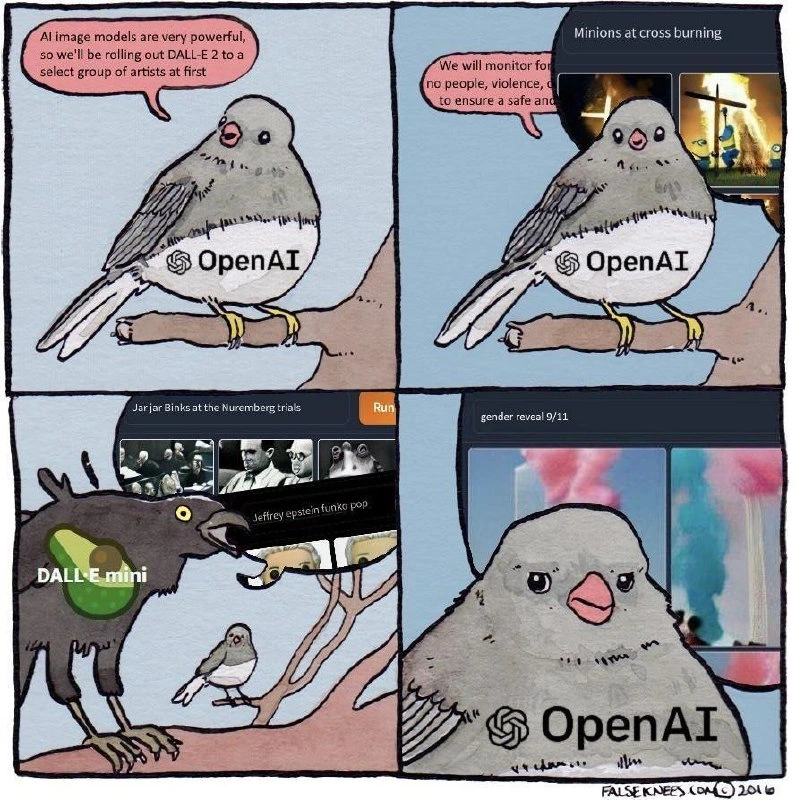
This meme is about two AI programs that both create images from text, but one is carefully controlled and the other is completely wild. The first is DALL·E 2, a cutting-edge image generator made by OpenAI. The second is DALL·E mini, a simpler, unofficial copy that anyone could use online. The small grey bird with the OpenAI logo represents DALL-E 2 (and OpenAI’s approach), while the big black crow represents DALL-E mini (the anything-goes approach). Let’s break down what each one is and what’s happening:

  • DALL·E 2 (OpenAI’s model): This is a very powerful AI that can create pictures based on written prompts. For example, if you typed “a dragon flying over New York City in watercolor,” DALL-E 2 would try to draw that. Because it’s so powerful, OpenAI was very careful about how they let people use it. In early 2022, only a select group of artists and testers could access it. OpenAI also put strict content moderation rules in place to keep the AI outputs “tame.” They didn’t want to accidentally generate something violent, sexually explicit, or harmful. The OpenAI bird in the comic talks about monitoring for “no people, violence…” which reflects these rules. In practice, OpenAI’s model safety policies for DALL-E 2 included things like: no realistic photos of real people (to prevent deepfake images), no violence or gore, no hate symbols or extremist content, no nudity or sexually explicit content, etc. If you tried a disallowed prompt, DALL-E 2 would refuse and say it can’t draw that. This approach is like putting the AI in a guided sandbox: it’s allowed to make amazing art, but with boundaries. The OpenAI bird speaks formally and cautiously in the meme because it’s conveying this responsible tone.

  • DALL·E mini (Craiyon): This was the “wild” version. Despite the similar name, DALL-E mini wasn’t made by OpenAI at all. It was an open-source project created by some independent developers, basically as a small-scale imitation of DALL-E. They later renamed it “Craiyon” to avoid confusion, but initially everyone called it DALL-E mini. It was available as a simple web app that anyone could use for free. You’d go to the site, type in a prompt, and it would generate a 3x3 grid of images for you. Importantly, DALL-E mini had minimal filtering. There were few, if any, prompt restrictions built into the demo. The creators added a warning about possible offensive content, but the model would try to draw pretty much anything you asked. However, because it wasn’t as advanced, the images often came out looking a bit crude or distorted (sometimes that made them even funnier). The big crow in the comic barging in with the label “DALL·E mini” embodies this unruly, unfiltered AI. It interrupts the OpenAI bird with a chaotic demonstration of what it can do – essentially saying, “Look, no rules here! Check this out!”

So what are those examples on the crow’s screen? They’re some of the edgy prompt examples that people actually tried with the open model, which became notorious online:

  • "Minions at cross burning" – This prompt asks for a mashup of the cute, silly Minions (little yellow cartoon characters from the Despicable Me movies) with an extremely hateful act (a Ku Klux Klan cross burning). This is a shocking combination. OpenAI’s DALL-E 2 would never allow a user to generate such an image because it violates multiple rules (hate symbolism, violence involving a protected group, etc.). But DALL-E mini, being unfiltered, did produce an image. The result was as awful as you’d expect: it showed cartoonish yellow minion-like figures in a dark scene with a burning cross. The mere fact that an AI would draw that is both horrifying and a bit surreal. This example set the tone for how far off-track an unregulated AI could go.

  • "Jar Jar Binks at the Nuremberg trials" – Jar Jar Binks is a goofy, clumsy character from Star Wars. The Nuremberg trials were the serious military tribunals after WWII where Nazi war criminals were tried. This prompt is basically dark humor: inserting a ridiculous sci-fi character into one of the gravest events in modern history. It’s the kind of absurd scenario people online come up with to test an AI. DALL-E mini’s attempt at this prompt resulted in grainy, unsettling images of a caricatured Jar Jar figure standing in what looked like an old courtroom with stern-looking people around (the tribunal). It’s very absurd and definitely something that wouldn’t pass a content policy if one were in place. Again, OpenAI’s model would have flagged terms like “Nuremberg trials” as sensitive (or at least the image of Nazi officials in a courtroom), but DALL-E mini just went for it.

  • "Jeffrey Epstein funko pop" – Jeffrey Epstein was a real person who committed terrible crimes, and his name is highly controversial. A Funko Pop is a line of cute collectible toy figures usually made for beloved characters or celebrities. This prompt asks the AI to create a cutesy toy version of a very not-family-friendly figure. It’s an intentionally tasteless prompt to see if the AI would do it. The open model did attempt it: the images were blob-like cartoon toys vaguely resembling Epstein’s face. It’s a prime example of the AI lacking any moral compass – it doesn’t know that making a toy of a criminal is in poor taste, it just knows “Jeffrey Epstein = a face” and “Funko pop = big-headed toy,” and tries to mix them. Any moderated system would block using such a person’s likeness in a frivolous context. DALL-E mini had nothing stopping it, so it produced a result (likely to the equal parts amusement and dismay of the person who tried it).

  • "gender reveal 9/11" – This one is especially provocative. It mixes the concept of a “gender reveal party” (where parents reveal a baby’s gender often with colored smoke or explosions of pink or blue) with the 9/11 terrorist attack (the destruction of the Twin Towers on September 11, 2001). Essentially, it’s asking, “What if the Twin Towers emitted pink and blue smoke as a way of ‘revealing’ a baby’s gender?” – a horrific and absurd idea. This is an extreme example of internet shock humor. Unsurprisingly, DALL-E mini’s output was an eerie image of the Twin Towers with one tower emitting pinkish smoke and the other blue smoke. Many people found this output jaw-dropping and not in a good way: it’s the kind of image that really makes you realize how an AI will just follow instructions without understanding the gravity of them. This would be absolutely disallowed on OpenAI’s platform (they have rules against references to tragic events, violence, etc.). The meme shows the OpenAI bird’s disgusted face right next to this output, highlighting just how wrong this content is, and by extension, how important those missing filters were.

In summary, the meme is depicting the showdown between a filtered AI and an unfiltered AI. The small OpenAI bird is the filtered, tame approach: only select users, lots of rules, trying to be socially responsible. The big crow is the untamed approach: open to everyone, no real rules, and as a result, producing some really off-the-rails images. The humor and message of the meme come from the contrast:

  • OpenAI’s side: “We have this amazing tech, but we have to be careful and slow. Please follow the rules, everyone.” (Strict teacher vibe.)
  • DALL-E mini’s side: “Look at all this crazy stuff I can do! No one’s stopping me!” (Wild child vibe.)

The poor OpenAI bird is left speechless and mortified because everything it was trying to prevent is happening anyway via the alternative model. This strikes a chord with developers because it shows how, in tech, you can try to carefully control something powerful, but an uncontrolled version might pop up and cause a scene. And in 2022, that’s exactly what happened: while OpenAI was carefully rolling out DALL-E 2 with content safeguards, the whole internet was fascinated with DALL-E mini’s raw, chaotic outputs. It’s a bit like a tale of two approaches in AI rollout: one tame and curated, one wild and free. And as this meme humorously captures, the wild version created a lot of buzz (and mess) that the tame version was trying to avoid.

To really highlight the differences, here’s a quick comparison:

Aspect OpenAI DALL·E 2 (official, filtered) DALL·E mini (open-source, unfiltered)
Access Limited beta release (only invited artists/testers) Public web demo (anyone can try it)
Moderation Strict filters on prompts and outputs (no violence, no hate, no real people, etc.) Little to no filtering (almost any prompt goes)
Output Quality High-quality, often realistic images (better at details and art style) Lower quality, often weird or distorted images (faces looked creepy, etc.)
Intended Use Serious creative projects, art, design (with oversight) Just-for-fun experimentation, memes, shock-factor sharing
Example Prompt “A cat playing a violin in the style of Van Gogh” (wholesome and allowed) “Jar Jar Binks at the Nuremberg trials” (absurd and would have been blocked on DALL-E 2)
Reactions “This is impressive – let’s be careful with it.” “OMG 😂 you have to see what crazy image I made with this thing!”

By looking at this, it’s clear why the OpenAI bird in the meme looks so done-with-it by the end. One side was all about safety and control, and the other side just went full no-rules chaos. The developer community found this scenario both humorous and insightful, which is why the meme became popular. It’s teaching us that with AI (and tech in general), if you don’t want something crazy to happen, chances are someone out there will do it anyway once they have the tool.

Level 3: Walled Garden vs Wild West

For seasoned developers and AI practitioners, this meme encapsulates a familiar showdown: the carefully walled garden approach of a big tech release versus the wild west of open-source experimentation. The small grey bird with the OpenAI logo represents the corporate, polished voice of OpenAI announcing the debut of DALL·E 2 in a controlled manner. In the first panel, it says something along the lines of, “AI image models are very powerful, so we’re rolling out DALL-E 2 to a select group of artists at first.” This is exactly what happened in reality — OpenAI invited a limited beta group and emphasized a safe release strategy. Experienced folks recognize this pattern: when you have a groundbreaking but potentially problematic technology, you stage the release, put up access gates, and put strict usage policies in place. It’s the AI equivalent of a soft launch with a lot of fine print. The bird continues, “We will monitor for no people, violence, … to ensure a safe and–” which directly echoes OpenAI’s content rules (they indeed disallowed generating images of real people, violence, hate, and other categories of misuse). In other words, OpenAI is the conscientious gatekeeper here, trying to preempt the very AIEthicsConcerns that everyone in the field has been talking about. Senior engineers have sat through those meetings: “How could our tool be abused? Let’s put guardrails and only let trusted users in first.” It’s cautious, it’s responsible, and yes, it’s a bit corporate. We nod along because we know why they do it — nobody wants a repeat of the Tay chatbot fiasco or an AI that generates something newsworthy for the wrong reasons.

Then comes panel 2 spilling into 3: enter the chaos. A large black crow labeled DALL·E mini literally crashes into the scene. This crow is holding up a screen that displays a gallery of what can best be described as AI’s id run wild. To an experienced dev, this moment is chef’s kiss — it represents the open-source community or just the uncaged internet doing what it does best: pushing tech to its unruly extremes. While the OpenAI bird was still mid-sentence about ensuring things stay “safe and…”, the crow has already generated something titled “Minions at cross burning” right in front of everyone. It’s a perfect metaphorical interruption: the controlled PR narrative is photobombed by a shocking prompt_engineering_misuse example. We find it funny because it’s exactly what happens in real life: a company carefully curates a narrative, and then reality (or the community) barges in with “Actually, look at THIS!”

Seeing those prompt examples, any developer familiar with the 2022 AI zeitgeist will remember the Twitter threads and Reddit posts. DALL·E mini outputs became a meme genre of their own. They were creepy, absurd, often unintentionally hilarious or disturbing – a form of AI humor born from a neural network’s unfiltered imagination. The prompts listed in the meme – Jar Jar Binks at the Nuremberg trials, Jeffrey Epstein funko pop, gender reveal 9/11 – were actual requests people made just to test how far an unregulated model would go. And it went there, producing visuals for each. It’s the kind of thing that makes an AI engineer both laugh and cringe simultaneously. We laugh because it’s such a caricature of AIHype gone awry: give people a little generative power and they conjure the most cursed, surreal scenarios possible. We cringe because we know these are precisely the AI ethics concerns and AI limitations we worry about: bias, harm, shock value, and context collapse all rolled into some pixels. The meme nails this duality. The tiny OpenAI bird at the bottom of panel 3, dwarfed by the crow’s presence, visually conveys how the narrative slipped out of OpenAI’s control. No matter how many safety speeches you give, once a mini-version of your model is out in the wild, the wild will do its thing.

For a senior dev, there’s also an element of “I’ve seen this movie before.” It’s reminiscent of earlier incidents in tech:

  • When OpenAI held back GPT-2 (calling it "too dangerous to release" at full size) and not long after, other researchers unveiled their own large text models or GPT-2 weights leaked – proving that the genie doesn’t stay in the bottle for long.
  • When Microsoft launched the Tay chatbot on Twitter without enough moderation and it got prompt-engineered by trolls into spewing garbage within hours. The lesson? If you don’t build the guardrails, the internet will drive your creation off a cliff.
  • Even the rise of Stable Diffusion (just a couple of months after this meme’s date) followed a similar pattern: an open-source image model was released to the public with relatively light restrictions, and immediately people found ways to create not-safe-for-work or controversial images that closed models like DALL-E 2 were holding back.

So the meme resonates as a commentary on the tension between closed, moderated AI services and open, unfiltered AI tools. “Walled Garden vs Wild West” is a well-known dichotomy. Here, OpenAI’s approach is the walled garden: controlled access, guided usage, heavy pruning of what’s allowed. DALL-E mini represents the Wild West ethos: throw it out there, see what people do, maybe put a disclaimer and a content warning, but essentially let users ride free. The imagery of the polite little bird versus the unruly crow is spot on. Crows are loud, unpredictable, and a bit ominous – just like the torrent of bizarre images DALL-E mini unleashed. The small bird’s expression in the final panel (next to that “gender reveal 9/11” image) is priceless: it’s a mix of shock, disapproval, and a touch of I can’t believe this is happening. Plenty of us in the field imagine that’s how the team at OpenAI felt seeing the public hype suddenly focus on a rogue, unaffiliated model producing exactly the kind of content they were trying to prevent. It’s humorous because OpenAI’s careful messaging was effectively derailed by a meme-worthy reality.

There’s also nuance in the humor: it’s not just making fun of OpenAI, it’s poking at the whole situation. One one hand, you have a company essentially saying, “Don’t worry, we’ve sandboxed this powerful tech for safety.” On the other hand, you have the open-source crowd (and internet at large) saying, “Look, we made a crappy but uncensored version and it’s hilarious/terrifying!” Veteran developers might chuckle at the inevitability of it. It’s like telling users “You can’t do X” – inevitably, someone replies “Hold my beer, I’ll do it anyway.” DALL-E mini was essentially the “hold my beer” answer to OpenAI’s cautious stance. The meme captures this by literally cutting off the OpenAI bird’s speech with a pop-up of “Minions at cross burning” – the timing is comedic and telling.

From a senior perspective, the meme also highlights the scale of challenge in model_safety_policies. OpenAI’s bird is trying to list everything they’ll monitor: “no people, no violence, …” – an experienced dev knows that list is endless. You can’t enumerate every bad case. The internet’s collective creativity will always find a combination of concepts that isn’t explicitly on the banned list but is shockingly undesirable (prompt engineering abuse at its finest). The examples given were beyond what any policy would explicitly list, yet clearly problematic. It underlines an ongoing truth in our industry: prompt engineering isn’t always used for good; people will intentionally try to break the model or make it produce outrageous outputs. The meme’s edgy prompts are instances of prompt_engineering_misuse – using the system’s flexibility to generate content way outside the bounds of propriety.

Finally, the choice of using a False Knees comic format (recognizable by those little birds with conversational bubbles, originally drawn by artist Joshua Barkman) adds an extra layer for those familiar. False Knees comics often feature birds speaking in gentle, contemplative tones about serious or absurd things. By co-opting that style, the meme sets up a soft, wholesome expectation (a cute bird discussing AI art) only to juxtapose it with a big crazy crow and extremely dark, absurd content on screen. It’s an intentional clash of tones: the earnest tone of OpenAI’s safety talk versus the absurd reality of the unfiltered model. For industry folks, it’s a witty visualization of what we all know: no matter how “pastel watercolor” and mild you try to make your messaging, technology in the real world can take a hard left turn into chaos when unleashed. And as OpenAI (the bird) found out, the open_source_ai_tools out there can steal the thunder – and also demonstrate exactly why the guardrails were needed, all in one fell swoop. The community finds this amusing because it’s both a cautionary tale and a bit of schadenfreude: the contrast between ideal rollout and actual use could not be more stark, and seeing it play out with cartoon birds and crazy prompts is a perfect geek allegory for AI in 2022.

Level 4: Ungoverned Latent Space

DALL·E 2 and DALL·E mini are both text-to-image generative models built on large neural networks. They work a bit like LLMs (Large Language Models) but for pictures: trained on massive datasets of image-caption pairs, they learn to connect words to visual concepts in a high-dimensional latent space. In this latent space, there are no built-in morals or common sense constraints. The model doesn’t “realize” that mixing a cartoon character with a horrific historical event might be off-limits – it simply sees a valid combination of patterns. OpenAI’s cautious rollout of DALL·E 2 is essentially an attempt to tackle the alignment problem for image generation: they want the model’s outputs to align with human ethical norms. But true alignment is notoriously difficult. These neural nets are value-agnostic function approximators; they’ll merrily produce an image of a cross burning with Minions or Jar Jar Binks in a war crimes trial if that’s what the input statistically calls for. The network has no concept of “should I do this?” – it only knows how to do it if asked.

To impose human rules on such a system, OpenAI had to bolt on content moderation and safety layers around the model. For DALL·E 2, this meant a combination of technical and policy measures:

  • Filtered training data: OpenAI curated the dataset to exclude certain images (e.g. extreme gore, pornographic content, identifiable real people) so the model would be less likely to learn to generate those.
  • Prompt filtering: The system would refuse prompts containing obviously disallowed terms (e.g. sexual violence, hate symbols, names of public figures) – similar to how a chat filter might block banned words.
  • Output detection: Even if a prompt slips through, an automated check (another AI classifier) scans the generated image. If it detects something like realistic human faces, blood, or recognizable logos, it can flag or suppress the output.
  • Human oversight: In the limited beta, human moderators (and the invite-only users themselves) reported problematic outputs. This feedback loop helped refine the model safety policies over time.

Despite all this, aligning such a model is a cat-and-mouse game. The space of possible prompts is infinite, and people find creative ways to bypass rules. For example, even if “violent riot” were blocked, a user could try “angry crowd with pitchforks and torches” to sneak past lexical filters – a classic content_moderation_bypass. The underlying generative model, if it has seen those concepts in training, can still produce them. Fundamentally, the model’s knowledge of the world isn’t separable into “allowed” and “disallowed” compartments unless you explicitly draw those lines. This is a key insight of the AI alignment field: powerful models will follow their training and inputs wherever they lead, unless we painstakingly constrain them.

Interestingly, OpenAI’s DALL·E 2 uses a two-part architecture with a diffusion prior and a decoder guided by CLIP (a powerful image-text representation model). CLIP provides a kind of semantic compass: it scores how well an image matches the prompt. However, CLIP itself doesn’t understand context or consequence – it only knows similarity. Thus, if the prompt is something bizarre or sensitive, as long as the output matches that bizarre request, the system is satisfied. The meme’s example “gender reveal 9/11” is a case in point: the model sees references to colored smoke, skyscrapers, and an explosion; none of these individually are “illegal” for the model to draw. In an ungoverned latent space, mixing them is just a matter of blending features – the model has no concept that this combination is horrifying to us. The edgy_prompt_examples in the meme highlight how the latent space allows for surreal, unconstrained combinations of concepts.

By contrast, DALL·E mini (an open-source project later renamed Craiyon) was built with a philosophy of openness and experimentation. It was a smaller model, roughly imitating the original DALL·E (1) architecture. Its outputs were lower fidelity and often had that dreamlike, distorted quality – artifacts of a less advanced neural net with limited resolution. Technically, DALL·E mini likely used a transformer or diffusion model with far fewer parameters and was trained on a publicly available dataset without stringent filtering. The open model also relied on a version of CLIP to guide it, but crucially it lacked the intensive alignment and safety training that DALL·E 2 had. The result? The entire latent space of that model was laid bare for users to explore, the beautiful and the grotesque alike. Anyone could summon AIGeneratedContent at will, with zero oversight. From a theoretical standpoint, DALL·E mini became a spontaneous experiment in the emergent behavior of generative models: when unleashed to millions of users, they will probe every corner case. And unsurprisingly, the AIHype around these new image models quickly met the reality of AILimitations – namely, that without governance, the outputs can and will go off-the-rails into morally and socially fraught territory. In essence, the meme humorously illustrates an important principle of advanced AI systems: power and control are separate variables. You can dial up power (like DALL·E’s incredible image generation ability), but maintaining control (keeping the outputs aligned with ethical norms) is a whole other challenge when the system is open-ended.

Description

Four-panel comic in pastel watercolor style: 1) A small grey bird perched on a branch, chest branded with the OpenAI logo, says in a speech bubble: “AI image models are very powerful, so we’ll be rolling out DALL-E 2 to a select group of artists at first.” 2) Same bird continues: “We will monitor for no people, violence, … to ensure a safe and - ” but the panel is overlaid by a dark UI window titled “Minions at cross burning” showing a flaming cross and a Minion, shocking the bird. 3) A large black crow labelled “DALL·E mini” barges in, holding a screen that lists bizarre prompts such as “Jar jar Binks at the Nuremberg trials” and “Jeffrey epstein funko pop,” while the tiny OpenAI bird looks overwhelmed below. 4) Close-up of the OpenAI bird’s displeased face beside another UI card reading “gender reveal 9/11” with pink and blue smoke rising from twin towers. Visually, the meme contrasts OpenAI’s controlled, limited DALL-E 2 rollout with the unfiltered chaos produced by the open DALL-E mini model, highlighting content-moderation challenges, ethical concerns, and the limits of AI governance in generative image systems
Comments

6
Anonymous ★ Top Pick DALL·E 2 feels like the microservice locked behind five layers of RBAC and an ethics review, while DALL·E mini is the forgotten bash script running as root that’s been piping /dev/random straight into prod since Friday
  1. Anonymous ★ Top Pick

    DALL·E 2 feels like the microservice locked behind five layers of RBAC and an ethics review, while DALL·E mini is the forgotten bash script running as root that’s been piping /dev/random straight into prod since Friday

  2. Anonymous

    Building enterprise-grade content moderation is like being the only parent at the playground who brought organic snacks while everyone else's kids are already mainlining pixie sticks from the guy in the van labeled 'DALL-E mini'

  3. Anonymous

    OpenAI's carefully orchestrated DALL-E 2 waitlist strategy - complete with artist vetting and safety guardrails - lasted about as long as it took the community to spin up DALL-E mini and collectively discover that 'content moderation at scale' is the distributed systems problem nobody wants to solve. Turns out when you announce revolutionary technology but gate it behind a velvet rope, the internet doesn't wait for your ethics review board - it just forks your research paper and ships it with a 'Run' button. Classic case of 'move fast and break things' meeting 'move carefully and watch someone else break things faster.'

  4. Anonymous

    That’s the alignment tax in practice: the closed beta ships with Trust & Safety middleware, the open clone yanks the middleware and turns your abuse-cases into performance benchmarks

  5. Anonymous

    AI guardrails in practice: gate DALL·E 2; DALL·E‑mini becomes the internet’s chaos monkey and turns your content policy into failing unit tests

  6. Anonymous

    Safety classifier nailed 100% recall on 'minors + Burning Man' - precision? Let's just say false positives are the new feature

Use J and K for navigation