Skip to content
DevMeme
4224 of 7435
In 2050 AWS has 1.5M services and I'm still writing Bash
AWS Post #4615, on Jun 29, 2022 in TG

In 2050 AWS has 1.5M services and I'm still writing Bash

Why is this AWS meme funny?

Level 1: Some Things Never Change

Imagine it’s the year 2050 and everything has become ridiculously exaggerated. Picture a toy store that now has 1.5 million different toys on its shelves – so many that you’d get lost just trying to pick one! Then, think of your favorite game or app; what if the company that makes it suddenly decided to stop all their games and apps completely? Sounds crazy, right? Now, suppose a popular video game series is on version 1,3120 – meaning they’ve updated it over a thousand times; even the version number is huge and silly. And maybe the computers everyone uses run on a new fancy system written in a super modern language, but weirdly they named it after the old rival system just to confuse everyone. Even everyday things got over-the-top: imagine your average smartphone or tablet now is as heavy as a car because it’s so bloated with stuff! This future world is wild and kind of funny because everything that used to be simple has become comically complicated or extreme.

But here’s the punchline: even in this wild future, one thing stays the same – the person in the story is still using a simple, trusty tool they’ve used for years. It’s like after describing all that crazy future stuff, they say, “...and I’m still just writing with my old pencil.” 😃 In the meme, that “old pencil” is writing Bash scripts (a basic way to tell computers what to do, kind of like giving instructions). In simpler terms, it means that no matter how much the high-tech world changes, the basic little things we rely on can remain unchanged.

The reason this is funny (and a bit comforting) is that it shows a big contrast. On one hand, everything around has changed in absurd, over-the-top ways. On the other hand, the protagonist is basically doing the same old thing they’ve always done. It’s like saying: “Wow, the future is crazy! But you know what? I’m still here doing my same old job with the same old tools.” That contrast makes us smile. It reminds us of the saying, “the more things change, the more they stay the same.” Even in a future that seems completely bonkers, some things – especially the simple, reliable things – never change. And that little truth is the heart of the joke. 😊

Level 2: The More Things Change

Let’s translate this meme for those not as steeped in cloud jargon. It lists a bunch of futuristic statements, each referencing a tech idea. Here’s what each one means in plain terms, and why it’s humorous:

  • AWS having 1,500,000 services: AWS stands for Amazon Web Services – that’s Amazon’s giant cloud platform that offers computing resources over the internet. A “service” in AWS is basically a specific tool or offering, like storage, databases, AI tools, etc. (for example, Amazon S3 is a storage service, Amazon EC2 is a virtual server service). As of today, AWS has a lot of services (hundreds!), and it introduces new ones frequently. This can be hard even for professionals to keep track of. The meme jokes that in the year 2050, AWS will have 1.5 million services. That number is intentionally outrageous – imagine a menu with 1.5 million options! The humor highlights how AWS’s habit of constantly adding services could get out of hand. It’s like saying, “Amazon keeps making more and more tools, and by 2050 it’s just ridiculously too many.” This is funny to cloud developers because even now they sometimes feel overwhelmed by just a few hundred choices – 1.5 million is poking fun at that feeling of cloud overload. (This concept of uncontrollably growing cloud offerings is often jokingly referred to as cloud sprawl.)

  • Google discontinued ALL its services: We all know Google – they provide services like Gmail, Google Maps, YouTube, Google Search, etc. Google also often experiments with new apps and projects, and not all of them last. In fact, Google has a bit of a reputation for shutting down services that aren’t hugely successful or that run their course. Examples: Google+ (their social network) was discontinued, Google Reader (a beloved news reader app) was shut down, and many others have been axed over the years. There’s even a website called the “Google Graveyard” tracking discontinued Google products. So tech folks joke that you can’t get too attached to a new Google app because it might be gone in a couple of years. The meme exaggerates this by saying that by 2050 Google has discontinued ALL its services – meaning everything, possibly even Gmail, Search, etc., is gone. Of course, that’s extremely unlikely (Google’s core services are hugely important), so it’s meant as sarcasm. It’s highlighting Google’s trigger-happy shutdown culture in a dramatic way. The idea of Google turning off every service is absurd – that’s why it’s funny. It taps into the slight paranoia developers have: “Will the Google service I rely on stick around?” By 2050, in this joke, the answer was “nope, they killed everything.”

  • Kubernetes is version 1.3120: Kubernetes (pronounced “koo-ber-net-ees”, often shortened to K8s) is a popular system for managing containers (we’ll explain containers soon). Think of Kubernetes as a control room that helps deploy and run applications packaged in containers across lots of computers. It’s very widely used in modern cloud computing because it makes running large applications (composed of many small pieces) easier to automate. Kubernetes is versioned like software, usually in the format “1.x”, with the “x” increasing when new updates come out. For example, around 2021 Kubernetes was version 1.21 or 1.22. They release new versions quite frequently (every few months). The meme says Kubernetes is version 1.3120 in the year 2050. That implies there have been 3,120 minor version updates under the major version 1. That number is ridiculously high – way beyond a realistic count! For context, if Kubernetes released ~4 versions a year, by 2050 (which is ~30 years from 2021) it might be around version 1.140 or so, not 1.3120. So what’s the joke? It’s exaggerating the idea that Kubernetes just kept updating continuously without ever calling any release “Kubernetes 2.0”. It’s a playful way to say “Kubernetes changed a ton (3120 updates!) but somehow never changed its first digit.” This is funny to insiders because major version “1” lasting that long is unlikely; usually, at some point, software would declare a new major version. So this paints a silly picture of Kubernetes developers stubbornly sticking to 1.x for decades.

  • Go is version 1.3120 (coincidentally): Go (often called GoLang) is a programming language created at Google. It’s actually the language Kubernetes is written in. Go had its first major release as Go 1.0 and then subsequently has had releases 1.1, 1.2, 1.3, and so on (at the time of 2021, it was around Go 1.17). The meme says Go is version 1.3120 in 2050, the exact same number as Kubernetes. The word “Coincidentally” in the tweet suggests it’s tongue-in-cheek that both ended up with that same version figure. Why would they match? Possibly as a joke because Kubernetes depends on Go – so if Kubernetes kept getting updates, Go must have too. In reality, it’s too coincidental to be real; it’s part of the humor. It implies that Go also never had a major version 2.0 and just incremented its minor version to keep pace, reaching the same crazy count. For a junior developer: basically, imagine two pieces of tech – one is a tool (Kubernetes) and one is the programming language it’s built in (Go). The meme jokes that both have been updated an absurd number of times (13120 times!) and amusingly share the same version number, hinting that they evolved together. It’s funny because that kind of precise alignment doesn’t happen in real life and the numbers are intentionally extreme to emphasize continuous change. It also slyly references how both Kubernetes and Go have, so far, avoided bumping their major version (staying in “1.x” series), so it’s poking at that tendency stretched over 30 years.

  • Linux is written in Rust and it’s called Windows: This one is a double-joke, so let’s unpack it. Linux here refers to the Linux kernel, which is the core part of the Linux operating system (the software that talks directly to hardware and manages resources). Traditionally, the Linux kernel is written in the C programming language (with some bits of assembly). Rust is a newer programming language that a lot of developers love because it helps prevent common bugs and security issues (thanks to something called a “borrow checker” that manages memory safely). By 2021, there were discussions and early experiments to allow writing parts of the Linux kernel in Rust (to make the OS more secure and stable). So when the meme says “Linux is written in Rust,” it means that by 2050 they’ve rewritten the Linux OS kernel using the Rust language instead of C. That’s a pretty drastic change! For many tech folks, that idea is exciting (Rust’s safety in an OS) but also huge (Linux has millions of lines of C code). Now, the second part: “and it’s called Windows.” Windows is Microsoft’s operating system – historically seen as the rival or opposite of Linux. Linux is open-source (anyone can see and modify the code) and often used by developers and servers, whereas Windows is closed-source and commercial, dominant on desktops. Saying Linux is now called Windows is a playful absurdity. It suggests that in 2050, maybe the two worlds merged or something bizarre happened like Microsoft took over Linux or Linux became mainstream under the Windows name. It’s like saying up is down and cats are now called dogs – very silly on purpose.

    To a newcomer: think of it this way — suppose there’s a famous recipe that’s always been made with a certain ingredient (like a traditional cake made with flour), and there’s a new ingredient people love (like a gluten-free flour) and they remake the whole cake with that. That’s “Linux is written in Rust” (remaking the OS with a new language). Now imagine after doing that, they also decided to rename this cake “Pie” which is actually the name of its long-time competitor dessert. Confusing but played for laughs. The humor comes from the sheer craziness of that scenario. Techies find it funny because it mixes two long-time competitors into one confusing statement, hinting at how much things might change or how alliances might shift by then. It’s also gently mocking the trend of rewriting everything in Rust (some folks jokingly suggest replacing all old code with Rust because it’s safer – here they went as far as the kernel) and the fact that Microsoft has been embracing Linux lately (so maybe in 2050 they’d go so far as to slap the Windows brand on it). It’s a wild, head-spinning idea meant to get a “haha, what did I just read?!” reaction.

  • The average container is 5.4 TB: Let’s clarify containers. In tech, a container is like a little package that has an application and everything it needs to run (libraries, dependencies, etc.), isolated from other applications. Containers are great because they let developers say “it runs on my machine and it will run the same way anywhere.” They’re usually much smaller than full virtual machines because they can share the host system’s kernel and don’t need a full OS inside each one. Typically, a container image might be a few hundred megabytes, maybe a few gigabytes if it’s large. 5.4 TB (terabytes) is 5,400 gigabytes, which is incredibly large – that’s the size of whole databases or thousands of HD movies! The meme claims by 2050 an average container is that huge. This is a joke about bloat – how software containers, despite intentions to be slim, sometimes grow larger and larger with extra stuff. To someone newer: imagine you had a bento box for lunch that’s supposed to be a small, self-contained meal. Now imagine over time people keep adding more and more snacks and items to the box until by 2050 the “bento box” is the size of a shipping container 😅. That’s basically what they’re saying about software containers. It’s funny because it’s the opposite of what containers are meant to be (lightweight and efficient). It’s an exaggeration that says, “if we keep packing things in, in 30 years our ‘lightweight packages’ will be ludicrously large.” Developers laugh (maybe a bit ruefully) at this because it satirizes a real problem: we sometimes include half of an operating system and every dependency under the sun in a container image just to run one app, leading to multi-gigabyte images. 5.4 TB is taking that problem to a cartoonish extreme.

  • “I still write Bash for a living”: Bash is a very common shell scripting language on Linux/Unix systems. It’s basically writing sequences of commands in a text file (a script) that the computer can execute to automate tasks. Bash has been around since the late 1980s and is considered a fundamental tool — not fancy or new, but extremely useful for quick automation, gluing systems together, and running routine tasks. When the meme’s author says “I still write Bash for a living,” they mean that in spite of all the crazy advancements and changes listed above, they’re still using the same old scripting language to do their day-to-day job tasks. For context, many new programming languages, DevOps tools, and automation platforms have appeared over the years (Python, Go, Terraform, you name it), but Bash remains a kind of universal glue in the tech world. A lot of build scripts, deploy scripts, and quick fixes are done with Bash because every Linux system has it and it’s quick to use for simple tasks. The humor here is the contrast: everything else in this future scenario sounds so futuristic or drastically changed (massive cloud services, insane version numbers, rewritten operating systems), but this one thing – Bash scripting – is unchanged and still part of the job. It’s like a punchline that grounds the joke in reality: after imagining flying cars and cities under the sea, the person says “...and I’m still driving my old bicycle.” It highlights that no matter how much technology evolves, some basic tools persist. For many developers, this line is very relatable and funny because even today, with all the fancy tech around, they often find themselves fixing something with a little Bash script. It’s a bit of tech nostalgia and pragmatism rolled into one line.

In summary, each item in that tweet is an exaggeration of a real tech trend or quirk: Amazon’s ever-growing cloud offerings, Google’s habit of killing projects, the rapid version churn of Kubernetes (and Go’s closely linked evolution), the push to rewrite systems in Rust (and Microsoft’s embrace of Linux, twisted together), the creeping bloat of containerization, and the enduring usefulness of old-school Bash scripting. The meme uses a future scenario (2050) as a mirror to reflect today’s patterns in a fun-house way – making them bigger, crazier, and funnier. For someone newer to these concepts, it’s basically joking: “What if all the current trends in tech got way, way out of hand? You’d have a ridiculous world... but you might still be doing the same basic stuff at your job!” The humor lands because it connects to real “in jokes” among developers and shines a light on how hype doesn’t always change the fundamentals.

Level 3: Hype Singularity Achieved

In this meme, a seasoned cloud engineer paints an absurdly exaggerated future to poke fun at today’s tech trends. It’s a tweet listing bullet-point predictions for the year 2050, each riffing on a current hype or pain point in software development. The humor comes from taking real industry patterns and cranking them up to ridiculous levels – a kind of tech dystopian comedy. Let’s break down why each point hits home for experienced devs:

  • AWS has now 1,500,000 services: Amazon Web Services (AWS) is famous (or infamous) for its ever-expanding buffet of cloud offerings. Compute, storage, databases, machine learning, networking – you name it, AWS probably has a service (or five) for it. By 2021, AWS already offered hundreds of services, and keeping up with them felt overwhelming. This meme rockets that trend into the far future: 1.5 million services by 2050. It’s a tongue-in-cheek nod to cloud sprawl – the idea that cloud platforms keep growing more and more complex. Seasoned engineers joke about “AWS announcement fatigue,” where every re:Invent conference introduces yet another oddly-named service. By imagining AWS with a million-plus services, the meme satirizes just how over-the-top and confusing as a service cloud might become. The subtext: choosing the right AWS product in 2050 might be like finding a needle in a massive haystack of offerings. (Will we need an AWS Service-of-the-Day calendar to keep track? 😅)

  • Google discontinued ALL its services: This line exaggerates Google’s notorious habit of killing products. In reality, Google has a graveyard of discontinued services – from beloved apps like Google Reader to projects like Google+. Many developers have learned the hard way that a promising Google product might vanish tomorrow (“Don’t get too attached; Google might sunset it!”). This meme amps that anxiety up to satire: by 2050, Google has shuttered everything – an extreme scenario where not a single Google service survives. It’s obviously implausible (Google wouldn’t kill all revenue-generating services… right? 🤔), but it pokes fun at the distrust developers sometimes have. The humor is darkly relatable: we’ve seen so many products come and go that imagining Google just pulling the plug on all of them is an ironic “ultimate conclusion” of that trend. Seasoned devs chuckle because it captures an underlying truth: Google’s product strategy can feel fickle, so this is the nightmare superlative – total shutdown. It’s hyperbole highlighting the silliness of a world where the tech giant famous for Search, Gmail, YouTube, etc., just… gives up. (Maybe in 2050 Google is 100% an ad company with no user-facing services? That’s the joke.)

  • Kubernetes is version 1.3120 & coincidentally, also Go is version 1.3120: Here the meme plays with the idea of version number inflation and the close relationship between Kubernetes and Go. Kubernetes (often written as K8s because there are 8 letters between “K” and “s”) is the de facto platform for orchestrating containers in the cloud-native world. It has frequent releases (roughly quarterly minors). In mid-2021, K8s was around version 1.22. The meme imagines that by 2050, Kubernetes has never moved to 2.0 – instead, it just kept issuing minor version after minor version, reaching an absurd 1.3120. That’s over three thousand one hundred minor releases! 😮 This hints at a future where Kubernetes evolved continuously but perhaps avoided a major version bump (likely to signal backward compatibility forever). It’s poking fun at semantic versioning gone wild – maybe the community was so proud of staying v1.x (to not break APIs) that decades later they’re at 1 dot thousands.

    Now, the “coincidence” that Go (Golang) is also version 1.3120 is a cheeky nod. Kubernetes is written in the Go programming language. As of 2021, Go itself was at version 1.17, and like K8s, it had remained in the 1.x series for years (with debates about if/when a “Go 2” would happen). The tweet jokes that Go’s version number in 2050 exactly matches Kubernetes’. This could imply that Go similarly never broke backward compatibility enough to warrant a 2.0, so it just kept incrementing 1.x releases until it bizarrely synced with Kubernetes. The chance of two independent things lining up at 1.3120 is basically zero – which tells you this is a deliberate, playful connection. It tickles seasoned devs because it suggests an almost cosmic relationship: Kubernetes and Go growing old together, lockstep, without ever shedding their “version 1” skin. It’s also commentary on how enterprise software often avoids major version changes (to not scare users with big breaking changes). So we get a laugh at the absurd image of running kubectl version and go version in 2050 and seeing something like:

    $ kubectl version --short
    Client Version: v1.3120.0
    Server Version: v1.3120.0
    
    $ go version
    go version go1.3120 linux/amd64
    

    😆 Essentially, version numbers have run amok. It’s exaggerating the continuous upgrade culture of modern software to a comical extreme.

  • Linux is written in Rust and it’s called Windows: This line packs multiple layers of tech irony. First, it references the Rust-everywhere trend. Rust is a modern systems programming language lauded for memory safety and performance. There’s a real movement to rewrite low-level components (even parts of the Linux kernel) in Rust to eliminate bugs and security issues common in C/C++ code. By 2021, Linux hadn’t been rewritten in Rust, but there were serious efforts to allow Rust drivers in the kernel. So the meme pushes that to the max: by 2050, Linux has been entirely rewritten in Rust. For developers aware of the industry’s love affair with Rust, this isn’t completely far-fetched – it’s the kind of ambitious, idealistic project people joked about (e.g., “Rewrite it in Rust!” became a meme itself).

    The second twist: it’s called Windows. 🤯 Now, Linux and Windows historically are like polar opposites in the OS world – open-source vs proprietary, geeky vs mainstream. So why on earth would Linux be called Windows? This is pure tech absurdity for shock value and a good laugh. It suggests a future where the distinctions between the two have blurred or inverted. Perhaps by 2050, Microsoft (maker of Windows) acquired or fully embraced Linux to the point of renaming it, or maybe the names swapped as a cosmic joke. For veteran techies, this evokes a “cats and dogs living together” level of paradox. Remember, Microsoft in the early 2000s was very hostile to Linux, but by the 2020s, Microsoft was running Linux on Azure, releasing WSL (Windows Subsystem for Linux), and open-sourcing a lot. So the cultures were already converging in surprising ways. The meme takes that convergence to an extreme punchline: the Linux kernel in Rust (a hyper-modern twist) ends up called Windows (the old rival’s name). It’s hilarious because it’s so intentionally wrong it loops around to “could you imagine?!” The underlying satire touches on how names and ownership in tech can flip. (There’s also a subtle pun: rewriting something in Rust – a systems language – and slapping the name Windows – an OS – on it, is like renaming the very foundation of computing. It’s deliciously absurd to any OS nerd.)

  • The average container is 5.4 TB: Containers are supposed to be lightweight. A container image packages an application with its dependencies, aiming to be lean and portable. In modern practice, though, containers can get hefty if you’re not careful (we’ve all seen a bloated Docker image that’s gigabytes because it included way too much). But 5.4 terabytes as an average container size is just comically off the charts. That’s 5,400 gigabytes – more storage than many entire servers use today! This exaggeration mocks a scenario where containerization – instead of slimming things down – led to extreme bloat. It’s the “monster truck” version of containers. Seasoned devs find this hilarious because it flips the promise of microservices (“small, isolated, easy to deploy units”) into a ridiculous caricature (“each deployment is huge and monstrous”). There’s an implicit jab at how we sometimes add so many layers of abstraction and dependency that what was meant to be efficient becomes unwieldy. Perhaps by 2050, every container might include not just an OS and an app, but also an AI, a database, maybe a whole development environment – who knows! It’s a satire of excess in tech. Anyone who’s waited for a giant container image to download or struggled with a bloated CI pipeline can relate. The number 5.4 TB is arbitrary but precise enough to be funny (it’s not just “5 TB”, it’s “5.4”, as if someone actually measured it 😜). It underscores the absurdity: like, how did we get to average containers being petabytes? This line hits on the common gripe that our tooling sometimes goes in the opposite direction of its intention (more convenience can mean more layers, leading to bloat).

  • “I still write Bash for a living.” After all these futuristic exaggerations, the final line is the meme’s punchline and grounding truth. Bash is a simple, old-school Unix shell scripting language. Many of us started automating tasks with Bash scripts decades ago, and guess what – despite all the flashy new tech, we’re often still using Bash in day-to-day work. This resonates strongly with seasoned engineers and DevOps folks. It carries a mix of pride and slight exasperation: after everything that’s changed, the one constant is that good old Bash script to glue things together. Why is this so relatable? Because it’s true – even in today’s complex cloud environments, when fancy tools fall short or you need quick automation, you often drop down to a Bash script. The meme humorously suggests that in 2050, even surrounded by AWS AI-driven quantum microservices and who-knows-what, this engineer’s core job hasn’t changed: writing Bash scripts to get stuff done. It’s the ultimate irony and a comforting one: new frameworks, languages, and systems come and go, but Bash endures as the duct tape of the internet. For a veteran, there’s almost a war-weary chuckle here – after surviving waves of Kubernetes operators and infrastructure-as-code tools, you might still be debugging a .sh file at 2 AM. This line ties the whole meme together with a cynical grin: the more things change, the more they stay the same. 😁

Collectively, these points strike a chord with experienced developers because they amplify real frustrations and absurdities in the tech industry. Cloud complexity growing out of hand, big companies like Google being unpredictable, version numbers spiraling, the Rust hype rewriting everything, containers becoming unwieldy, and good old Bash sticking around — each of these is an inside joke. The tweet format (a bullet list of futuristic “news”) reads like a dev’s tongue-in-cheek predictions after one too many late-night on-calls. It’s funny and a bit cathartic. We laugh because it’s our world’s caricature: a far-future where all our present trends hit ludicrous mode, yet we’re still fighting the same battles (scripting and hacking away with Bash). In essence, the meme is a wink to cloud-native engineers: Yes, tech is crazy and accelerating, but we see through the hype – and we’ve got our Bash scripts ready no matter what year it is! 🚀🧓

Description

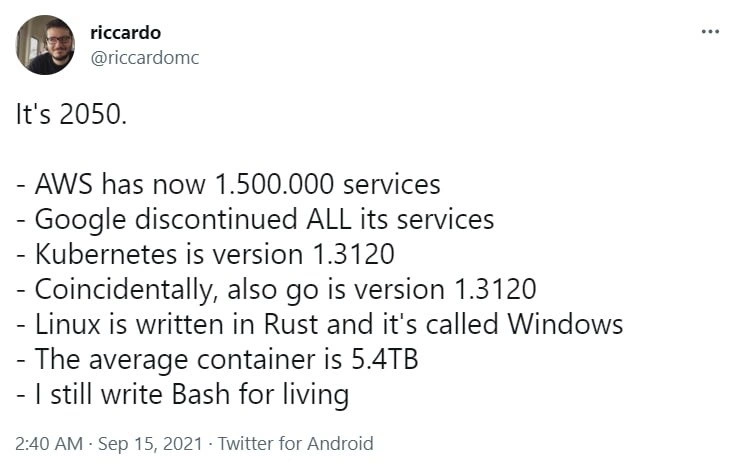
Screenshot of a tweet posted by the user “riccardo” (@riccardomc). The tweet text reads: “It's 2050. - AWS has now 1.500.000 services - Google discontinued ALL its services - Kubernetes is version 1.3120 - Coincidentally, also go is version 1.3120 - Linux is written in Rust and it's called Windows - The average container is 5.4TB - I still write Bash for living”. A timestamp below shows “2:40 AM · Sep 15, 2021 · Twitter for Android”. The interface is the standard Twitter white background with black text and a small circular avatar at the top left. Technically the meme riffs on runaway cloud complexity, Google’s product shutdown reputation, version-number inflation for Kubernetes and Go, the Rust-everywhere trend, container size bloat, and the enduring need for Bash scripting - humor that resonates with seasoned cloud-native engineers

Comments

6
Anonymous ★ Top Pick 2050 release playbook: choose the two AWS services that haven’t been renamed this sprint, cram everything into a “slim” 5 TB container, watch Kubernetes 1.3120 deprecate both APIs mid-deploy, then rescue prod with the same four-line Bash script we wrote in 2002
  1. Anonymous ★ Top Pick

    2050 release playbook: choose the two AWS services that haven’t been renamed this sprint, cram everything into a “slim” 5 TB container, watch Kubernetes 1.3120 deprecate both APIs mid-deploy, then rescue prod with the same four-line Bash script we wrote in 2002

  2. Anonymous

    The scariest part isn't the 5.4TB containers or the 1.5 million AWS services - it's that we'll still be debugging the same race condition from 2024 because someone insisted on keeping that one microservice "for backwards compatibility."

  3. Anonymous

    By 2050, AWS will have more services than there are atoms in the observable universe, yet somehow we'll still be debugging YAML indentation in Kubernetes manifests while our 5.4TB containers take longer to pull than it took to build the pyramids. Meanwhile, Google will have discontinued so many products that 'Google Graveyard' becomes a UNESCO World Heritage Site, and the only constant in our careers will be that one Bash script from 2015 that nobody dares to touch because it 'just works' and the original author left the company a decade ago

  4. Anonymous

    With 1.5M AWS services and k8s v1.3120, the only stable interface left is ssh + Bash - still the most battle‑tested SRE API

  5. Anonymous

    2050 status: AWS ships ServicePicker to navigate its 1.5M services; Google immediately deprecates theirs; K8s 1.3120 schedules my “slim” 5.4TB container on Linux rewritten in Rust, marketed as Windows - and Bash remains the only stable ABI

  6. Anonymous

    2050: Rust kernels ship with 5TB containers, yet one Bash loop still deploys faster than any IaC manifest

Use J and K for navigation