Updating fundamental models and watching legacy learners meltdown in every field
Why is this Mathematics meme funny?
Level 1: Change Is Hard, Even If It’s Right
Imagine you grew up calling your pet cat a “dog” and your pet dog a “cat.” It’s silly, but let’s say everyone in your town did this for years. Now one day in school, the teacher gently says, “Actually, we should use their correct names: a cat is a cat, and a dog is a dog.” That makes sense, right? But you’ve been used to the wrong names for so long that you shout, “No! You can’t just switch them! I’ll have to relearn all the names!”
This situation is funny because obviously calling a cat a dog was wrong to begin with, and fixing it is the right thing to do. But we can sympathize with the tantrum: change means effort, and it’s uncomfortable. The meme is just like that: someone wants to fix a mistake or make things clearer (like calling things by their right names or using a better rule), and another person freaks out because they don’t want to adjust what they already learned. It’s poking fun at how we humans sometimes prefer to stick with something familiar — even if it’s a bit wrong or awkward — just because learning it again sounds tiring. In simple terms, it’s saying: “Changing the rules or facts, even for the better, can make people react like a kid told to do homework all over again.” And that gap between what’s smart to do and how people actually react is what makes it humorous.
Level 2: Old Models vs. New Models
Let’s break down the meme’s content and the technical references for someone newer to these concepts:
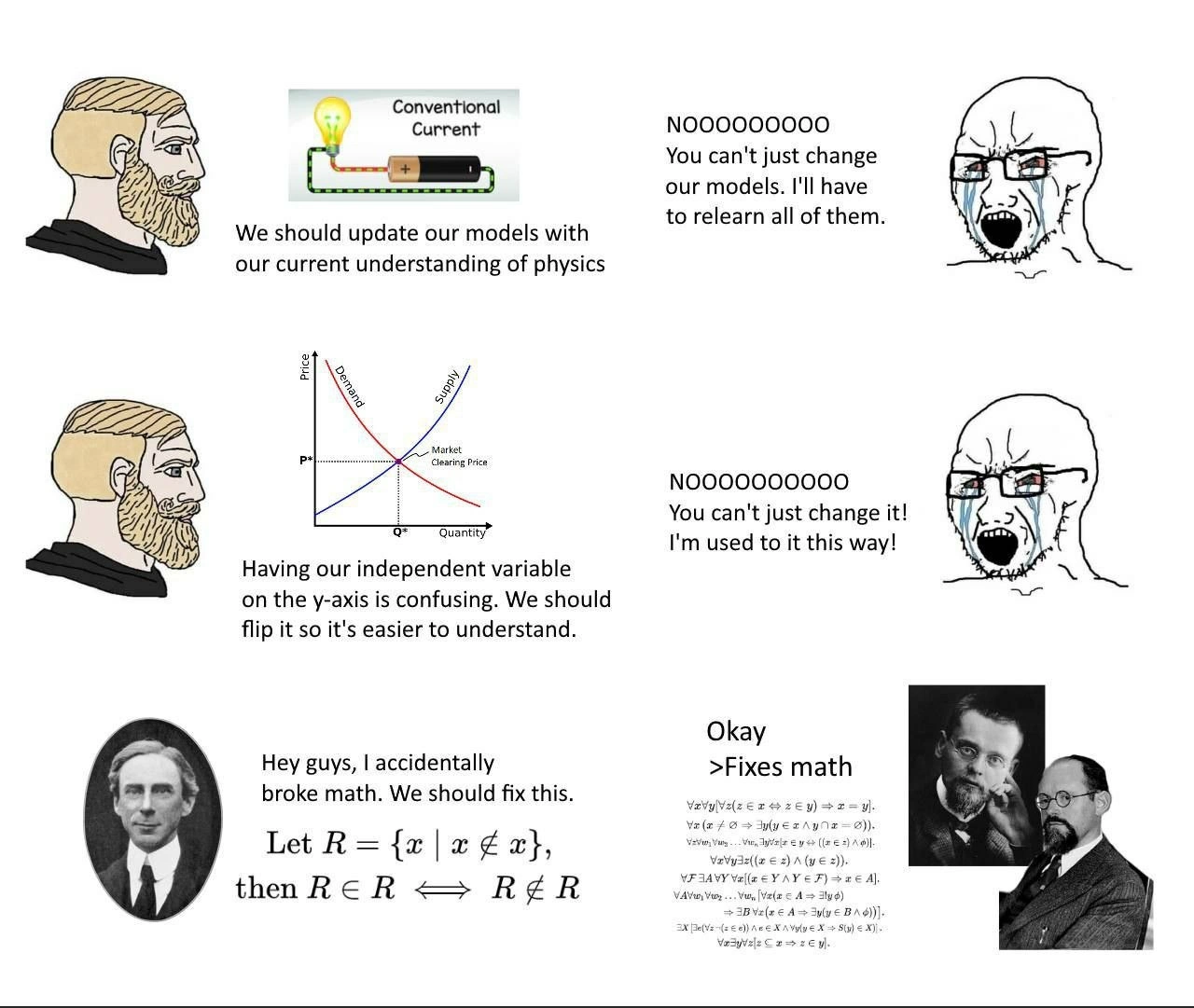
Conventional current (Physics): The top panel’s little circuit diagram (battery and bulb) labeled “Conventional Current” refers to how we define the direction of electrical current. Current means flow of charge. By convention, in virtually all textbooks and diagrams, current is shown flowing from the positive (+) side of a battery, through the circuit, to the negative (-) side. This is a historical artifact. In reality, the charge carriers in most circuits are electrons, which are negatively charged and actually move from the negative side to the positive side. So why do we say current goes + to -? Because long ago, people didn’t know electrons were the movers, so they arbitrarily picked a direction for positive charge flow. We’ve stuck with that convention for consistency. The calm character basically says, “We have better scientific understanding now (we know electrons go the other way), so let’s update our model to match reality.” That’s a logical suggestion: it would make things less confusing for students (no more explaining “well, electrons go opposite to the arrow we draw for current”).
Wojak’s reaction (resistance to change): Wojak is the Internet meme character used to represent someone upset or distraught (often the “cranky old guard” or just a person crying out in frustration). Here Wojak screams that changing the models isn’t allowed because “I’ll have to relearn all of them.” This is a relatable exaggeration: once you’ve learned something a certain way, having that foundational thing change can feel like the rug is pulled out from under you. In physics class, if suddenly all circuit diagrams flipped their arrows, students and teachers would have to adjust a lot of materials and habits. The humor is that Wojak is being overly dramatic (“NOOOOOOO” with tears) — it’s poking fun at how emotionally people can react to what is logically a beneficial change. It mirrors how a developer might react if, say, a familiar library changed its function names overnight — “You can’t do that, I’d have to relearn the API!”
Supply and demand graph (Economics): The middle panel shows a standard econ 101 graph. The demand curve (usually downward sloping) and the supply curve (upward sloping) intersect at a “Market Clearing Price” at quantity Q* and price P*. In that graph, Price is on the vertical axis and Quantity on the horizontal axis. If you remember basic math or science graphs, typically the horizontal axis (x-axis) represents the independent variable (what you choose or input), and the vertical (y-axis) represents the dependent variable (what results or output). Here it seems flipped: one might think quantity demanded responds to price (so price is independent), or depending on interpretation, it’s just a long-standing custom. The calm figure says it’s “confusing” to have the independent variable on the y-axis and suggests flipping the axes. That means, put quantity on the vertical and price on the horizontal, so that the usual convention (independent = horizontal) holds. This suggestion has actually been made by some educators to reduce student confusion. It’s analogous to a developer saying “Our data format’s axes/fields are swapped compared to everyone else’s; let’s align it with the standard to avoid confusion.”
Wojak’s second reaction: Again, Wojak yells “You can’t just change it! I’m used to it this way!” This highlights habit and familiarity. Students of economics, professors, and all existing literature use the current standard orientation. Changing it would mean reprinting textbooks, retraining instructors, and re-labeling a ton of charts. The content doesn’t actually change — it’s purely a representational change — but it disrupts the familiarity. This is like when a software UI you use every day suddenly moves some buttons around or renames menu items: even if the new layout is objectively better, your first reaction might be frustration because you had muscle memory for the old way. In tech terms, the supply-demand graph’s axes are a legacy practice. It works fine once you’re used to it, so people developed an attachment to it, even if newcomers have a learning curve.
Russell’s Paradox and fixing set theory (Mathematics/CS Fundamentals): The bottom panel is a bit heavy on math/logic, but here’s the breakdown. There’s an old portrait on the left — that’s Bertrand Russell, a philosopher/mathematician. The text says: “Hey guys, I accidentally broke math. We should fix this. Let R = {x | x ∉ x}, then R ∈ R ⇔ R ∉ R.” This is describing Russell’s paradox in words: Define a set R that contains all sets that do not contain themselves. Then ask: does R contain itself?
- If you say “Yes, R contains itself,” then by definition of R it should only contain sets that do not contain themselves — contradiction.
- If you say “No, R does not contain itself,” then by definition R should include all sets that don’t contain themselves — so it should contain itself (because it doesn’t contain itself!) — also a contradiction. In simpler terms, it’s a no-win loop: R contains itself if and only if it does not contain itself. This kind of self-referential problem shattered the foundations of naive set theory (which was used as a basis for mathematics and logic). In computer science, you can see a parallel to a self-referential definition that leads to an infinite loop or a paradox (like a function that calls itself in a way that never ends). This paradox meant the existing system of defining sets was too powerful (allowed any kind of set definition, even crazy self-referencing ones) and thus inconsistent.
The right side of that panel shows another portrait pair with the caption “Okay > Fixes math,” followed by a dense block of axioms. Those portraits are likely mathematicians Ernst Zermelo and Abraham Fraenkel (who developed Zermelo-Fraenkel set theory, ZF). The block of text with ∀ (for all), ∃ (there exists), ∈ (is an element of) is part of the formal axioms that Zermelo, Fraenkel (and others like von Neumann, Gödel) introduced in the early 20th century to rebuild set theory in a safe way. For example, one axiom (Separation) essentially says you can only form a new set by filtering an existing set, not by a completely unrestricted property — this avoids creating the paradoxical R in the first place. Another axiom (Foundation) says no set can contain itself (so R ∉ R always, eliminating the illogical scenario). The meme humor here comes from summarizing that as “> fixes math” — as if it were a simple patch. It’s akin to a huge code refactor or a patch to a programming language spec: after Russell pointed out the “bug” in math’s foundation, these mathematicians rolled out Math 2.0 (now with paradox protection).
For a newcomer: think of it like discovering a fatal flaw in an operating system. The developers (mathematicians) have to release a big update that changes how some core routines work (the axioms) so that the system (mathematics) doesn’t crash (fall into contradiction). There was pushback back then too — not everyone was immediately on board with these new axioms because they felt complicated compared to the old intuitive “set of all X” idea. But ultimately, the change was adopted because, well, you had to fix the paradox to have consistent math. In computer science fundamentals, this aspect connects to things like type theory and logic: modern type systems avoid certain self-references (like a type that contains itself) for similar consistency reasons. That’s why this is tagged with CS_Fundamentals as well — it’s not just math, it underpins how we ensure programs and proofs don’t blow up on self-contradiction.
“Breaking changes” in general: The description mentions this mirrors developers griping when APIs or data models evolve. In tech, a breaking change is any update that is not backward compatible — meaning code written for the old version will no longer work correctly after the change. Each scenario in the meme is essentially a breaking change in a knowledge system:
- Changing current direction would break all the old diagrams/calculations (imagine code that assumed a certain sign convention — it would all invert).
- Flipping graph axes would break all references and tutorials that assume the old orientation (like code that parses graph data might get X and Y mixed up suddenly).
- Revising math axioms literally broke the previous “API” of math (some proofs that were okay in naive set theory were no longer valid in the new system, they had to be redone under new rules).
Developers often feel frustrated by breaking changes because it means their knowledge or code becomes outdated overnight. If you learned a framework’s way of doing X, and version 2.0 does X completely differently, you have to relearn and possibly refactor your entire project. This meme is showing that same sentiment but in fields like physics or economics: someone who’s been using the old model their whole life dreads the thought of re-learning fundamentals (even if it’s for the better). It’s a universal learning curve problem.
To illustrate, here’s a quick comparison of each panel’s “old vs new” and the reaction:
| Field | Old Convention | Proposed Update | Reaction (Wojak) |
|---|---|---|---|
| Physics | Current flows from + to - (by convention) | Current flows from - to + (match electron flow) | “No way, that reverses all our circuit rules! Too confusing to relearn.” |
| Economics | Price on Y-axis, Quantity on X-axis (legacy) | Quantity on Y-axis, Price on X-axis (align with math norms) | “You can’t flip it now, all our graphs/textbooks use the old setup!” |
| Mathematics | Naive set theory (allow any set definition, even self-referencing) | Axiomatic set theory (ZF) (restrict definitions to avoid paradox) | “What is this new weird formalism? I liked the old intuitive sets!” (initial resistance, eventually adopted) |
And developers could easily add a row for their world, e.g. changing a beloved library:
- Software: Old framework version (legacy methods, maybe some flawed logic) -> New framework version (breaking changes to fix flaws or improve) -> “Nooo, I have to rewrite my code and relearn the new API!”.
The key terms that newbies might want to know from the tags:
- BreakingChanges: In software, a breaking change means an update that breaks compatibility with what came before. Code that used to work may no longer work after, say, upgrading a library. It’s like changing the rules of a game — players have to adjust their strategies or nothing works. The meme parallels this with changes in models that would “break” people’s existing understanding.
- LegacyPractices: These are old methods or conventions that persist mainly because they’ve been around a long time, not necessarily because they’re optimal. Legacy often just means “the old way that we inherited.” The meme highlights legacy practices (like conventional current direction or how graphs are drawn) that people stick to simply due to tradition.
- LearningCurve: This is the effort required to learn something new. A steep learning curve means it’s hard initially to get up to speed. Whenever models change, there’s a learning curve to reach the same proficiency with the new model as you had with the old. The screaming character is essentially saying “I don’t want that learning curve again!”
- CSFundamentals: Computer Science fundamentals go down to things like algorithms, data structures, and yes, even set theory and logic which underlie computing. The set theory part of the meme is a direct nod to CS fundamentals — showing how a core CS/math concept had to evolve. Understanding such changes (like why we have the rules we do in math/CS) is part of grasping fundamentals deeply.
In summary, each part of the meme is an example of updating a fundamental model in some domain, and the humorous angry reaction is about being forced out of one’s comfort zone. A junior developer or student can recognize this feeling from their own experience: perhaps you learned one way to do something and then a teacher, or a new version, says “Actually, we do it differently now,” and you think “Oh no, all that learning was for nothing?!” It’s initially frustrating. But over time, you come to appreciate the new way if it truly is better (just like eventually mathematicians appreciated the new axioms, or developers appreciate a better-designed library — though it might involve some grumbling first).
Level 3: Breaking Changes & Legacy Rage
This meme brilliantly captures a scenario every seasoned developer recognizes: the resistance to breaking changes. Whether it’s a programming API, a data schema, or a fundamental library, whenever maintainers announce “We’re updating our model to something better (but incompatible with the old)”, there’s always that chorus of upset users crying out like the Wojak: “Nooo! You can’t just change this, I’m used to the old way!” It’s developer humor because we’ve all been on one side or the other of that exchange. The meme uses physics, economics, and math as parallels, but it’s mirroring the exact dynamic of software evolution.
Think of a time when a popular framework or language released a new major version with improvements that broke older code. For example, when Python 3 came out, it fixed a lot of things (like making print a function, consistent Unicode handling, etc.), but the Python community heard a collective groan: “You can’t just change how strings work! All my Python 2 scripts will fail!” It was the same vibe: legacy learners melting down because they had to relearn parts of the language. Another instance: AngularJS vs. Angular 2. The framework was basically rewritten from scratch (for good technical reasons). The team effectively said “We learned better patterns, let’s update the model,” and some developers responded just like our meme’s screaming character: “I’ll have to relearn everything?! NOOO!” It’s almost a law of tech: any time you flip a fundamental assumption, no matter how justified, you trigger a storm of grumpy opposition.
Why do we find this so funny (and painful)? Because it’s true across all fields. The meme exaggerates it in domains like science and math to highlight the absurdity: rational Chad proposes a fix to a model that everyone knows is outdated or weird, but immediately the entrenched user base erupts. In software, this is daily life. We accumulate legacy practices and tribal knowledge — whether it’s a function that returns 0-based indexing when 1-based might have been more natural, or a config file format that is clearly flawed but widely used. The moment someone suggests, “Hey, let’s clean this up with a better approach,” the initial reaction is often panic about the learning curve and the work required to change. Developers joke that we hate breaking changes, yet we also complain about technical debt. It’s a catch-22: you can either improve the model (and suffer short-term chaos) or cling to the old (and suffer ongoing clunkiness).
This meme’s panels correspond to exactly that dilemma in code:
Conventional current = Legacy API conventions: Perhaps an API has function names or behaviors that are counter-intuitive (like our “current flows positive-to-negative” quirk). Everyone knows it’s not ideal, but all the documentation and code rely on it. When someone suggests renaming variables or reversing a boolean flag to make it logical (e.g., a function named
isEmptythat actually meant “is not empty” due to a mistake — yes, those happen), the maintainers fear the uproar. They imagine hordes of users yelling “You can’t just change that, all our integrations will break!” So often, they leave it as-is and add a comment in docs: “Note: this is legacy behavior.” It’s the software equivalent of footnoting electron flow while keeping conventional current for everyone’s sanity. We’ve even institutionalized this: think of deprecation warnings. We announce “This will change in future, please prepare,” and still when the day comes, many are unprepared and upset.Supply/demand graph axis = Established UI/UX or data format: This is like a library that chose a non-standard way of doing things early on. For instance, a JSON API that uses uppercase keys where almost everything else uses lowercase, or a framework that treats rows as columns and columns as rows internally (just hypothetically). Newcomers are confused (“Why is it done this way? It’s opposite of what I learned in CS class”), so someone suggests, “Let’s refactor it to the conventional way for clarity.” It’s a sensible idea, but legacy users will protest: “We’re used to this quirky behavior, if you flip it now, it will break our mental model and code!” There’s a real-life echo in database conventions: SQL, for example, puts column names on the left side in some CLI outputs and values on the right, which confuses newbies expecting
x, ycoordinates style. Propose swapping it and DBAs would freak out – all their scripts and muscle memory assume the old output order. The point is, habituation is powerful. Once people have adapted to a quirk (even a confusing one), changing it feels like ripping out the rug from under them. As the meme suggests, “I’m used to it this way!” often trumps “this would be objectively clearer.”Russell’s paradox fix = Major architectural overhaul: Sometimes, like with naive set theory, the only way forward is to introduce a breaking change because the status quo is untenable. In tech, this is akin to those moments when a system is so broken or insecure that a ground-up rewrite or a fundamental patch is non-negotiable. Think about a protocol that has a severe security flaw (e.g., early versions of SSL had to be deprecated in favor of TLS — some old clients screamed “Nooo you can’t just drop support for SSLv3!” but we had to for security). Or consider programming language evolutions: remember when memory models in languages were updated (like C++11 introducing a new memory model for threading)? That was a big foundational shift; some code that relied on undefined behavior broke, and some veteran programmers weren’t thrilled about learning new keywords (
std::atomic, etc.). But it had to be done to “fix” the model of how threading works in C++, analogous to mathematicians fixing axioms to prevent logical inconsistency. In the meme, the third row joke is that mathematicians actually went through with the breaking change (they replaced the entire set theory foundation) because the problem was critical — and indeed some folks at the time (early 1900s) resisted the unfamiliar new axiomatic approach. It’s very similar to how an engineering team might say: “We have to rewrite this module with proper types or it’ll keep causing errors,” and some teammates complain because it means everyone must learn the new system and discard comfortable old assumptions.
Across all these scenarios, a senior developer will nod knowingly at the DevOps truth hidden here: people fear change, even if it’s change for the better, because it comes with a learning curve and refactoring effort. That’s why the meme hits home — it exaggerates the whiny resistance (“I’ll have to relearn all of them”) which we’ve heard in real codebases whenever major updates happen. It’s a satire of the universal refrain: “If it was like this for so long, how dare you change it now!”
The contrast between the calm character (suggesting improvement) and the screaming Wojak (resisting) is basically the dialogue between progressive developers and maintenance-minded developers or users:
- The calm Chad represents the forward-thinker saying, “Let’s clean up this legacy mess or adopt a model consistent with reality/common sense.”
- The crying Wojak represents the overwhelmed legacy practitioner saying, “Don’t break my familiar tools/knowledge; I don’t have time to start over.”
In practice, both perspectives have merit, which is why this tension is constant in software engineering:
- You need to fix fundamentals sometimes (or you end up with worse problems down the road, like pervasive technical debt or, in math’s case, a paradox that collapses your system).
- But you also have to consider the cost of change — retraining everyone, updating countless lines of code or documentation, and possibly introducing new bugs or confusion if the change is misconstrued.
This is why we have things like semantic versioning (so we know when an update might include breaking changes) and long debates in open-source projects about whether to finally remove that weird legacy behavior in version 5.0 or keep it for compatibility. The meme distills that drama into simple terms. It’s essentially calling out the conservative inertia in every field, with a wink to developers: “See, it’s not just your team that bikesheds on changes — even physicists, economists, and mathematicians deal with this!”
Ultimately, experienced devs find humor (perhaps a bit of dark humor) in this because we’ve lived the “should we refactor or not” battles. The meme’s broad scope (physics to set theory) underscores a comforting thought: you’re not alone — legacy frustration is universal. Whether it’s an API endpoint or the direction of electric current, someone somewhere is shouting “But we’ve always done it this way!” and someone else is facepalming. It’s a cycle as old as technology (and yes, as old as science). Upgrading a model or system is always harder socially than technically, and that’s the insightful punchline here.
Level 4: Axioms to the Rescue
At the deepest theoretical layer, this meme pokes at fundamental models in physics, economics, and mathematics — and how even core frameworks sometimes need correction. The bottom panel references Russell’s paradox, a famous logic bomb discovered by Bertrand Russell in 1901 that essentially said: if you make a set of all sets that don’t contain themselves (R = {x | x ∉ x}), you end up with the statement R ∈ R ⇔ R ∉ R — a contradiction. This blew up the naive set theory of the time (Frege’s system) because it showed an inconsistency at the foundation of math. The meme’s “Hey guys, I accidentally broke math” is Russell humorously noting the paradox, followed by “Okay > fixes math” with a dense block of symbols. Those symbols are part of the Zermelo-Fraenkel set theory axioms (ZF), a rigorous new model that patched mathematics after Russell’s paradox. For example, ZF introduced rules like the Axiom of Separation (you can only form subsets from existing sets, preventing self-swallowing sets like R) and the Axiom of Foundation (no set can contain itself, directly or indirectly). These are formal logical rules — basically the “unit tests” for set theory — ensuring no more paradoxes. The result was a new consistent framework (ZFC, Zermelo-Fraenkel with Choice) that mathematicians adopted to fix math so it wouldn’t blow up on self-referential loops.
In the middle panel, the meme highlights an odd convention in economics: the classic supply and demand graph. Traditionally, economists plot Price on the vertical y-axis and Quantity on the horizontal x-axis. But wait — in math, we almost always put the independent variable on the x-axis (horizontal) and the dependent variable on the y-axis. If we think of quantity as something that drives price (or vice versa), the convention could be seen as “flipped”. This stems from historical choices; some say it goes back to 19th-century economist Alfred Marshall, who popularized this graph with price on the vertical. It might also be because economists treat price as a function of quantity in some cases, or simply because early graphs did it that way and everyone copied it. Flipping the axes now to match standard mathematical convention would technically make interpretations easier for students with a math background (no more mentally swapping X and Y roles). But doing so means overturning a century of economic diagrams in textbooks and research. The meme’s Chad-like figure on the left suggests exactly that rational change — “let’s swap the axes to make it more intuitive and align the model with typical math usage” — while the Wojak on the right panics “You can’t just change it! I’m used to it this way!” It’s a clash between theoretical clarity and practical legacy. The axis flip debate is a real pedagogical discussion: is it worth re-training everyone in economics for a small clarity gain, or do we live with a quirky convention? The tension is between elegance (more consistent models) and inertia (entrenched learning).
Now, the top panel: Conventional current direction in physics. This is a classic historical quirk taught in introductory electronics. By convention, electric current is treated as flowing from the positive terminal of a battery to the negative terminal (as labeled in the diagram). This convention dates back to Ben Franklin, who guessed (with 50/50 odds) the direction that charges flow — and guessed wrong. In reality, electrons (negatively charged) flow from the negative side to the positive side. But because Franklin’s sign convention stuck, to this day we teach “current flows from + to -” in circuit theory, calling it conventional current. It’s like a legacy API in science: everyone knows it’s technically “backwards,” but we keep using it because so much of our electrical engineering framework is built on it. The left character calmly says, “We should update our models with our current understanding of physics” — i.e. redefine current flow direction to match the actual electron flow (negative to positive). From a physics purity standpoint, that makes sense: align the teaching model with reality. But cue the screaming Wojak: “NOOOOOO You can’t just change our models. I’ll have to relearn all of them.” Changing the direction convention now would mean every circuit diagram arrow, every textbook explanation, and every engineer’s intuition built over years would need adjustment. It’s a breaking change at the very foundation of electrical engineering. And even though it’s just a sign flip, imagine relearning Kirchhoff’s current law or re-labeling all batteries — the legacy practice is so ingrained that the cost of unlearning outweighs the benefit. In practice, physicists and engineers stick to the old convention (and just footnote “actually, electrons go the opposite way”). Here we see the CAP theorem of pedagogy in action: you can have consistency or adoption, but not both easily – the community resilience to change is extremely high for fundamentals.
The common thread in all these panels is resistance to adjusting fundamental models despite clear rational reasons to do so. In each case, the proposed change would harmonize the model with reality or logic:
- In physics: current direction would reflect actual particle flow (no more mental gymnastic of “conventional current”).
- In economics: graphs would align with mathematical convention (independent variable on x-axis).
- In math: set theory was made consistent (no paradoxes lurking in the foundations of logic).
Yet, humans (or legacy systems) built on the old model push back hard. The “NOOOO you can’t change it, I’m used to it!” is practically the scream of legacy code when you try to refactor it. It’s a fascinating interplay: sometimes, as with Russell’s paradox, the model breakage is so severe we have no choice but to introduce a drastic fix (even if it means every mathematician has to learn new axioms). Other times, the model’s shortcomings are mild inconveniences or historical oddities — like current direction or axis orientation — and the pain of change is deemed worse than the quirk itself, so the legacy model survives. Essentially, this level exposes the theoretical vs. practical tug-of-war: where theory says “this is elegant/consistent”, practice says “but billions of people already learned it the other way.”
Description
Three-row Wojak/Chad style meme. Row 1: a calm left character points to a small diagram labelled “Conventional Current” (battery-and-bulb circuit) and says “We should update our models with our current understanding of physics”; on the right a tear-streaming Wojak screams “NOOOOOOOOOO You can't just change our models. I'll have to relearn all of them.” Row 2: a supply-and-demand graph (price on the vertical, quantity on the horizontal) sits beside the calm figure who says “Having our independent variable on the y-axis is confusing. We should flip it so it's easier to understand.”; the Wojak repeats “NOOOOOOOOOO You can't just change it! I'm used to it this way!”. Row 3: an old portrait with the caption “Hey guys, I accidentally broke math. We should fix this. Let R = {x | x ∉ x}, then R ∈ R ⇔ R ∉ R” is followed by another portrait pair captioned “Okay >Fixes math” and a dense block of axioms beginning with “∀x∀y∀z(x ∈ y ∧ y ∈ z ⇒ x ∈ z). ∀x∃y∀z(z ∈ y ↔ (z = x ∨ z ∈ x)) …”. The comic satirizes resistance to breaking changes - whether in physics, economics graphs, or set theory - mirroring how developers gripe when APIs or data models evolve

Comments
6Comment deleted
Physics lets electrons flow opposite the arrows, economics leaves price on the Y-axis, math survived Russell by shipping ZFC - yet somehow a single protobuf field rename is where our legacy champions draw the line
The same energy as a team spending three sprints debating naming conventions but immediately accepting a complete rewrite to Rust because "the borrow checker will fix our concurrency issues."
This perfectly captures the enterprise architect's dilemma: everyone agrees the current system is suboptimal, but the migration cost of retraining an entire organization on a 'better' convention vastly outweighs the marginal improvement. Russell literally broke mathematics and got it fixed within a generation, yet we're still teaching electrical current flowing the 'wrong' direction because Benjamin Franklin made an unlucky guess in 1747 and now it's in every textbook, schematic, and semiconductor datasheet ever printed. At least with Russell's Paradox, the fix was just adding axioms - imagine if we had to recall every PCB ever manufactured
Math hit R ∈ R ↔ R ∉ R, shipped a semver-major with new axioms, and everyone upgraded; meanwhile I need three RFCs and a six-month deprecation window to flip an axis label
Physicists clinging to y-axis independents? Just like architects blocking a DB schema flip: 'But my queries run fine!'
Conventional current and econ’s y-axis are legacy APIs no one dares deprecate; math hit Russell’s paradox and shipped ZF as a major version - try getting that past an architecture review board