AI as the Combine Harvester for Software Engineering
Why is this AI ML meme funny?
Level 1: The Big Farm Machine
Imagine you and your friends are picking apples from a big apple orchard. You’re all on ladders or on the ground, plucking apples one by one and filling up baskets. It takes a long time and a lot of effort for all of you to gather those apples. Now suppose someone comes along with a giant robot machine that can shake the trees and collect all the apples in just a few minutes. Suddenly, you have heaps of apples gathered with almost no effort – way more than you guys could ever pick by yourselves in the same time. At first, everyone is excited: wow, so much food and so fast! But then you realize something: if the machine can do that every day, you might not need all your friends to help pick apples anymore. Maybe one person can drive the machine and do the job that previously took ten people. The rest of you might stand there thinking, “Hmm, what do we do now?” You’d feel happy because now apple picking is easy and there are more apples for everyone, but also a bit worried because the machine might have taken over the job you were doing.
This meme is making that kind of comparison, but with coding instead of apple picking. It jokes that programmers (people who write software) were kind of like the apple pickers working by hand, and that a new smart machine (an AI that can write code) is like the tree-shaking robot. With this machine, we can get a lot more software made (like getting more apples) in a short time. But if one machine can do so much, maybe you wouldn’t need as many programmers to do the work anymore – and that idea makes programmers a little nervous. The feeling behind the joke is a mix of “Cool, look how much more we can do!” and “Uh-oh, will we still have our jobs after this?” It’s a funny analogy to help people understand both the excitement about new AI tools and the concerns about how those tools might change the work and jobs of the people who build software.
Level 2: The Code Combine
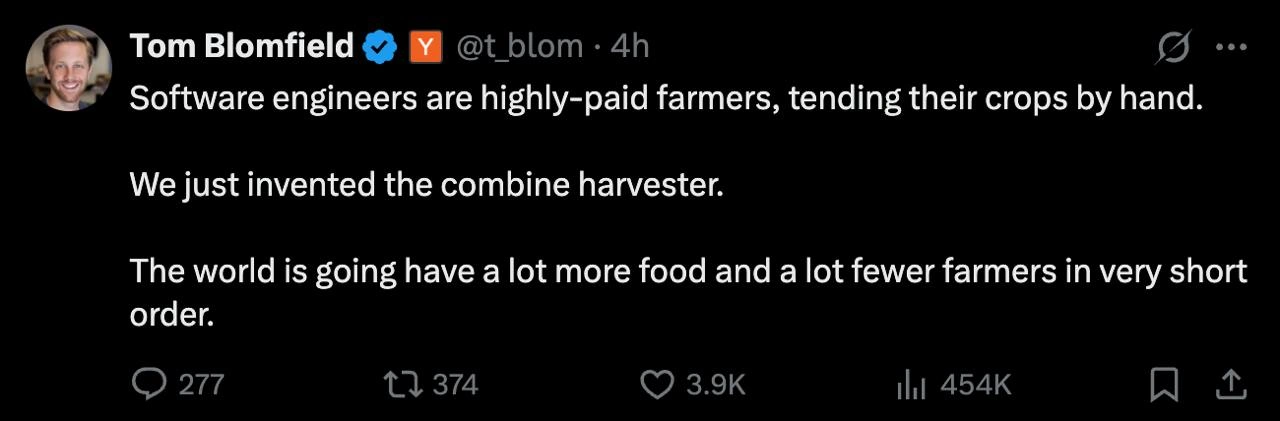
This meme is a screenshot of a tweet where a tech CEO, Tom Blomfield, compares software programming to farming. The tweet is shown in Twitter’s dark mode (black background with white text), which many developers prefer because it’s easier on the eyes during those long coding sessions. You can see Tom’s name, his handle @t_blom, and a little orange Y badge next to it – that badge means he’s associated with Y Combinator (a famous startup incubator), signaling that he’s a notable figure in the tech industry. In other words, this isn’t just a random person tweeting; it’s someone people in tech listen to, which makes the bold statement he’s making even more attention-grabbing.
In the tweet, Tom uses a farming analogy to talk about software engineers and new AI tools. Let’s break down the tweet line by line and explain the meaning:
- “Software engineers are highly-paid farmers, tending their crops by hand.” – Here, “software engineers” (the people who write code) are being compared to farmers who take care of their crops manually. The “crops” represent code or software projects. So he’s humorously saying that programmers, even though they earn a lot, are basically doing manual labor on their code, carefully nurturing and handling everything themselves, much like farmers working in a field plant by plant.
- “We just invented the combine harvester.” – A combine harvester is a big, advanced farming machine that can do multiple tasks (like cutting crops and separating the grain) extremely fast, replacing a ton of manual work. By saying “we invented the combine harvester,” he means the tech industry has created something equivalent for coding. This is referring to the latest AI coding tools (for example, think of GitHub Copilot or ChatGPT’s coding abilities). These tools are like machines that can automatically write and generate code much faster than a person can do it by hand. It’s a metaphor to say we now have a way to automate the hard part of software development.
- “The world is going to have a lot more food and a lot fewer farmers in very short order.” – Sticking with the metaphor: if you suddenly have combine harvesters on farms, the world gets a lot more food because machines are super efficient, and you need fewer farmers because the machine does most of the work. Translating that out of metaphor: thanks to AI tools, we’re going to get a lot more software built (more output, like more food), and we will need fewer software engineers to build it (fewer people doing the work manually). “In very short order” means very soon or very quickly. So he’s predicting a near-future where software development is hugely productive but doesn’t require as many programmers as before.
Below this text, the screenshot shows the tweet’s engagement: there are 277 replies, 374 retweets, 3.9K likes, and 454K views. Those numbers indicate that this tweet got a lot of attention. Thousands of people saw it and reacted to it. Why so much interest? Because it touches on a hot topic and a worry in the programming world: the rise of AI in software development. It’s mixing humor with a serious prediction, and that makes people stop and think (or laugh, or reply with their own opinions). In terms of meme categories, it falls under AIHumor and IndustryTrends – it’s a joke on the surface, but about a trend (AI automation) that everyone is talking about.
Now, let’s explain some of the key concepts and terms that come up with this meme:
- Combine harvester (metaphor) – In real life, a combine harvester is a huge farming machine that can harvest crops way faster than humans can by hand. Farmers love it because it saves time and labor. In the tweet, the combine harvester is a metaphor for an AI machine that can write code. So, think “big machine that automates work” = “AI tool that automates coding.”
- Software engineer-to-farmer analogy – This is the comparison being used. It might sound funny, but it’s comparing writing code to farming. “Tending their crops by hand” implies doing everything manually without automation. This analogy emphasizes that a lot of programming work right now involves manual effort – typing out code, fixing bugs one by one, deploying updates – kind of like tending a field crop-by-crop. By calling engineers “highly-paid farmers,” the tweet humorously suggests that even though coding is high-tech and well-paid, it’s as labor-intensive in its own way as farming used to be before modern machinery.
- Generative AI coding tools – These are the “new invention” that’s like the combine. Generative AI refers to AI systems (often using machine learning) that can create new content. In this case, the content is source code. Tools like GitHub Copilot (which is like an AI pair-programmer that suggests lines of code as you write) or advanced chatbots like ChatGPT (which you can ask in plain English to write code for you) fall into this category. They work by having been trained on lots of existing code and learning patterns, so they can generate code that looks like a human wrote it. For example, you can type a comment or prompt, “function to sort a list of numbers,” and an AI tool can actually write out the code for that function automatically. It feels a bit like magic when you first see it.
- AI hype vs. reality – “Hype” means lots of excitement and talk about something, sometimes with exaggeration. Right now, AI is surrounded by a ton of hype in the tech industry – you hear grand claims like “AI is going to change everything!” The tweet itself is kind of a hype statement (it’s making a big bold prediction). The “reality” is what actually happens, which might be a bit different or take longer. So, AIHypeVsReality is a common theme where people discuss “Okay, here’s what people hope or fear AI will do, but what will it really do?” In simpler terms: there’s a question of how much of this combine harvester story will come true and how fast. Tech history has shown that new inventions often take time to spread and have limitations initially, but we tend to get very excited early on.
- Automation anxiety – This is a term for the nervousness or fear people feel about their jobs when a new automation technology comes around. It’s happened throughout history: factory workers felt it when robots were introduced, and drivers are feeling it with talk of self-driving vehicles. Now software developers are feeling a bit of it with AI. It’s basically the question, “Will this technology replace me or reduce the need for my skills?” In the context of the meme, developers might chuckle at the joke but also think, “Yikes, if that’s true, what does it mean for my career?” That uneasy feeling is what we mean by automation anxiety.
- AI job displacement in coding – “Job displacement” means jobs being moved or eliminated because something changed (like technology). In coding, AI job displacement would mean AI taking over parts of the programming job so effectively that fewer human programmers are needed. The tweet is directly addressing this idea by saying there will be “a lot fewer farmers” (programmers). It suggests that many coding jobs could be impacted. This doesn’t necessarily mean all programmers get fired; it could mean new types of jobs appear (maybe managing AIs or working on more creative tasks) while older routine coding jobs decrease. But it’s definitely pointing toward a shift in the job market for developers. It’s a topic of serious discussion: some think AI will just be a tool that makes programmers more productive (so they still have jobs, just working faster), while others think companies might not need as many programmers because one programmer with AI can do the work of several.
For a newer developer or someone just learning programming, this meme might be a bit startling. The basic message is: “We have a new technology (AI for coding) that can automate a lot of programming work. This will let us create software much more quickly (a boom in productivity), but it might also mean we won’t need as many human programmers as before because the AI is doing much of the heavy lifting.” It’s both an exciting and unnerving idea.
On the exciting side: if you use these AI tools, you could get your work done faster. Suppose you’re building a simple website – instead of coding every element, you might ask the AI to give you a starting template or even entire chunks of code. It’s like having an assistant who writes drafts for you. This could free you up to focus on more interesting parts of the job, like deciding features or polishing the user experience, rather than wrestling with boilerplate code.
On the unnerving side: you might wonder, if the AI can do a lot of tasks automatically, will companies hire fewer entry-level developers? After all, if one experienced dev with an AI can do the job of, say, 3-4 people, that’s efficiency for the company – but fewer opportunities for people. This is the “fewer farmers” part of the tweet. It’s a big reason why this tweet got so much attention. It touches on CareerHumor (joking about our careers) but also real career concerns.
In reality, as of today, AI coding tools are impressive but not self-sufficient. They often need supervision. For example, Copilot might write a function for you, but you still have to check if that function really does what you want and doesn’t introduce bugs. ChatGPT might generate code that looks correct but sometimes it can be slightly wrong or inefficient, and you need to debug or refine it. It’s similar to how a combine harvester can gather a lot of crops, but the farmer still needs to oversee it and handle the output (like sorting the good grain from the bad, fixing the machine if it jams, etc.). Many developers who use these tools see them as assistants rather than replacements. They can automate the easy 80% of a task, but the remaining 20% (the tricky parts, integrating with the rest of your system, handling edge cases) still requires human insight.
It’s also worth noting that when productivity shoots up (we can write code faster), sometimes expectations and demand rise as well. The tweet doesn’t mention this, but historically in software, when we got better tools, we often ended up building more complex things, not just doing the same work faster and then relaxing. So the future could be one where developers are still in demand, but the job might involve more supervising AI, more high-level decision-making, and handling more projects at once since each project is easier to do. In effect, the role could evolve rather than disappear.
To wrap it up in simple terms: this meme jokingly says “Programming is about to get its big farming machine moment.” Just like farming went from lots of people working by hand to a few people managing machines, programming might go from lots of people writing code line-by-line to a few people directing AIs that generate most of the code. It hasn’t fully happened yet, but that’s the scenario the tweet is playing with. It’s humorous, a bit hyperbolic, but it resonates because the technology (AI code generation) is very real and improving rapidly. For someone early in their developer career, the best takeaway is: be aware of these AI tools and learn to use them to your advantage. They can make you more productive. But also, don’t panic: the sky isn’t falling today. Instead, the job is gradually changing. Much like farmers had to learn to operate tractors and harvesters (instead of using a shovel all day, they became machine operators and mechanics), developers may need to become adept at working with AI – writing good prompts, integrating AI output, and focusing on the creative and complex parts of software that AI can’t handle alone. This meme captures that whole idea in a one-two punch: a funny analogy and a bold prediction that gets everyone talking.
Level 3: Reaping What We Code
If you’re an experienced developer, this tweet hits like a lightning bolt of hype with a thunderclap of truth. It’s posted by Tom Blomfield (notice the blue check and the little orange Y badge for Y Combinator next to his name, signaling startup royalty), and he basically just called software engineers “highly-paid farmers” and AI the new farming machine. Ouch. It’s tongue-in-cheek, but it taps into something real. The software industry has been toiling away with a lot of manual coding, and here comes a fancy new AI tool promising to automate that grind. The tweet went viral (thousands of likes, hundreds of comments) because it speaks to a mix of excitement and fear that's pervasive right now. There’s plenty of AI hype in tech, but also developer automation anxiety – that nervous joke we crack about an AI taking our job after it finishes helping us with our job. In fact, a term "copilot anxiety" popped up when GitHub Copilot was released – that uneasy feeling of “Wow, this thing can code… uh, how much of my work can it do?” Tom’s tweet throws a bit of fuel on that fire, with a wry smile.
Why is it funny? Well, calling programmers “farmers” is a deliberate, ironic downgrade. We like to think software engineering is a sophisticated, intellectual endeavor – far from manual labor under the sun. Yet, there’s a kernel of truth that makes the joke land: a lot of coding is repetitive, menial, almost mind-numbing work at times. Think about grinding through another CRUD application or writing yet another user login feature from scratch. It can feel like tending rows of crop: methodically writing similar lines, fixing similar bugs, one after another. So when Tom says “We just invented the combine harvester,” he’s using a vivid image to say “We made a machine that automates all that tedious coding work.” Every developer who's spent late hours writing boilerplate or converting requirements into code can imagine how game-changing such a machine would be.
The punchline is that “the world will have a lot more food (software) and a lot fewer farmers (engineers) in short order.” That’s equal parts thrilling and chilling. Thrilling because, wow, we might usher in an age of software abundance – projects that used to take months might be done in days. Chilling because, well, if you’re one of the “farmers,” you’re wondering if you’re about to be downsized in this new era. It’s a mic-drop statement that plays on every developer’s ambivalence about automation: we love automating others’ work, but we get nervous when our own work is on the automation menu. The humor has a bit of a bite: it suggests many devs (especially those doing more routine coding) could become obsolete as quickly as horses did when tractors showed up.
Now, if you’ve been around the tech block, you’ve heard grand predictions like this before. IndustryTrends come in cycles. Remember the hype around low-code platforms? Or a decade ago when everybody said outsourcing and offshoring would eliminate developer jobs in high-cost countries? Or even go further back: tools like Dreamweaver were supposed to let “anyone build a website, no programming needed.” Each time, what happened? We still had plenty of developers – but their jobs shifted focus. When Stack Overflow came around, suddenly every coder had a giant knowledgebase at their fingertips (some might say Stack Overflow was the first unofficial AI assistant, delivering ready-made code solutions). We definitely got more efficient – nobody misses coding sorting algorithms from scratch for the 100th time when you can grab it off the internet – but we didn’t end up with fewer programmers. Instead, we took on bigger, more ambitious projects. So, a seasoned engineer might read Tom’s tweet and think, “We’ve heard this tune before. New tool arrives, we automate some drudgery, then we just tackle harder problems (and usually, pile on even more work for ourselves).” The AIHypeVsReality question looms: is this combine harvester really going to shrink the developer workforce, or will it just change what developers do all day?
That said, even the skeptics are paying attention now, because the generative AI tools we have in 2025 are a big step beyond anything before. Tools like GitHub Copilot and ChatGPT can actually produce useful chunks of code, not just syntax highlighting or boilerplate project templates. You can literally say, “Hey AI, build me a simple website with a login form,” and it will spit out HTML, CSS, Javascript, and maybe some backend code. That feels like science fiction come to life for those of us who slogged through code line-by-line in the past. So developers joke about "starting that alpaca farm finally" (if you can’t beat ’em, join the farmers for real 😅), but they’re also actively figuring out how to coexist with this new tech. Many of us are thinking about becoming that farmer who drives the combine instead of picking by hand – in other words, the developer who is supercharged by AI tools. In practice, this means learning prompt engineering (the art of asking AI the right way to get good results) and integrating AI outputs into our workflow. New roles are emerging too; for example, some companies are hiring experts specifically to manage and curate AI-generated code, kind of like mechanics for the new harvester. So while one part of the dev community is cracking jokes about being replaced, another part is saying, “Hey, maybe I can be the one controlling this new machine and become 10x more productive.” The smart money as an engineer is on adapting, not resisting – essentially becoming the skilled operator of the coding combine.
Still, there’s an undercurrent of caution (and more dark humor) that runs through dev circles when we talk about this. Sure, the AI can generate code at light speed, but who deals with it when that code breaks? Think about all the legacy systems out there held together by duct tape and late-night caffeine – now imagine adding a ton of AI-generated code to them. If it goes wrong, guess who’s on call to fix it? Us. The few of us that remain, if the tweet is right. It’s like being the farmer who has to fix the combine at midnight when it jams – except in our world, that’s a pager alert at 3 AM because the AI introduced a subtle bug that brings production down. Every experienced dev has been in that firefight and knows it’s not fun. So there's this running joke: “AI can write code, but will it also run PagerDuty when something goes sideways?” The meme leverages that shared experience. It’s implicitly asking: even if we have fewer engineers, will the ones left be carrying an even heavier pager?
# When the AI "combine" breaks down at 3 AM...
try:
AI.deploy_all_the_things()
except Exception as e:
alert_on_call_dev(f"Combine harvester error: {e}")
In other words, the machine might do the easy work, but the hard emergencies – those still end up on a human’s plate. This is the not-so-glamorous reality that tempering the hype: an AI that generates code isn’t the same as an AI that takes full responsibility for a live system with real users.
So the tweet lands in a sweet spot of tech humor. It exaggerates to make us laugh (“haha, we engineers are just farmers now”), but it also strikes a nerve. It’s CareerHumor with a sharp edge. Developers are sharing it along with comments like, “Guess I should update my LinkedIn – now accepting roles as AI Combine Operator.” There’s also that meta-joke in the post text: “y'all always wanted to be farmers and Tom says you were the one all along!” This references how some devs half-jokingly dream of quitting the rat race to literally go farm somewhere peaceful – and here comes Tom saying we’ve been farming (in code) the whole time. It’s a clever full-circle punchline.
In the end, the meme’s humor comes from this collective realization: the game is changing. It pokes fun at our current situation (lots of manual coding) and our future uncertainty (will AI take our jobs?). We laugh because the farm analogy is spot on in many ways, and sometimes humor is the best way to deal with an unpredictable future. As developers, we’re used to learning new tools and adapting – this just might be the biggest one yet. The tweet packages that complex mix of hype, hope, and fear into a few witty lines that make you smirk, then immediately think, "Wait, is it really going to be like that?" That bit of nervous laughter you hear in offices and online forums – that’s developers collectively processing the idea that the next “industrial revolution” of code might have just begun, and we’re simultaneously the farmers, the beneficiaries of the bumper crop, and the ones wondering about our place in this new world.
Level 4: From Plow to Prompt
At the deepest technical level, this meme’s analogy hints at a seismic shift in how code is produced – essentially the mechanization of programming. We’ve seen computing steadily climb levels of abstraction over the decades: coding evolved from flipping switches and writing assembly (hand-tilling the soil) to using high-level languages and frameworks (riding a tractor). Now generative AI is poised to become the ultimate force multiplier – a combine harvester for code. Instead of painstakingly writing functions line by line, a developer can feed a specification into an AI and get entire modules or solutions generated. It’s as if a single machine suddenly can do the work of many farmhands: one engineer with an AI assistant might accomplish what used to require a team. This is the grand promise behind tools like OpenAI’s code model or GitHub Copilot, and it’s why the tweet proclaims such a dramatic increase in “food” (software output) with fewer “farmers” (programmers).
Under the hood, our new coding combine is powered by a Large Language Model (LLM) – essentially a colossal neural network (think of models in the GPT series) that has been trained on vast fields of text and code. These models use the Transformer architecture to analyze context and predict what comes next in a sequence. In coding terms, that means they can autocomplete or even synthesize entire algorithms when given a prompt. They’ve effectively absorbed patterns from millions of source files, libraries, and Stack Overflow answers. With enough training data, an LLM develops an uncanny ability to produce code that looks correct for a given task. Just as a combine harvester mechanizes multiple farming steps at once (cutting, threshing, winnowing), an AI coding model can take a high-level request (“build me a web form with user login”) and perform many coding steps in one go – from creating the UI layout code to the authentication logic. It’s a powerful convergence of computing techniques that yields speed and volume in programming never seen before.
However, computer science theory throws up some caution signs on this autobahn of automation. Writing lots of code quickly doesn’t automatically solve the hardest parts of software development. In classic terms, it tackles the accidental complexity (the grunt work of writing syntax, boilerplate, repetitive code), but not the essential complexity – the actual problem solving, design, and requirement understanding that only humans (for now) truly grasp. There’s a famous essay by Fred Brooks titled No Silver Bullet, which argues that no single tool or advancement will give us an order-of-magnitude improvement in productivity without introducing its own challenges. The AI combine harvester is astonishing, but it isn’t a magical silver bullet that makes the fundamental complexity of software vanish. For instance, if you don’t precisely know what the software should do (vague or changing requirements), an AI can’t figure that out for you – it might just produce the wrong “crop”. It will confidently generate a solution, but whether that solution is correct or optimal is another matter.
From a more theoretical lens, consider the problem of verifying that code is correct and bug-free. That veers into the territory of formal methods and even touches on the Halting Problem and other undecidable questions in computer science. An AI can blast out hundreds of lines of code in a flash, but determining if that code will work for all cases (and not crash or misbehave) is immensely hard to fully automate. We have testing and type-checking, yes, but no AI today can guarantee a piece of code is perfectly correct in the general case – that’s fundamentally hard. So we end up with a scenario where the AI harvester reaps a huge crop of code, but humans still need to inspect, clean, and refine that output to ensure it’s usable (like millers checking the grain after a mechanical harvest). In farming terms, someone still has to taste the soup to see if the harvest was good. In software terms, we still write unit tests, do code reviews, and think critically about architecture. The AI doesn’t eliminate that intellectual work; it just changes its nature.
There’s also the question of Jevons Paradox and historical precedent. In agriculture, when the combine harvester and other machines appeared, food production skyrocketed. The immediate effect was that you truly needed far fewer farmers – eventually. (In 1900 a huge percentage of the population farmed; today only a few percent do, yet we grow even more food.) But what also happened is that those farmers didn’t all stay idle; many moved to new types of jobs (like manufacturing the tractors, or service industries, etc.), and society started expecting more production and variety as things got cheaper. In software, if it becomes 10 times faster to produce a certain kind of application, we might not fire 9 out of 10 developers immediately; instead, we might start building ten times as many applications, or aim for problems we couldn’t touch before. Historically, every big jump in developer productivity (think higher-level languages, or libraries, or open-source sharing) led to more software and frankly more developers employed overall, not less, because when it’s easier to make things, people imagine and demand more things to make. The tweet’s prophecy of “a lot fewer farmers” hints at a rapid workforce reduction, but economics and past trends suggest the long-term outcome could be more complex. It might redistribute what developers work on rather than simply empty out the field.
In summary, the combine harvester metaphor at this level is both exciting and a bit deceptive. AI absolutely has the potential to change the game: a single engineer wielding an advanced model could indeed produce what once took a whole team, at least for certain kinds of tasks. That’s the part of the analogy that rings true and has everyone buzzing – it’s the next giant leap in automating the toil of coding. But the reasons we have teams of software engineers aren’t solely because typing code is slow; it’s also because understanding user needs, ensuring reliability, managing complexity, and maintaining code over years are really hard problems that don’t disappear with faster code generation. The “world” will get a lot more software, as the tweet says, but whether we truly end up with dramatically fewer software engineers, or just software engineers doing different work, will depend on those deeper complexities. Just like mechanized farming didn’t eliminate food challenges (it created new ones around distribution, economics, etc.), mechanized coding will solve some problems and create new ones. The meme cleverly captures a pivotal moment in tech – a combine harvester moment – and invites us to think about how we’ll adapt to this new engine of creation in the programming world.
Description
A screenshot of a tweet from user Tom Blomfield (@t_blom). The tweet is displayed in white text on a black background. The text reads: 'Software engineers are highly-paid farmers, tending their crops by hand. We just invented the combine harvester. The world is going have a lot more food and a lot fewer farmers in very short order.' The tweet shows engagement metrics including 277 comments, 374 retweets, 3.9K likes, and 454K views. The meme uses the analogy of the agricultural revolution to comment on the state of software development. It posits that software engineering has traditionally been a manual, labor-intensive process, much like farming by hand. The 'combine harvester' is a metaphor for a transformative technology, strongly implying generative AI or advanced automation, which will dramatically increase productivity. The controversial conclusion is that this will lead to a significant reduction in the number of software engineering jobs, a common topic of debate and anxiety within the tech industry
Comments
18Comment deleted
The new AI 'combine harvester' is great, but it keeps trying to refactor the legacy COBOL field into a gluten-free, non-GMO data stream
If GPT-4 is the combine harvester, my decade-old monolith must be the rusty scythe we still bring to sprint planning
Funny how we're comparing ourselves to farmers when most of us can't even keep a houseplant alive, yet here we are building the very combine harvesters that'll harvest our own job security
Ah yes, the combine harvester moment - where we automate ourselves into 'senior prompt engineers' while the AI does the actual farming. The irony is that we're building the very tools that will make us obsolete, then celebrating the productivity gains in our performance reviews. At least when the agricultural revolution happened, farmers didn't have to write the documentation for the combine harvester that replaced them
LLMs may be the combine, but after headcount “optimization” you’re the lone SRE unjamming the header at 3am because it confidently harvested the neighbor’s field - production - behind a mis-specified tenancy boundary
AI harvester: 10x code yield from half the hands - until it hallucinates weeds into your microservices architecture
If LLMs are the combine, the pager still rings when it harvests the prod firewall - headcount drops, incident volume stays asymptotically constant
Those crops suck Comment deleted
Unfortunately that "combine harvester" is going to damage a lot of crops. Comment deleted
Who is this anyway? Comment deleted
maybe a "combine harvester" bro? Comment deleted
some fucking moron obviously Comment deleted
At the expense of lower quality food Comment deleted
lmao true Comment deleted
well, we know which way the tradeoff went with actual food Comment deleted
why would you censor it lol Comment deleted
These ain't harvesters, these are artificial fertilizers Comment deleted
https://www.youtube.com/watch?v=btEpF334Rtc Comment deleted