The Infamous 8-Drive RAID 0: A SysAdmin Horror Story
Why is this Storage meme funny?
Level 1: All Eggs in One Basket
Okay, here’s what happened in very simple terms: The person in this story kept all their important stuff in one risky setup, and it backfired. It’s like carrying all your eggs in one basket. Imagine you have 8 eggs (because there were 8 drives) and you put them in one basket to carry them home. If you trip and drop that basket, all 8 eggs can break at once. You’d have no eggs left, right? A smarter idea would be to put some eggs in a second basket, or have a friend carry a couple, so that not everything is lost if one basket falls. In the meme, the guy didn’t do the smart thing – he effectively tied all his “eggs” (data) together so that if one “egg”/drive fell, it would ruin everything. And he didn’t have a spare copy of those eggs in the fridge (no backup). When one of the drives failed (the equivalent of dropping the basket), all the data got smashed. Now he’s really upset, dropping F-bombs (lots of angry words), because he realizes he lost something super important and it was his own doing. People find it darkly funny because it was such an obvious mistake – like watching someone ignore advice and then suffer the exact consequence you warned them about. But it’s also a bit sad, because you can feel how mad and panicked he is now that everything is gone. In everyday terms, the lesson is: don’t put all your important things in one place without any safety net. If it’s something you really care about, keep a backup or some protection, so one accident doesn’t wipe out absolutely everything.
Level 2: Striping Without Safety
Now, let’s break this down in simpler terms. The situation in the meme is about how data was stored and how that went very wrong. The key technology here is RAID (Redundant Array of Independent Disks). RAID is basically a method to connect a bunch of physical hard drives so that your computer sees them as one big drive, and to do clever things like improve speed or reliability (depending on the RAID type). There are different “levels” of RAID, each with its own balance of speed, capacity, and safety.
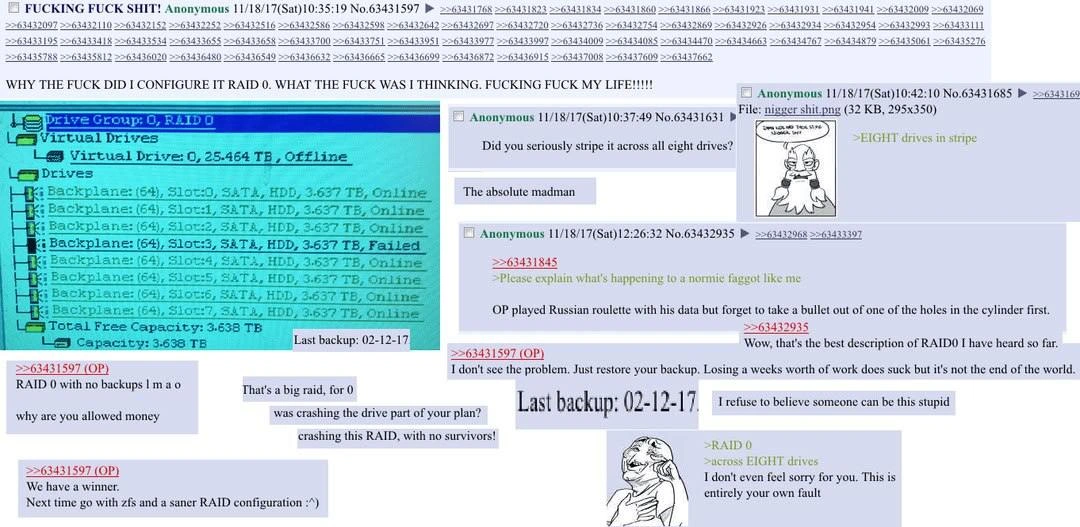
RAID 0 is all about striping data across drives for speed and capacity, but it provides no safety. If you have 8 drives in RAID 0, it will chop your data into 8 pieces and write those pieces in parallel to all drives. This makes reading and writing data much faster (almost like having 8 people work on a task simultaneously), and you get to use the full combined storage of all 8 drives. In the meme, that’s how they got a single ~25 TB volume (by combining eight ~3.6 TB drives). However, RAID 0 has a big catch: if any one of those drives fails, the whole system fails. Since pieces of every file are spread across all drives, losing one drive means you lose parts of every file. It’s like a jigsaw puzzle: if one puzzle piece goes missing, the picture can’t be completed. The RAID controller (the hardware or software managing the array) will mark the whole array as Offline or broken if a drive dies because it knows the data is now incomplete. That’s exactly what the image shows – the RAID BIOS screen lists one disk as “Failed” and the 25 TB virtual drive as “Offline”. No disk, no data.
Other RAID levels add a safety net. For example, RAID 1 keeps an exact copy of your data on a second disk (mirroring), so if one disk fails, you still have the other. You sacrifice capacity (two 4 TB drives in RAID 1 give you 4 TB usable, since one is a mirror of the other) but gain reliability. RAID 5 and RAID 6 use striping with parity. They spread data out like RAID 0, but also store extra information that can be used to recover data if a drive fails. RAID 5 can survive one drive failure (it uses 1 drive’s worth of space for parity info), and RAID 6 can survive two drive failures (it uses 2 drives worth of space for parity). These are common in businesses because they blend extra storage with some fault tolerance. In the event of a failure, you replace the bad drive and the system rebuilds the lost data from the parity info and the remaining drives. The key idea: there’s some redundancy – either full copies or parity – to avoid catastrophe if a drive dies.
ZFS (mentioned in one of the replies) is a modern filesystem that includes its own RAID-like system called RAID-Z. It’s designed with data integrity in mind. If OP had used something like ZFS with RAID-Z2 on those 8 drives, two drives could fail and he’d still not lose any data. ZFS also constantly checks that data isn’t corrupted (using checksums) and can repair issues on the fly using the redundant data. People in the meme suggest this because ZFS is sort of an “all-in-one” solution that might have prevented the disaster: it wouldn’t have let him run 8-disk stripe without at least some redundancy (or at least it would strongly warn against it), and it would have caught errors before they became full-blown failures.
Now, let’s talk about backups. A BackupStrategy means having copies of your data stored somewhere safe (often separate from the main system). Backups are the ultimate safety net. Even if your entire RAID array exploded or your server room caught fire, a backup (on an external drive or in the cloud, for example) means you can still recover your information. In this meme, OP’s last listed backup was from 2017 – several years old. That basically means everything new or changed since 2017 was not backed up at all. So when the drives failed in 2025 (the post date), all that data from 2018, 2019, 2020… up to 2025 vanished, with no secondary copy to restore from. This is why the responders are facepalming and saying things like “why are you allowed money” – implying that if you can afford an 8-drive setup, you should have definitely invested in backup storage too. No backup in this scenario is almost unforgivable because it’s the one thing that could have saved him after the RAID 0 blew up. There’s a common refrain in IT: “RAID is not a backup.” Even if he had a safer RAID (like 5 or 6), that guards against hardware failure, but not against things like accidental deletion, viruses, or multiple failures. That’s why backups are still needed. In his case, he had neither redundancy nor backups – a double whammy of bad planning.
The meme also references “Russian roulette” which is a morbid analogy: in Russian roulette, you gamble with a revolver that has one bullet in the cylinder and several empty chambers, hoping you get a “click” (empty chamber) and not a “bang”. OP’s setup was like putting a bullet in every chamber of the gun – meaning a “bang” was a sure thing eventually. Every drive in RAID 0 is like a loaded chamber; you spin the cylinder (time passes, drives wear out), and one day… bang, a drive fails and the data’s dead. It’s not if, it’s when.
When that failure happened, OP’s reaction (all the panicked profanity) shows he immediately understood the gravity: he’s essentially saying “I can’t believe I was so foolish to do this!” The internet’s reaction, as shown in the meme, is a mix of ridicule and lesson-teaching: people are mocking the mistake (because it’s a well-known no-no in the industry), but also reinforcing the lesson (“never do that again; use redundancy; keep backups; consider safer filesystems”). It might feel a bit cruel, but it’s how tech communities often respond to such a colossal blunder – a bit of tough love and dark humor, born from the fact that many of those commenters have seen similar failures before (or maybe even made similar mistakes in their early days).
To put it plainly: OP took eight hard drives and linked them in the riskiest way possible (striping without safety). This made a super-drive that was fast and huge, but fragile. When one of the eight drives had a Hardware failure (which eventually happens to all drives – they wear out like tires on a car), the entire storage system went down. Because there was no backup, all the data on it became inaccessible and potentially lost for good. The only possible remediation now is trying DataRecovery services: basically sending the failed drive to specialists who attempt to retrieve data from it. These services exist because sometimes, when a drive fails, a skilled technician in a lab can still pull data off the magnetic platters using special tools or by repairing the electronics. It’s very expensive, and success isn’t guaranteed – think of it as an ambulance for your hard drive. You’d only call it when you have no other choice. If they can salvage the failed disk’s data, theoretically one could reconstruct the RAID 0 by rejoining the recovered data with the other seven disks. But it’s a long shot; RAID 0 has no extra info to help rebuild, so everything relies on that drive being readable again. It’s the kind of situation you never want to be in, which is why everyone in the meme is effectively saying, “This is your own fault, and it’s going to hurt bad.”
In short: the meme is a lesson about overconfidence and lack of precautions. OP’s approach was all performance and capacity with zero thought to “What if something breaks?”. And something did break, as it always eventually does. The result was a total meltdown – both of the storage system and of OP’s composure – which the internet is gleefully dissecting so others can learn from it (and laugh a bit in disbelief). The takeaway for any junior developer or sysadmin reading this is clear: never put all your data in one place that can be taken out by a single failure, and always maintain recent backups. Even if it seems unlikely anything will fail, experience (and Murphy’s Law) says it’s just a matter of time. Don’t gamble with 25 TB of important data like it’s poker chips; you will eventually lose the hand.
Level 3: The Hubris of RAID 0
Zooming out to a senior engineer’s perspective, the meme captures a painfully familiar saga of overconfidence in infrastructure. The title sets the tone: “When 25 TB of RAID-0 decides it’s time for Russian roulette.” The key elements here are a massive Storage setup (25 terabytes is huge) configured in the most failure-prone way possible (RAID 0 across eight disks), and an operator (OP) who clearly didn’t plan for failure. Every veteran in Infrastructure has seen a variant of this story: someone chases performance or capacity and says “What could go wrong?” – only to have that decision blow up spectacularly.
In the meme’s 4chan collage, OP’s raid0_regret comes through in an all-caps, profanity-laced wail: “WHY THE F* DID I CONFIGURE IT RAID 0. WHAT THE F*** WAS I THINKING. F*** MY LIFE!!!!!”** This is the sound of an IT person realizing they’ve made a career-altering mistake. The humor is dark: we’re essentially witnessing someone’s panic attack after a self-inflicted outage. Surrounding his post are anonymous replies delivering a mix of ridicule and I-told-you-so wisdom. One commenter flatly observes, “RAID 0 with no backups l m a o”, which is internet-speak for “I can’t believe you were stupid enough to do RAID 0 without any backup.” It’s harsh, but it’s exactly what every experienced engineer is thinking. Another asks mockingly, “Did you seriously stripe it across all eight drives? The absolute madman.” – highlighting the eight_drive_stripe insanity. Striping data over 8 disks in RAID 0 is like playing Russian roulette with an eight-chamber revolver fully loaded; there was never a safe chamber. A reply even spells this out: “OP played Russian roulette with his data but forgot to take a bullet out of one of the holes in the cylinder first.” In other words, he gave himself zero chance to survive a drive failure.
Adding to the comedy of errors, a snippet in the image shows someone quoting OP and responding with dry sarcasm: “I don’t see the problem. Just restore your backup. Losing a week’s worth of work does suck but it’s not the end of the world.” This is followed by the devastating update from OP: “Last backup: 02-12-17” (February 12, 2017). That date – literally years old – pops up in bold, like a red flag in the screenshot. The reply to it: “I refuse to believe someone can be this stupid”. This exchange is meme gold for IT folks. It encapsulates the classic blunder: not only did OP use the most failure-prone RAID, but he also neglected regular backups, the ultimate safety net. The “just restore from backup” line is an obvious solution every professional would suggest in a data loss scenario – and the fact that OP can’t do that (because his last backup is ancient or possibly non-existent) is the punchline. It’s a BackupStrategy failure on top of a RAID misconfiguration. Essentially, he built a house of cards and also forgot to insure it.
The hubris comes from thinking “it won’t happen to me.” For a while, OP probably enjoyed having 25 TB of blazing-fast storage. RAID 0’s appeal is real: you get to use 100% of your disk capacity (no space “wasted” on mirrors or parity) and you get a performance boost since reads/writes are spread over 8 spindles. It’s the all-in on speed approach. But any senior engineer knows to ask: “And what happens when a drive fails?” Hard drives, especially eight of them, are not a question of if they’ll fail, but when. Maybe OP assumed the odds were in his favor or that drives fail so infrequently he could chance it. That’s why the community reaction is a mix of laughing and facepalming – it’s hard to feel too sorry because the risk was so obvious in hindsight. A familiar mantra gets repeated in IT circles: “RAID is not a backup.” Here, RAID wasn’t even RAID (no redundancy), and there was no backup at all. It’s the ultimate cautionary tale.
The meme visuals reinforce this. The BIOS screenshot with its retro teal interface lists “Drive Group: 0, RAID 0” and shows the ~25.464 TB virtual drive as Offline, with one disk status in glaring Failed. Any sysadmin who’s been in an operations war room knows that seeing “Offline” on your array is the stuff of nightmares. The Wojak cartoon character in the collage is literally facepalming, labeled with green text >RAID 0 across EIGHT drives. That’s the sysadmin_facepalm to end all facepalms – the kind of expression your teammate has when you admit “Yeah, all our production data was on a RAID 0 and… one disk died.” It’s equal parts disbelief and I-could-have-told-you-this. The OnCall_ProductionIssues vibe is strong: one can imagine the 3 AM call, the slack message thread full of “OMG everything’s down, what happened?!” and then the sheepish response: “uh, we lost a disk in the array… and it was RAID 0… and we haven’t backed up since 2017.” Cue everyone else’s head hitting their desk.
Some of the meme’s text also offers “next time, fix it” advice, albeit tongue-in-cheek. One snippet says: “We have a winner. Next time go with zfs and a saner RAID configuration ^)”. The smiley doesn’t hide the genuine recommendation: ZFS (a Zettabyte File System known for data integrity) and a more sensible RAID setup. ZFS is beloved by storage geeks because it practically enforces good practices. With ZFS, OP could have used, say, RAID-Z2 (equivalent to RAID 6) across 8 drives, meaning any two drives could die and his data would still be okay. ZFS also has features like continuous checksums and scrubbing to detect and repair data corruption – basically, it’s designed to prevent the very situation that RAID 0 created. The meme community suggesting ZFS is both a bit of nerd snobbery (“shoulda used the right tools!”) and actual good advice for the future. In plain terms: learn from this, use some redundancy. Even traditional hardware RAID 5 or 6 would have saved OP’s data here: with RAID 5, one drive’s failure is survivable (you swap the bad disk, rebuild the array from parity), and with RAID 6 even two drives could fail. Yes, those setups would have meant his 25 TB pool might be more like 21 TB (RAID 5) or 18 TB (RAID 6/RAID-Z2) of usable space – a trade-off of capacity for safety – but that trade-off is literally what saves you from disasters. As things stand, OP traded away all safety for that extra space and speed, and Murphy gladly cashed in that debt.
One more layer of this dark comedy: DataRecovery. Without redundancy or backups, OP’s only hope now is an expensive visit to a data recovery service. Professionals might attempt to rescue the failed drive in a clean lab, transplant its platters or circuit board, and if they’re very lucky, retrieve chunks of those lost files. It’s a tedious, costly process (think thousands of dollars, and weeks of waiting) with no guarantee of success – especially for a drive that was part of a stripe. Even if you can image most of a failed disk, reconstructing a RAID 0 from a partially recovered disk is like solving a jigsaw puzzle with missing pieces: every file on the volume is scattered across all drives, so even small unrecoverable sectors can corrupt many files. It’s the absolute last resort. The fact that OP is ranting on a forum implies he’s at that despair stage where you contemplate these drastic measures. Seasoned engineers are basically reading that and saying, “Yep, you’re pretty much screwed,” while maybe recommending a reputable recovery company as a slim ray of hope.
In summary, the meme strikes a chord with IT veterans because it’s the perfect storm of what NOT to do in storage management, combined with the dramatic flair of an internet meltdown. We have:
- A massive single point of failure (eight drives in RAID 0, any one of which kills everything).
- No backup, meaning a failure instantly becomes a major data loss event.
- An operator who underestimated the risks and is now eating humble pie (with a generous side of public humiliation).
- A peanut gallery of other techies responding with equal parts scolding and dark humor (“the absolute madman”, “no survivors”, “use a sane config next time”).
It’s funny in that cringe-inducing way because everyone in the field knows it could have been avoided with just a bit more caution. The meme, at its core, is a communal eyeroll: “Look at this disaster. Classic. We’ve been warning about this for decades.” Yet, it’s also a perverse bonding experience – nearly everyone has at least one story of a catastrophic outage caused by oversight or hubris. This one is just especially egregious, making it instant meme fodder. The next time someone suggests running critical data on RAID 0 or similarly skating on thin ice, an exasperated engineer might just drop this meme and say, “Remember the RAID0 Russian roulette guy? Yeah, let’s not be him.” It’s a lesson paid in full by someone else’s pain.
Level 4: Murphy’s RAID Law
At the deepest technical level, this meme highlights a brutal truth of system design: more components = more chances for failure. RAID 0 is essentially a case study in risk aggregation. In a RAID 0 array, data is split (striped) across N disks with zero redundancy. Reliability-wise, it’s the worst of all worlds: the system fails if any one disk fails. In reliability math, if each drive has a failure probability p, the probability at least one fails is magnified with multiple drives. For example, with 8 drives, the chance of surviving a given period is roughly $(1-p)^{8}$ – meaning the risk of catastrophe grows exponentially with each added disk. Even if each disk is 99.9% reliable over a year, an 8-disk RAID 0 is only about $(0.999)^8 \approx 0.992$ (99.2%) reliable that year – ~8× more likely to fail than a single drive. Over a few years, Murphy’s Law virtually guarantees an outage. In other words, a RAID 0 takes the individual disk failure rate and multiplies it by the number of disks, creating a ticking time bomb of DataLoss probability.
From an information-theory perspective, RAID 0 is an erasure code with no parity bits – the most naive scheme. Lose one of the striped chunks and there’s no way to reconstruct the missing data because no extra information was stored. By contrast, higher RAID levels add redundancy: RAID 5 introduces a parity block (like a simple XOR sum of data blocks) that can regenerate one lost block, and RAID 6 uses two parity blocks (often based on Reed-Solomon coding) to handle two simultaneous failures. These are essentially error-correcting codes at the storage level. RAID 0 has none of that; it assumes everything will work perfectly (a bold and usually false assumption). The original 1988 RAID paper by Patterson, Gibson, and Katz defined RAID as Redundant Array of Inexpensive Disks – emphasis on Redundant – but RAID 0 cheekily violates that principle by providing zero redundancy. Some engineers even argue RAID 0 isn’t “real” RAID because it has no fault tolerance. It’s basically an AID (Array of Independent Disks) – great for performance, terrible for reliability.
This is a classic case of a single_point_of_failure scaled up to eight instances. In systems engineering, you avoid designs where one fault can bring down everything. Here, the OP made each disk a single point of failure for the entire 25 TB volume. It’s analogous to an 8-engine rocket where any one engine exploding destroys the whole launch – the more engines, the higher the chance something blows. Seasoned professionals know that hard drives (or any hardware) have a finite lifespan and non-zero failure rates. By chaining 8 drives together without any safety net, OP essentially inverted the usual high-availability design: instead of eliminating single points of failure, he multiplied them. The result was inevitable by laws of probability and Murphy’s Law: if one thing can go wrong, with eight drives, something will go wrong (and likely at the worst possible time). Experienced infrastructure folks cringed, not because the technology is novel, but because it’s a well-understood folly – the kind of scenario that keeps OnCall_ProductionIssues people up at night. (And indeed, such failures have a habit of happening at 3 AM on a weekend, as any cynical veteran will tell you.)
Description
A classic piece of internet tech lore presented as a screenshot of a 4chan-style forum thread. The thread, dated November 2017, begins with a user's panicked all-caps post: 'WHY THE FUCK DID I CONFIGURE IT RAID 0... FUCKING FUCK MY LIFE!!!!'. The user includes a screenshot from a storage management interface showing an 8-drive, 25.464 TB array configured as 'RAID 0'. One of the 3.637 TB HDDs is marked as 'Failed', causing the entire virtual drive to be 'Offline'. A crucial detail in the screenshot is the 'Last backup: 02-12-17', indicating no backups were made for over nine months. The rest of the image is a collage of anonymous replies mercilessly mocking the original poster (OP). Highlights include calling the OP an 'absolute madman' and a now-famous analogy describing the situation: 'OP played Russian roulette with his data but forget to take a bullet out of one of the holes in the cylinder first.' This image is a legendary cautionary tale for anyone in IT, sysadmin, or DevOps roles. It perfectly illustrates the catastrophic risk of RAID 0 (striping without redundancy), where a single drive failure leads to total data loss, compounded by the cardinal sin of not having proper backups. It's a masterclass in data mismanagement and the resulting community schadenfreude
Comments
11Comment deleted
The performance of an 8-drive RAID 0 is unparalleled. It can transform 25 terabytes of data into a career-limiting anecdote at the speed of a single head crash
RAID 0 is amazing: you get N×the throughput, N×the capacity, and 1⁄N the MTBF - perfect if your disaster-recovery plan is “start a new thread.”
The only thing striped faster than data across a RAID 0 array is the career prospects of whoever signed off on using it in production without redundancy. At least they achieved maximum performance... in data loss velocity
RAID 0 across eight drives with a backup from February? That's not 'Russian roulette with one bullet removed' - that's playing with a fully loaded revolver while standing on a tightrope over a shark tank. At least with RAID 5 you get to watch the rebuild fail; with RAID 0, you just get to watch your career flash before your eyes. The real tragedy isn't the 25TB of lost data - it's that somewhere, a junior dev is learning that 'RAID is not a backup' the hardest way possible, and a senior architect is updating their resume while muttering about 'performance requirements' and 'acceptable risk.'
RAID1: Because one initramfs oversight wasn't embarrassing enough - now it's mirrored
RAID 0 across eight disks is the rare architecture where throughput scales linearly with the probability your week becomes a postmortem - aka a distributed single point of failure
RAID0 over eight spinners is the architecture where both IOPS and blast radius scale linearly - one disk sneezes and you benchmark 25 TB/sec straight to /dev/null with an RPO of 02-12-17
What was I thinking, what was I thinking, what was I thinking What could I have been thinking https://youtu.be/xaXYwdS_V2Q Comment deleted
Imagine the speed on this though Comment deleted
8 good old 4TB 3.5" 7k2 SATA HDDs? The very best that such an HDD can do is 200–300 MB/s at sequential access, a maximum of 2400 MB/s total, which is on par with a single NVMe SSD; the worst case scenario — random access — will be, well, much worse though. Comment deleted
Oh I didn't notice these were HDDs, I thought that was an SSD array. Then he can probably even recover most of his data Comment deleted