When the lone senior shields the Jurassic monolith from feature creep
Why is this LegacySystems meme funny?
Level 1: Don’t Add That Block
Imagine you have a really tall tower of toy blocks that you built a long time ago. It’s old and wobbly, but it’s still standing. Now, all your friends are super excited and each friend wants to put another block on top of the tower to make it taller and cooler. They’re cheering and grabbing more blocks to stack up. But there’s one older kid – the one who helped build that tower and knows how shaky it is – who jumps in front of the tower with his arms out. He’s like, “Whoa, hold on! If you keep adding more blocks, this whole thing might fall down!” He’s basically protecting the wobbly tower from collapsing. In the meme, that older kid is like the knight with the shield, and the tower of blocks is like an old code base. The excited friends are like the managers asking for more features. It’s funny and cute because we see one lone “knight” heroically guarding an old, fragile creation from a bunch of enthusiastic people who just want to pile more on, not realizing they might topple everything. It’s a bit like saying: sometimes you need someone to say “no more, or it will break!” to keep things safe, even if everyone else just sees the fun in adding more. In simple terms, the picture jokes that the experienced protector has to save the fragile old thing from too many well-meaning additions – just like that careful kid stopping others from adding one more block to a shaky tower.
Level 2: Feature Creep Siege
In simpler terms, this meme highlights a common situation in software teams, especially those dealing with LegacySystems. Let’s break down the characters and labels first. We have an armored knight with a shield – that represents the only senior engineer on the team, meaning the one very experienced developer who knows the old system inside and out. He’s shielding a woman labeled “legacy code base” – that stands for the legacy system or old application that the company relies on. A legacy code base is code that was written a long time ago (in tech years) and is still in use. It might be built with outdated tools or in an older style, but the business still needs it to run. This legacy code is often fragile: it works, but no one is quite sure how it works except that one senior person, and if you change something small, you might unintentionally break something big. It’s called “Jurassic monolith” in the title because “monolith” means a single, large unified piece of software (all tightly connected like one big block), and “Jurassic” implies it’s been around since the age of the dinosaurs in tech – in other words, really old. When software is designed as one big monolith, it lacks the modular separation of modern microservices, so doing updates is like performing surgery on a very old patient: risky and delicate.
Now, on the other side, we have the crowd in the background labeled “management asking for more features.” This represents project managers, product managers, or executives – basically the people who decide what features the software should have and when they want them. Management_PMs often come up with new ideas or respond to customer requests by asking the engineering team to add more capabilities. They might say things like “Wouldn’t it be great if the app could also do X?” or “Our competitor has Y feature; we should have it too asap!” This constant inflow of new requests is what we call feature creep or scope creep. It means the feature list “creeps” larger and larger over time, sometimes without proper control. If you’ve worked on a project that started with one set of requirements but then people kept adding “just one more thing,” you’ve seen feature creep in action. It can be really challenging because it often leads to delays, increased complexity, and sometimes a messier product if not managed well.
The knight’s shield has “the only senior engineer” written on it for a reason. In many companies with legacy systems, there might literally be just one or two engineers who deeply understand that old code. Perhaps they wrote part of it years ago or maintained it over time. They have the historical knowledge of every quirk and patch. For example, a junior developer might look at a weird function in the code and wonder, “why on earth is it done this way?” – that senior engineer likely knows the answer (“Oh, that’s because back in 2010 we had a bug and the quick fix was to hardcode this value”). This knowledge can become very siloed, meaning it’s not widely shared. That’s risky (what if that person goes on vacation or leaves the company?), but it happens a lot. We sometimes call this the “single point of knowledge” problem or say the system has a bus factor of one – implying if one person (in a morbid joke, hit by a bus or otherwise unavailable) is gone, the team is in trouble. Here the only senior engineer is exactly that person. They effectively act as a shield because when new feature requests come in, they are the ones who push back or at least carefully filter what can be done without breaking the legacy code.
Think of management’s requests as a barrage of arrows or cannonballs in a medieval siege. The senior engineer stands at the front, shield up, basically saying “Hold up, let’s not destroy this thing with too many changes!” If you’ve ever been in a planning meeting where the product manager keeps saying “we need this new feature and that new feature,” and an experienced developer has to explain that the software can’t easily handle those changes without major rework, that’s exactly what’s happening in this meme. The senior dev is protecting the legacy codebase from being overburdened by new demands because they know the system’s limits. They might say “We can’t just slap on a new reporting module; the old system isn’t designed for that,” or “If we add more data fields here, we might hit a performance issue or run out of database columns,” etc. They’re not trying to be negative – they’re trying to prevent a meltdown or a massive bug in production. This dynamic can be frustrating on both sides: management feels like engineering is being slow or resistant, and engineers feel like management doesn’t understand the fragility of the legacy system.
For those newer to the industry, let’s clarify some of these core ideas:
Legacy code base: Software that was developed in the past (sometimes decades ago) and is still in use. It often uses older languages or frameworks. Legacy code can be hard to modify because it might not be well-documented, and the original authors might even be gone. It’s like an old machine that still runs but no one makes the parts for it anymore. Developers often approach legacy code cautiously, since fixing one thing might break another if you’re not careful.
Monolithic system: This is a design where the entire application is one big unit or a few big units, rather than lots of small services. Many legacy systems are monoliths. For example, imagine a huge codebase handling everything from the database to the UI in one project. The opposite would be breaking the app into microservices, where each service handles one piece (like user service, order service, etc.) and they communicate with each other. Monoliths can be simpler to deploy as one package, but harder to maintain when they grow very large. Any change means touching that big blob of code, which always carries some risk.
Feature creep: Also known as scope creep, this is when new features keep getting added to a project beyond what was originally planned. If you’ve ever had a simple idea (say, write a to-do list app) and then someone says “Oh can it also send reminders? And sync with my calendar? And share tasks with others?” — soon your simple app becomes a complex project. That’s feature creep. In professional settings, feature creep can lead to projects never finishing on time because there’s always something more. It can also result in a product that tries to do too much and ends up doing nothing well, or in our meme’s context, it can strain a system beyond its capacity.
Technical debt: This is a metaphor comparing writing quick, messy code to taking on debt. For instance, if developers rush to deliver something without cleaning up the code or writing tests, they incur “debt” – meaning at some point, someone will have to pay that debt by fixing or refactoring the code. If you don’t pay off technical debt, it “accumulates interest”: the code becomes harder and harder to change, bugs multiply, and future development slows down. In the legacy code base here, there’s likely a lot of technical debt. Each time in the past when the business said “we need it live by Friday, just do whatever works,” the team probably added a hack or left the code slightly uglier. Over years, that creates a system that works, but it’s delicate and full of weird corners. The senior engineer is aware of this debt; management mostly sees that “hey, the software is still working, so it must be fine, right?” – which creates tension when new features are requested.
Senior engineer vs. others: A senior engineer generally means someone with a lot of experience (years of building and especially maintaining software). They’ve seen projects succeed and fail, and they have deep knowledge of the codebase and its pitfalls. In contrast, a junior engineer might be great at writing code but doesn’t yet have the context or historical knowledge. In a healthy team, seniors mentor juniors and share knowledge. But sometimes with legacy systems, seniors become gatekeepers just because it’s so hard for new folks to ramp up on that old code. In this meme, it’s explicitly the only senior engineer – implying maybe all the other experienced folks left or the team is mostly new hires. That poor lone senior doesn’t even have fellow knights to help hold the line!
If you’re early in your career, you might still relate to parts of this scenario. Perhaps you joined a project where there was some old module nobody wanted to touch, and you were warned “If you change anything in there, do thorough testing because it’s fragile.” Or maybe you experienced a manager or client continuously piling on requests and you felt the stress of “how are we going to implement all this without breaking stuff?” If you haven’t yet, you likely will at some point – it’s quite common. Many new developers are surprised to learn that a lot of real-world programming isn’t starting from scratch with the latest technology, but rather maintaining or updating existing systems that can be quite old. That’s why this meme hits home: it’s depicting a reality in a fun way.
The visual metaphor of a knight shielding someone is actually a pretty accurate feeling. The senior engineer might often be the one telling the product team “no, we can’t do that right now” or “yes, we can do it, but we need to allocate time to refactor and test, otherwise things will break.” It can feel like you’re fighting a battle. And the legacy code base being a damsel in distress is tongue-in-cheek: it suggests the legacy system always needs “rescuing” – it won’t survive on its own if bombarded with too many changes at once. Management being an excited crowd implies they’re celebratory and eager (they want features, and maybe they just sold a big new feature to a client without checking feasibility). They’re not depicted as evil, just overeager and oblivious to the risk. This is often true in real life: managers have goals and pressure from higher-ups or customers, so they push for more, more, more. They might not realize the engineering team is sweating bullets to keep an old system running and that it can’t magically handle everything.
One relatable scenario for junior devs is the concept of “it works, don’t touch it.” You might have encountered a piece of code that everyone says is messy but “if it’s working, better to leave it alone until we absolutely must change it.” That is a hallmark of a fragile legacy piece. Now imagine management comes and says that code needs a new behavior. The tension rises immediately – what if implementing the new feature breaks the old functionality? Who’s confident enough to touch it? That’s when the senior dev steps in, sometimes reluctantly, to guard it or carefully make the change with extensive caution. They might even resist making the change unless given proper time, because sometimes the safest answer is “Let’s not mess with it until we have a plan.”
In summary, at this level we see the meme as a humorous illustration of Management_vs_Engineering conflict in the context of old software. It teaches a sort of lesson: if a code base becomes a huge, old monolith and knowledge isn’t shared, then adding new features (especially under pressure) can be dangerous. The senior engineer in the picture represents the experience and caution required to handle that situation. Meanwhile, the crowd of stakeholders shows how business demands often come in celebration mode, not fully grasping the technical risk. Many newcomers to tech eventually learn that adding features isn’t only about writing code – it’s about understanding the existing system and knowing what that system can handle. And when the system is as old as a dinosaur, you sometimes have to put on a metaphorical helmet and shield to protect it (and your company’s sanity!). That’s what our lone knight is doing: bravely saying “no” or “not yet” to save everyone from a potential disaster. It’s funny because it’s dramatized, but it’s also a gentle warning: this is what can happen if we let technical debt and knowledge silos grow unchecked – we end up with one person shielding an entire castle of old code from a rain of requests.
Level 3: Guardian of the Monolith
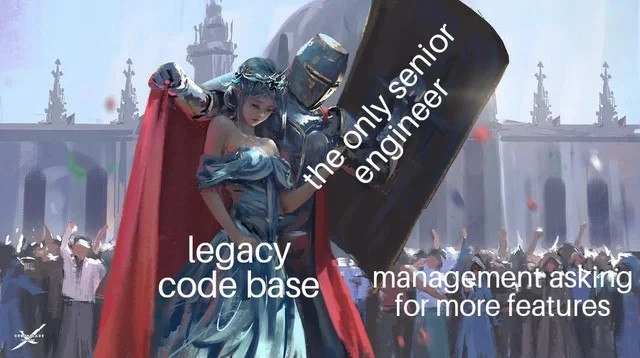
This meme paints an epic picture that seasoned engineers know all too well. Here we see a lone senior engineer cast as a medieval knight in shining armor, brandishing a massive shield labeled "the only senior engineer." Clutched behind that shield, like a protected princess, is the legacy code base – in all its fragile, monolithic glory. Charging from the background is a euphoric crowd labeled "management asking for more features," effectively an onslaught of relentless feature creep that the knight is fending off. It’s a humorous exaggeration of a very real workplace dynamic: one battle-hardened dev heroically defending an aging monolith against a barrage of new feature requests that threaten to knock the whole shaky system over.
In technical terms, the "Jurassic monolith" here refers to a monolithic architecture – a single colossal codebase (often millions of lines and decades of hacks) that runs an entire application or even a suite of business processes. This kind of system is usually a giant entangled beast: each part is tightly coupled to every other, so adding or changing one thing can unpredictably break a dozen others. Over years, such a codebase accumulates layer upon layer of technical debt (quick-and-dirty fixes, outdated libraries, kludgy integrations) to the point where it’s basically a museum exhibit of past technology decisions. Jurassic, indeed – some of these systems are so old that pieces of the code are like fossils from another era (looking at you, 2000s-era COBOL "mature" enterprise apps). The meme captures that perfectly by showing the legacy system as something precious yet precarious that needs shielding from harm.
Now, why is only one senior engineer holding the fort? This hints at a classic bus factor of 1 scenario (meaning if that one person disappears, the knowledge of the system gets hit by a bus too). In many enterprises, legacy systems end up being understood by just a handful of veterans – sometimes literally a lone subject matter expert who’s been around since the code’s Cretaceous period. That knight has scars under the armor: they’ve likely spent countless late nights patching production issues and bending that monolith without breaking it. They know which parts of the code are held together by duct tape and prayers. For example, they remember that one cron job that must run at 2 AM or the whole billing system goes haywire, or the magic number in the config that nobody should ever change from 42 because “trust me, it crashes otherwise.” All that lore lives with them. So when fresh-faced management or new devs come charging in yelling "Let’s add this cool new feature!", our lone knight instinctively raises the shield – not because they hate innovation, but because they know one ill-considered change could bring the whole ancient castle crashing down.
This leads us to feature creep, which the background crowd represents. Feature creep (or scope creep) is the tendency for project requirements to keep growing — “Can we also have it do X? Oh, and Y would be great too! Maybe just one more thing…” Management, product owners, and other non-engineering stakeholders often cheer for these additions (hence the confetti flying around in the meme). To them, more features mean happier customers or a competitive edge, so why not keep pushing? They’re like an excited medieval crowd at a tournament, blissfully unaware that each extra lance thrown (each new feature) adds weight on an already overloaded steed. The senior engineer, however, is painfully aware. Each new feature request on a legacy system feels less like a party and more like a siege on the codebase’s stability. They’ve seen how a "tiny change" can have a cascade effect of bugs. In a monolith, nothing is truly isolated — a simple update to the login module unexpectedly might break reporting, because who knows, they shared some hidden state or global config. The knight’s shield symbolizes saying "no" or at least "slow down" to these requests, absorbing the managerial pressure to prevent catastrophic collapse.
To experienced devs, this scenario is both hilarious and hauntingly familiar. It highlights the unwritten duty of senior engineers in legacy-laden organizations: acting as the last line of defense against whimsical change. The humor is in the dramatic role reversal – the senior dev isn’t coding or deploying in this image, but literally acting as a human shield. That’s how it feels sometimes when you’re the only one pushing back on unrealistic feature demands: you end up spending as much time in meetings explaining why “just one more feature” could blow up production as you do actually writing code. Everyone chuckles because we’ve either been that knight or watched one in action. The meme exaggerates reality (no actual swords at standups, hopefully) but nails the emotional truth. We grin at the absurd accuracy of it: management’s jubilant feature frenzy coming in like arrows, and the grizzled dev gritting their teeth thinking, “If you add one more task to this sprint, this whole thing could go to Valhalla.”
Let’s not forget the technical debt aspect lurking here. That legacy code base is teeming with it. Management might not see the structural weaknesses because from the outside the system still (mostly) works. But the senior engineer knows the debt is there – like cracks in a medieval fortress wall. Every time past management said “We don’t have time to rewrite this properly, just make it work for now,” a little gremlin of debt was added to the code. Over years, those gremlins multiplied. Now the code is so fragile that even a small new feature could wake the sleeping dragon of system failures. This is why the knight is so reluctant to let random projectiles (features) hit the castle walls. They’re painfully aware of the trade-offs that have piled up. In engineering terms, the system lacks modularity and safety nets: perhaps minimal automated tests, no continuous integration for this old repo, and highly stateful logic that’s tricky to tweak. Piling new requirements on it without reinforcing the foundation is asking for trouble. In short, our knight isn’t just being dramatic – they’re preventing a legacy meltdown.
We also see a bit of corporate culture critique: why is there only one knight to begin with? Ideally, knowledge about critical systems should be spread among multiple engineers, and legacy systems should be incrementally modernized or at least thoroughly documented. But enterprises often end up in a state where one person becomes the keeper of the legacy. Maybe others transferred, or newer engineers avoid the “scary old code” leaving it to the one patient soul. Management, on their part, often underestimates the complexity hidden in that old code. They hear “legacy system” and think “Oh, just old code, but you can still add this feature by next month, right?” Meanwhile, the senior dev is running a mental diff against every haunted module and calculating risk like a battlefield general. It’s a classic disconnect between Management_vs_Engineering mindsets: one side is all about new requirements, the other about system stability.
To visualize that disconnect, consider how the requests are perceived on each side:
| Management's Request | Engineer’s Behind-the-Shield Reaction |
|---|---|
| “It’s just a small UI change.” | “Small? There’s no such thing in this codebase...” |
| “We need this new feature ASAP!” | “Sure… which decade would you like that done by?” |
| “Our competitor has this, we must add it.” | “Our code might literally go extinct if we force this in.” |
| “Can we slip in one more change? 🙂” | “One more straw and this camel’s back will break.” |
The table above captures the meme’s subtext: what management says with a smile versus what the lone senior hears based on past trauma. It’s darkly funny because it’s true. The stakeholder pressure (feature requests with smiling 🙂 urgency) often belies the true cost seen by engineering (the camel’s back about to snap). The senior engineer essentially stands in front of the legacy system yelling “Hold on, do you want this thing to blow up!?” while the crowd of feature-hungry managers cheers obliviously. The corporate humor here is that everyone claims to value stability, but in practice the excitement over new features usually wins – until something breaks spectacularly, at which point all eyes turn to the knight: “Why didn’t you protect us from ourselves?”
Ultimately, this meme resonates on an almost spiritual level with developers who have been there. It’s depicting the heroics and absurdity of being the sole guardian of an old, creaky codebase. The senior engineer is doing their best to prevent a legacy system collapse, essentially saying no to feature creep so the software can live to fight another day. The humor comes from the medieval metaphor (because some days, software development does feel like war with dragons) and from the uncomfortable truth that many companies rely on a single overworked knight to prop up a dinosaur system while an army of feature requests beats on the gate. Legendary as that knight may be, we all know this situation is unsustainable – and that’s the unsaid punchline: sooner or later, either the monolith will crumble or the knight will collapse from exhaustion. But for now, in this single frame, the lone senior bravely holds the line, and everyone in the developer community both laughs and sighs in sympathy.
Description
Digital painting style meme: A fully armored medieval knight in a gleaming blue helm and red cape embraces a woman in a flowing teal dress. White overlay text on the woman reads "legacy code base." The knight’s large black shield bears the caption "the only senior engineer" in bold white letters. In the background, a cheering medieval crowd and confetti-like debris are labelled "management asking for more features," as if they’re the incoming threat the shield blocks. The scene humorously depicts the solitary senior developer protecting a fragile, decades-old codebase from relentless management demands, a familiar dilemma in enterprise environments dominated by technical debt and legacy stack constraints
Comments
7Comment deleted
You know you’re the bus-factor-one knight when your sprint board reads: DEFEND THE MONOLITH ➜ infinity story points
The bus factor is 1, the technical debt compounds at 12% annually, and somehow I'm both the knight and the dragon in this story
The senior engineer's dilemma: You're the only one who understands the legacy codebase well enough to refactor it, but you're also the only one who can deliver features fast enough to satisfy management - so you'll never get time to refactor it. It's the perfect catch-22, wrapped in a monolith, deployed on a server whose SSH key only you have
Our org implements backpressure with an artisanal API gateway called “the only senior engineer” - latency goes infinite on PTO, but it prevents catastrophic writes to the legacy schema
Current architecture: a single human WAF labeled “senior” shielding a 15-year-old monolith, and the official DR strategy is “hope they don’t take PTO.”
Senior eng motto: 'This legacy monolith has outlived three rewrites - features? Over my dead malloc.'
C++ devs routine work Comment deleted