Rebranding Technical Debt for the Modern Developer
Why is this TechDebt meme funny?
Level 1: Candy Now, Cavity Later
Imagine you decide to eat a ton of candy now and just worry about brushing your teeth later. At first, this sounds great – you get all the sweets right away and don’t think about any bad effects. But of course, if you gobble up all that candy, later you’ll end up with a bad stomach ache and maybe a bunch of cavities. Even if you give this plan a fun name like “Candy Now, Cavity Later,” it doesn’t stop your teeth from hurting in the end. You still have to face the consequences (and probably the dentist!). The meme is joking about the same idea: just calling a messy situation by a cool new name doesn’t make its problems go away. It’s a simple way to say, “Sure, you can skip the hard work now, but you’ll definitely pay for it later.”
Level 2: Marketing vs Reality
Technical debt is a term programmers use to describe what happens when they take shortcuts in coding that they’ll have to fix later. Imagine you have a project due and you write some quick-and-dirty code just to make it work. You might skip writing tests, duplicate some code, or ignore best practices to save time. All those shortcuts you took are like borrowing trouble from the future. We say you’ve incurred technical debt – meaning there’s a mess in the code you’ll need to clean up eventually (and it might be even harder to do later).
For example, maybe you leave a note in your code like // TODO: handle this properly because you know the current solution isn’t ideal but you don’t have time to refine it now. That comment is basically you saying, “I’ll deal with this later.” Here’s a tiny snippet showing what TechDebt might look like in code:
// Quick hack: we promise to fix this later (technical debt)
function getUser(id) {
// TODO: add proper error handling and input validation
return database.fetchUser(id); // returns undefined if id is bad, but oh well
}
See that TODO comment? It’s a marker of technical debt. You got the feature working (code now), but you postponed the cleanup (pay later). Every developer, especially early in their career, faces this trade-off. It feels great to solve the problem now, but those unfinished bits can come back as headaches.
Now, where does “code now, pay later” come from? It’s a play on the phrase “buy now, pay later” that you see in online shopping or finance apps. Buy Now, Pay Later (BNPL) is a service that lets you buy something immediately but pay for it over time in installments (often with extra fees or interest). It makes buying things feel easy because you don’t pay anything upfront. It’s basically a friendly way to say “get it now, deal with the cost later.” So, code now, pay later applies that idea to software: build the product now, deal with the consequences later. It’s a tongue-in-cheek way to rebrand technical debt with a trendy, seemingly harmless label.
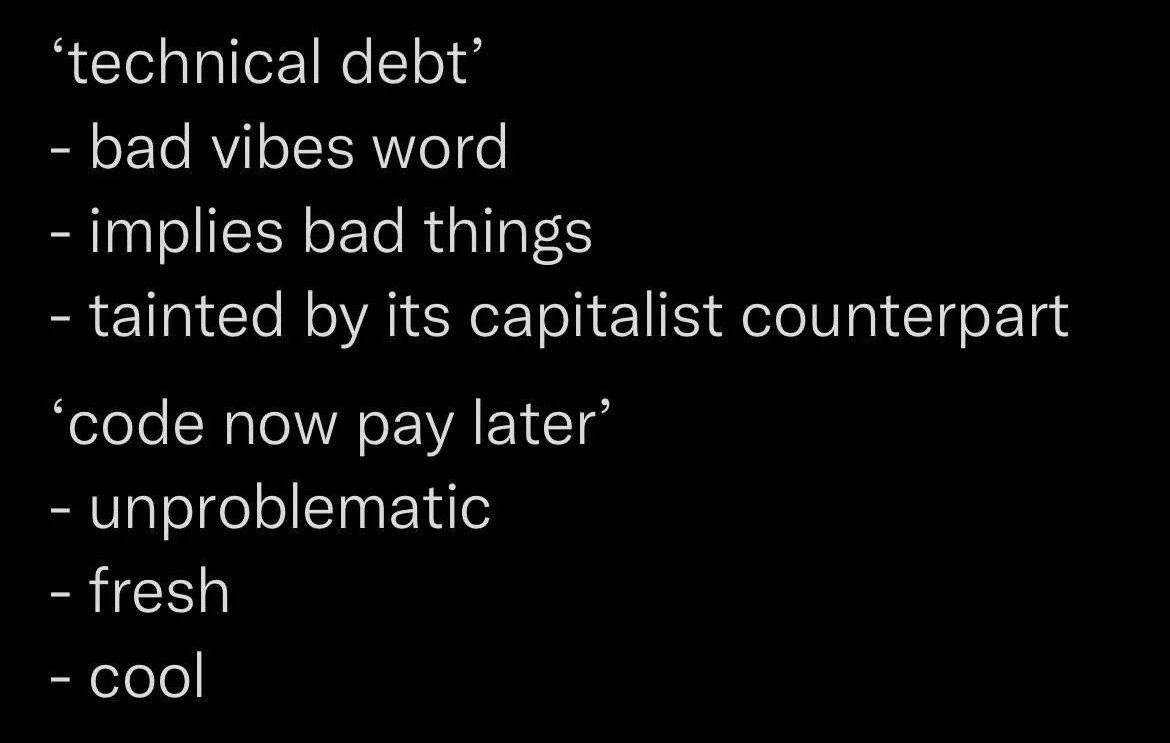
Of course, no matter what you call it, technical debt will still cause problems eventually. But in many companies, people try not to use the word “debt” because it sounds scary or negative. Corporate culture loves putting a positive spin on things. So instead of admitting they have a big technical debt problem, they come up with a friendlier phrasing. For example, someone might say, “We’re taking a code now, pay later approach on this project,” trying to make it sound more acceptable. The meme’s text captures this perfectly: it shows how “technical debt” as a term has negative vibes (implies bad things), and then how calling it “code now pay later” suddenly sounds unproblematic, fresh, and cool. It’s poking fun at this exact marketing vs reality gap. Even with a cute new name, those quick fixes will still slow the team down later on. The new label is just a euphemism – a nicer word to mask the messy reality.
This joke is very relatable humor for developers because we’ve all been in that situation: the boss wants features fast, and we say we’ll clean the code “next time” (though next time keeps getting pushed out). It’s a common shared pain in software teams. The meme basically winks and says, “Calling it ‘code now, pay later’ doesn’t change the fact that you’ll have to pay later!” Whether you’re a junior dev learning why rushed code can be trouble, or a senior dev nodding knowingly, the humor lands. A mess by any other name is still a mess – and eventually, somebody’s going to have to clean it up.
Level 3: New Name, Same Smell
In the enterprise world of TechDebt (technological compromise disguised as progress), senior engineers have watched this scenario on repeat: code quality sacrificed for speed, then management tries to package that wreckage in shiny wrapping. Technical debt is a term every experienced developer dreads because it literally implies a lingering liability. The phrase originated as a capitalist metaphor (Ward Cunningham coined it in the ’90s), likening rushed, suboptimal code to a financial debt. You borrow time now to ship a feature fast, but you’ll pay interest later in the form of slower development, gnarly bugs, and late-night fire-fighting. In practice, interest on technical debt accrues like compound interest in the codebase – each shortcut adds extra complexity that makes future changes even harder.
It’s no surprise that in many companies “technical debt” has become a bad vibes word. It conjures up images of looming bills and implies bad things: unstable systems, drawn-out refactors, maybe even a dreaded rewrite project on the horizon. The meme jokingly notes it’s “tainted by its capitalist counterpart” – indeed, the word debt reminds everyone of financial debt (never a fun topic in project meetings). Nobody likes hearing they have debt – whether on a credit card or in a codebase. It means eventually you’ve got a bill to pay, and it’s rarely pleasant.
Enter the corporate culture spin machine: if a term is too honest and scary, just rebrand it into something breezy. This meme hilariously shows marketing’s attempt to reframe technical debt as “code now, pay later” – basically a fintech-flavored euphemism. Why call it debt (ew, negative) when you can package it like a trendy Buy Now, Pay Later plan? Code now, pay later sounds so fresh and cool, almost like an exciting new feature rather than a ticking time bomb in your architecture. It’s the tech equivalent of putting lipstick on a pig: the pig is still a pig, but hey, now it’s an innovative pig with a payment plan! The humor here comes from that contrast: we all know renaming the problem doesn’t fix it, but marketing seems to think a catchy slogan will make everyone chill.
Seasoned devs have a sarcastic been-there-done-that chuckle at this rebranding. We’ve seen Marketing vs Reality collisions like this before. Sure, call that tangled legacy module a “Modularity Deferred Initiative” or dub your bug-ridden prototype the “Code Now, Pay Later strategy.” It doesn’t change the fact that someone (likely the on-call engineer at 3 AM) will eventually have to untangle the mess. In the trenches, we call that “paying the debt” – when all those shortcuts come due as a weekend lost to emergency refactoring or a midnight outage. The shared pain is very real. But from the air‑conditioned conference room, some executive is probably saying, “Don’t worry, it’s not technical debt… it’s our code now, pay later approach!” – as if a hip fintech catchphrase makes the underlying problems disappear. By riffing on the popular buy now, pay later analogy, the meme highlights how absurd it is to treat tech debt like a harmless installment plan. In online shopping, Buy Now, Pay Later makes spending money feel painless (until the bill arrives with interest). In software, Code Now, Pay Later tries to make shipping unstable code sound unproblematic. But trust me, the bill always comes due – and it often includes hefty on-call sleep debt with a side of burnout.
Description
A text-based meme on a black background with white text. It presents a comparison between two terms. The first term is 'technical debt', which is described with negative attributes: '- bad vibes word', '- implies bad things', '- tainted by its capitalist counterpart'. The second term, presented as a preferable alternative, is 'code now pay later', which is described with positive attributes: '- unproblematic', '- fresh', '- cool'. The humor lies in the satirical reframing of a negative but critical software engineering concept (technical debt) into a trendy, financially-inspired term ('buy now, pay later') to make it seem more palatable. It's a commentary on the tech industry's tendency to use marketing-style language to downplay persistent problems and the consequences of sacrificing long-term code quality for short-term gains
Comments
12Comment deleted
Our startup doesn't accumulate technical debt; we issue 'future implementation bonds'. They're like zero-coupon bonds, but instead of maturing, they just cause production outages
Sure, let’s call it “code now, pay later” - just remember the interest rate is measured in midnight hotfixes
After 20 years in the industry, I've learned that technical debt compounds at a higher interest rate than any BNPL scheme, but at least Klarna doesn't wake you up at 3am when the payment comes due in production
Ah yes, let's rebrand technical debt as 'code now pay later' - because nothing says 'we've learned from our mistakes' quite like adopting the naming convention of predatory consumer financing. At least when the codebase collapses under its own weight in 18 months, we can offer stakeholders a convenient 0% APR restructuring plan with only minor penalties for early refactoring
Call it “code now, pay later” if you like - the interest still compounds into 3am pages and your SLO reads like an APR
Technical debt's capitalist stench? Rebrand to 'code now pay later' - fresh vibes until prod's compound interest triggers the outage cascade
Call it 'code now, pay later' if you like - the APR is still denominated in on-call pages per deploy
backward quality growth Comment deleted
be paid now code later Comment deleted
Our debt! Comment deleted
>“debt” phrase is tainted by capitalism >better use “buy now pay later” Comment deleted
And later someone else will pay. Comment deleted