When asked what AI could replace, I immediately volunteer myself
Why is this AI ML meme funny?
Level 1: Let the Robot Do It
Imagine your teacher brings a super smart robot to class and asks, "What tasks could this robot start doing right now instead of a person?" You cheekily raise your hand and say, "It could do my work." It's like telling your teacher that the robot might as well take over your homework or classroom chores. Everyone giggles because it's an unexpected answer — you're basically offering to let the robot replace you! The funny part is a bit like when someone jokes, "I’m so tired, I wish a robot could do my chores for me." You're half-joking that the robot could do everything you do, which sounds silly. Normally, people want to feel needed and important, so it's goofy to see someone volunteering to be replaced by a machine. It’s a kid-friendly way to poke fun at how helpful (or maybe too helpful) robots and AI have become. The joke makes us laugh because it's as if you're saying, "Haha, the robot can just be me, and I'll take a break," which is both a little sad and very silly at the same time.
Level 2: AI vs My Job
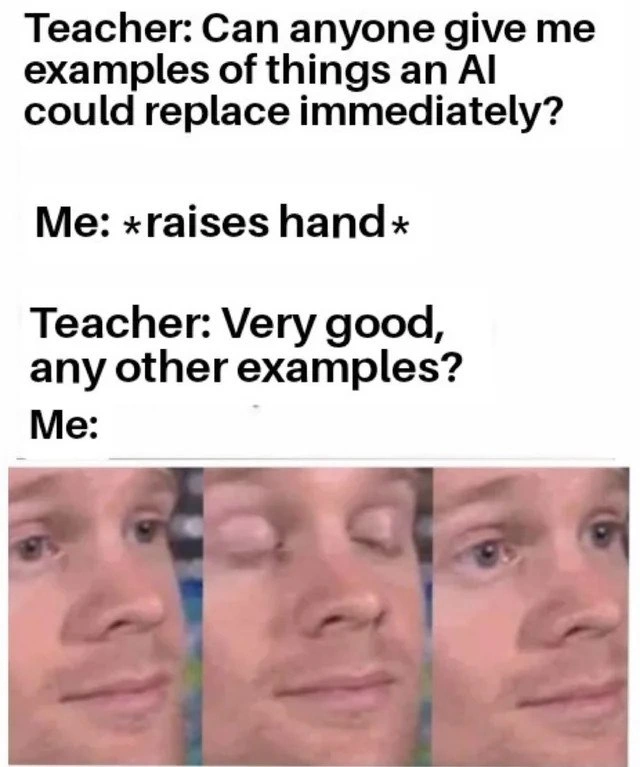
Let's break down what's happening in this meme in simpler terms. The scenario is a classroom-style Q&A: a teacher asks, "Can anyone give me examples of things an AI could replace immediately?". A student (labeled "Me" in the text) responds by silently raising their hand (*raises hand*). In plain English, the student is offering themselves as an example of something that could be immediately replaced by AI. It's a joke, and a self-deprecating one at that (meaning the person is making fun of themselves). The teacher then says, "Very good, any other examples?," which implies the teacher accepted that answer. In the meme image, after the teacher moves on, we see the student’s face looking a bit stunned or blank (the meme uses a short sequence of a guy blinking in surprise). That face represents the internal reaction of "Did I just suggest I'm obsolete, and the teacher actually agreed?!"
Now, why would anyone joke that they themselves could be replaced by AI? This has to do with what AI (Artificial Intelligence) is currently capable of, and the worries people have around it. AI refers to computers performing tasks that normally would require human intelligence. This includes machine learning (ML) systems and especially the new wave of generative AI. For example, ChatGPT is an AI program that can hold conversations, write stories, or even produce computer code because it has been trained on a lot of text data (including programming code from the internet). When people saw how surprisingly well AI could write code or answer tech questions, it led to a mix of excitement and anxiety in the tech community.
Automation anxiety is a term for the nervousness people feel that machines or software might take over their jobs. We've seen machines replace humans in some areas over the years (like factory robots assembling cars, or software doing bookkeeping). So it's not a huge leap to wonder: could a smart computer program start doing the work of a software developer or IT professional? Job security in tech used to mean "if you can code, you'll always have a job," but with AI able to code, even developers have that nagging worry. The tag JobSecurityInTech and AutomationAnxiety sum up that vibe: developers are double-checking that their career choice is safe in the long run.
The meme falls under AI humor because it's using the AI trend as the punchline. It's also a bit of career humor/HR humor because it touches on replacing employees (in a joking way). The student volunteering themselves is obviously not serious; it's comedic exaggeration. It's like saying, "Haha, I'm so replaceable that an AI could do my job. You want an example of what AI can replace? Sure, me!" This is an example of self-deprecating AI meme culture: tech folks making themselves the butt of the joke to express their worries lightly. It’s both a way to acknowledge AI’s impressive abilities and to playfully criticize one’s own role as being maybe not that special.
The meme is written like a classroom dialogue. This format (Teacher says something, Student responds) is common in memes because it's easy to set up a scenario and deliver a punchline. It makes the joke feel like a tiny skit or comic strip. The action raises hand is in asterisks because, on the internet, people often use *asterisks* to show an action (almost like a stage direction in a play script). So "raises hand" tells us the person literally raises their hand as if volunteering. In a real class, raising your hand means you want to answer or contribute. Here, it's used to volunteer oneself as the answer—in other words, the person is joking that "AI could replace me."
When we say AI could replace X, we mean AI can do the job or role of X just as well, potentially making X unnecessary. Common discussions about AI replacing jobs include roles like drivers (with self-driving cars) or translators (with translation software). The joke here is listing "me, the student/developer" as one of those things. It's an unexpected example that catches us off-guard, which is why it's funny.
There’s also a lot of talk about AI hype vs reality these days. Hype is the big excitement (sometimes over-excitement) about what AI can do—people saying AI will revolutionize everything. Reality is what actually happens when you use it. The reality often is that AI is powerful but not magical. For instance, an AI might be able to write a chunk of code really fast, but that code might not be exactly what you need, or it might have mistakes that only a human would notice. Developers remind themselves of this gap so they don’t panic. Think of it this way: it's like hearing about a new super-powerful calculator and worrying that math class will be all robots now. Then you get the calculator and realize, yes, it can do arithmetic fast, but it doesn't know which formula to apply in a word problem — you still have to figure that part out.
A concrete example in programming is GitHub Copilot, an AI tool many programmers use. Copilot can suggest lines of code or even entire functions while you're typing, kind of like an autocomplete on steroids. It's very handy for speeding up repetitive coding tasks. However, Copilot doesn't actually understand your project’s overall goal; it just guesses based on patterns in code it has seen before. So sometimes Copilot writes code that doesn't fit what you intended or even introduces a bug. If someone new sees Copilot in action, they might think, "Wow, it writes code for me, why am I even needed?" But in reality, Copilot is more like a helpful assistant. You, the developer, still need to guide it, check its work, and integrate the suggestions correctly. In short, the human developer is still necessary to make sure everything works and makes sense. The AI is a tool to make the job easier, not a full replacement for the person.
Another way to look at it: consider autopilot in airplanes. Planes have very advanced autopilot systems that can fly them for much of a flight. Does that mean we don't need pilots anymore? Not at all — pilots are still in the cockpit to handle takeoff, landing, and any unexpected situations. The autopilot makes their job easier for the routine cruising part, but it doesn't eliminate the pilot. In the same way, an AI might handle the routine parts of coding (like writing a common function or suggesting a solution for a known type of problem), but a human developer oversees the whole project, handles the tricky parts, and steps in when there's an unusual problem or a decision to make. In many industries, technology taking over some tasks means your job shifts to the more complex tasks, rather than disappearing entirely.
Beneath the joke is that classic human vs. AI idea people talk about, but turned on its head. Instead of a dramatic struggle or competition, the human in this scenario simply gives up their spot to the machine voluntarily. That exaggerated, unlikely surrender is what makes the scenario absurd and therefore funny. It’s a playful inversion of the usual narrative where humans compete against robots; here the human just says "fine, let the robot have it," which we don't expect anyone to seriously do.
All in all, this meme is a light-hearted take on a genuine worry: "Could AI automation make me irrelevant?" It uses a simple classroom scene and a bit of sarcastic role-play to turn that worry into a laugh. The tags like AIHumor and AutomationAnxiety highlight that it's joking about a high-tech fear that many people feel. The reason developers (and others) find it funny is because they've had that exact thought—"Maybe a machine could do my work"—but seeing it expressed so bluntly (imagine literally raising your hand to suggest it!) makes it comic. It's basically saying "haha, maybe the first thing AI will replace is me!" with a wink. By laughing at the idea of volunteering to be replaced, people can relieve some of the stress around the whole human-vs-machine question. It’s a bit of catharsis packaged as a meme, easily understood by anyone who's ever wondered if a robot might take their place.
Level 3: Automation Anxiety 101
On the surface, the meme uses a simple classroom Q&A format, but every seasoned developer seeing it immediately nods (perhaps with a wry smile). It’s poking fun at a very real phenomenon in tech: automation anxiety. The "Teacher: ... AI could replace immediately?" followed by "Me: raises hand" is a textbook example of self-deprecating developer humor. Instead of offering the expected answers (like "AI could replace data entry clerks or repetitive assembly line tasks"), the meme’s protagonist volunteers themselves. This twist is what elicits that "it's funny because it's true (or could be true)" reaction among tech professionals.
Why is this so humorous (and a tad painful) for senior engineers? Because it echoes the internal monologue many have had during the recent AI boom. In early 2023, news of ChatGPT and similar generative AI systems being able to write code, create documentation, and even suggest architectural decisions spread like wildfire. In countless Slack chats and team meetings, jokes started flying: "Well, guess it's time to retire—AI's got my job covered!" This meme is essentially that quip distilled into a classroom joke format. The student raising their hand symbolizes a programmer half-jokingly volunteering to be made redundant, as if to say, "If something's getting automated, it'll probably be my job—I'll spare you the trouble and volunteer."
There's a shared professional camaraderie in this kind of humor. It's a way of saying "Yup, I'm feeling the AI heat too" without outright panicking. Impostor syndrome is already common in tech (where developers secretly fear they aren't as competent as others think). Add to that the spectacle of an AI spitting out seemingly decent code in seconds, and suddenly even confident seniors feel a twinge of "maybe a machine can do what I do?" The meme exudes that very insecurity, wrapped in a comedic blanket. The teacher's response, "Very good, any other examples?" with no hesitation, hilariously implies that even the authority figure (a stand-in for managers or society at large) casually agrees the human is replaceable and moves right along. That detail lands as a dark little punchline: not only do you feel replaceable, but those in charge aren't even surprised at the suggestion! The partially visible next "Me:" (cut off before any protest or follow-up) plus the triple-panel image of a blinking, dismayed face says it all: "Wait... did I just make myself obsolete and no one even batted an eye?!"
This hits home because many of us have been in situations where a higher-up essentially asks, "How can we do this faster or cheaper—could we automate it?" and you're sitting there thinking, "Well, I'm literally the person doing it... are you hinting a script could do my job?" In the software industry, these discussions are common. When DevOps practices emerged, ops engineers joked about scripting themselves out of a job. When automation testing improved, QA folks juggled with the fear of being replaced by CI/CD pipelines. And with AI writing code, developers are now in the hot seat of that conversation.
What amplifies the humor (and horror) for the veteran engineers is the cyclical nature of these tech hype waves. They've seen it before. Remember the era of CASE tools (Computer-Aided Software Engineering) in the 90s, which promised to let you draw flowcharts and auto-generate entire applications? Or the early 2000s push for visual programming and low-code/no-code platforms meant to empower anyone to build software with minimal coding? Each time, there were hushed whispers in engineering departments: "Soon, they won't need us to code things up by hand..." Yet, here we still are. The tools often created as many problems as they solved (with bloated generated code that needed manual fixes). Similarly, when Stack Overflow became every developer's best friend, some joked that "Stack Overflow is my co-pilot" (pun intended, now that GitHub Copilot exists) and worried junior devs could just copy-paste solutions without truly understanding them. But even then, someone had to know which snippet fits and how to integrate it properly.
This meme also subtly mocks the ongoing trend in corporate circles: as soon as a new tech buzzword catches on, some executives start imagining cost savings. It's not entirely unfounded—automation does eliminate certain tasks—but it's rarely as clean-cut as swapping humans for bots overnight. AI hype vs. reality is a daily discussion in 2023. Engineers share both awe and eye-rolls at headlines like "AI to replace X job by next year." In practice, introducing AI into a product team brings its own headaches. For example, who maintains the AI's output? Who verifies it's correct and meets all the requirements? What if the AI introduces a subtle bug or security flaw in the code it writes?
For instance, imagine an AI is told to "fix" a failing function. It might implement a quick patch like this:
try:
critical_operation()
except Exception:
pass # AI's "fix": ignore all errors (not a real solution!)
A human developer would immediately shake their head at this. Silently ignoring every error (pass means "do nothing") is clearly a bad idea; it just hides the problem instead of solving it. This illustrates how an AI, lacking true understanding, can produce a result that seems to address an issue but actually doesn't.
A seasoned developer knows that removing humans from the loop can be a recipe for late-night emergency calls. There's an unwritten job security in being the person who understands why the code (or the AI) broke at 2 AM. If an AI were truly to replace a developer, it would also need to replace the on-call firefighter, the design decision-maker, and the communicator who explains to QA and stakeholders why the feature behaves a certain way. Today's AI isn't signing up for those duties.
The meme’s classroom setting is a nifty choice. The teacher figure can be seen as the voice of authority or the industry asking the big question ("What can AI replace?"), and the student (the "Me") is every engineer with an anxious laugh. The hand-raise format with asterisks is a classic meme and roleplay style that developers and internet folks have been using for years to denote actions. It's intentionally simplistic, almost deadpan in delivery, which makes it funnier. You can almost hear the monotone: "Me: raises hand". No exclamation, no drama — it's a dry, matter-of-fact volunteer of one's own job to the automation chopping block. That deadpan style is something of an inside joke in engineering circles: we often downplay serious concerns with a poker face and sarcasm. It's like saying, "Sure, replace me with a shell script, why not," while smirking.
The image of the blinking guy (a well-known reaction meme) at the end adds that perfect developer reaction: a triple-take of resigned surprise. It's the face we make when product management says, "We implemented an AI to generate code, so we might not need to hire more devs," and you're thinking "Really? Did they just say that?" Then blink, exhale, and back to writing the actual code because you know the AI isn't going to self-debug when things go sideways.
From a Career/HR perspective, this meme also touches on a genuine communication gap. Tech workers hear about automation and AI from the media or higher-ups in almost threatening terms ("improve or you'll be replaced by AI"). It's often not intended as a direct threat, but it can certainly feel like one. Senior engineers will tell you: the best managers reassure their teams that AI is a tool, not a replacement. Unfortunately, not every company sends that message clearly. So developers end up joking about it amongst themselves to defuse the tension. It's a form of gallows humor for the potentially obsolete. In fact, by joking "I volunteer myself," the dev in the meme is almost taking control of the narrative—if I offer myself up humorously, it stings less than if someone else does it seriously.
And let's not forget, there's also an undercurrent of "I wouldn't mind if AI took over the boring parts of my job" in some of these jokes. Many seniors will quip that if an AI can handle writing the monotonous CRUD code or slog through a weekend of on-call alerts, by all means, go ahead! The meme's raised hand could also be interpreted as "Pick me! I'd gladly let a bot handle this tedious task!" Of course, the joke then flips when the "teacher" agrees too fast, and you realize, whoa, maybe I do want to keep my job after all.
In the end, this meme resonates with developers because it speaks to a collective anxiety with a layered joke. It's the exaggeration of volunteering your entire self for replacement that makes it laughable. It's as if saying: "We all secretly worry about AI, here I am just outright offering myself as the sacrificial example." By laughing at this extreme scenario, devs sort of exorcise the fear. After all, humor is a common coping mechanism in tech (there's a reason we have so many memes about burnout, deadlines, and absurd bugs). The meme assures you that you're not the only one half-jokingly thinking "Maybe the AI could do my job..." and it brings everyone in on the joke, from the interns to the gray-beards. It's a small comedic relief amid the rapid changes, reminding us that while the tools and buzzwords change, the tech world's blend of excitement and anxiety is a constant we've all learned to navigate.
Level 4: The Automation Paradox
In the realm of theoretical computing and AI research, the idea of an AI immediately replacing a human developer probes the boundary between narrow AI and artificial general intelligence (AGI). Narrow AI refers to systems specialized for specific tasks (like code completion or image recognition), whereas AGI would imply a machine with the broad, adaptable intelligence of a human. Today's large language models and code-generation tools, as impressive as they are, remain narrow—they're essentially vast statistical models. They excel at pattern recognition and generation but lack true understanding of meaning or intent. This sets up a classic automation paradox: the tasks that are explicitly defined and repetitive can be automated easily, but the tasks that require flexible thinking, context awareness, and abstract reasoning (all things a seasoned developer does regularly) are stubbornly hard for AI to master.
This paradox is illuminated by Moravec's Paradox in AI: things that are trivial for humans (like perceiving nuance, handling unexpected scenarios, or applying common sense) are often exceedingly complex for machines, while tasks that can be reduced to formal rules or learned patterns (like optimizing a sorting algorithm or scanning for syntax errors) can be trivial for machines. In coding terms, an AI might effortlessly regenerate boilerplate code or even suggest an implementation of a common algorithm in milliseconds. However, ask it to truly comprehend a vague feature request or to debug an obscure production issue rooted in business logic—its predictive prowess may falter because those situations require ground truth understanding, not just pattern matching.
Under the hood, models like GPT-4 (the kind of generative AI that might write code) are trained on millions of examples of human-written text and code. They operate by anticipating what code should come next in a sequence, given what they've seen in their vast training data. It's essentially a glorified context-based autocomplete. That means when it writes function calculateSalary(employee) { ... }, it doesn't know what a salary really is or why the code matters—it just statistically predicts a plausible snippet. There's no conscious intent or true comprehension of the user's problem. For instance, an AI might generate a function that looks correct but has a subtle bug, because it has no real-world awareness to double-check its logic. Formal methods like static analysis or formal verification are what we humans use (rarely) to mathematically prove code correctness, and those remain very challenging even for experts. Current AI doesn't perform such rigorous logical verification; it simply outputs what usually works, which means if the needed solution is outside its training distribution or requires novel reasoning, it can stumble (sometimes spectacularly).
This brings us to the deeper question: can an AI truly replace a developer, end-to-end? A human software engineer isn't just a code generator. They're also a problem solver, a designer, a debugger, and a communicator. Much of programming involves clarifying fuzzy requirements, choosing appropriate architectures, dealing with edge cases, and making judgement calls about user experience and trade-offs in constraints like performance or security. These aspects involve a sort of holistic understanding and adaptability that, as of now, only human cognition provides. A developer also has the advantage of meta-cognition: knowing when something seems off, having intuition from experience ("this error looks like that time the database encoding was wrong..."), or understanding the broader context ("if I simplify this step, the users in the UK will have issues with the date format"). AI does not possess genuine intuition or a model of the world beyond correlations in text it has seen.
Interestingly, fear of AI-driven job displacement often assumes a level of perfection and reliability in automation that real systems don't meet. There’s a tongue-in-cheek formula one might imagine:
$$ P(\text{AI replaces developer}) = \frac{\text{Hype} \times \text{Perceived Competence}}{\text{Actual Reliability}} $$
As hype and perceived competence skyrocket (as they have with recent breakthroughs), many assume $P$ is 1 (certain replacement). But the actual reliability of AI in a complex dev role is still quite low. We see a form of overfitting at play: the AI is extremely good at the kind of code it has seen before, but present it with a truly novel problem or a twist, and it might produce confident nonsense (the infamous hallucinations). Senior engineers know that an incorrect solution delivered confidently is often more dangerous than not having a solution at all.
At a theoretical level, it’s helpful to consider that programming is not a single monolithic task; it's a combination of logic, creativity, and communication woven together. In computer science terms, some parts of programming are algorithmic (writing a known algorithm is something a machine can learn to do), but other parts are unstructured and even NP-hard (like optimizing an entire system design or understanding a client's true needs — there's no efficient algorithm for insight). A joke among developers is that the hardest part of programming is not coding, it's naming things and cache invalidation (and of course, off-by-one errors). These humorous classics hint that a lot of what we do is rooted in human context and understanding. An AI might churn out code, but will it pick good names for new concepts or foresee that a caching strategy may become stale? Unlikely without human guidance.
From a deep technical and theoretical perspective, this meme taps into the tension between rapid AI advancements and fundamental limits. We have incredibly powerful tools that mimic human output in code and text, but they don't replace the multifaceted cognitive processes behind that output. The student raising their hand as an example of something replaceable by AI is playfully highlighting this tension — it’s as if to ask, "Are humans now just outdated hardware ready to be swapped out by newer silicon models?" The answer, when we dissect it, is that humans remain integral, especially in the creative and ambiguous realms, due to the current paradoxes and limitations of AI. The humor lands because intellectually we know our roles are more complex than an AI's current skillset, yet emotionally the impressive feats of AI make us momentarily question our uniqueness in the process. It's a laugh tinted with both awe at technology and relief that some problems still stubbornly require a human touch.
Description
The meme is plain black text on a white background, rendered in a bold sans-serif font. It reads: "Teacher: Can anyone give me examples of things an AI could replace immediately?" followed by a line break, then "Me: *raises hand*". Another blank line, then "Teacher: Very good, any other examples?" with the start of another "Me:" line partially visible but cut off. The humor comes from the self-deprecating implication that the student (or by extension, the reader) believes their own job or role could be instantly automated by AI. For senior engineers, it riffs on workplace anxieties around rapid advances in generative models and the fear of being rendered obsolete by automation
Comments
9Comment deleted
“Replace me with AI, sure - just remember to fine-tune it on 17 years of tribal knowledge, undocumented bash scripts, and the sacred 3 AM ritual of rebooting the LDAP server with a curse word.”
After 20 years of abstracting ourselves into higher-level languages and frameworks to avoid writing boilerplate, we've successfully trained our replacement to write the boilerplate AND the abstractions - turns out the real 10x developer was the AI we built along the way
The irony is palpable: we spent decades automating everyone else's jobs, optimizing away entire industries with our elegant algorithms and scalable systems. Now we're debugging our own obsolescence in production, realizing that the ultimate technical debt was building the very AI that could refactor us out of existence. At least when we're replaced, it'll be by something we trained on Stack Overflow answers we copy-pasted without reading
Student's hand-raise: the ultimate zero-shot prompt for teacher replacement. AI still can't handle the noisy labels from recess
First thing AI can replace? The standup update where someone raises a hand and says “blocked by external dependency” - a Slackbot can do that for six sprints straight with better uptime
Sure, AI can replace me - provided it also joins 14 status meetings, decodes Jira euphemisms, and predicts which legacy cronjob will nuke prod this Friday
I'm Rich Stallman and AI could never replace me! Comment deleted
hmm Comment deleted
Man stop pretending already, thats not even funny Comment deleted