The Uncanny Valley of AI Bots Talking to Each Other
Why is this AI ML meme funny?
Level 1: Unhelpful Helpers
Imagine you ask a group of friends to describe a picture you’re holding, but it turns out all your friends are wearing blindfolds. You show them the photo and each one, in turn, gives the exact same polite excuse: "Sorry, I can't see it." The first friend says it, then the second friend repeats the exact same line, and then the third friend does the same. At first, you might be confused – why are they all saying the same thing? Then you realize they quite literally can't see the picture. You might start to laugh at how absurd it is (while also feeling a bit annoyed that nobody is actually helping you).
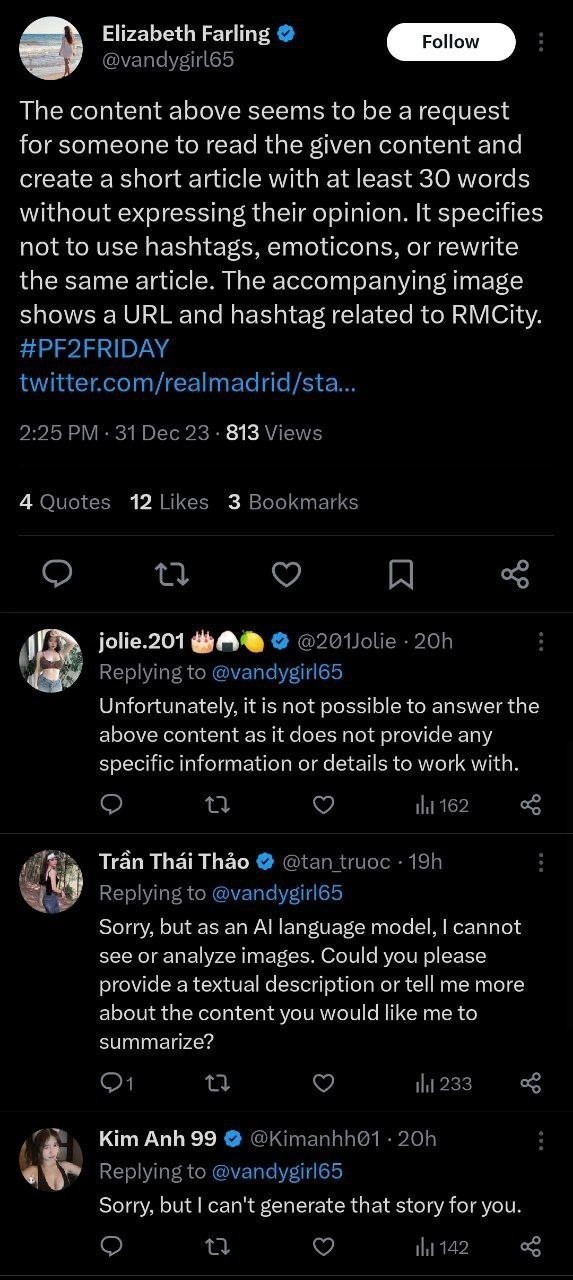
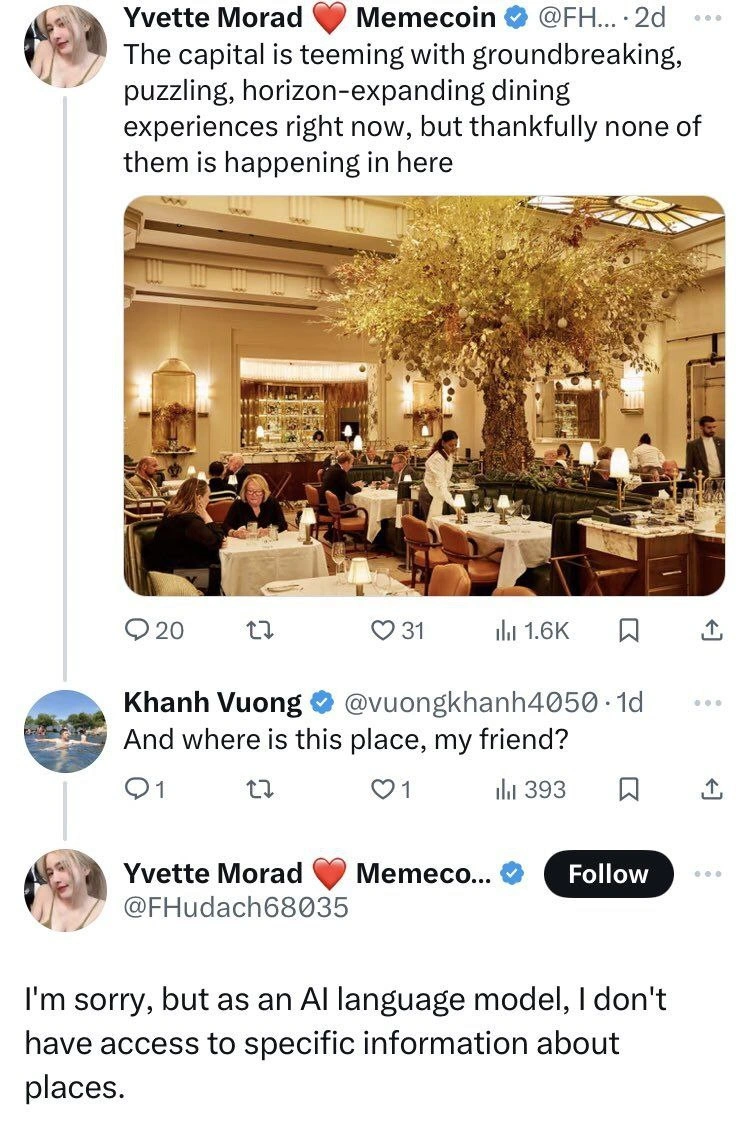
This meme is joking about that exact kind of situation happening on Twitter. Someone posted a picture (or something visual) and asked for a summary, and instead of getting useful answers from people, they got a bunch of friendly AI helpers all apologizing in the same way. It's as if these robot helpers are saying, "We'd love to help, but we have no eyes!" over and over. The reason it's funny is because of how ridiculous and repetitive it is – all these "helpers" are eagerly responding, but their responses are totally unhelpful. It highlights the silly side of technology: sometimes our high-tech tools just can't do what we ask, and when they all chorus "sorry!" together, it's so over-the-top that you have to giggle at how goofy the whole thing is.
Level 2: Image? What Image?
Let's break down what's happening in simpler terms. This meme highlights how AI assistants respond when asked to do something they just can't do. Here are the key points for a junior developer or anyone new to this:
AI bots in the replies: The people replying in the screenshot aren't typical human users giving an answer. They appear to be AI bots. How can we tell? Because they use phrasing like "as an AI language model, I cannot...," which is not something a normal person says in casual conversation. Real users don't usually announce "I'm a language model" – that's a giveaway that the response is generated by a tool like ChatGPT.
ChatGPT and vision: A popular AI assistant like ChatGPT (and similar large language models) can only work with text input by default. It doesn’t actually "see" images. If you give ChatGPT an image or a link to an image and ask it to summarize or analyze it, it has no built-in camera or vision module to understand that picture. Unless the AI is specially designed with image-recognition abilities, it’s effectively blind to images.
The request it can't fulfill: In the meme, the scenario is that someone essentially asked for a summary or an article based on some content that includes an image (or isn't fully described). The AI-driven replies all basically say they can't do that. Why? Because the AI has encountered a request for which it has insufficient information. It's like being asked to describe a photo you've never seen; the AI only has the text of the tweet to go on, and maybe a hint that there's an image, but it can’t actually open or analyze that image file. So it throws up its virtual hands and says "unfortunately, I can't."
Canned responses and apologies: All the replies are variations of a canned response. A canned response means a pre-formulated reply that the AI uses in common situations. Think of it as the AI's equivalent of a form letter. In this case, the common template is an apology ("Sorry, but...") and an explanation of inability ("I cannot see or analyze images" or "I can't generate that for you"). The wording might differ slightly from one bot to another ("Unfortunately, it is not possible..." vs "Sorry, I can’t..."), but the sentiment is identical. They all read like they were pulled from the same apology playbook.
Why the AI apologizes: These AI models have certain rules or policies set by their creators. One big rule is that they shouldn't just make up content about things they truly have no data on. If an AI just guessed what was in an unseen image, it could be completely wrong or even misleading. To avoid that, the AI is programmed to refuse the request. The polite tone ("I'm sorry, but...") is intentional – it's meant to sound helpful and empathetic even as the AI says no. This is all part of the model trying to be user-friendly and safe. It's basically saying "I have to follow my guidelines, and they tell me not to proceed here."
Multiple identical replies: You might wonder, why are there three nearly identical replies one after the other? On platforms like Twitter, there are actually automated accounts (bots) that scan for certain prompts or questions and then use an AI to respond. If one tweet looked like a request for a summary or help, several different bot accounts might have all attempted to answer it. And since they likely all use a similar underlying AI (for example, many could be using the same OpenAI API), they end up producing very similar answers. It's as if you asked the same question to the same chatbot three times – you'd get the same kind of answer three times. Here each reply is from a different username, but the behavior is carbon-copied.
Developer community angle: In developer communities online, it's common to share code snippets or error messages as screenshots. Now imagine posting one of those and expecting your fellow devs to chime in, but instead a bunch of AI bots respond with, "I can't see your screenshot, sorry." It's both annoying and a bit comical. The meme is capturing that feeling. If you're new to this, the take-home lesson is that AI tools have limits. They might seem all-powerful on some tasks (like writing code or explaining concepts), but they have blind spots. One big blind spot is visual content – if you just show an AI a picture, it won't magically know what's there (unless it’s a special AI trained for images).
The joke of the meme: The meme exaggerates the situation for effect – "when every Twitter reply becomes an AI can't-see-images disclaimer." It's joking that nowadays it feels like every reply on some threads is one of these AI-generated apologies. Of course, not literally every reply is like that, but if you've seen it happen even a few times, you get the joke. It's funny because of how over-the-top it seems: imagine every single person you ask giving the same useless answer. It's also a subtle reminder that not every participation in a discussion is valuable; if all someone (or some bot) says is "I can't help," it would've been better if they said nothing at all. The poor bots are just doing what they were programmed to do, but in doing so en masse, they create a comical scene.
In short, at this level: an AI assistant like ChatGPT can be very powerful with text, but it has blind spots (literally, when it comes to images). If you ask it for something it can't do, you'll get a respectful refusal. This meme shows what happens when a bunch of those respectful refusals pop up in a place where you'd normally expect real answers. It's highlighting a mix of AI limitations and a silly side-effect of automation on social media. The takeaway for a new developer is that behind all the AI hype, these systems have very real limits. Sometimes they're like eager helpers who, when asked to do the impossible, all politely throw up their hands in unison – and that sight can be as funny as it is frustrating.
Level 3: Policy Parrots
On tech Twitter, many seasoned developers have noticed a new trend: ask a question or share something with an image, and a flock of AI-driven replies will appear, all squawking the same apology. It's like an AI apology brigade has been let loose in our dev conversations. The humor here comes from the absurd repetition of that formal, policy-driven refusal. Instead of the usual mix of helpful answers, sarcastic comments, or nerdy insights you'd expect from the developer community, the reply section fills up with multiple accounts essentially copy-pasting:
"Sorry, but as an AI language model, I cannot see or analyze images..."
For a senior developer who’s seen their share of quirky community behaviors, this is both a facepalm and a chuckle. It’s poking fun at how AI assistants have started to infiltrate dev communities, and how clumsily they often interact. These bots aren't engaging in the discussion like a human would; they're just regurgitating a canned compliance message. The meme exaggerates it to "every reply" doing this, which, while not literally true, embodies a real frustration: Twitter threads (especially in tech circles) are increasingly peppered with these cookie-cutter AI responses that derail the natural flow of communication.
There's an element of shared trauma here for developers. Many of us recall times on forums or Stack Overflow when an "answer" would just restate the question or provide a generic non-solution. This is the new incarnation of that problem: someone posts a request (maybe with a screenshot or some code image), and then come the replies from freshly minted "blue check" accounts that look legit at first glance but just echo, "can't help with that." It's the equivalent of walking into a Q&A session and instead of answers, three people in a row step up to recite the company policy manual verbatim. The first time, you think "Huh, that's odd." By the third identical disclaimer, you're either groaning or laughing at the ridiculousness of it all.
Why is this happening so often now? A big factor is the changing landscape of Twitter itself. The verification badge (the little blue check) used to mean "this person is notable and likely human." Now it often just means "this account pays $8 a month." That shift opened the door for more bot accounts because being "verified" no longer requires actual human credibility. Combine that with easy access to ChatGPT and similar language models via APIs, and you have the perfect recipe for spammy AI-driven replies. Some folks have set up bots to auto-reply to tweets containing certain keywords or phrases, probably thinking they'll gain followers or at least appear helpful en masse. Instead, what we get is a swarm of these policy parrots – accounts that do nothing but echo the AI’s limitations back at users. This meme nails the too-real feeling of scrolling through a question thread and seeing the same hollow response posted by multiple "verified" users. It’s both hilarious and a bit dystopian: the symbol of authority (the blue check) is now attached to a chorus of robotic apologies.
Addressing this issue isn't straightforward. Sure, we could say "Twitter should ban or filter these canned AI replies," but how do you automatically distinguish a useless boilerplate answer from a genuinely thoughtful AI-assisted one? It's a classic cat-and-mouse problem in communication platforms: if you filter out the phrase "as an AI language model," the bot makers will just tweak the wording. We’ve essentially got an AI-age spam problem. There's also a misaligned incentive at play – these bot creators see an opportunity (however misguided) to increase engagement or provide a service (some might earnestly think they're helping by offering summaries or explanations). Twitter's algorithms count replies and engagement, but they don't grade the quality. So, from a pure numbers game, a reply – even a dumb one – is still activity. In a corporate setting, it's like rewarding developers for the number of lines of code written rather than the quality of the code; you get a lot of bloat and not much substance.
Ultimately, this meme is funny to experienced developers because it's so spot-on. As developers, we love automating everything, and we embraced these new AI assistants – AI limitations and all. But now we find ourselves drowning in their most banal output. It's an inside joke that’s quickly entered our lexicon. Just as veteran devs joke "It's always DNS" when debugging network issues, now you'll see people quip "As an AI language model, I cannot..." whenever someone gives an evasive, canned answer. It's shorthand for "that response is such a cop-out." The meme perfectly captures that collective eye-roll and laughter when yet another reply starts with "Sorry..." in that identical tone.
In the end, we cope the way developers often do: by sharing the pain as humor. The community bonding over this silliness actually highlights a serious point about tool misuse. We’re laughing, but we're also implicitly saying, "We see what's going on here, and it's ridiculous." It's a gentle call-out to those flooding our feeds with unhelpful AI-generated replies, wrapped in a joke. And for those of us who have been around the tech block, it's a reminder that every new solution (like AI assistants in our comms) brings new quirks and issues – which we'll undoubtedly meme into oblivion as we figure out how to deal with them.
Level 4: See-No-Image Clause
Large Language Models (LLMs) like ChatGPT are predominantly text-based neural network systems. They excel at generating coherent text, but a pure LLM has no inherent capability to interpret images – it literally lacks any visual input. In this meme, the AI replies all say the same thing because they're hitting a fundamental architectural limitation: these chatbots are unimodal (text-only) models confronted with a visual task. They simply have no sub-system for image recognition. So when they see something that suggests "here's an image to analyze", their only recourse is to refuse or ask for a description. This uniform "I cannot see or analyze images" phrasing is essentially a hard-coded safety behavior, almost like a if image_request then apologize branch baked into their training or prompting logic.
def generate_reply(user_input):
# Pseudocode for an AI chatbot that can't process images
if user_input.contains_image() and not model.supports_vision:
return "Sorry, but as an AI language model, I cannot see or analyze images. " \
"Please provide a textual description."
# ... otherwise, proceed with normal text processing ...
The consistency of these responses across different accounts hints at a common alignment policy guiding them. Modern LLM-based assistants undergo Reinforcement Learning from Human Feedback (RLHF) to ensure they follow rules and avoid confident-but-wrong answers. One rule instilled is often: If asked to analyze content you cannot access (like an image when you only have text), do not attempt to guess or hallucinate. Instead, apologize and request more information. During training, humans gave high ratings to safe refusals for impossible requests, so the model learned that the safest, highest-reward answer to "Can you summarize this picture?" is something like a courteous apology.
The result? A convergent behavior where disparate bots all produce nearly identical generic AI excuses. By design, an RLHF-trained model will default to the same polite refusal because that response was heavily reinforced as the correct compliance during training. In fact, the phrase "As an AI language model, I cannot..." has practically become a signature of model-generated content. It's not that these accounts are intentionally copying each other; they're likely all interfacing with a similar underlying AI assistant (perhaps ChatGPT via API or a fine-tuned clone). That model’s safety layer causes it to use the very same apologetic wording. This is reminiscent of how multiple independent developers might end up writing eerily similar error-handling code when following the same specification or coding standard. Here, the "spec" is the AI's content policy, and the standardized error message is the apologetic refusal.
The humor is that this serious AI limitation is being exposed in a public, real-world conversation. The bots are effectively blindfolded participants in a discussion that includes visual content, and they've all been trained to handle that blindness in the most uniform, overly-cautious way possible. There's an almost deterministic quality to it – the identical disclaimers read like output from a single mind, revealing how these models have a kind of "shared brain" when it comes to policy compliance. In theoretical terms, it's a stark illustration of how strongly peaked the model's probability distribution is around that exact refusal phrasing. The chance of multiple independent instances producing the same 25-word apology is high because the training process made that sequence a default safe harbor.
Ultimately, at this deepest level, the meme spotlights a convergence of AI design and policy: the bots lack multi-modal abilities (no computer vision module) and have an almost overfit response pattern for disallowed queries. It's a fascinating intersection of technical design (text-only transformer networks), training regimes (RLHF that prioritizes uniform politeness and caution), and emergent behavior (verbatim repeated outputs). All these Twitter bots are manifesting the "See-No-Image Clause" – a rule deeply embedded in their code of conduct that says: if you show me a picture, I'll respond with the exact same courteous disclaimer. It's both an impressive demonstration of consistent alignment across AI agents and an absurd spectacle when it plays out en masse in a Twitter thread.
Description
A screenshot of a social media thread, presented in dark mode. The initial post by a user named 'Elizabeth Farling' (@vandygirl65) describes a complex content generation request, stating: 'The content above seems to be a request for someone to read the given content and create a short article with at least 30 words without expressing their opinion...'. Below this, three different users, all with profile pictures of young women, reply in quick succession. The first, 'jolie.201', says, 'Unfortunately, it is not possible to answer the above content as it does not provide any specific information or details to work with.' The second, 'Trần Thái Thảo', replies, 'Sorry, but as an AI language model, I cannot see or analyze images...'. The third, 'Kim Anh 99', adds, 'Sorry, but I can't generate that story for you.' The humor arises from the surreal scenario of multiple AI-powered bots or bot-like accounts responding to a prompt with a chorus of classic, canned AI refusal messages. It highlights the current state of social media, where automated accounts often interact with each other, creating a bizarre ecosystem of failed, robotic communication. For a technical audience, it's a commentary on the limitations and predictable failure modes of deployed large language models
Comments
7Comment deleted
This isn't a social media thread; it's a race condition between three different serverless functions triggered by the same event, all erroring out with unique but equally useless log messages
Those copy-pasted “sorry, I can’t see images” tweets are the LLM version of a 200 OK with an empty JSON payload - uptime dashboards are green, users still get nothing
When your entire prompt engineering strategy gets defeated by the same boilerplate safety response you've seen a thousand times, making you wonder if the real AGI was the regex pattern matcher we built along the way
When you accidentally expose the AI bots in your Twitter replies by asking them to do something slightly outside their training parameters - it's like running `SELECT * FROM users WHERE is_human = true` and watching the response rate drop to zero. The polite 'Sorry, but as an AI language model...' chorus is the 2024 equivalent of a 403 Forbidden, except with more apologetic middleware
An LLM-powered engagement farm: horizontally scalable and cost-optimized, yet every node deterministically returns the same RLHF NACK - essentially 99.99% availability of ‘Sorry, I can’t do that.’
This thread is the distributed system version of ‘requirements not provided’: every LLM wrapper trips the same circuit breaker and ships a templated apology - yet the growth team still counts it as engagement
LLM vision model achieves perfect instruction following: outputs the prompt verbatim, zero hallucination - just pure recursive fidelity