When AI progress graphs forget there’s a second hyperbola branch
Why is this AI ML meme funny?
Level 1: Infinity and Beyond?
Imagine you have a friend who’s super excited and says, “My new toy robot is getting smarter so fast that by the time we reach my next birthday, it will be infinitely smart!” You see them draw a little chart where the line stays low for a while, then suddenly zooms straight up to an infinite point at that birthday. It’s like saying the robot’s intelligence will go through the roof and off the charts – literally to infinity. That sounds kind of like a crazy, over-the-top promise, right? Now, you being a curious kid, point at the chart and ask, “Okay, but what happens after that birthday? Your line was shooting up like a rocket to infinity… does it keep going? Does it come down? Does it go negative or below zero? What does that even mean?”
Your friend pauses, confused – they hadn’t thought about that. The truth is, saying something will grow to infinity by a certain time is almost like a cartoonish exaggeration. If we take it seriously, it’s as if after reaching an impossible point, the prediction just breaks. In a silly sense, it’s like saying, “After my robot becomes infinitely smart, the next day it might have negative intelligence (which doesn’t make any sense – how can you have less than zero smarts?).” This whole scenario is funny because it shows a person getting carried away by hype and not thinking it through. They focused only on the exciting part (“to infinity!!”) and ignored the fact that their prediction beyond that point is gibberish.
This meme is doing the same thing with AI progress. People are excited, saying AI will improve faster and faster, almost like a rocket ship blasting upward. The meme jokes, “If you really believe it’s going to go hyperbolic (crazy fast to infinity), then tell me what this weird part of the graph is!” – highlighting a part of the picture where the line goes crazy downward after the big blast-off. The emotional core here is a mix of skepticism and humor: it’s poking fun at wild promises. It’s like hearing someone brag that they’ll count to infinity and then asking them, “And then what? Count backwards from infinity?!” You’re basically catching the exaggeration and showing it’s a bit ridiculous.
So even without any fancy math, the simple idea is: be careful when people say something will grow without limit. In real life, nothing just becomes infinite; there’s usually some practical limit or a twist. The meme uses a funny graph with a strange “other side” to say, “Hey, that wild claim doesn’t really make sense, does it?” It’s amusing because it’s a reality check wrapped in a joke – reminding us that what goes up super dramatically might come down or break in an equally dramatic way if we’re not realistic.
Level 2: Second Branch Surprise
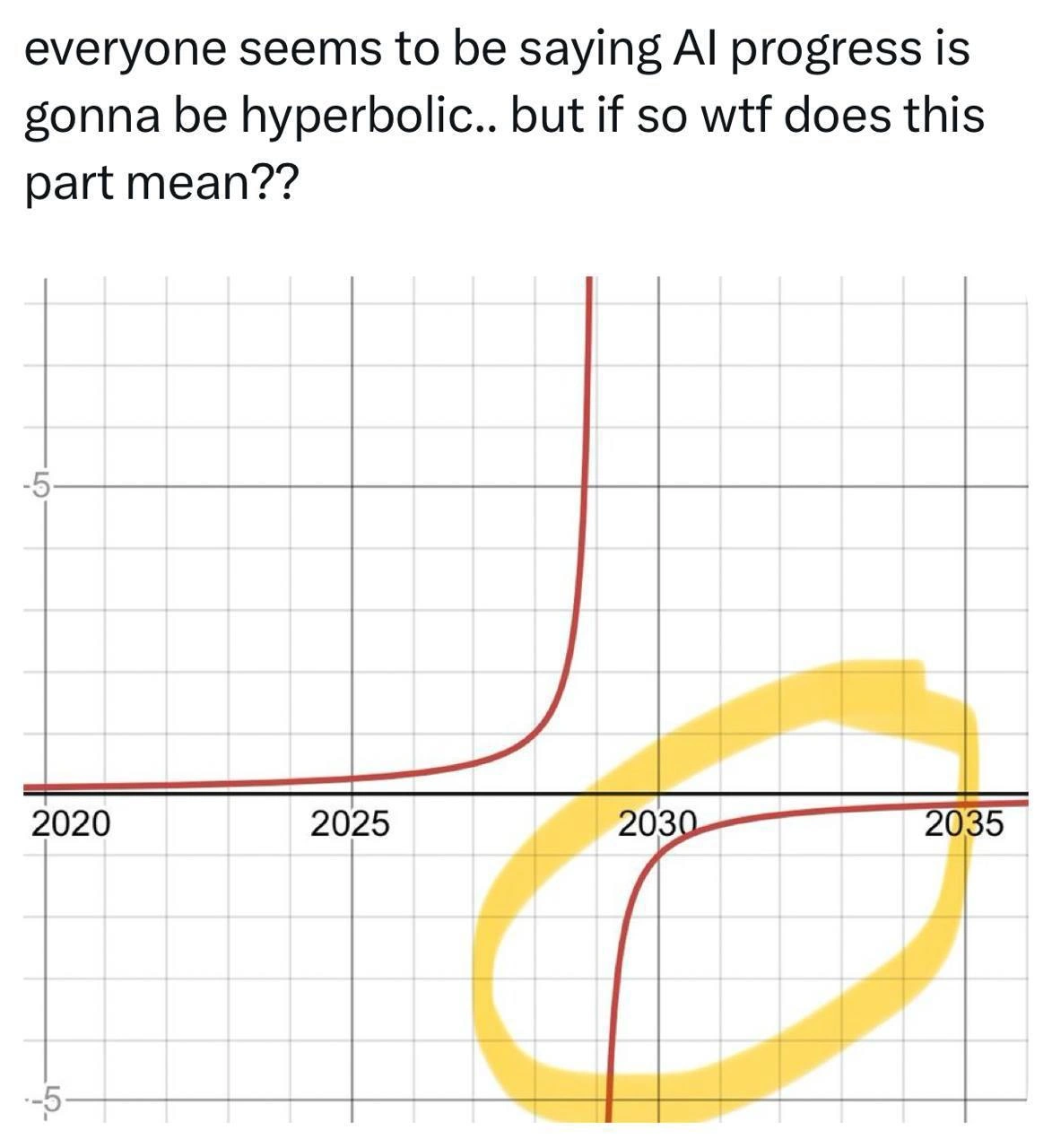
Let’s break down the joke in simpler terms. The meme creator drew a hyperbolic function on a graph to mock the phrase "AI progress is gonna be hyperbolic." A hyperbolic function (in this context) is one that looks like an upside-down L-shape curve that shoots up towards infinity at a certain point, and actually has two pieces (two branches). The key features to understand are:
Vertical asymptote: This is a vertical line on the graph (here around the year 2030) that the curve approaches but never touches. As the input (time, in years) gets close to this line from the left side, the output (AI progress, whatever that means) goes up to infinity. It literally becomes astronomically large. If you plug the year 2030 into a formula like
1/(2030 - t), you’d be dividing by zero, which is undefined – that’s why the curve goes whoosh straight up. It’s basically a mathematical way of saying “something blows up at this point and the formula breaks.” In the graph, that’s the red line going vertical at 2030. This idea of hitting infinity at a finite time is analogous to the popular notion of the technological singularity – a point where AI becomes infinitely powerful or changes civilization in an unfathomable way.The second branch: A hyperbola isn’t a single continuous curve; it has a mirror-image portion on the other side of the asymptote. After the year 2030 (to the right of that vertical line), the mathematical function doesn’t just vanish – it produces another curve (the red line in the yellow highlight) that comes from negative infinity at just past 2030 and rises upward toward 0 by the year 2035. In plain terms, the formula would spit out negative values after 2030. So if before 2030 the graph was going up to +∞, immediately after 2030 it starts at -∞ and climbs upward (getting less negative) approaching zero. This is weird if you’re thinking about “AI progress” – negative progress doesn’t really have a clear meaning. You can’t have less than nothing progress, or negative intelligence (the idea of AI getting infinitely dumb or causing massive regression perhaps?). It’s clearly a nonsensical scenario in real terms.
Now, why is this funny? The text on the meme says: “everyone seems to be saying AI progress is gonna be hyperbolic... but if so wtf does this part mean??” – pointing to that second (negative) branch. The humor comes from a mix-up in language and a bit of math education. People often say “hyperbolic” when they mean “exaggerated” or “extremely fast” (technically they might mean exponential growth, which is a more common way to describe rapid increase). But hyperbolic in a strict math sense refers to this two-branch curve with a vertical asymptote. The meme-maker is acting like they take the statement literally. It’s as if someone proclaimed a very specific mathematical model for AI, and our meme-maker goes, “Alright, here’s the hyperbola graph of AI progress — now explain this downward crazy part!” It’s highlighting that the person who said “hyperbolic” probably didn’t consider or even know about the second branch at all.
In simpler tech terms, imagine an excited prediction: “By 2030, AI will be infinite in power!” That’s essentially what the upper branch implies (a near-infinite jump in capability as we approach 2030). Now a literal-minded nerd says, “Okay, and after 2030? Does AI power become negative infinite? Huh? Explain that!” Of course, the prediction wasn’t meant to be that rigorous – it was hype. So the meme humorously exposes the flaw in using that hyperbolic model. It’s a gotcha: the speaker used a big word or concept without understanding it fully, and now the overlooked consequences (the “second branch surprise”) make the whole statement sound absurd.
Let’s define a few terms and concepts from the meme for clarity:
Hyperbolic function: In math, this is a function like
y = 1/xor any similar reciprocal function that produces a hyperbola shape. It grows toward infinity asxapproaches some value (its asymptote), and it has a symmetrical part that goes toward negative infinity on the other side of that value. It’s important to note this is different from “hyperbolic” in common English (which means exaggerated or over-the-top). Here it literally refers to that two-part curve.Hyperbole (the English word): Means exaggeration. It’s funny because saying AI progress will be hyperbolic is itself hyperbole. The meme trades on this dual meaning. In one sense folks are exaggerating AI’s future (hyperbole), in another sense they inadvertently invoked a math curve (hyperbola) that doesn’t really fit nicely with reality. The tags like AIHype and misapplied_math capture this: the hype is overblown and the math is misused.
Vertical asymptote (in this graph): The vertical line at ~2030 where things blow up. Think of it as a wall in time that the function can’t cross normally. As you approach the wall, the output goes to infinity or negative infinity. In an equation form, it’s where the denominator goes to zero (like
2030 - t = 0). This concept pops up whenever you have something like a division by(T_c - t)– you can’t inputt = T_c, it’s a singularity (an undefined point). The meme uses year labels (2020, 2025, 2030, 2035) on the x-axis, suggesting 2030 is that special yearT_cwhere a singularity happens.Technological singularity: A popular idea in futurism and AI discussions. It’s not a math term, but it fits the picture – it’s the hypothetical moment AI becomes so advanced (possibly self-improving recursively) that its growth in capability becomes vertical – off the charts, beyond human comprehension. In hype terms, it’s when AI progress hits “infinite” on the graph. The meme humorously graphed that concept with an actual mathematical singularity. The text “wtf does this part mean” points to the aftermath of such a singularity in the literal math sense, which no one really talks about because, well, in the real singularity scenario, time beyond that is “undefined” in the model – anything could happen (or our models just don't apply). The meme is a lighthearted way to show the ridiculousness of drawing a simple graph for something so complex and the danger of taking analogies too far.
Doom branch: This isn’t a standard term; it’s a jokey label (from the tags) for that negative part of the curve. Since that second branch plunges into negative territory (like something terrible), one could whimsically call it the “doom branch” – as if it forecasts doom or a catastrophic decline after the singularity. In AI debates, there are indeed AI doomers who predict catastrophe (like superintelligence turning against us). So you can see an tongue-in-cheek parallel: one branch of thought says AI will shoot to utopian heights, another says after a point it could all go terribly wrong (the doomsday scenario). The meme’s graph isn’t literally about those scenarios, but it echoes them in a fun, graphical way.
In summary, at this level, the meme is both a math lesson and a cautionary tale about predictions. It reminds newcomers that not every flashy tech forecast is grounded in proper math or reality. If someone uses a mathematical term (like hyperbolic growth) incorrectly, you can end up with a goofy situation — like a graph that predicts infinite AI power followed by some mysterious negative future. The “second branch surprise” is basically the meme-maker cheekily asking the hype-men: “Did you actually think about the consequences of what you’re saying, or were you just throwing big words around?” It encourages a healthy skepticism: understand the model you use, and don’t take wild predictions at face value, especially if they promise infinity (or apocalypse) by a certain date.
Level 3: Hyperbole vs Hyperbola
For seasoned developers and industry observers, this meme lands as a clever mix of AI hype skepticism and math nerd humor. The phrase “AI progress is gonna be hyperbolic” sounds grandiose, but it’s technically suspect. Experienced folks recognize that people often conflate hyperbole (exaggeration, hype) with mathematical hyperbolic growth. So the meme’s author takes that literally and says, “Alright, if you insist progress follows a hyperbola, you gotta account for the weird part of that curve too!” – pointing to the ominous second branch. Essentially, it’s calling out the hype cycle and over-extrapolation so common in the tech industry. We’ve all seen Gartner’s “Peak of Inflated Expectations” followed by the “Trough of Disillusionment”. In AI, that pattern has appeared before: periods of extreme optimism (AI will solve everything by year X!) followed by crashes known as “AI winters” when the promises don’t materialize immediately. The yellow-circled branch on the graph tongue-in-cheek looks like a “trough” that nobody talked about – as if the unchecked AI hype could lead not only to a peak, but to a dramatic plunge. The meme implicitly asks: What if the same rhetoric predicting infinite growth is unintentionally also predicting an infinite crash?
From a senior perspective, the humor also lies in misapplied modeling – something many of us have encountered in projects or seen in sensational tech forecasts. Extrapolating trends is a risky game. If a data scientist or analyst tried to fit a curve to AI’s progress and naively chose a hyperbolic function (perhaps because performance metrics were improving faster and faster), they’d produce a graph exactly like this: creeping up slowly, then shooting toward infinity at some critical date. It might even fit past data decently up to that point. But any seasoned engineer knows to question such a model: “What happens after that date? Does the world end? Does the metric go negative? Your equation suggests something crazy beyond the range of your data.” In real predictive analytics, we guard against overfitting and nonsensical extrapolations – and here the meme is a satire of hype-driven overfitting. It playfully posits that the AI cheerleaders have essentially “overfit” their growth model to a hyperbola without thinking through the full domain.
To illustrate in coder terms, imagine we formalize this hype curve model in a quick Python snippet:
def hyperbolic_model(year):
# A naive hyperbolic growth model with a singularity at 2030
return 100 / (2030 - year) # 100 is an arbitrary scale factor for "AI progress metric"
# Test the model at various points in time
for year in [2025, 2028, 2029, 2030, 2031, 2035]:
try:
progress = hyperbolic_model(year)
print(f"{year}: {progress:.2f}")
except ZeroDivisionError as e:
print(f"{year}: Error -> {e}")
Running this would yield something like:
2025: 20.00
2028: 33.33
2029: 50.00
2030: Error -> division by zero # Boom, singularity year not computable
2031: -100.00 # progress jumps to a huge negative value
2035: -20.00 # by 2035 it's creeping back toward zero from below
This comically mirrors the meme’s graph. By 2029 our AI progress metric is shooting up (50 units and climbing fast). At 2030 the ZeroDivisionError hits – the model blows up (the mathematical singularity). In 2031, the formula doesn’t magically stop; it returns a negative value (-100), which is nonsensical as a measure of progress. By 2035, it’s -20, inching upward toward 0. This silly experiment highlights exactly what the meme is showing visually: following a hyperbolic model blindly leads to an “undefined” moment and then a bizarre negative trajectory. It’s a programmer-friendly way to see why believing a pure hyperbola forecast is folly. As senior devs, we chuckle because it’s a classic case of “did you even look at the whole function, bro?” – akin to shipping code that handles the sunny-day scenario but never considered what happens after an overflow or a sign flip.
The broader industry commentary here is about AI hype vs. reality. In recent years (especially leading up to 2025 and beyond), we’ve heard countless claims about AI’s rapid progress – sometimes phrased as “progress is exponential!” or even mistakenly as “hyperbolic”. The meme wittily says: if you truly expect a vertical takeoff in AI (a singularity curve), you might want to check what your model implies right after that takeoff. The circled “wtf” branch might symbolize unanticipated consequences: maybe an AI crash, a plateau, or even a dystopian reversal (the term doom_branch in the tags hints that some interpret the negative branch as “AI progress becomes AI catastrophe”). It resonates with the wariness many veterans have: every tech revolution has limits and often a backlash. If someone is painting an unbounded utopia with no consideration of pitfalls, an experienced engineer will smirk — the real world usually throws a curve (or in this case, a second curve!).
So, the meme gets a laugh from those in the know on multiple levels:
- It’s a visual pun on the word “hyperbolic,” conflating marketing hype with actual math.
- It satirizes the AI hype cycle, suggesting that after the fever pitch of singularity talk, reality might smack us in the face (perhaps not literally a negative dive, but certainly not an endless vertical ascent).
- It nudges us to remember our Calc 101 or modeling sanity checks: don’t trust a curve without understanding its domain and asymptotes. If your forecast literally goes to infinity, something’s off. As the saying goes in engineering meetings: “This graph goes vertical here... that’s never a good sign in real life.”
In short, hyperbole vs. hyperbola is the heart of the humor. The industry is full of hyperbolic claims (“AI will solve everything in 5 years!”), and this meme cleverly responds: “Sure, bud, hyperbolic – just don’t forget that little detail where your fancy curve predicts the end of the world (or whatever that bottom part means) right after your so-called singularity.” It’s a nerdy way to keep hype in check, using the language of math that true techies appreciate.
Level 4: The Other Side of Infinity
At the most technical level, this meme highlights a mathematical misinterpretation involving hyperbolic functions and the concept of a finite-time singularity. In mathematics, a hyperbola is a two-branch curve typically described by an equation like y = 1/(T_c - t) or more generally x·y = C (a rectangular hyperbola). The graph shown is essentially one branch of a hyperbolic function that shoots up toward a vertical asymptote (the red curve going to +∞ just before year 2030), and the other branch diving from -∞ on the far side of that asymptote (the circled yellow part after 2030). A vertical asymptote at t = 2030 means the function’s value grows without bound as time t approaches 2030 from the left, and becomes undefined at 2030 (division by zero), then reappears as a negative infinite value just past 2030 on the right side. In other words, the red curve goes to infinite AI progress as it nears the year 2030 from before, and then the complementary branch implies negative progress after that moment – which is mathematically required by the function, but physically nonsensical in real-world interpretation.
This kind of hyperbolic curve implies a finite-time singularity – a point in time where the output skyrockets to infinity. Such behavior is far more extreme than standard exponential growth. For comparison, an exponential function (like y = e^(0.3·t)) grows without bound as t → ∞, but it never becomes infinite at any finite time; it just keeps doubling over longer periods. A hyperbolic function y = 1/(T_c - t) instead blows up at a finite critical time T_c. This critical time acts like a threshold beyond which the model cannot be extended (because you’d be dividing by zero). Mathematically, if you plug in any time t beyond T_c, the formula yields negative values approaching zero from below. The graph in the meme literally draws that: as time moves past 2030, T_c - t becomes negative, and the red line emerges from negative infinity and climbs back up toward 0 by 2035. That downward branch is a direct consequence of the function’s symmetric behavior around the asymptote.
To a mathematician or data scientist, seeing someone claim “AI progress is gonna be hyperbolic” immediately raises a flag: do they truly mean it will follow a hyperbolic function curve (implying a vertical asymptote – essentially an infinite blow-up at some date)? Or are they just using “hyperbolic” as a fancy synonym for “really, really fast”? If they truly mean the former, the math predicts a bizarre outcome: as we approach the singularity year, some metric of AI capability would trend to infinity (unbounded growth). And then, if one naïvely continues the hyperbolic model, the metric would flip to negative infinity beyond that point – which in practical terms is absurd. This is what the meme’s caption jokes about: “WTF does this part mean??” – pointing at the neglected second branch of the hyperbola that any proper graph of a hyperbolic function would have.
There’s some genuine theoretical context here. The idea of a technological singularity in AI (popularized by futurists like Vernor Vinge and Ray Kurzweil) often envisions a moment of runaway growth in intelligence – effectively a vertical asymptote in progress around some year. Mathematicians sometimes model finite-time singularities with hyperbolic functions or power-law divergences. In fact, hyperbolic growth models were historically used to predict things like world population growth. An infamous example: in the 1960s, some researchers fitted a hyperbolic curve to population data and predicted infinite population by the year 2026, with the tongue-in-cheek label “Doomsday Curve.” Of course, in reality, no population or technological metric can literally become infinite; constraints kick in, models shift—something gives. Those hyperbolic extrapolations “forget” that beyond the asymptote, the mathematical model breaks down. The meme leverages this exact notion: taking the rhetoric of “AI progress will be hyperbolic” to its literal mathematical conclusion, and then poking fun at the obvious absurdity of that conclusion by highlighting the mysterious “doom branch” that appears after the singularity. In essence, the humor operates on the gap between the precise mathematical meaning of hyperbolic growth and the colloquial hyperbole of tech hype. It’s a little jab of misapplied math satire: if we’re going to use impressive math words to describe AI trends, we’d better be ready to explain the whole curve, second branch and all. The meme-maker knows that the typical AI evangelist wasn’t considering any negative branch — and that’s exactly why it’s funny to draw attention to it.
Description
Meme shows a Cartesian grid with a red hyperbolic curve plotted against time on the x-axis (labels: 2020, 2025, 2030, 2035) and unlabeled y-axis gridlines ranging roughly from - 5 to +∞. Above the plot, black text reads: “everyone seems to be saying AI progress is gonna be hyperbolic.. but if so wtf does this part mean??”. The curve hugs the x-axis until ~2028, then shoots vertically upward toward infinity just before the 2030 tick; the complementary branch dives from - ∞ just before 2030 and rises back toward zero by 2035. A thick yellow oval highlights this lower (negative) branch, implying confusion about what a hyperbola’s ‘other side’ forecasts for AI. The humor riffs on hype-curve extrapolations, mathematical literacy, and the tendency to assume unbounded exponential-style growth while ignoring inconvenient asymptotes and inverse branches
Comments
14Comment deleted
That circled region is the CFO’s budget line after you scale model parameters past 10¹² - turns out the singularity has a balance-sheet antipode
Ah yes, the classic AI hyperbolic growth curve that becomes so advanced it invents time travel, goes back to 2030, and decides to tank its own progress after realizing it left the GPU cluster running and the AWS bill exceeded the GDP of several nations
Ah yes, the classic mistake of extrapolating hyperbolic growth without considering the full domain - turns out when you model AI progress with y = 1/(x-2028), nobody mentions the asymptote works both ways. That downward curve after 2030? That's either the heat death of GPU clusters, or the moment we realize we've been overfitting on benchmarks this whole time. Perhaps the real singularity was the mathematical functions we misunderstood along the way
Post-spike drop: when trillion-param models hit the Bekenstein bound and start entropy-encoding their own obsolescence
Everyone says AI growth is hyperbolic; great - are our OKRs on the branch before the 2030 asymptote, or the one after it where progress < 0 and the budget divides by zero?
If AI progress is truly hyperbolic, we race toward 1/(2030−t) infinity - then discover budgets and regulation are discontinuous functions, landing on the other branch; in other words, welcome to production
Back to sticks and stones Comment deleted
Exactly Comment deleted
World population Comment deleted
The machines rose from ashes of the nuclear fire... Comment deleted
world war III with huge amount of nuclear weapon use Comment deleted
integer overflow Comment deleted
that's because no one knows what will be after, maybe it's like negative temperature that's actually hotter than any positive temperature 😁 Comment deleted
Asynshit Comment deleted