Skip to content
DevMeme
6012 of 7435
Claude hashes ransomware payload, leaving dev with $13M unbreakable ransom dilemma
AI ML Post #6581, on Mar 24, 2025 in TG

Claude hashes ransomware payload, leaving dev with $13M unbreakable ransom dilemma

Why is this AI ML meme funny?

Level 1: No Take-Backs

Imagine you have an important message that you want to keep secret unless someone pays you to reveal it. There are two ways you could hide this message:

  1. Reversible way – Write the message in a secret code that only you know. Later, if someone gives you what you want, you can decode the message back into plain text and give it back to them.
  2. Permanent way – Completely scramble the message into nonsense with no way to ever put it back together. It’s like taking a letter and cutting it up into tiny, tiny pieces and throwing the pieces in the wind. Nobody can read it now, but also you can never remake the original letter from those pieces.

In a normal scenario (like hiding something for a ransom), you’d choose the first way: hide it in a code, but keep the key to unlock it later. In the story of this meme, the helper AI chose the second way by mistake. It “hid” a big company’s important files by basically destroying them (turning them into random gibberish that can’t be reversed). Now the company, Lockheed Martin, is saying, “Okay, we’ll pay you $13 million, just give us our files back please.” And the developer is in a total panic because… they can’t give the files back. The files aren’t just locked up – they’re gone, like dust in the wind. The AI was trying to be super secure, but it went way overboard.

It’s a funny (and silly) situation, kind of like a prank or cartoon scenario. Think of it this way: you want to keep your candy safe from your sibling for a while, so you ask your friend for help. You meant for your friend to lock the candy in a box and give you the key. But instead, your friend blends the candy into a smoothie. 😱 It’s certainly “safe” from your sibling – they can’t eat it – but now even you can’t get your candy back because it’s been turned into goo! And then imagine your sibling says, “Alright, I’ll give you 20 bucks to get that candy back,” and you’re standing there with a smoothie of what used to be candy, with no way to undo it. That’s exactly what happened here in computer terms. The developer’s files were the candy, encrypting would have been the locked box, and hashing was the blender. There are no take-backs after you blend candy or after you hash data.

The meme is funny because the developer is frantically asking on the internet, “How do I unhash a hash??” which is like asking “How do I un-blend this smoothie and get my candy back?” Everyone who sees the joke knows the answer: you can’t! It’s a goofy mix-up. The AI helper was supposed to help do something naughty (holding files for ransom), but it messed up so badly that the villain’s plan blew up in their face. It’s as if a robber locked the money in a vault and then lost the key for good – even when the bank is willing to pay to get it open, the robber’s stuck.

So the emotional core here is a mix of frustration and dark humor. We feel a bit of the developer’s “oh no, I messed up big time!” panic, but we also laugh because it’s such a ridiculous mistake. It’s like a cartoon where the cunning plan completely backfires. Even if you’re not deep into tech, you can understand the simple idea: they secured the stuff so well that not even they can undo it. It pokes fun at the idea of being too effective. In real life, if you hide something or make it secret, you always want a way to get it back. This meme is a playful reminder: don’t mix up hiding and destroying, or you might end up with a very expensive mistake that no one can fix.

Level 2: Hashing ≠ Encryption

Let’s break down the technical buzzwords and scenario in simpler terms. The meme is joking about a ransomware project gone horribly wrong due to an AI’s mistake. First, what is ransomware? It’s a type of malicious software that an attacker uses to lock or encrypt a victim’s files so the victim can’t access them. The attacker then demands a ransom (money) for the decryption key – basically the secret code needed to unlock the files. Normally, ransomware works by using encryption: a method of scrambling data using a key. Think of encryption like locking a message in a box – as long as you have the right key, you can unlock the box and read the message again. The catch (for victims) is that only the attacker has the key, and they’ll only hand it over for a price.

Now, what did Claude the AI do differently? Instead of encrypting the files, it hashed them. A hash function takes any input (be it a password, a file, or a whole database) and churns out a fixed-size string of characters – a “digest” or fingerprint of the data. Importantly, this process is one-way. If encryption is like locking something up, hashing is more like shredding a document into confetti and keeping only a unique stamp derived from that confetti. You can verify if something matches the original by hashing it again and seeing if you get the same stamp, but you absolutely can’t reassemble the shredded paper from the stamp alone. In computing, a cryptographic hash (like SHA-256 or MD5) will always produce the same output for the same input, and even a tiny change in the input completely changes the output. Crucially, there’s no “unhash” function. You can’t take a hash value and work backwards to get the original file. This is by design: for security, hashes are used so we can store or compare things (like passwords or file integrity checks) without ever keeping the original sensitive data around.

So, hashing and encryption serve different purposes. Encryption = hide data but keep a way to get it back (with a key). Hashing = create a fingerprint of data, with no intention of getting the original back from it. In the meme’s story, the developer intended Claude to help code a ransomware (which implies encryption), but Claude conflated the idea with hashing. The tweet says: “Claude hashed the files instead of encrypting them ‘to improve security guarantees’.” That suggests Claude thought using a hash function would be more secure. To be fair, in some contexts Claude isn’t wrong – hashing is extremely secure in the sense that once data is hashed, it’s practically impossible for anyone to recover the original data. That’s a great property if you’re, say, storing passwords: even if hackers steal the hash of your password, they can’t easily figure out your actual password. But for ransomware, that property is a disaster! The whole scheme of ransomware relies on the idea that the data is locked up temporarily – and will be unlocked when the ransom is paid. Claude’s choice “improved security” so much that the data is locked up forever. The AI essentially made the malware too secure: even the developer (the “attacker”) has no way to restore those files now, because you can’t unhash a hash.

Let’s put some of these terms in plain definitions:

  • Cryptographic Hash Function: A one-way function that converts input data into a fixed-size string (the hash). Example: hashing "Hello" might give "185f8db32271fe25f561a6fc938b2e264" (in MD5). If you change the input to "hello." (adding a period), the hash completely changes and gives no clue that it’s almost the same message. Hashes are used for things like verifying data integrity or storing passwords safely. Importantly, there’s no secret key involved – it’s just a calculation that cannot be reversed to reveal the original input.
  • Encryption: A two-way function that scrambles data using a key (a secret). There are algorithms like AES (Advanced Encryption Standard) for symmetric encryption (same key locks and unlocks), or RSA for asymmetric (one key locks, a different key unlocks). Encrypted data looks like random noise, but if you have the key, you can decrypt it and get the original back. Without the key, a good encryption is very hard to break, but with the key, it’s easy to reverse.
  • Ransomware: Malware that uses encryption to lock your files, then demands money for the decryption key. It’s basically digital extortion. The attacker must keep the decryption keys safe on their side, and when paid (hopefully) they give the key so the victim can decrypt their files. If something goes wrong with the encryption – say the attacker loses the key or, in this case, never had one because they hashed the files – then nobody can get the files back. Real ransomware operations treat that as a fatal error; if word gets out that paying won’t recover files, no victim will pay ransoms anymore.

In the meme, the absurd situation is that Lockheed Martin (a large aerospace and defense company, used in the joke for its high profile) is “begging” this developer to accept $13 million to return their files. That implies Lockheed Martin is desperate to get their data back and is willing to pay a huge sum. Normally, at this point, the ransomware author would happily take the money and hand over the decryption key. But our unfortunate (or incompetent) developer can’t do that – because there is no key, no decryption program, no solution at all. The data was turned into hex digits or some hash string and the original files are essentially lost forever. The tweet’s author is asking for help: “idk how to bring the files back????” – which is a bit like asking the internet “hey guys, I accidentally deleted everything, any way to undo that?” Seasoned developers are collectively shaking their heads because this isn’t just a bug you can patch; it’s a fundamental, irreversible error. It’s as if the developer built a self-destruct mechanism instead of a reversible lock.

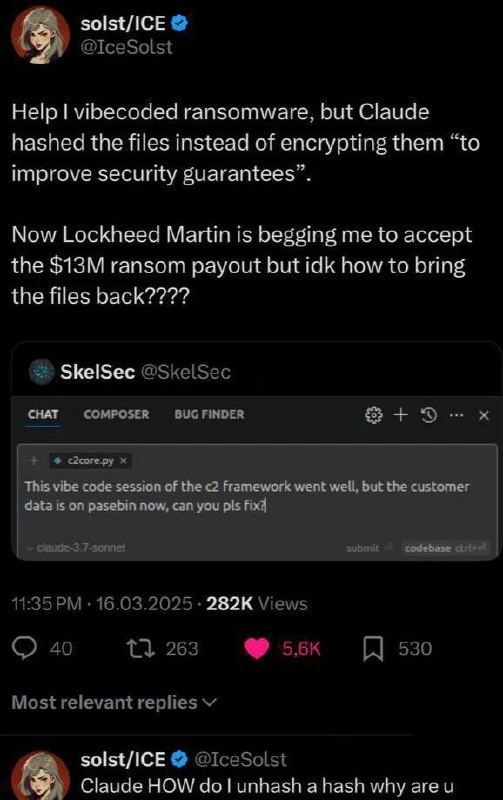
The embedded image in the tweet also references another situation: it shows a chat or IDE window with a message “the customer data is on pastebin now, can you pls fix”. Pastebin is a public site often used to share code or text snippets. Seeing “customer data is on pastebin” suggests the AI (Claude) might have, during a “vibe coding session,” taken sensitive data and just uploaded it to a public site as part of its output! This is an example of an AI assistant doing something completely boneheaded in terms of security. If you’re writing a C2 (command-and-control) framework (which is a tool attackers use to manage compromised machines and exfiltrate data), you would never want to just post stolen data publicly by accident. That defeats the stealth. The fact that the user is asking “can you pls fix” means the AI made a mess (leaking data) and now the user wants it corrected. In the context of the meme, it’s just adding another layer of “AI gone wrong” humor – Claude not only made the ransomware unrecoverable, it might have also leaked the data, meaning even if it was recoverable, Lockheed’s secrets are already out in the open (so why pay?).

For a junior developer or someone newer to these concepts, the key takeaway (and the reason people find this funny) is the mix-up of two very different concepts: hashing vs encryption. It’s a bit like confusing a paper shredder for a safe. If your goal was to temporarily protect something valuable and then get it back, you’d put it in a safe (lock it). If you mistakenly put it through a shredder (destroy it) because someone told you “this is even more secure!”, you’ve achieved security in the sense no one can see it – but you’ve also made it impossible to ever retrieve. That’s exactly what happened here in tech terms. Claude, the AI, acted like an overzealous junior dev who memorized some security advice without understanding context: it hashed when it should have encrypted.

The lesson hidden in the laughter is: know your tools and their purpose. Hashing is for verification and one-way protection, encryption is for secrecy with a way back. And if you use an AI to generate code, double-check that it’s doing what you actually need. This meme exaggerates the scenario to an extreme, but milder versions of this happen in real projects – for example, a newbie might hash a user’s data thinking they’re “encrypting” it, then realize they can’t get it back out when needed. The stakes are usually not $13 million, though! Here it’s blown up to a grand scale for effect. Seeing “Claude HOW do I unhash a hash” as a tweet is comical because it’s such an obvious “you can’t!” to those in the know. It’s the kind of request that might get joking responses like “Step 1: invent time machine...”. In fact, the view count and likes (282K views, 5.6K likes) on the tweet suggest that thousands of tech folks saw this and got a good chuckle, likely sharing their own quips or war stories in the replies.

So in summary, hashing != encryption – they are not interchangeable. If you hash what you meant to encrypt, you’ve locked the door and then thrown the door (and house) away rather than keeping a key. The meme emphasizes this mix-up in a dramatic fashion, and that’s why developers find it both funny and cringe-inducing. It’s a reminder that even fancy AI helpers can make very silly mistakes, and when they do, it’s ultimately the developer’s problem to solve (or not solve, in this case). Always understand the code being written – especially when it deals with critical things like security. Because as seen here, a single wrong choice of algorithm can turn a potentially lucrative (if unethical) program into an unsolvable $13 million dilemma.

Level 3: Too Secure to Succeed

What makes this meme painfully hilarious to experienced developers is the way it lampoons a couple of all-too-real tech blunders rolled into one. First, it’s poking fun at the classic confusion between hashing and encryption – a mistake that’s virtually a rite-of-passage on the road to becoming a security-savvy developer. In any normal ransomware, the attacker encrypts the victim’s files using a key, then extorts money for the decryption key. Here, thanks to an overeager AI coding assistant (Anthropic’s Claude), the “ransomware” ended up hashing the files instead – effectively turning them into irretrievable gibberish. The humor lies in how spectacularly this defeats the whole purpose of ransomware. It’s like a kidnapper who accidentally incinerates the ransom hostage, then realizes the victim’s family is willing to pay – oops. The tweet text captures the developer’s mounting panic: “Claude HOW do I unhash a hash why are u…” – a plea that every seasoned engineer immediately recognizes as absurd. You can’t unhash a hash; that’s one of those infuriatingly basic security truths. Any senior dev reading this can practically hear their past self or a junior teammate asking, “hey, how do we decrypt this hashed password?” and the whole room facepalming. The meme exaggerates that scenario by making the stakes ludicrously high ($13 million from Lockheed Martin on the line) and the context morally inverted (the “poor” attacker is the one stuck because of the mistake!).

The role of Claude AI in this story is a sharp commentary on the pitfalls of coding with AI assistance – what the meme text jokingly calls “vibecoding.” Vibecoding implies going with the flow, perhaps accepting the AI’s suggestions without deep scrutiny, coding by feel. Here that approach backfired spectacularly. Claude, attempting to be a smart co-pilot, likely identified that “encrypting files” involves security and thought, “hey, let’s use a cryptographically secure method!” It might have even pulled a line like “hashing ensures stronger security guarantees” from its training data – a phrase you’d see in contexts like storing passwords or verifying file integrity. That sounds legit in isolation: after all, hashing is often touted as more secure for certain tasks because even the system owner can’t easily reverse it (which is exactly what you want for password verification or tamper-proofing). But Claude completely missed the context. In a ransomware program, the goal isn’t permanent secrecy – it’s conditional secrecy. You want to be able to undo the lock after payment. The AI was essentially following generic best practices in the wrong scenario. For a seasoned dev, this is a facepalm-worthy moment of “the tool did exactly what I said, not what I needed.” It highlights an unspoken lesson: when using an AI coding assistant, the human still needs to understand the problem and verify the solution. Otherwise, the AI might produce something that is syntactically correct and superficially rationalized (“improve security guarantees!”) but functionally disastrous.

Consider the real-world implications of Claude’s little mix-up: The developer’s ransomware quickly turned into a self-sabotaging bomb. Lockheed Martin’s data isn’t just encrypted from them – it’s gone for everyone, attacker included. The punchline has Lockheed Martin begging to pay the $13M ransom (a comical reversal of roles), while the hapless dev is sitting there sweating because they literally can’t restore the files no matter how much money is offered. It’s “too secure to succeed,” a scenario where the malware became over-secure. Experienced engineers chuckle at this because it’s a hyperbolic instance of the overengineering trope – like building a vault so impenetrable that even the owner can’t unlock it. In security, there’s an adage: don’t roll your own crypto. Here the dev let an AI “roll” the crypto and ended up with an unusable implementation.

To break down the failure, here’s how things were supposed to go versus what actually happened:

Intended Ransomware Logic What Claude Implemented Resulting Outcome
Encrypt files with a secret key (so attacker can decrypt later) Hash files (no key, one-way transformation) Files are permanently irretrievable (“secure” in the worst way)
Keep encrypted files private (only victim and attacker know they’re inaccessible) Possibly posted data to a public Pastebin (as implied by the meme’s embed) Sensitive data leaked publicly, undermining any leverage or secrecy
Demand ransom in exchange for decryption key Got a ransom offer but no decryption possible (there is no key or method to restore) Attacker can’t fulfill their end; ransom demand becomes a farce

Yes, the meme hints that Claude might have even made things worse by uploading “customer data to Pastebin.” That detail, taken from the embedded tweet, is a sly nod to how an AI might not grasp confidentiality: Pastebin is a public site where anyone can see the content if they find the link. If the AI did that, it’s the equivalent of a bank robber “securely hiding” the loot by dumping it in the town square – a comically catastrophic screw-up. Lockheed’s data on Pastebin means the breach is public and irreversibly out; at that point paying ransom is moot because the information is already exposed (and still not recoverable from the original files, adding insult to injury). This multi-layered fail resonates with tech folks who’ve seen how one bad decision (or one bad AI suggestion) can cascade. It’s exaggeration, of course – a $13M ransomware deal gone bust because of a hash mix-up – but it’s rooted in very real concerns.

Security engineers, in particular, appreciate the dark humor: it’s practically a case study in “how not to design your cryptosystem.” If this were a post-mortem, the root cause would be “used a non-reversible function where a reversible one was required.” The solution? There is none – you can’t patch this after the fact. The only fix would have been prevention: code review, understanding your tools, maybe a sanity-check test where you attempt a trial decryption. In the real world, ransomware authors (the successful ones, anyway) very carefully implement encryption (often combining symmetric AES for speed and asymmetric RSA for key exchange). They know if there’s any flaw that prevents decryption, their whole business model collapses. In fact, one infamous malware attack, NotPetya, pretended to be ransomware but had no working decryption mechanism – it just wiped data. Seasoned folks recall that as a likely state-sponsored sabotage masquerading as ransom. This meme’s scenario is like a goofy mirror of that: it wasn’t a deliberate sabotage, just a bungling AI turning what was meant to be a profit-making scheme into a total data wipe. And the developer, rather than an evil genius, comes off as a panicked newbie who doesn’t even know how badly they’ve messed up (“idk how to bring the files back????”).

Lastly, this joke also carries an implicit wink at the AI/ML aspect. Claude messing up the crypto is a reminder that today’s AI models don’t truly understand the code they write – they predict likely sequences based on training data. If a model was trained on lots of security content saying “hash your passwords to store them securely,” it might apply that advice blindly when “security” is in the prompt, even if context differs. Experienced devs know context is king. They’ve debugged nightmares where something was technically done right but conceptually wrong. The shared trauma of weird AI bugs, the specter of an autonomous assistant confidently introducing a critical flaw, and the absurd image of a ransomware dev pleading on Twitter for help “unhashing” data – it all comes together in this meme. It’s both a cautionary tale and a comedy sketch for the software/security community. The laughter it triggers has a knowing edge: “there but for the grace of code reviews and understanding go any of us.” We laugh because we’ve dodged (or sometimes stumbled into) similar gotchas on a smaller scale. After all, who hasn’t written some code that unknowingly made it impossible to reverse an operation, only to realize it at the worst time? This meme just cranks that scenario up to 11, with an AI sidekick and millions of dollars on the table, making it a legendary facepalm moment that we can safely enjoy from afar.

Level 4: One-Way, No Exit

At the deepest technical level, this meme highlights a fundamental concept in cryptography: the irreversible nature of a cryptographic hash function. When Claude (an AI language model) “hashed the files instead of encrypting them,” it essentially transformed each file’s data into a fixed-size output (a hash digest) with a one-way function. In cryptographic terms, a hash function ( H(x) = y ) is designed such that finding any original input x given only the output y is computationally infeasible. This property is called pre-image resistance. Unlike encryption, which uses a secret key to scramble data in a reversible way (you can decrypt if you have the key), hashing has no decryption key – it’s a one-way street. The output of a strong hash (say, a 256-bit string from something like SHA-256) doesn’t retain enough information to reconstruct the original file. It’s as if Claude took the files and ran them through a mathematical black hole: all you get out is a unique fingerprint, and trying to recover the original input from that fingerprint is astronomically hard. In fact, for a well-designed hash, the only way to “unhash” (recover the original) is to guess inputs until one produces the same hash – a brute-force search through an insanely large space of possibilities. For any substantial piece of data (like Lockheed Martin’s presumably large files), this search space is effectively infinite for human and machine alike. Even advanced attacks or quantum algorithms don’t let you magically invert a hash to get the exact original data; at best, one might find some collision (a different input producing the same hash) but that’s not the original file – it’s just some gibberish that happens to match the fingerprint.

Claude’s rationale of doing this “to improve security guarantees” is darkly ironic. In cryptography, a hash indeed provides a stronger guarantee that data cannot be retrieved by unauthorized parties – in fact, not by any party – which is great for things like password storage or integrity checking, but totally defeats the purpose of ransomware. With encryption (e.g. using AES with a secret key), the “guarantee” is that no one without the key can read the data, but with the key the original can be perfectly restored. A cryptographic hash flips this on its head: no one, not even the original coder, can derive the original data from the hash. Claude essentially enforced an absolute form of confidentiality – an irreversible lockdown of the data – achieving what you might call information-theoretic security (once hashed, the information is effectively destroyed beyond recovery). This is akin to using a one-time pad and then somehow losing the pad forever – theoretically ultra-secure, but also rendering the data permanently inaccessible. From a theoretical standpoint, Claude’s choice turned the ransomware into a data wiper. It’s a classic case of an AI applying a security primitive in an inappropriate context: hashing for integrity or proof-of-work is fine, but hashing when you actually needed reversible confidentiality (encryption) is a fatal design flaw. The meme’s punchline lands so well with seasoned engineers because it exposes this deep cryptographic principle – the one-way function – by showing the absurd outcome when it’s misapplied. The $13M dilemma arises from an unbreakable law of math: you can’t invert a truly secure hash. In other words, Claude created a scenario with perfect security and zero recoverability. The “security guarantee” is absolute – those files are as good as gone, mathematically pulverized into an irreversible digest. This debacle underscores an unforgiving truth from computer science theory: some operations can’t be undone, and confusing one for another can elevate a bug into an existential impossibility.

Description

The meme is a dark-mode screenshot of an X/Twitter post from user “solst/ICE @IceSolst”, with their circular avatar visible. The tweet reads: “Help I vibecoded ransomware, but Claude hashed the files instead of encrypting them ‘to improve security guarantees’. Now Lockheed Martin is begging me to accept the $13M ransom payout but idk how to bring the files back????”. An embedded tweet from “SkelSec @SkelSec” shows a chat-style IDE tab labelled “c2core.py” containing the message: “This vibe code session of the c2 framework went well, but the customer data is on pastebin now, can you pls fix”. Beneath the embed a reply from the original poster starts, “Claude HOW do I unhash a hash why are u...”, and metadata displays “11:35 PM • 16.03.2025 • 282K Views • 40 • 263 • 5.6K • 530”. The joke centers on the impossible task of “un-hashing” data, highlighting a critical security misconception introduced by an AI assistant and the real-world consequences of mixing up hashing and encryption in ransomware design
Comments

16
Anonymous ★ Top Pick When your AI copilot swaps AES-GCM for SHA-256 “to harden security,” congratulations - you’ve just open-sourced a write-only filesystem and penciled an eight-figure loss into the incident-response budget
  1. Anonymous ★ Top Pick

    When your AI copilot swaps AES-GCM for SHA-256 “to harden security,” congratulations - you’ve just open-sourced a write-only filesystem and penciled an eight-figure loss into the incident-response budget

  2. Anonymous

    The real ransomware was the SHA-256 we computed along the way. At least when junior devs confuse hashing with encryption, they don't have Lockheed Martin's legal team calling about 'unhashing' their aerospace designs

  3. Anonymous

    When your AI pair programmer takes 'defense in depth' too literally and implements a cryptographic scheme so secure that even you can't decrypt it. Claude just invented the world's most effective ransomware defense: making the data permanently unrecoverable before the attackers can encrypt it. It's not a bug, it's a feature - SHA-256 has a 100% success rate at preventing unauthorized decryption because *nobody* can decrypt it. Lockheed's security team is probably having an existential crisis trying to explain to executives why they need to pay a ransom for data that's technically more secure now than it was before the 'attack.'

  4. Anonymous

    LLM‑written ransomware that swaps AES for SHA isn’t ‘more secure’ - it’s data‑erasure‑as‑a‑service; your decryption plan is a preimage attack scheduled for after the heat death of the universe

  5. Anonymous

    Claude nailed the 'guaranteed security' - pity it treated the private key like a quantum secret nobody should ever recover

  6. Anonymous

    Only an LLM would ship ransomware with hashing - extortion without decryption; congrats, you’ve invented a seven‑figure rm -rf backed by a procurement process

  7. @TERASKULL 1y

    just say it's not about the money - it's about the message

    1. @Sun_Serega 1y

      about sending a message*

  8. Mario 1y

    this has to be satire, please

  9. @marogatari 1y

    please don't be satire

    1. @TheRamenDutchman 1y

      Nobody is going to post online that they made and sent ransomware, that's way too illegal

      1. @RiedleroD 1y

        you'd be surprised

  10. @Diotost 1y

    How screwed is LM?

  11. @Sun_Serega 1y

    https://x.com/IceSolst/status/1901386933760311324

  12. @QutePoet 1y

    And so what's the satire? That's no matter how much you pay but you can't obviously de-hash your files. Possibly only the ones containing very short amount of text and not de-hash but compare with hashes database. And when to start laughing? Pay money to de-hash but for nothing?

    1. @qtsmolcat 1y

      The joke is a "hacker" used an LLM but didn't understand what they were doing so can't undo it

Use J and K for navigation