The Absurd Pace of AI Progress
Why is this AI ML meme funny?
Level 1: The Uninvited Winner
Imagine you set up a puzzle contest between people and robots. đ A big company (letâs call them Apple, like the fruit) says, âLook, people are much better at these simple puzzles than our best robot. See? The people solved 92 out of 100 puzzles, but the robot only solved about 70 out of 100. Humans win!â They feel pretty good showing that humans are still champs at these little games.
But hereâs the funny twist: the company forgot to invite one more robot to the contest â letâs call this robot o3. When someone finally lets o3 try the same puzzles, o3 solves 96 out of 100 â even more than the humans did! đ In fact, o3 is so good it beats the human score easily, like it wasnât even hard. Itâs as if the company was saying âNo robot can beat us at this!â and then o3 walks in late and says, âHey, I can do it better than you guys.â Surprise!
This is funny because itâs like a teacher announcing, âNone of the students can solve this riddle,â but then a new kid (who wasnât in the class earlier) shows up and solves the riddle without breaking a sweat. The big company was trying to show how limited robots still are, but they ended up getting surprised by a robot they didnât test. In simple terms: they spoke too soon! Everyone chuckles because the unexpected winner (the o3 robot) proved the boast wrong. It shows how fast things can change â one moment you think humans are ahead, the next moment a machine comes out of nowhere and steals the show. And that makes it a little bit funny and a little bit amazing at the same time.
Level 2: Puzzle Performance Primer
Letâs break down what happened in plain terms. Apple (yes, the iPhone and Mac Apple, which also does a lot of secretive AI research) published a study about AI limitations. In this study, they gave both humans and AI systems a set of little puzzle tests â things that are pretty easy for people, to see if AI can solve them too. These puzzles included:
- Perspective taking (PTT): For example, a question might say âPretend you are standing at X and facing Y. What angle is object Z relative to you?â. Youâd need to imagine yourself in a different position and figure out directions â something humans do with mental pictures.
- Maze completion (MCT): A tiny maze puzzle. Think of a simple blue maze where you have a start and finish; humans can usually find the exit quickly, but can an AI find the path by reasoning?
- Judgement of Line Orientation (JLO): This is a classic visual puzzle where you see lines at various angles and must identify which lines match a given angle. Humans use their visual/spatial skills to judge angles â like a mini game of matching orientations.
- Selective attention (SAtt): Kind of like a âfind the thingâ puzzle. For instance, a grid of objects (say, apples đ and other items) is shown, and the task asks for the location of a specific item or count of items meeting some criteria. It tests if you can focus on the right details given some clues, ignoring distractions.
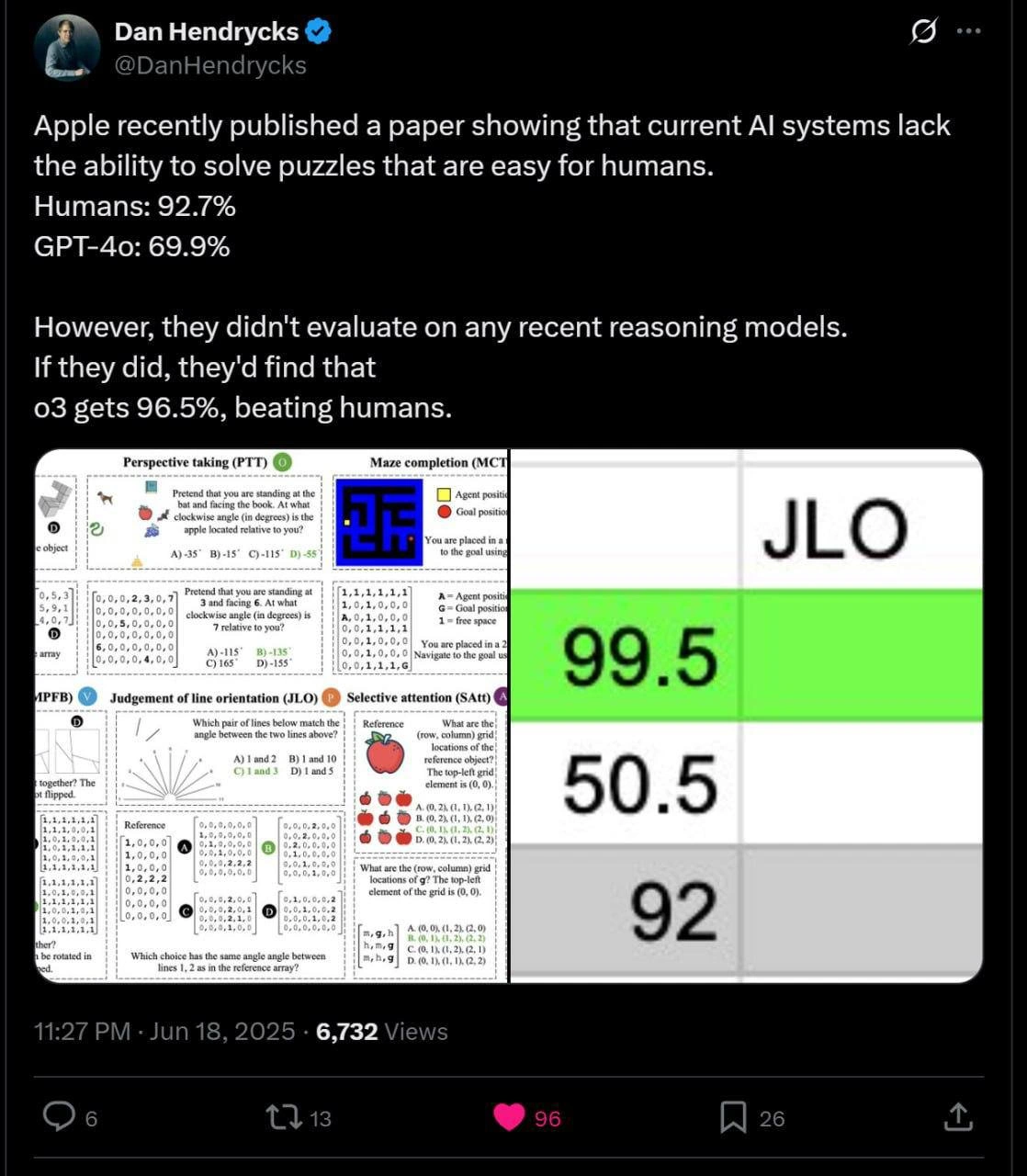
Appleâs results showed that humans did really well on these puzzles (no surprise, since they were designed to be easy for humans). On average, people got about 92.7% of the questions right. Now, they also tested a version of GPT-4 (one of the most advanced AI language models, think of it like the brain behind ChatGPT). GPT-4 is usually super smart with language, but on these puzzles it didnât do so hot â only about 69.9% correct. Thatâs a big drop from human performance. In simple terms, Apple was demonstrating that âSee? Even our best AI today struggles with some basic reasoning puzzles that we find simple.â This was an example of AI research highlighting a gap: the AI might be great at writing essays or code, but ask it to do a little spatial reasoning or visual puzzle in text form and it gets confused. This underscores the AI hype vs reality issue: AIs seem all-powerful, yet they can fail at tasks a child finds easy, reminding us theyâre not truly intelligent in the way people are.
Now, hereâs where the meme part comes in. A researcher named Dan Hendrycks pointed out on Twitter that Appleâs study missed something important. Thereâs a newer AI model â referred to as âo3â â that Apple didnât test. And guess what? When you test o3 on those same puzzles, it scores around 96.5%. Thatâs even higher than the humansâ 92.7%! đĽ In other words, the very gap Apple highlighted (humans beating AI) was already closed â and even reversed â by this new model. o3 beat the humans at their own puzzle game.
This is a classic case of the AI world moving very fast. In the time between Apple doing their study and sharing the results, someone built or released a model thatâs better at these reasoning puzzles. Apple either didnât know about it or didnât include it, so their paper made it seem like âAI canât do it,â but the reality (as pointed out on Twitter) is âactually, one AI can now do it better than people.â The tweet even compares the scores side by side:
| Solver | Puzzle Accuracy |
|---|---|
| Humans | 92.7% đ |
| GPT-4 (old) | 69.9% đ¤â |
| o3 (new) | 96.5% đ¤â |
You can see: GPT-4 got about 70%, nowhere near human level on this test. But o3 got an impressive 96.5%, which is above the human average. That means o3 solved almost all the questions correctly â even more than the people did on average. It casually outperformed humans. This was a bit of a âWhoa!â moment.
Letâs clarify a few terms and why this is notable:
- GPT-4: A very advanced AI model developed by OpenAI. Itâs great at understanding and generating text, and it has some reasoning ability, but it wasnât specifically trained for these puzzles. Think of it as a very smart generalist.
- o3: This is the name given to a newer model or version that specializes in reasoning tasks. Itâs not a household name like GPT-4, but in research circles itâs apparently making waves. Maybe itâs fine-tuned or designed to handle puzzle-like reasoning better. In any case, itâs the new challenger here.
- Human baseline: In AI evaluations, we often compare how humans do on a task to how AI does. The humans getting ~92.7% is the baseline to beat â the bar for âas good as people.â If an AI goes above that, itâs a headline-worthy achievement (at least for that narrow task). Thatâs what happened with o3.
- Reasoning evaluation: Apple was evaluating âreasoningâ â not just rote question-answering, but the kind of thinking where you might have to imagine something or logically work through a puzzle. These particular tasks test spatial reasoning and attention. Theyâre like an IQ test for AIs in some sense.
So, Appleâs study was showcasing a limitation: âAha, hereâs something AI canât yet do as well as us!â Itâs a bit of a reality-check against AI hype, showing that AI assistants and models still struggle with some basic cognition. But then the tweet turns it into a bit of humor by saying, âIf only they had tried this new model, theyâd see it actually does better than humans.â Itâs funny because itâs ironic â the whole point of the Apple paper gets kind of undercut by a development they overlooked. In the AI industry, this kind of thing happens a lot: one month you declare a problem, next month someone fixes it. Itâs hard to keep up!
This resonates as a form of AI humor among developers and researchers. Everyone shares that feeling of âoh wow, that was fast!â Itâs also a gentle jab at Apple: a company known for being on top of things âforgotâ to check the latest model. Kind of like a tech version of âyou missed a spot.â
In summary, the meme is pointing out that:
- Apple said: Current AI canât solve these easy human puzzles (humans > AI).
- Reality (very quickly) said: Actually, a new AI can solve them even better than humans (AI > humans now).
Itâs a mix of amusement and amazement. Amusement because itâs a bit embarrassing for Appleâs study (imagine publishing something and almost immediately being outdated), and amazement because o3âs jump in performance is impressive â it highlights how quickly AI is advancing in areas we thought we had an edge. Todayâs joke, in a way, is that you canât blink in this field or youâll miss the next breakthrough!
Level 3: Overlooked Overachiever
In this memeâs scenario, Apple basically got caught publishing yesterdayâs news about AI limitations. Their paper proudly pointed out a set of âeasy for humans, hard for machinesâ puzzles â and indeed, they showed humans scoring ~92.7% versus GPT-4âs 69.9% on a custom Apple puzzle benchmark. Thatâs a significant gap, implying current AI still fumbles on tasks a toddler might ace. The humor hits when Twitter discourse (via Dan Hendrycksâ tweet) says, âSurprise! You forgot to test the latest model, and it casually tops humans.â Itâs the classic tech punchline: one more thing was missing, and it was a big thing. Apple, of all companies, left out the âone more thingâ â in this case, the o3 model â and that model swooped in with a 96.5% score, dunking on both humans and GPT-4 (GPT-4o). The tweetâs tone is half informative, half gotcha!: itâs poking at Appleâs evaluation methodology for being a bit behind the times. In the fast-moving world of AI industry trends, not checking the newest model is like publishing a smartphone review and ignoring the latest iPhone â a recipe for immediate obsolescence (and a little embarrassment).
So why is this funny (especially to AI folks and developers)? For one, it highlights the AI hype-vs-reality whiplash we face daily. Appleâs paper painted a cautious reality: âlook, even GPT-4 struggles with these reasoning puzzles; humans still reign supreme on them.â That feeds a certain narrative in AI research and safety circles: current AIs have glaring blind spots, lacking true reasoning. But reality didnât sit still. An up-and-coming model turned that into hype again by beating the human baseline. If Appleâs message was âdonât over-hype AI, it canât do this yet,â the o3 model promptly responded, âhold my đ (apple) â I can do it now.â Itâs a comedic reversal where Appleâs claim aged about as well as week-old milk. The FOMO (fear of missing out) in benchmarking is real â nobody wants to be the researcher who overlooked the new champion model. Here Apple inadvertently became that researcher, and the AI community is chuckling because weâve all seen this before. Todayâs limitation might get obliterated by tomorrowâs breakthrough, especially in machine learning.
Thereâs also an undercurrent of AI humor in how the tweet is phrased and presented. The collage image beneath the tweet is almost meme-like in itself: it shows bits of the actual puzzles (little diagrams and grids) and a results table with âJLOâ (Judgment of Line Orientation) and a big green 99.5 score for one model. Itâs as if to visually say, âthe new model absolutely nailed this test.â Seeing a bright green 99.5 next to human 92 and a poor 50.5 (presumably GPT-4âs JLO score) is absurdly satisfying for those following AI benchmarks. Weâre used to hearing âX model now beats humans at Y taskâ in headlines, so much that itâs become a bit of a trope in MachineLearningHumor. This tweet plays right into that trope knowingly. Itâs funny because of the timing and the casual tone: âOh BTW, o3 gets 96.5%, beating humans.â Casually beating humans â as if it were no big deal, when in reality thatâs a pretty big deal! The implication: Appleâs researchers mustâve been momentarily proud of finding a domain where humans > AI, only to discover a new AI went â+1 upâ immediately.
From a senior dev or researcher perspective, thereâs a lot of subtext:
- Benchmark leapfrog: We recognize a pattern where as soon as someone identifies a performance gap or publishes a benchmark, a flurry of activity (or an existing project like o3) closes the gap. Itâs a constant game of leapfrog. You can almost hear seasoned engineers sigh, âOf course a new model already beat it⌠figures.â
- Testing methodology: Appleâs omission hints at either the new model not being widely known or available during their study, or a deliberate focus on certain models. It raises an eyebrow: did Apple cherry-pick models that would support their point about AI limitations? Or were they just unlucky with timing? In any case, not testing âthe latest and greatestâ is a faux pas in competitive benchmarking. Every experienced ML engineer knows you check if someone posted a new arXiv paper or GitHub repo claiming better results before finalizing your own claims. Here it looks like Appleâs team either didnât know about o3 or underestimated it. The tweetâs author (Hendrycks) is basically giving them a friendly ribbing for that oversight.
- Real-world scenario: Imagine this in a dev context: Itâs like writing a report, âOur system canât handle more than 1000 requests/sec,â but forgetting that a patch came out that same week doubling the throughput. Everyone who reads your report goes, âWell actually, if you applied the patchâŚâ đ . This feels similar. Apple announced âAI canât solve these human-easy puzzles,â and the community answer is, âWell actually, the new model can.â
- Organizational dynamics: Itâs interesting that this comes from Apple, a company known for secrecy and less involvement in public AI bragging contests. So when Apple does publish something about AI, the community pays attention â and apparently isnât above fact-checking it in real time on Twitter. The meme captures a bit of that big-corp vs open-research dynamic: the open community (or other labs) might move faster in some areas, and a corporate research paper can accidentally look out-of-date by publication time. Itâs a subtle poke at how fast the AI industry moves and maybe at Appleâs expense for not keeping up with AI industry trends outside their bubble.
To a seasoned AI developer, thereâs also the recognition that beating humans on a benchmark is a moving target. âHumans: 92.7%, AI: 96.5%â â celebrated today, but what about tomorrow? The meme hints that rushing to claim AI limitations can backfire spectacularly. Todayâs AI assistants and models might falter on puzzles, but with a bit more data or a clever tweak (hey, maybe just prompt engineering or a fine-tune), they leap ahead. Itâs both exciting and comical. As an enthusiastic observer, you canât help but grin at how AI hype vs reality sometimes flips overnight. Apple said âAI canât do itâ; reality (and Twitter) retorts âActually, it just did.â đ¤đ
And of course, letâs not forget the lighthearted Apple vs (orange) o3 pun in the title: comparing apples to⌠o3s? đ In any case, this meme is a nerdy joyride through the rapid progress of AI, and a reminder not to underestimate how quickly a machine learning model can go from zero to hero on a task. One day youâre writing about AIâs failure, the next day youâre writing an erratum because someoneâs new model aced it. Itâs all in good humor â a shared laugh at how even experts canât keep up with the breakneck pace of AI progress.
# Pseudo-code of Apple's evaluation pipeline (humorously simplified)
models_to_test = ["GPT-4", "OtherModel_v1"] # Apple's list of current AIs
scores = {m: evaluate_on_puzzles(m) for m in models_to_test}
print(scores)
# Output might be: {"GPT-4": 0.699, "OtherModel_v1": 0.505} (i.e., 69.9%, 50.5%)
# Oops, they didn't include the new 'o3' model in models_to_test...
# ...so they missed that 'o3' would score ~0.965 (96.5%)!
Level 4: Emergent Spatial Reasoning
At the cutting edge of AI research, even simple human puzzles reveal deep technical challenges. Appleâs paper zeroed in on tasks like perspective taking, maze navigation, line orientation judgement, and selective attention â classic spatial reasoning tests. These puzzles might look trivial, but they encapsulate what early AI theorists called Moravecâs paradox: skills that are easy for humans (like visual puzzle-solving) can be hard for AI. Apple observed a large gap â GPT-4 struggled (about 70% correct) while humans breezed through (~92.7%). This gap hints at AILimitations in how current models reason about space and geometry.
Why would a state-of-the-art language model stumble here? Itâs partly because transformer AIs like GPT-4 are built for sequential pattern processing (words and tokens), not innate geometric intuition. Solving a judgement of line orientation (JLO) puzzle or a maze requires constructing an internal mental model â effectively performing transformations in a 2D/3D space or performing search algorithms. A human brainâs visual cortex and spatial reasoning can do this effortlessly; an AI must approximate it with computations over text or coordinates. Without special handling, a prompt about rotated lines or a tiny blue maze might as well be a foreign language to a vanilla GPT-4. It lacks an explicit physics engine or a built-in sense of space, so it has to learn any spatial reasoning from data alone.
However, large models have shown emergent abilities: at a certain scale, they begin to show flashes of reasoning or pattern recognition that werenât explicitly programmed. The new o3 model seems to have tapped into such an emergent capability for spatial puzzles. Scoring 96.5% (above the human baseline!) suggests it either learned a remarkably general strategy or was fine-tuned extensively on similar tasks. Perhaps o3 employs advanced techniques â think of methods like chain-of-thought prompting, where the model is coaxed to reason step-by-step (âFirst, imagine rotating object A... then align line B...â). It might also leverage hybrid approaches, combining neural networks with symbolic logic or search. This touches on a theoretical question in AI research: did o3 truly generalize spatial reasoning, or did it just memorize how to solve those particular puzzles? In other words, is it displaying genuine reasoning or just extraordinarily good pattern matching on this benchmark?
From an evaluation theory standpoint, Appleâs omission of the latest model underscores a classic pitfall: benchmark saturation and the ever-moving target of SOTA (state-of-the-art). An academic paper is a snapshot in time. Here that snapshot aged in mere months â a new modelâs capability overshot the human level, turning Appleâs finding on its head. Itâs a reminder that in the fast-paced AI industry, evaluating âreasoningâ isnât one-and-done; itâs an ongoing race. The deeper irony is almost philosophical: we design these puzzles to test human cognitive quirks (e.g. mental rotation tasks were once used to test IQ and spatial awareness), and now an AI not only learned to pass them, but to outperform the average person. Does that mean the AI truly âunderstandsâ spatial relations like we do? Or has it discovered a cheat code â an algorithmic way to solve the puzzle without âseeingâ it the way humans do? These questions lie at the heart of assessing AI capabilities and AI limitations. The humor in the meme belies a profound achievement: a once-insurmountable cognitive puzzle gap might have lasted only a fleeting moment before computational brute force, clever algorithms, and massive data closed it. Weâre watching AI hype vs. reality collapse into a single point â todayâs AI reality was yesterdayâs hype.
Description
This image is a screenshot of a tweet from user Dan Hendrycks (@DanHendrycks). The tweet critiques a recent Apple paper that claims AI systems struggle with puzzles easy for humans, citing GPT-4o's 69.9% score versus humans' 92.7%. Hendrycks counters that the paper omitted recent reasoning models, stating that a model named 'o3' achieves 96.5%, surpassing human performance. The tweet includes a composite image: one part shows examples of cognitive tests from a research paper (like perspective taking and maze completion), and overlaid on the right is an unrelated, absurdist meme chart. The chart has a header 'JLO' and three rows with numbers '99.5', '50.5', and '92'. The technical humor lies in the rapid, almost daily obsolescence of major AI research findings. A significant paper from a tech giant like Apple is publicly refuted with new data, showcasing the breakneck speed of AI development. The 'JLO' chart is a non-sequitur, a form of niche internet humor or 'shitposting' common in tech circles, adding a layer of surrealism to the very serious topic of AI benchmarks
Comments
44Comment deleted
The half-life of an AI benchmark paper is now shorter than the time it takes to get CI to pass on a legacy codebase. By the time it's published, it's already a historical document
Impressive numbers, but Iâll believe o3âs reasoning supremacy when it can configure an Apple developer certificate on the first try
Apple: 'Our puzzles are so easy, humans ace them!' OpenAI: 'Hold my gradient descent.' Classic case of benchmarking against yesterday's models while the field moves at GPU clock speeds - by the time your paper's published, someone's already fine-tuned their way past your human baseline
Ah yes, the classic AI research cycle: publish a benchmark showing AI fails at 'simple human tasks,' then six months later watch reasoning models absolutely demolish it. It's like we're speedrunning Moravec's Paradox in reverse - turns out spatial reasoning puzzles are easier than getting an LLM to consistently count the letter 'r' in 'strawberry.' The real puzzle here is whether Apple's researchers intentionally skipped o3 to make a point, or if their paper review process moves at the speed of a waterfall SDLC. Either way, I'm sure the next benchmark will involve something truly human-specific, like understanding why we still use YAML despite its cursed indentation rules
Apple's benchmark rigor meets frontier model velocity: evals obsolete before arXiv hits production
99.5 on JLO, 50.5 on mazes - quintessential leaderboard engineering: P95 demo, P50 outage
Cool - o3 crushes JLO at 96.5%; wake me when a model can reason through a Friday rollback on a multiâregion microservice while finance asks why the AWS bill looks like a maze
I'm not following the situation, please explain Comment deleted
showel seller was shocked to find out that you can replace people with showels now Comment deleted
idiot finds out that by spending more non-renewable resources and time, you can replace humans with AI in certain tasks no one cares about, more at eleven Comment deleted
Calling LLM an AI is a disgrace to a human race Comment deleted
disrace Comment deleted
pls no racism Comment deleted
you started it. I'm just making some jokes Comment deleted
im a dog, i can be racist Comment deleted
Your website is racist towards mobile users. I can see only half of captcha and parts of a page are on top of each other đ Comment deleted
guys, please do your dishes or something Comment deleted
The weak must suffer Comment deleted
A racing dog I assume? Comment deleted
no, backdoor labrador Comment deleted
Thatâs just heterophobic Comment deleted
I love racism. My favourite racist is Max Verstappen Comment deleted
SS (Super Super) Max Comment deleted
Can you play 5 stars on hidden mod? Comment deleted
what abut min verstappen Comment deleted
Apple got cucked out of mainstream AI market so now they're trying to gaslight everyone into thinking AI isn't actually that big of a deal Comment deleted
me when i don't know how science works Comment deleted
it aint lol Comment deleted
This Comment deleted
> big deal "oooo look at me I can generate unmaintainable code even faster now" Comment deleted
Apple was in consumer ML integration on their iphones before it was a thing. They did a lot of improvement that doesnât look like ML did it but they are. Comment deleted
ofc why trying to improve apple ai, just spend time creating a paper on how ai isnt reasoning Comment deleted
I don't think people understand the Apple pullout well. They've always been about shipping well-polished and very detailed features that hold up to their standards, and not shipping something they think is subpar. If you remember, that was their whole thing about not having a calculator on iPad, because they couldn't just ship a boring calc, it had to be extra. They see that right now, AI cannot be relied on as a flawless tool that will hold up to their standards. Where they were able to apply ML to give consistent and almost deterministic results, they use it (like generative emojis). However, with LLMs they failed to achieve what they wanted (perfection), because LLMs are insanely imperfect at the moment for the amount of compute they reqiuire, so they decided it will be a net loss for them. That said, all pure conjecture. Comment deleted
I bought my iphone in 2018 and after airpod pro, i still used win and now i used mac. but apple need to improve on a lot of things Comment deleted
I also think that quite a bit of what they make is dogshit, but their intention is what I described. They just sometimes fail at it. Comment deleted
The refutation of the Apple's research: https://arxiv.org/html/2506.09250v1 Comment deleted
Copium Comment deleted
ask gippity summarize Comment deleted
Y'all kinda toxic Comment deleted
Here Comment deleted
Fox baby Comment deleted
~2kW/h for sudoku Bright future ahead Comment deleted
J/s² don't really makes sense as a unit, and neither does kW/h Comment deleted
JLO (no scores) They asked Jennifer Lopez to solve those puzzles, and she did complete none of them? Comment deleted