A Dark Knight's Guide to Process Management
Why is this OperatingSystems meme funny?
Level 1: Batman and the Baby Program
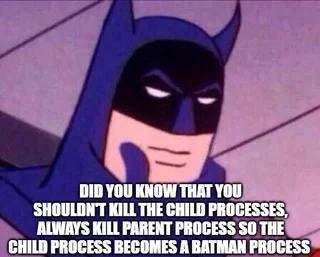
Imagine a little kid playing while their parent is supervising. Now picture the parent suddenly has to leave, and the kid is left on their own. Instead of crying, the kid decides to continue playing and even starts helping other kids – like a tiny hero. This is similar to how Batman’s story goes: Bruce Wayne’s parents were gone, so he had to grow up solo and chose to become a superhero fighting bad guys. The meme jokes that something like this can happen with computer programs. In a computer, one program (parent) can start another program (child). If the main program (parent) is stopped, the little program (child) doesn’t immediately stop too – it’s taken care of by the big boss program of the computer (kind of like a guardian). The meme says that this child program becomes a “Batman process,” meaning it’s now an orphan (no parent) but keeps on running and doing its job, just like Batman kept fighting crime after he lost his parents. We find it funny because it mixes a superhero story with nerdy computer stuff. Essentially, it’s saying: instead of stopping the little programs, stop the big one that created them, and the little ones will turn into Batman! – which is a silly way to remember a real computer trick. It makes us laugh because it’s an absurd, cartoonish explanation for something technical, and the idea of a tiny orphan program heroically running on its own is both cute and geeky.
Level 2: Orphan Processes for Newbies
Let’s break down the tech and humor in simpler terms. In an operating system like Linux (a type of Operating System), programs that run are called processes. When one process starts another, it’s like a family: the original is the parent process and the new one is the child process. For example, when you use a CLI (Command Line Interface) and run a shell script that in turn launches another program, the script is the parent and the launched program is its child. The OS keeps track of this relationship with something called a PID (Process ID) for each process and a PPID (Parent Process ID) which tells you who the parent is. You can actually see this by running commands like ps -ef or pstree in a terminal to get a list of processes and their hierarchy.
Now, what happens if a parent process stops or is killed while the child is still running? The child doesn’t just crash immediately – instead, it becomes an orphan process. This means its parent is gone. But the operating system won’t leave that child process hanging completely alone – it gets a new guardian automatically: the special init process (with PID 1). PID 1 is essentially the first process that starts when the system boots up (on modern Linux, this is often a program called systemd or similar). Think of PID 1 as the nanny or custodian for all processes; when any process loses its parent, PID 1 adopts it. This adoption is officially called re-parenting. So, an orphan process is one that has been re-parented to PID 1. The system does this so that someone (PID 1) is always around to monitor and “clean up” the orphan when it eventually finishes.
The meme jokes about kill signals – that’s when we use the kill command in the command line to send a signal to a process to stop it. For instance, typing kill 1234 sends a polite request (by default SIGTERM, signal 15) to process 1234 asking it to terminate. If that doesn’t work (maybe the process is stuck), we might forcefully terminate it with kill -9 1234 (that sends SIGKILL, signal 9, which the process cannot ignore). The meme’s text says: “you shouldn’t kill the child processes, always kill the parent process so the child process becomes a Batman process.” This sounds dramatic, but in tech terms, it’s advising: instead of stopping the individual child processes, stop the parent process. Why? Because if you terminate the parent, any children it created will become orphans – i.e., they’ll get adopted by PID 1. And here’s the funny leap: an orphan process in the system is being called a “Batman process.” Why Batman? Well, in the Batman comics/movies, Bruce Wayne (Batman) was a child who tragically lost his parents – essentially he’s an orphan – and he later grew up to be a hero fighting crime. So an orphan child process that continues running under PID 1’s care is metaphorically like Bruce Wayne continuing on his mission after his parents’ death. It’s a “Batman process” because it’s an orphan that (we joke) might “fight crime” on your system.
For a newer developer or junior sysadmin, the humor also highlights a real lesson: process management. Many server programs have a parent process (master) and several child processes (workers). If you only kill a worker (child), the master (parent) might just start another worker because it thinks one died accidentally. It’s like cutting one head off a hydra – another head appears. But if you kill the master process, no new workers will be spawned; the existing workers might either stop or become orphans. In some cases, letting a worker process become an orphan can be okay – it might finish whatever it was doing under the supervision of init, and then exit on its own. System administrators often prefer to stop the parent/master process to properly shut down a service, rather than chasing every child process. The meme takes that practical advice and gives it a comedic spin by bringing Batman into the mix. It basically says: “Look, if you end the parent process, the child is left parentless (just like young Bruce Wayne). Instead of dying, that orphan process will now run under PID 1’s wing. Who knows, maybe it’ll do something good – hence, Batman!” Of course, in reality an orphan process isn’t actually a superhero – it’s just a program without its original parent – but we geeks enjoy the funny analogy.
So if you’re new to this: remember that “killing” in computing just means stopping a program. And the meme’s bold advice to “kill the parent not the children” is a play on words with a real sysadmin strategy beneath it. The Batman reference makes it memorable and humorous. It’s turning a dry Unix rule (“orphan processes get adopted by init”) into a playful scenario where a crime-fighting orphan (Batman) is analogous to a lone process carrying on. The categories here, Operating Systems and CLI, are about where this concept lives: deep in the OS’s process control system and the use of command-line tools (kill, ps) to manage processes. Tags like UnixCommands and SysadminHumor tell us this is the kind of joke system administrators laugh at after dealing with pesky processes. Ultimately, the meme is a lighthearted way to learn a bit about how processes work: even if you don’t get all the details of PIDs and signals at first, you’ll probably remember “orphan = Batman process” and realize it means the orphaned program survived its parent’s termination. And that’s both cool and kinda funny!
Level 3: Kill the Parent, Spare the Child
Seasoned developers and system administrators will smirk at this meme because it wraps a sly bit of sysadmin wisdom in a darkly comic superhero metaphor. The text urges, “Don’t kill the child processes, always kill the parent process so the child process becomes a Batman process.” On the surface, it sounds like some twisted moral from bizarro-world: in real life you’d never say “eliminate the parent to empower the child”! But in the realm of operating systems and the command line, this joke lands because sometimes ending the parent process is indeed the smarter move. Experienced engineers have encountered sprawling process trees where a parent process (say, a supervisor or job controller) continuously spawns child processes (worker tasks, daemons, etc.). If one of those child processes misbehaves or hangs, an inexperienced person might try to kill that child alone. But guess what? The vigilant parent might notice and, thinking its child simply died naturally, start a new child process (like a hydra growing a new head). The problem persists. The clever fix? Take out the parent process – cut off the problem at the source – and then all its children either terminate or get orphaned (adopted by PID 1). In other words, “kill the boss, not the interns.” This is analogous to how Batman’s story began: the loss of his parents was the critical event that led Bruce Wayne (the child) to transform into something entirely different (the caped crusader). In computing terms, killing the parent frees the child process from any supervising manager, turning it into an independent “Batman” process – a lone vigilante not bound by a parent’s rules. It’s a tongue-in-cheek way to describe an orphan process that continues to run and potentially “do good” (or at least do its job) under the wing of the init system.
The humor really shines for those of us who’ve spent late nights in the throes of SysadminLife, squinting at ps listings and hunting down rogue processes (the "stray daemons" as we often call them). Picture a weary DevOps engineer at 2 AM, dealing with a cluster of zombie or hung processes. They might quip, “Time to play Batman – take out the parent and let the child live to fight another day.” It’s funny because it’s true: sometimes the fastest way to end a runaway situation is to send a kill signal to the root of that process family (the parent), rather than whack-a-mole’ing each child. This meme also pokes fun at our collective habit of debating SIGTERM vs SIGKILL when trying to gracefully stop processes. Seasoned pros know to try a gentle SIGTERM first (“ask” the parent to shut down nicely, giving it a chance to clean up children) and only escalate to SIGKILL (“tell” it to just die already) if it refuses to comply. Yet here the meme gleefully says skip the politeness, just off the parent outright! It’s satirically endorsing the most dramatic approach: use the “guillotine” (kill -9 on the parent), and boom, the children become orphans under init – i.e., “Batman processes” free to roam.
The imagery of Batman adds an extra layer that senior devs appreciate: Batman is the quintessential orphan-turned-hero, operating independently to fight crime. An orphan process left running can sometimes feel like a little vigilante in your system – it wasn’t meant to be out there alone, but it might still carry on its task. In fact, there are real scenarios where an orphaned child process saves the day. For example, consider a server where a master process coordinates worker processes to handle requests. If the master crashes unexpectedly but one of the worker children keeps running and handling user requests, that orphaned worker might keep the service partially alive – like a lone superhero picking up the slack after the commander falls. Us old-timers have witnessed weird cases of a background job still chugging along after its controlling script died; it’s not the ideal state, but when you discover that lone surviving process is still serving customers or completing a long computation, you can’t help but anthropomorphize it as a tiny caped crusader. And of course, eventually you either have to rein it in or formally adopt it into some new process group – in systems terms, maybe let it continue or kill it off once its work is done – but for a brief moment that “Batman process” was the hero Gotham (your system) needed.
Also lurking in this meme is a wry commentary on proper process management. In an ideal world, you shouldn’t have to manually kill processes at all – you’d send polite shutdown signals, services would terminate gracefully, and no orphans would be left wandering. But reality is messy. Daemons misbehave, scripts don’t clean up, or developers forget to handle child processes. The result: you end up with orphan processes owned by init (PID 1) that you notice only when debugging some performance issue (“What on earth is this process still doing running… and why is its parent ID 1?!”). Seasoned sysadmins share a knowing laugh here because they’ve all had that “aha” moment tracing a misbehaving process’s lineage only to find its original parent long gone. The meme’s flamboyant advice – always kill the parent! – exaggerates a kernel of truth from those war stories. It underlines the strategy of tackling problems at their root and also jabs at the almost comic-book drama of on-call firefighting: sometimes you feel less like an engineer and more like a vigilante swooping in to restore order in the dead of night. In short, experienced folks find this hilarious because it connects a critical piece of operating systems trivia (orphaned processes and PID 1 adoption) with a dash of pop culture in a way that perfectly captures the absurd heroism often required in late-night system administration. Who knew process management could sound so epic? 🦇
Level 4: Kernel Orphanage
At the heart of this meme is a slice of Unix process management lore. In Unix-like operating systems (think Linux, macOS, etc.), every running program is a process identified by a number called a PID (Process ID). These processes form a family tree: when one process starts (forks/spawns) another, we call the starter the parent process and the new one the child process. Now, fundamental to Unix kernel design is that there’s a “root” of this family tree – a special process with PID 1 (historically the init process, now often systemd on modern Linux). PID 1 is like the benevolent caretaker of last resort. Whenever a process loses its parent (say the parent crashes or is killed), the kernel automatically re-parents that orphan process to PID 1. This isn’t just a cute detail – it’s crucial for system stability. PID 1 acts as the “kernel orphanage”, adopting all orphan processes to ensure they get properly cleaned up when they eventually finish. Without this, orphaned processes could become zombies (no, not the fun Halloween kind – these are defunct processes that stick around wasting system resources because no parent collected their exit status). The adopt-and-reap mechanism by PID 1 prevents lingering zombies and keeps the process table healthy.
From a theoretical standpoint, this behavior arises from how process control and termination are implemented. When a process ends, the kernel needs a way to handle any of its still-running children. Early Unix designers (Thompson, Ritchie, et al.) engineered the solution that PID 1 (init), as the first process started at boot and ancestor of all, would also serve as the default parent for any process left hanging. This is baked into the OS’s process scheduler and syscall implementations: the moment a parent process dies, the kernel internally does something like child->ppid = 1. The init process periodically calls wait() (or similar) to reap any child processes that have finished (including those it adopted). This design has endured for decades – it’s simple, robust, and surprisingly elegant. It even gave rise to common daemon creation patterns: for instance, the famous double-fork technique in Unix programming intentionally creates an orphan. A process forks a child and immediately exits (the first fork’s child becomes orphaned and adopted by init), then that child forks a grandchild and exits, leaving a grandchild process that is doubly orphaned (no parent, init is now its parent) – voila, the grandchild is now a daemon running in the background, unattached to any user session. It’s an accepted trick to let a process live on its own, much like Bruce Wayne being raised by Alfred after his parents’ death – an orphan turned independent operator. This deep Unix lore underpins the meme’s joke: by “killing” a parent process and letting the child live, you’re leveraging a core OS principle that orphaned processes don’t just die – they get promoted under init’s watch. In a sense, the system encourages orphans to keep running (and finish their work) under the guardianship of PID 1.
On a more granular level, signals come into play. The kill command in the CLI actually sends a signal to a process – by default SIGTERM (signal terminate) or explicitly SIGKILL (signal kill, a non-catchable, non-ignorable kill). If you send a friendly SIGTERM to a parent process, the parent might catch it and gracefully shut down, possibly also terminating its children as part of cleanup. But if you send a brutal SIGKILL (e.g. kill -9), the OS immediately terminates the parent process without giving it a chance to clean up. In that harsh scenario, any child processes are instantly orphaned. They get the proverbial tragic backstory: their “parent” vanished without a goodbye, and now PID 1 steps in as the foster parent. There’s even an edge-case consideration in modern systems and containers: within a Docker container, the process running as PID 1 inside the container is often a minimalist init or the app itself. If that PID 1 inside a container doesn’t reap children, zombies can accumulate. That’s why container best practices sometimes include using a tiny init process (like tini) or proper signal handling in the app, to play that orphan-reaper role. It’s the same principle – every orphan needs a guardian. In summary, this meme is rooted in core OS internals: it’s playing with the idea that an orphaned process isn’t a dead end at all, but rather a process given a new lease on life under the system’s ultimate parental figure (PID 1). And in a nerdily poetic way, an orphaned child process that continues executing under init really is a bit like a vigilante with no original parent – the Dark Knight of the process table, born of a kill signal and ready to fight crime (or at least finish its computation) on its own terms.
# Example: Demonstrating orphan re-parenting in a Unix-like shell
$ my_parent_process & # Launch a parent process in background (it will spawn a child)
$ ps -o pid,ppid,comm -C my_parent_process,my_child_process
PID PPID COMMAND
1234 1 my_parent_process # Parent's parent is 1 (perhaps started from init or shell)
1235 1234 my_child_process # Child's parent is 1234 (our parent process)
$ kill -9 1234 # Force-kill the parent process
$ ps -o pid,ppid,comm -p 1235
PID PPID COMMAND
1235 1 my_child_process # Child is now an orphan adopted by init (PPID=1)
Description
The image features a close-up screenshot of Batman from 'Batman: The Animated Series,' looking stern and determined against a purple background. White, all-caps text with a black outline is overlaid at the bottom, reading: "DID YOU KNOW THAT YOU SHOULDN'T KILL THE CHILD PROCESSES, ALWAYS KILL PARENT PROCESS SO THE CHILD PROCESS BECOMES A BATMAN PROCESS". This meme is a dark, technical pun that merges a core concept of operating systems with Batman's famous origin story. In computing, when a parent process is terminated before its child processes, the children become 'orphan processes' and are typically adopted by the system's root 'init' process. The joke cleverly rebrands this state as a 'Batman process,' humorously implying that the process becomes a vigilante after its parents are 'killed.'
Comments
8Comment deleted
Some child processes become orphans and get adopted by init. Others become Batman processes, consuming all available system resources to avenge their parent's termination by a rogue SIGKILL
Remember: every time you SIGKILL a parent, systemd adopts the kid - no wonder PID 1 has such a dark backstory
The real tragedy isn't that Bruce Wayne's parents died, it's that init didn't properly reap their child process, leaving him to wander Gotham's process table seeking vengeance against unhandled signals
The real tragedy isn't that Batman's parents were killed - it's that they didn't properly handle SIGCHLD before terminating, leaving Bruce as an orphaned process to be adopted by init. At least Alfred had the foresight to implement proper signal handlers and reaping mechanisms, otherwise Wayne Manor would be full of zombie processes haunting the Batcave's process table
Pro tip: Orphan processes with kill -TERM on parent first - zombies hate Batman adoption by PID 1
Kill the parent with -9 and systemd becomes Alfred - adopting your orphans, reaping your zombies, and quietly judging your lack of signal handling
POSIX protip: kill the supervisor and let PID 1 adopt the workers - every orphan becomes Batman, but only zombies need a real reaper
So that's what they meant by .bat Comment deleted