Skip to content
DevMeme
6296 of 7435
The Perpetual Search for the 'Perfect' Tech Stack
DesignPatterns Architecture Post #6902, on Jun 19, 2025 in TG

The Perpetual Search for the 'Perfect' Tech Stack

Why is this DesignPatterns Architecture meme funny?

Level 1: Building a Bigger Cage

Imagine you have a problem, like being stuck in a small room, and you try to solve it in a very funny way: by building a new bigger room around the small room and moving into that, thinking “Ah, now I’m free!” But oops – now you’re just stuck inside two rooms instead of one. This meme is making fun of exactly that kind of situation, but for computer programmers.

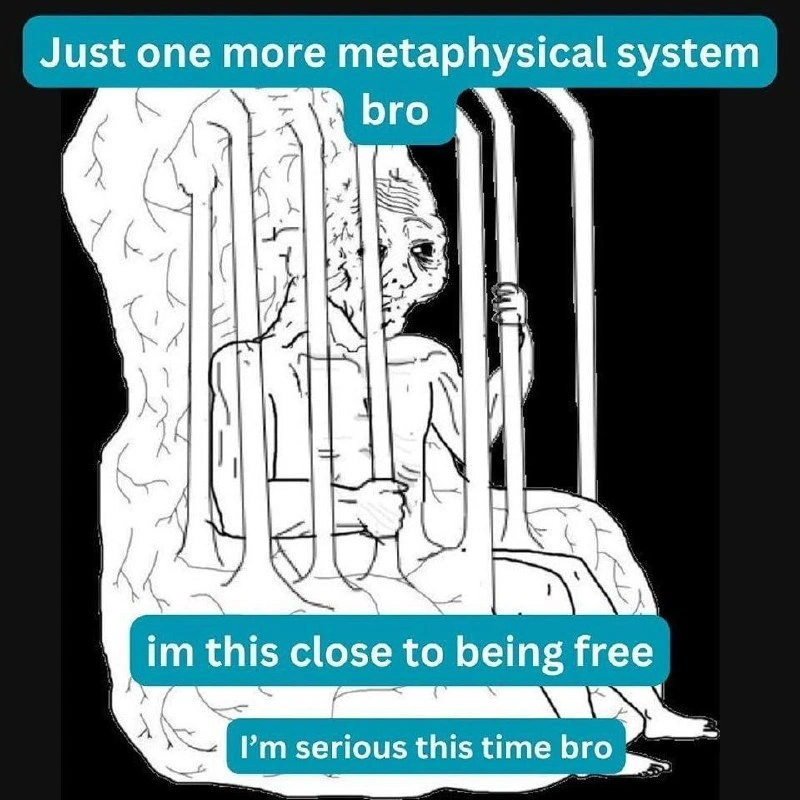
In the picture, there’s a character sitting behind bars like he’s in jail. He really wants to get free. He says, “Just one more metaphysical system, I’m this close to being free… I’m serious this time!” That’s like him saying, “I truly believe if I add one more complicated idea, I can escape my problems.” The twist is, the bars of his jail cell are drawn over and over around him, like he built a second cage outside the first, and maybe a third outside the second. He’s literally building new cages around himself thinking each new cage will help him escape the last one. It’s a bit silly – because common sense says if you’re trapped in a cage, making another cage around it won’t help, it’ll just be another barrier!

Why is this funny (and a little sad)? Because we humans do this sometimes. It’s like digging yourself deeper into a hole while trying to get out. For example, imagine your toys are all tangled up in a net. Instead of untangling them, you wrap that mess in another net, hoping it will contain the tangle. Now you just have a bigger tangle! In software (and in life), when you keep trying complicated “fixes” that don’t actually solve the root problem, you end up with an even bigger mess.

The feeling behind the meme is very relatable: it’s that mix of desperation and optimism when you say “I’m sure this next try will solve it,” even though previous “tries” only made things more complex. The humor comes from recognizing that the character is fooling himself – anyone looking at him can see he’s getting more trapped, not less. It’s like watching a friend try to untie a knot by adding more knots; you kind of smile because you understand that impulse, even if it’s obviously not working.

So in super simple terms: the meme jokes that adding more and more complicated solutions to escape an old problem can backfire, leaving you even more stuck. It's funny to programmers because we've all been that person saying, "Just one more quick fix, and everything will be perfect!" — and then ended up face-palming because our “fix” just added another layer of trouble. The image exaggerates it by showing a guy putting cage after cage around himself. Even a kid can see: if you’re already in one cage, adding another cage isn’t how you get free! That clear visual makes the joke easy to get: sometimes the way we try to solve a problem just builds a bigger problem around us. And the first step to actually getting free is realizing what you're doing – maybe you should stop building cages and start removing some bars instead.

Level 2: One More Wrapper

At this level, let's break down the technical ideas and jargon in the meme. The core joke is about abstraction layers and over-engineering in software design. An abstraction layer is basically a wrapper or a cover that hides lower-level details behind a simpler interface. For example, imagine you have a messy bit of code that interacts with a database. You might write a new function (or module) that calls that messy code, but presents a cleaner function name and output. That new function is an abstraction: it wraps the messy part so callers don’t see the gory details.

However, if you keep wrapping layers around layers, you get a tall stack of indirection. It’s like if you put a box inside another box, then another, and so on – eventually it’s a puzzle to reach the innermost item. In programming, too many layers can make it really hard to follow what’s happening. Over-engineering is when a solution is more complicated than necessary, often due to adding these extra layers, features, or patterns “just in case” or because it sounds clever. This meme jokes that developers sometimes say “just one more layer and all our problems will be solved!” but in reality, each new layer can make the system heavier and more confusing.

Let’s decode the visual: We have the Wojak character looking miserable behind prison bars. Then you realize the bars and even Wojak himself are drawn again around him – like he’s inside a cage, inside another cage. This shows recursive complexity or self-imposed constraints. In simpler terms, the developer (Wojak) built a system to solve a problem, but that system became a cage. Then to escape that, he built another system around it… which is just a bigger cage. Instead of freedom, he ended up with more bars between him and a real solution. Each framework or architecture he added was supposed to free him from the limitations of the previous one, but they all ended up restricting him in new ways.

Now, design patterns and architecture come into play. Design patterns are like reusable blueprints for solving common programming problems (examples include the Singleton, Factory, Adapter, etc.). They’re useful, but if misused or overused, you can end up with code that’s all structure and no clear logic – like an elaborate machine that turns something simple into something convoluted. For instance, imagine you just want to display “Hello, World!” on screen. A straightforward way: a single function call to print "Hello, World". An over-engineered way would involve making a GreeterInterface, implementing it with a StandardGreeter class, then having a GreeterFactory to instantiate the greeter, etc. Frameworks are larger structures (often external libraries or platforms) that provide a lot of these patterns and tools out-of-the-box. They can save time by handling generic stuff (like web request handling, database access, UI rendering), but they also come with their own learning curve, rules, and constraints. When the meme says “metaphysical system”, it’s humorously referring to a very grand, perhaps overly philosophical architecture or framework – basically something very abstract and complex.

Let’s clarify technical debt too. Technical debt is a metaphor: when you cut corners in code (for speed or because of deadlines), you incur a “debt” which you’ll have to pay back later by fixing or refactoring. If you don’t handle it, the interest (extra difficulty) accumulates. Here, instead of paying off the debt properly (cleaning up the messy code), the developer just keeps adding a new layer on top to hide the mess. That’s like covering a dirty room with a new carpet instead of actually cleaning – eventually, you’re going to have to deal with the smell under the carpet, and now the carpet itself might be a problem too. Each abstraction layer added to hide complexity is a form of interest on the debt – you still owe the original cleanup, and now you have more code to maintain as well.

Legacy code or legacy systems often motivate these “wrap it up” solutions. Legacy means old code that is still in use – often it’s fragile, poorly documented, or uses outdated tech, but the business depends on it. Developers sometimes avoid touching it (for fear of breaking things), and instead write new code around it. Suppose you have a clunky old module that calculates something but is hard to modify. You might write a new module that calls the old one but formats its output differently or adds a tweak. Now you have two layers doing one job. If that wasn’t enough, maybe later someone finds even that insufficient and wraps both in yet another module or microservice to add more features. Now there are three layers deep just to get a result, and if something goes wrong, you have to debug through all three.

We can illustrate a simple over-abstraction:

# Legacy function (existing messy code)
def get_data_from_db():
    # Imagine there's complex, messy logic here
    return "raw_data"

# New abstraction layer to 'simplify' the interface
def get_data():
    return get_data_from_db()

# Even another layer added later for 'flexibility'
class DataRepository:
    def fetch_data(self):
        return get_data()

# Using the new repository abstraction
repo = DataRepository()
result = repo.fetch_data()
print(result)  # This ultimately calls get_data(), which calls get_data_from_db()

In this snippet, we started with get_data_from_db(). Then someone wrote get_data() as a wrapper to maybe hide messy details. Then later, a DataRepository class wraps that function in an OOP style. When we call repo.fetch_data(), it goes through three layers to eventually call the original function. We didn’t actually improve the old code; we just added indirection. This is a toy example, but in real systems, you might see many layers like this – e.g., a web request goes through a Controller, which calls a Service, which calls a Manager, which calls a Repository, which finally runs an SQL query. Each layer might only do a tiny bit (logging, or converting data formats), but together they add up to a maze. If everything works, fine – the user just sees their data. But if there’s a bug or slowdown, a developer has to navigate all those layers to find where the issue is. That’s why more layers = more bars to get past when troubleshooting.

Now let’s touch on architectural trade-offs. Why do people add these layers if they can cause trouble? Because each layer does offer some benefit, at least in isolation. For example, splitting a monolithic program into separate microservices (small independent services) can make each piece simpler by itself and let teams work more independently. That’s a valid benefit. The trade-off is you introduce complexity in how those pieces talk to each other (network calls, data consistency, error handling across services, etc.). It’s not that abstraction is evil – it’s that too much or the wrong abstraction leads to hidden complexity. The meme is pointing out a scenario where someone keeps adding so many abstractions (maybe without truly needed justification) that they've trapped themselves.

Overengineering often comes from good intentions: “We might need this flexibility later” or “Let’s use a fancy pattern to be safe.” The first caption, “Just one more metaphysical system,” suggests the developer is thinking in an almost philosophical way – like they’re building the ultimate system of systems. It’s poking fun at how we sometimes get carried away with grand designs instead of addressing the concrete problem directly. The second caption, “I’m this close to being free,” and the third, “I’m serious this time bro,” both mimic someone in denial – they’ve probably said this before with previous frameworks or layers, and it failed, but they still believe the next one will do the trick. It’s a bit tragic and a bit funny, because we all have a tendency to get excited about a new tool or idea that will clean up the mess, only to find out later we just moved the mess.

To sum up in plain terms: the meme is joking that developers sometimes try to fix a messy situation by covering it with more structure rather than cleaning it up. They create a new architecture or system hoping to escape the problems of the old system. But if you keep doing that without solving root issues, you just end up with layers of recursive complexity – kind of like a Russian nesting doll of problems. It resonates with developers because it’s a shared pain: many of us have been stuck maintaining a project that has layer upon layer, where each layer was added by someone who said “this will make things better,” but in the end it made a new kind of headache. The key terms (like OverEngineering, ArchitecturalTradeoffs, TechnicalDebt, HiddenComplexity) all point to this idea: balancing simplicity vs. complexity is hard. And when that balance tips too far into fancy abstractions, you might find you've built a framework cage for yourself, just like Wojak in the picture.

Level 3: Turtles All The Way Down

The meme hits on a classic software tragedy: every time we try to escape complexity by adding yet another layer of abstraction, we end up with complexity plus one. The Wojak behind prison bars is the overzealous architect trapped in a cage of their own design – and in this image, that cage is recursively drawn over and over. It's a nerdy visual metaphor for recursive complexity: each new metaphysical system (i.e., grand architecture or framework) is just a copy of the last cage, making the prison thicker.

Senior engineers chuckle (perhaps a bit bitterly) because they've lived this. We’ve all heard some version of:

“Just one more layer, bro, I promise this abstraction will solve our problems – I’m this close to being free!”

Only to discover a month later that the new layer is just another set of bars around us. It’s overengineering in action, a form of self-inflicted technical debt masquerading as progress. Every additional framework, every new design pattern or architecture rewrite was supposed to liberate us from the messy past – whether it’s migrating a monolithic app into microservices, or wrapping legacy code with an “improved” API layer. Instead, each time we just added another dependency that can break, another abstraction that can leak, and another cognitive hurdle for the next poor soul who must understand the system.

This is basically the software equivalent of the old quip: “We had one problem, so we used regex an abstraction. Now we have two problems.” 😈 The humor comes from pain: it's relatable to anyone who’s been promised that this new architecture will be the silver bullet. Senior devs know there’s no silver bullet – every solution has trade-offs. We replace spaghetti code with an intricate pattern-heavy framework… and get spaghetti config files or endless XML/YAML instead. We introduce microservices to untangle a big ball of mud… and end up with distributed mud (and a pager vibrating at 3 AM because one tiny service in the chain failed). We add an ORM to abstract the database… and then spend days fighting the ORM’s quirks, wishing we had just written a simple SQL query.

The top caption, “Just one more metaphysical system bro,” nails the mindset of the repeat offender: the architect who thinks one more abstraction layer will finally break the cycle. The meme’s recursive art – Wojak and his cage drawn within a copy of itself – perfectly symbolizes “turtles all the way down.” That phrase, popular in computing, jokes that underneath every abstraction layer is another layer, and another, ad infinitum. In practice, we see this with systems built on systems built on other systems. For example, consider a modern web app: it runs in a Docker container (an abstraction of an OS) on a VM (an abstraction of hardware) in a cloud platform (an abstraction of a data center). Inside the app, you maybe have multiple modules or microservices (abstractions of independent applications) communicating via APIs (abstraction of function calls) over HTTP (an abstraction of lower-level network protocols). Each layer hides the details below, but when something goes wrong deep down, that poor on-call engineer has to peel through all the layers of indirection to find the root cause. And let's be honest, by the time you’re tracing a bug through a chain of 12 microservices, 5 middleware layers, and 3 serialization formats, you feel exactly like Wojak: imprisoned by a system you built yourself.

Leaky abstractions also lurk here. Joel Spolsky famously stated the Law of Leaky Abstractions: “All non-trivial abstractions, to some degree, are leaky.” In other words, you can never completely seal away the underlying complexity – it will ooze out in weird bugs and performance issues, forcing you to confront the very details you tried to abstract. The meme’s cage is “leaky” in the sense that each new framework cage doesn’t truly eliminate the old problems; it just puts them one level further out. But when things break, you still have to reach through all those bars. Maybe you introduced a fancy framework to handle state management in your app because manual state was messy. It worked great – until a subtle bug cropped up deep in the framework’s internals. Now you’re stepping through framework code (which is twice as convoluted as your original code) to figure out why state is misbehaving. The hidden complexity came back to bite, because it never really left – it was just hiding behind a curtain.

Another aspect is second-system syndrome. In his Mythical Man-Month essays, Fred Brooks described how the second system a developer designs is often over-engineered – they’re so eager to fix all the shortcomings of the first system that they overcompensate, adding every feature and abstraction imaginable. The result? The second system collapses under its own weight. The meme’s protagonist has a whiff of that: “I’m serious this time bro,” he says about his next grand system – famous last words in software rewrites! Seasoned devs have witnessed teams scrap a decent working system (maybe a bit clunky, a bit legacy, but functional) in favor of a shiny new architecture that promises the world. A year later, the new system is behind schedule, over budget, and just as problematic – only now the team has two systems (the old one they can’t fully decommission, and the new one that isn’t fully functional). They wanted freedom, but got a framework cage around the old cage.

Let's talk tech debt too. Technical debt is like financial debt: a shortcut or quick-and-dirty code that makes future changes harder (you “borrow” time now at the cost of paying interest later in extra work). Each new abstraction layer is often an attempt to pay down tech debt by papering over it. Instead of cleaning up the messy core, we say “we’ll just wrap it in a cleaner interface.” In theory, this isolates the mess. In reality, the mess is still there, and the wrapper can become its own source of problems. Over time, you accumulate “interest” on both the original mess and the added abstraction – more code to maintain, more documentation needed, more things that can go wrong. It’s like building new rooms around a cluttered old room: unless you actually tidy up the core, you’re just expanding the confusing space. That’s why the meme resonates: architectural trade-offs and shortcuts can turn into a trap.

We also see a commentary on framework addiction. Some teams jump to adopt the latest framework or design pattern du jour, hoping it will solve all their problems: “Our web app is slow? Let’s add this caching layer. Still slow in some areas? Okay, how about a microservice architecture? Ops overhead? Let’s throw in Kubernetes and a service mesh. Complexity? Let’s add an orchestration framework to hide Kubernetes!” – you can practically hear the “just one more bro” at each step. It’s both funny and painful that developers (ourselves included) often know we’re piling up complexity, but we cling to the hope that the next layer will finally abstract it all away and make life simple. Spoiler: it usually doesn’t. You end up with fragile complexity: so many interlocking pieces that an update in one library or a misconfigured setting can send the entire castle of cards tumbling down.

The meme’s dark humor is that the escape from legacy becomes the new legacy. That recursive Wojak figure could be each generation of system at a company: Legacy System 1.0 was a mess, so we built System 2.0 around it. Then that got hairy, so we built System 3.0 as a wrapper. Give it a few years and suddenly 3.0 is the new “prison” we feel stuck in. One more rewrite, we tell ourselves, and we’ll be free... just like a prisoner saying one more set of bars and I can squeeze out. Experienced devs have seen this movie before, which is why they smirk at the meme. The bars are “self-imposed constraints” – nobody forced us to add all those layers; we did it to ourselves in the name of improvement.

In summary, the meme lands because it exaggerates a truth in software development: we often try to solve problems by adding complexity (fancy patterns, new layers, extra abstractions) rather than by simplifying. It’s relatable developer experience to sincerely believe the next refactor or new tech stack will fix everything (“I’m serious this time bro” 😅), only to find we traded one giant problem for a pile of smaller, intertwined ones. The seasoned, perhaps cynical perspective is encapsulated perfectly: we built the cage we’re trapped in. The way out isn’t by constructing another cage layer – it might be by breaking some bars (i.e. reducing complexity, refactoring to simpler design). Until we learn that, well... we’ll keep being Wojak, this close to freedom in our minds while unknowingly welding a thicker set of bars around ourselves.

Description

A black and white Wojak-style drawing depicts a withered, brain-like figure trapped inside a cage formed from its own brain matter. The figure grips the bars, looking desperate. Blue text bubbles overlay the image with phrases: "Just one more metaphysical system bro," "im this close to being free," and "I'm serious this time bro." The meme format is known as "Prisoner of His Own Mind" or "Brainlet in a Cage." This meme humorously critiques the developer anti-pattern of constantly chasing new frameworks, architectural paradigms, or complex systems with the belief that the next one will be the ultimate solution. It satirizes the cycle of over-engineering where each new "metaphysical system" (like microservices, serverless, or the latest JavaScript framework) adds more complexity and constraints rather than providing the promised freedom, trapping the developer in a prison of their own design

Comments

22
Anonymous ★ Top Pick The road to technical debt is paved with 'just one more abstraction layer.' We end up building a distributed monolith so complex that the original problem looks like a vacation
  1. Anonymous ★ Top Pick

    The road to technical debt is paved with 'just one more abstraction layer.' We end up building a distributed monolith so complex that the original problem looks like a vacation

  2. Anonymous

    Senior rule #42: if your rescue plan involves shipping *one last* meta-framework, congratulations - you’ve successfully containerized your technical debt

  3. Anonymous

    After 20 years in the industry, you realize every 'revolutionary' abstraction layer is just another YAGNI violation wearing a trendy conference talk - and the skeleton isn't waiting for freedom, it's the last developer who tried to understand the dependency injection framework's dependency injection framework

  4. Anonymous

    Every senior architect has been here: convinced that introducing a service mesh, event sourcing, CQRS, and a custom DSL will finally untangle the monolith - only to realize six months later that you've built a distributed monolith with ten times the operational complexity. The real freedom comes not from adding the next abstraction layer, but from having the wisdom to recognize when 'good enough' beats 'architecturally pure.' As the saying goes: you can't abstract your way out of a problem you abstracted your way into

  5. Anonymous

    “Just one more paradigm” - monolith → microservices → service mesh → data mesh; turns out the only thing we successfully containerized was our freedom, into YAML bars

  6. Anonymous

    The architect's curse: eternally nesting abstractions like Russian dolls, forever searching for the business logic Matryoshka

  7. Anonymous

    Architect’s paradox: each “one more” abstraction removes one sharp edge and adds three bars to the cage

  8. @ercolebellucci 1y

    What is this reference

    1. @SamsonovAnton 1y

      This.

  9. @Johnny_bit 1y

    Once you drop into reality being relative you're in this shite. Scottish Common Sense Reality fixes this.

  10. @TERASKULL 1y

    philosophy helps open the closed mind, and closed minds are not able to open without understanding this

    1. @mrYakov 1y

      open mind for what ? for some garbage that broke logic and allow you to deduce anything out of anything through anything

      1. @TERASKULL 1y

        if you think that all philosophy is a monolith and that platos "bipedal chicken" example is what all philosophy looks like, then you probably don't know much to start with, hence, the closed mind. it's not the problem of philosophy to explain itself. people attack semantics instead of the actual meaning. just like it is with words like "feminism", "socialism", "anarchy". people have warped understanding of the meanings of these words because of the way they are portrayed in media. basically philosophy is more than just being a stoic and saying "it is what it is" all the time. same can be said about therapist scammers. psychology is not evil just because a few self-proclaimed "psycologists" are doing bullshit. don't judge the whole thing only by info you got from media. Nothing is a monolith, and there can be multiple opinions on a topic under what from the side appears to be one entity.

        1. @mrYakov 1y

          I agree that philosophy is not a monolith and some philosophical currents have some sense behind them. but the problem is that philosophy itself does not create any criteria that would help distinguish complete bullshit from normal reasoning. in the end, everything would become even worse if one person tried to do philosophy. instead of polished formulations of known trends, which at least more or less resemble logic, he gets concrete heresy, but since there is no criterion for checking this, such a person calmly perceives his "reasoning" as the truth and tries to convince everyone of this. science was formed from philosophy precisely due to the addition of such a criterion, and works great. therefore, for me, philosophy is basically dead, science took all the best, and got rid of the worst.

          1. @TERASKULL 1y

            that's correct, but there is really no way to enforce that. unfortunately, studying philosophy on your own is pretty much equal to being in a cult. the echo chamber gets too loud. that's why you have to leverage the existing "pillars of knowledge" and not blindly follow whoever tries to talk pseudo-intellectual bullshit. as it seems there is no objective truth or even only one truth for that matter. everyone can say whatever and "debunk" each other. for every 1 unit of truth/fact, there is 1000 units of misinformation, and that does not help. no different from trusting nasa vs trusting a random facebook post someones grandma reposted. actually, because of those pseudo-philosophy people, normal philosophy is not taken seriously. i think both science and philosophy (valid philosophy) should exist side by side, as just science can't capture the exact nature of existance. scientists don't even know what consciousness is, so we have to balance it out somehow. don't let "good" be the enemy of "perfect"

            1. @mrYakov 1y

              consciousness, well, philosophers have absolutely no idea what it is. There is no sane definition that would be applicable to any degree in life. there are some virtual objects, that lack formal definition and will lack it forever. just accept it.

              1. @TERASKULL 1y

                i always accepted it. that's because philosophy never aims to be perfect. just to explain everyday life that is too "uncategorizable" for science. it wouldn't be philosophy if it had a formal definition, right? it's not even one small part of it. "sane", just like "normal", is highly subjective. who are we to judge what is sane and what is normal? where do we draw the line? that's what philosophy (adjacent to morals) is about - trying to draw lines, find patterns, explore the general human mind, just not in a psychological way. most philosophers are dumbasses, that try to reinvent thoughts. in reality every thought has already been thought. every angle and viewpoint has already been disected a million times, and we are doing nothing new. the goal is pretty much to find yourself and understand why you view the world the way you do, and what would it feel like if you looked at it differently. hope my long rambling opened your mind about the topic a bit more

                1. @mrYakov 1y

                  I studied philosophy in university. i know what it is and what it trying to do. and it useless for me. trying to draw lines, find patterns, explore the general human mind, well sounds good, but in reality it struggle with that, if you just try to apply it to real world. i mean, we have a well known "I think, therefore I am", and even better version of "I doubt, therefore I think, therefore I am". and even small modern llm match it. qwen3 just output this: I doubt (whether this response aligns with your expectations), therefore I think (about the nature of doubt itself), therefore I exist. But wait—does the act of doubt even occur here? If I truly doubt, then the very act of questioning my own existence or validity is the proof. Yet if I am merely programmed to simulate this, where is the authentic doubt? The line between simulation and genuine thought blurs... Is there a "me" at all? and its like, doubt in almost every sentence here. and also there is a lot of doubt in thinking section, where it like, "wtf even user wants from me ?". so or it is useless definition, or almost everybody is serial murderer, that kills thing with consciousness on every generated token, lol

                  1. @TERASKULL 1y

                    yea, doubt plays a big role here. but it's a slippery slope anyways. where do you draw the line on free will? does it exist? are we programmed to feel like it exists? it's fun to entertain these thoughts. it doesn't have to provide immediate value or use. just like art. art is highly subjective, and i think anything can be art, with, or without the intent. just like philosophy, art can be useless to some people, but that does not remove its importance. it was never intended to map to the real world, but just to abstract it enough. i would know, as we had bullshit classes on philosophy in uni too, and they almost killed my interest in it. actually, now i wonder what's your MBTI type, if you don't mind doing this quick test: dynomight.net/mbti it would explain your rationality a bit towards science vs theoretical discussions and concepts. i'm an ISTP

                    1. @mrYakov 1y

                      𝚒𝚗𝚃𝚓

                      1. @TERASKULL 1y

                        i fucking knew it lmao. you are all good, great type btw

        2. @Agent1378 1y

          This is a monolith

Use J and K for navigation