Skip to content
DevMeme
5695 of 7435
When You See Text as LLM Tokens, Not Words
AI ML Post #6246, on Sep 20, 2024 in TG

When You See Text as LLM Tokens, Not Words

Why is this AI ML meme funny?

Level 1: Seeing Only Code

Imagine you learned a secret code where every word is written as a number. If you study it long enough, you might start to forget what the regular words look like and only see the secret numbers! This meme is joking that an AI programmer has reached that point. In the picture, there’s a scene from a famous movie, The Matrix, where a character can look at a screen full of gibberish symbols and actually understand what’s happening – kind of like reading a secret language. The joke replaces those symbols with a bunch of numbers that represent parts of the word “strawberry” in a computer’s language. When the developer says, “I don’t even see the R’s. All I see is 302, 1618, 19772, 198…”, he’s pretending that he no longer notices the normal letters like R in the word “strawberry”. Instead, he only sees the code numbers that the computer would use for those letters. It’s a funny exaggeration showing how deeply he’s been working with AI internals. The humor comes from the idea of someone being so absorbed in their high-tech work that their whole view of text flips into machine code. It’s like if you have a friend who does a ton of puzzles – one day you write them a normal message and they grin and say, “Wow, this message has 5 letters that all line up with the puzzle code I use!” You’d laugh because who thinks about normal words that way? Here, the developer has looked at the “inside” of computer language so much that a simple word like “strawberry” appears to him as a bunch of token ID numbers. It’s a playful way to show how obsessed (or experienced) someone can get: they start seeing the hidden mechanics behind everyday things. Basically, the meme is saying: this AI developer has gone so deep into his work that he’s seeing the Matrix – seeing only the secret code – when he looks at text. And that idea is both impressive and amusing, which is why it makes us smile.

Level 2: Words into Tokens

To understand the joke, let’s break down the technical bits. Modern AI language models (like OpenAI’s GPT-3) don’t actually read text one character at a time like we do. Instead, they use a process called tokenization, which means turning text into chunks called tokens. Each token is basically a snippet of the original text – it could be a whole word (“apple”), part of a word (“app” + “le”), or just a single letter or symbol, depending on the word. There’s a fixed dictionary of these tokens that the AI knows from its training. So when you give the model a sentence, it chops it up into tokens according to that dictionary, and then each token is represented by a number (the token ID) so that it can be fed into the model. Think of it like the model’s secret alphabet of tens of thousands of symbols: it can’t natively understand “strawberry” as one new word, but it knows, for example, the pieces “straw” and “berry” which it learned from many texts. So it will represent “strawberry” as two known tokens: one for “straw” and one for “berry”. Those tokens might be numbered, say, 3504 for “straw” and 1100 for “berry” (just as an illustrative example). In reality the actual token IDs might be different, but the idea is each chunk has an ID.

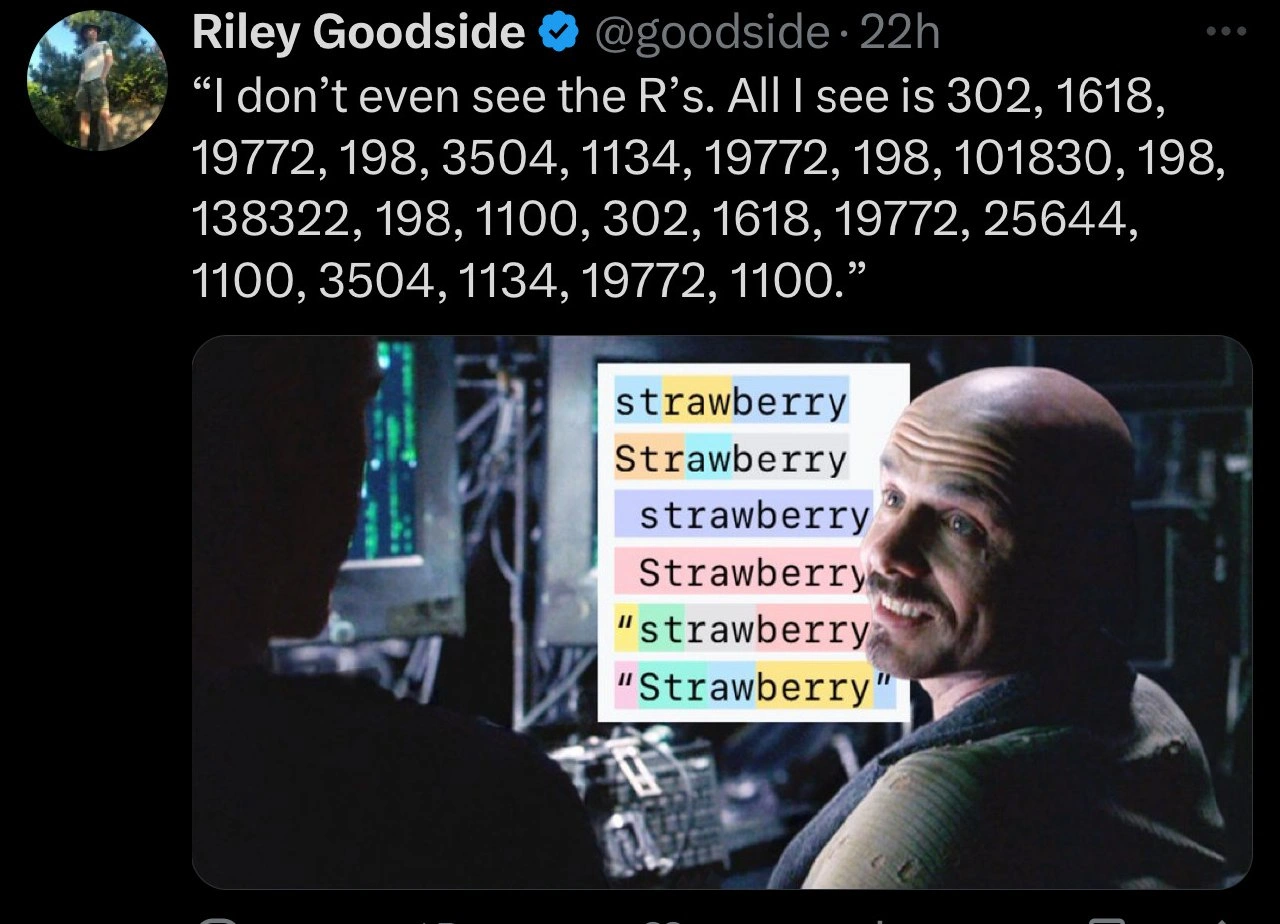
Now, the meme shows a tweet with a series of numbers: 302, 1618, 19772, 198, 3504, 1134, .... These numbers are actually token IDs that correspond to text. Below the tweet, there’s an image from The Matrix movie: we see one of the movie characters (the bald guy, Cypher) looking over at a screen. In the original film, that screen is full of dripping green code (random-looking symbols) which represent the virtual world. But in the meme, that screen has been edited. Instead of green glyphs, it shows a table with the word “strawberry” written in different ways (different capitalization and with quotes), each with colorful highlights on the letters. Those highlights indicate how the word is being split into tokens. For example, on one line the word strawberry might be highlighted as “stra” (one color) and “wberry” (another color), meaning the tokenizer broke it into two tokens there. On another line, “Strawberry” (with a capital S) might be split differently – maybe “Str” and “awberry”, or something like that, because a capital letter changes how the algorithm chunks it. If you add a quotation mark like "strawberry", the tokenization changes again: the quote itself can be a token (or part of a token) and can alter how the following text is tokenized. All those different color segments in the image correspond to different tokens, and each of those tokens has its own number ID under the hood. So the tweet’s long list of numbers is likely the exact sequence of token IDs for all those variants of “strawberry” (with newlines and quotes included). In the list, 198 is repeated several times; 198 is a special token ID that stands for a newline character (kind of like how \n works in programming strings to denote a new line). That suggests the text being encoded had line breaks (since the image indeed has the word on separate lines). Other numbers like 302 could be the token ID for a quotation mark or for a quotation mark followed by a letter (tokenizer algorithms sometimes treat a common combo like " + S at the start of a word as one token if that pattern occurs a lot in training data). The specifics aren’t super important to get the joke, but the key is: the developer is looking at those numbers and “sees” the word strawberry and its variations in them.

Why would a developer ever be able to do that? It’s partly exaggeration for humor, but it’s based on real experience. Developers who work with LLMs have to care about tokens a lot. For example, these models have a limit to how many tokens they can handle in one go (that’s why you can’t input an infinitely long essay into ChatGPT; GPT-3 had a limit of about 2048 tokens initially, newer ones allow more). So when constructing prompts or inputs, an AI developer will often count tokens to make sure they don’t exceed the limit. They use tools like tokenizers (for instance, OpenAI provides a library called tiktoken) to break down text and count tokens. Over time, you start noticing patterns or specific token quirks. A funny real-world example: the word “needle” might be a single token, but add an “s” (“needles”) and suddenly it might become two tokens like “needle” + “s” if that plural wasn’t common enough during training to be merged. These little things stick out when you debug why a model output got weird or why a prompt isn’t working as expected. Riley Goodside, the person who tweeted this, is known in the AI community for being a prompting expert – he pushes language models in clever ways to see how they behave. When he says “I don’t even see the R’s,” he’s humorously implying that he’s so deep in this stuff that he’s lost the normal perception of text. The letter “R” is just part of a token to him, not something he explicitly registers. It’s like a coder who has looked at raw ASCII codes for so long that the code 82 means ‘R’ to them more than the letter “R” on screen does. In other words, Riley is joking that he’s developed “token vision” – instead of reading letters or words like a regular person, he immediately thinks of their token IDs.

The Matrix reference drives this point home by analogy. In The Matrix, the operators see the streaming code (those glowing green characters) and because of training and experience, they can tell what’s happening in the simulated world (“there’s a lady in a red dress” or “Agents are coming”) without actually seeing the images, just by interpreting the code. Similarly, an LLM developer might see a stream of token IDs and, with enough context, know what text they represent or at least understand its structure (like “oh, 198 here means a new paragraph, and I see the token sequence for ‘straw’ followed by the one for ‘berry’”). It’s a hyperbole – in reality, even experts can’t just glance at a long token sequence and read a novel from it (we’d consult a decoder tool). But we might recognize certain telltale token numbers, especially weird ones we’ve encountered (for example, we know 50256 is an end-of-text token in GPT-2/3, or we know 198 is newline). The meme tickles developers because it’s playing on that grain of truth: working intensely with a tool changes your perspective. This is a part of developer experience (DX) that is both frustrating and kind of comical. After wrestling with AI tokenization, you might catch yourself counting token lengths of sentences in your head or wondering what ID a new slang word would get. It’s the same kind of nerdy over-analysis that makes insider tech jokes funny. We laugh because we recognize a bit of ourselves in it – “Haha, sometimes I do feel like I’m looking at the Matrix when debugging GPT!” – and because the visual of someone literally seeing text as a jumble of numbers is absurd in a delightful way. This meme is a lighthearted nod to the tools (AI tools and processes) we use in machine learning development, and how they can re-wire our brain after a while.

Level 3: Blonde, Brunette, Byte-Pair

This meme riffs on an unforgettable scene from The Matrix (1999), repurposing it for the age of GPT-3 and AI tokenization. In the original movie, a character looking at the scrolling green code comments, “I don’t even see the code. All I see is blonde, brunette, redhead.” He’s joking that he’s so accustomed to the raw Matrix code that he directly perceives the people and things it represents. In our meme, Riley Goodside’s tweet twists that line into:

“I don’t even see the R’s. All I see is 302, 1618, 19772, 198, 3504, 1134, 19772, 198, 101830, 198, 138322, 198, 1100, 302, 1618, 19772, 25644, 1100, 3504, 1134, 19772, 1100.”

Now the joke is that a seasoned LLM engineer has spent so much time debugging and reading GPT’s token output that they’ve started to perceive text the way a model does. Instead of seeing the letter “R” or the word “strawberry” on the screen, they see a series of token IDs like 19772 and 1100. It’s a classic bit of AI humor: taking a relatable developer experience (being knee-deep in model internals) and exaggerating it to a comical extreme. If you’ve ever done prompt engineering or fiddled with GPT’s raw output, you know that everything is ultimately numbers under the hood. After hours of staring at token dumps while trying to figure out why the model is behaving oddly, you almost start dreaming in token IDs. This meme says, “Yep, been there, done that.” It’s LLM humor that lands with people who have had to count tokens to avoid hitting context length limits or who have scrolled through those pastel-colored token visualizations trying to spot why a certain word is split funny.

Look at the image composition: on one side, the familiar Matrix “digital rain” of green glyphs flows down a CRT monitor. On the other side, replacing a screen in the scene, we see a pastel token chart for the word “strawberry” in various forms (capitalized, in quotes, etc.), each segment of the word highlighted in a different color. This is exactly the kind of output you get from a tokenizer debug tool (like OpenAI’s tiktoken visualizer or similar), where each color represents a distinct token. For instance, "strawberry" might be split into [straw] [berry] as two tokens, whereas "Strawberry" (capital S) could tokenize differently, maybe [Straw] [berry] or even three tokens if the capital “S” isn’t fused with the rest. Add quotation marks, and you introduce separate tokens for the quotes (unless the tokenizer merges a quote with a following space or letter as a single token, which it sometimes does for common patterns in text). The tweet’s list of numbers is actually the output of such a tokenizer running on multiple variants of strawberry with different capitalization and punctuation. 198 appears repeatedly as suspected newline tokens separating each variant, while tokens like 302 likely correspond to an opening quote character ("), and others map to pieces like “straw” or “berry”. The phrase “I don’t even see the R’s” is a cheeky way to say he’s no longer noticing individual letters (like the letter R) at all. It hints that the letter “R” in “strawberry” is not a standalone token and gets absorbed into these numeric codes – our expert only registers the codes now, not the literal “R” characters that a normal reader would see. It’s a clever nod to how tokenization can split words: for example, the two “r” letters in “strawberry” might be part of larger token chunks, so you never get a token that is just “R”. The veteran dev has internalized this so deeply that letters have become an irrelevant layer of reality; only tokens are real to them.

For senior developers and ML engineers, this hits home because it satirizes a real phenomenon: over-familiarity with abstraction. It’s like an old-school Unix wizard saying, “I don’t even see the GUI, I only see command-line arguments,” or a web developer joking, “I no longer see the webpage, only the DOM.” Here it’s “I don’t even see the text, only the tokens.” There’s also an element of developer pride under the humor – being able to “see the Matrix” of your system means you’ve achieved a kind of elite understanding. Riley Goodside (the one who tweeted this) is known for being a prompt wizard, someone deeply skilled in bending AI models to his will. So, when he quips about seeing only token IDs, it’s both a joke and a humble-brag to fellow devs: he’s spent so much time in the trenches of GPT-3’s encoding quirks that reading raw token sequences is second nature. The blending of a cyberpunk movie reference with machine learning internals is pure gold for the tech crowd. It connects two generations of geek culture – the 90s vision of hackers “jacking into” a virtual world, and the 2020s reality of developers coaxing intelligence out of neural networks. In both cases, only the initiated can decode the hidden reality: whether it’s green glyphs representing the woman in the red dress, or a sequence of token IDs representing the word “strawberry”. This shared trope of “seeing beyond the surface” makes the meme instantly recognizable and hilarious to us. It’s essentially saying: Being an LLM dev is like being Neo in your own little text-based Matrix. And honestly, every AI engineer who’s watched their model output gibberish until they realize it was a tokenization issue will chuckle and go, “I feel seen.”

Level 4: The Embedding Matrix

Underneath every piece of text, there’s a hidden matrix of numbers that machines actually understand. In modern Large Language Models (LLMs) like OpenAI’s GPT-3 or GPT-4, text gets broken down into fundamental units called tokens. Each token is a substring of a word (sometimes just a few letters, sometimes a whole word if it’s common) which is assigned a unique number – a token ID. The sequence 302, 1618, 19772, 198, ... in the tweet is literally the model’s native language: it’s how the word “strawberry” (and its quoted or capitalized variants) appears to the AI internally. This is thanks to a compression-inspired algorithm called Byte Pair Encoding (BPE), which iteratively merges frequent letter combinations into single tokens. The result is a fixed vocabulary of subwords that can express any text. It’s as if English were stripped down to tens of thousands of building blocks, and every sentence was then rebuilt out of those blocks and stored as a list of numeric IDs.

From a theoretical perspective, this is about optimizing how the machine sees language. Instead of one token per character (which would make texts very long) or one token per full word (which would break on unknown words), BPE finds a sweet spot. It leverages information theory: common word fragments get their own IDs to save space (just like data compression), while rare words are formed by stitching together multiple smaller tokens. In our meme’s example, “strawberry” might be split into tokens for “stra”, “w”, and “berry” or even a single token if it’s frequent enough. The seemingly random numbers like 19772 or 1100 are actually codes for those subword fragments (for all we know, 19772 could be the code for “berry”). The number 198 shows up repeatedly because it’s the code for a newline character – the tweet’s token list likely spans multiple lines of text, with 198 acting like the line break token. To a veteran LLM developer, these tokens are as familiar as letters: they’ve stared at dumps of token IDs while debugging prompt engineering issues or optimizing model input, until patterns emerge. They start recognizing that 1618 or 3504 corresponds to a common word prefix, or that 302 might mean a quotation mark followed by a capital letter (since tokenizers often fuse frequent combos like an opening quote plus an uppercase letter into one token). Essentially, they’ve learned to “read” the token stream, not by deciphering letters but by recalling the subword pieces each ID stands for.

In the iconic Matrix movie, the digital rain of green glyphs streaming down the operator’s screen is the raw code of a simulated reality. Only trained operatives can interpret it, spotting patterns that represent people, objects, or events inside the Matrix. This meme draws a perfect parallel in the AI world: an LLM’s reality is composed of token IDs, and an expert can discern the text content or structure directly from those numbers. It’s a deep nod to how AI tools have their own hidden language. An embedding matrix (fittingly named!) in the model transforms each token ID into a mathematical vector, enabling the neural network to understand context and meaning. But before any fancy attention heads or layers come into play, everything the model knows starts as a sequence of IDs like 302, 1618, 19772…. The humor here is rooted in this highly technical truth: the developer has gone so deep that they are effectively seeing the Matrix of the LLM. They no longer perceive text as human-readable letters; they perceive the underlying encoded reality of the machine. It’s a mind-bending, almost cyberpunk idea – a blend of classic cypherpunk aesthetic with cutting-edge AI internals. For those of us who know these innards, there’s a kind of nerdy delight in recognizing that yes, all our sophisticated dialogues with AI ultimately reduce to numbers on a screen. The meme tickles that part of the brain that loves both the science fiction of The Matrix and the gritty technical reality of machine learning. It simultaneously celebrates and pokes fun at the LLM dev mindset: being so fluent in the machine’s language that the boundary between human text and computer code starts to blur.

Description

This is a screenshot of a tweet from user Riley Goodside. The tweet text parodies a famous line from 'The Matrix': 'I don't even see the R's. All I see is 302, 1618, 19772, 198, 3504, 1134...'. Below the text is an image of the character Cypher from 'The Matrix', who originally says 'I don't even see the code. All I see is blonde, brunette, redhead'. Overlaid on Cypher is a visual representation of how a tokenizer breaks down the word 'strawberry' in various formats (e.g., 'strawberry', 'Strawberry', '"strawberry"'), with different parts of the word highlighted in different colors to represent separate tokens. The joke is that once you understand how Large Language Models (LLMs) process text through tokenization (breaking words into smaller numerical units), you can no longer perceive text naively and instead 'see' the underlying token IDs, just as Cypher saw the essence of the Matrix, not its representation
Comments

13
Anonymous ★ Top Pick An LLM's vocabulary is just a few thousand tokens. The rest is just clever combinatorial art, which is also how I describe my last refactor
  1. Anonymous ★ Top Pick

    An LLM's vocabulary is just a few thousand tokens. The rest is just clever combinatorial art, which is also how I describe my last refactor

  2. Anonymous

    After three weeks of tokenizer audits, the senior engineer files a bug: “UI unexpectedly renders letters instead of integer arrays.”

  3. Anonymous

    After 20 years of explaining Unicode normalization and character encoding edge cases to junior devs, you finally achieve enlightenment: realizing that your AI assistant literally can't count the R's in 'strawberry' because it sees the world in BPE tokens - making you nostalgic for the simpler times when the hardest counting problem was just off-by-one errors in for loops

  4. Anonymous

    When you've debugged so many 302 redirects and 504 timeouts that you start seeing HTTP status codes in LLM token streams - turns out the real Matrix was the tokenization artifacts we found along the way. The AI can't count the R's in 'strawberry' because it never saw the letters, just like we can't unsee the status codes in what should be random numbers. We've achieved Neo-level consciousness, except instead of dodging bullets, we're dodging off-by-one errors in byte-pair encodings

  5. Anonymous

    You know you’ve been living in LLM land too long when product copy renders as tiktoken.encode(cl100k_base) and you file a PR because marketing added three stray 198s

  6. Anonymous

    You know you’ve shipped an LLM when strings become invoices - 19772+1100 for “strawberry,” 302 for the quote, and 198 for the newline your token budget forgot

  7. Anonymous

    Tokenizer overfitting at its finest: letters vanish, leaving only BPE IDs in the wild

  8. @callofvoid0 1y

    not even ascii wtf?

    1. @deerspangle 1y

      It's node IDs in a neural network

      1. @seyfer 1y

        why it uses node js?

      2. @mira_the_cat 1y

        token IDs

        1. @deerspangle 1y

          That's the one

    2. @mira_the_cat 1y

      because giving it few letters at a time works better than one letter afaik all attempts to just give an LLM bytes/characters ended up being worse on most tasks

Use J and K for navigation