Skip to content
DevMeme
5696 of 7435
Senior Dev's Jedi Mind Trick for Legacy System Assignments
LegacySystems Post #6247, on Sep 20, 2024 in TG

Senior Dev's Jedi Mind Trick for Legacy System Assignments

Why is this LegacySystems meme funny?

Level 1: Tricked Into Chores

Imagine you really want to go play with your new toy, but your dad smiles and says, "Wouldn't you rather clean up your room first? That will be so much fun!" He waves his hand like a magician, and suddenly you find yourself nodding and saying, "Yes, I want to clean my room now." Normally, you'd never pick doing a boring chore over playing, right? It's a silly situation, and that's why it's funny. The meme is just like this: a wise older person somehow tricks an eager younger person into happily doing a boring but important job instead of the fun new thing they originally wanted to do.

Level 2: Brownfield Brainwashing

In simpler terms, here's what's happening in the meme:

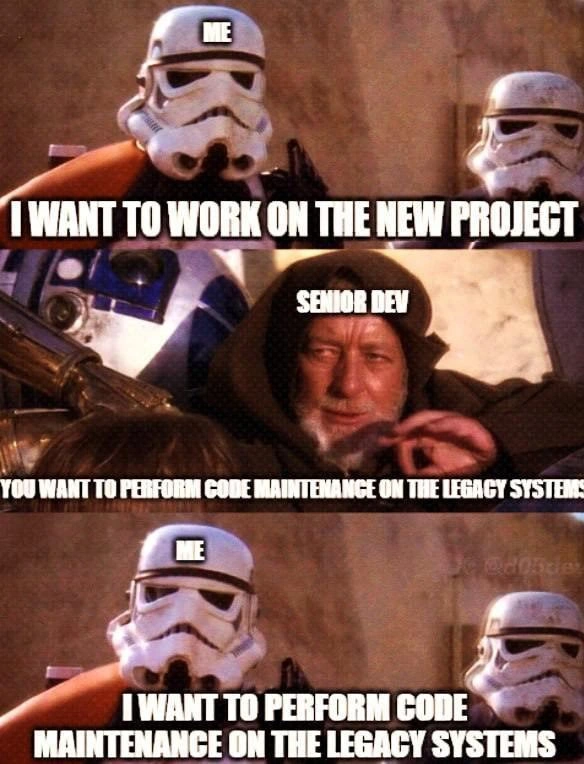
  • "ME" (the stormtrooper) – This is the junior developer (in the image, a stormtrooper with "ME" labeled on it). They're saying "I want to work on the new project." That represents a newcomer who's eager to be part of something fresh and exciting.
  • "Senior Dev" (Obi-Wan Kenobi) – This is the experienced developer, represented by Obi-Wan doing a Jedi mind trick. In Star Wars, a Jedi mind trick is a special hand-wave move that lets a Jedi put suggestions into someone's mind. The classic example is Obi-Wan making stormtroopers repeat after him and accept what he says. Here, the senior dev is essentially doing that to the junior dev.
  • Senior Dev: "You want to perform code maintenance on the legacy systems." – This is the suggestion that the senior is planting. In normal terms, they're telling the junior dev, "Actually, you should work on fixing/updating the old code base instead of that new project."
  • Stormtrooper (Junior) repeats it – In the final panel, the stormtrooper, still labeled "ME," echoes, "I want to perform code maintenance on the legacy systems." It's like the junior developer has been convinced (almost hypnotized) to want the very thing they initially dreaded.

Now, let's clarify some terms and why this scenario happens:

  • Legacy systems / Legacy code: This refers to older software that a company or team has been using for a long time. A legacy codebase might be one that was written years ago in an older language or framework. It might not follow current best practices, and often the original authors have moved on. But it’s crucial: the business still relies on it every day. Think of it as that old machine or old software that nobody is excited about, but if it breaks, everything stops.
  • Code maintenance: This means working on existing code to keep it running smoothly. It includes fixing bugs, improving performance, refactoring messy code, or updating components without rebuilding everything from scratch. It's like being a mechanic for software: the car (program) is already built, and your job is to tune it up and fix any issues, rather than designing a new car.
  • Technical debt: This is a metaphor in programming. Imagine you take a shortcut in your code to meet a deadline (for example, hard-coding a value or skipping tests). That’s like taking on "debt." It makes things faster now, but you owe cleanup later. Over time, these quick-and-dirty decisions build up. The code becomes harder to change without breaking something. Paying off technical debt means spending time later to fix or improve those areas. Legacy systems tend to have a lot of technical debt because they've been changed and patched over many years.
  • Greenfield project: In software, a greenfield project means starting a brand new project from the ground up, on a "green field" with no existing constraints. Developers love these because you can use the latest technologies, set everything up cleanly, and you aren't stuck with old design decisions.
  • Brownfield project: This is the opposite of greenfield. It's when you're working on an existing project or codebase (the "brown field" already has something built on it). It means you have to deal with choices and mistakes made in the past. Brownfield work often involves a lot of code maintenance and integration, because you can't just start fresh – you have to work with what's there.
  • Senior vs. Junior developers: A junior developer is someone new to the team or early in their career – they're usually excited to prove themselves and learn new things. A senior developer has more experience and a big-picture understanding of the software. Seniors often end up deciding who works on what, and they mentor juniors. They also carry the responsibility for keeping systems stable.

In the meme, the junior dev (the stormtrooper labeled "ME") really wants to be on a greenfield project – the cool new thing. This could be anything like developing a new app with a fresh tech stack or starting a feature from scratch. The senior dev knows that there’s urgent work on the legacy code (a classic brownfield assignment) that needs to be done to keep everything running. The junior isn't volunteering for that, so the senior dev uses a "Jedi mind trick" – a playful way to say the senior convinces or gently pressures the junior to accept the maintenance task.

Why does the senior care so much about the junior working on legacy maintenance? Usually, because the legacy system is really important. It may not be fun or modern, but it's the backbone of the product or company. If nobody fixes its bugs or updates it, things could fall apart. Senior devs have likely spent years with this system; they understand its quirks and how critical it is. They also know that working on it is a great way for a newcomer to learn how the whole system works. It's pretty common on real teams that new developers spend time fixing bugs or adding small improvements to the existing system before they get to start brand new projects. It might even be unofficially a test or rite-of-passage: "Let’s see how you handle the real messy stuff, then we’ll talk about shiny new projects."

So the meme humorously exaggerates that situation. Instead of a normal conversation, it depicts the senior as literally mind-wiping the junior into saying they want to do the dull work. This is wrapped in a Star Wars joke because many people in tech love Star Wars, and it perfectly fits the dynamic: Obi-Wan (wise old mentor) has a trick to make the hapless stormtrooper (foot-soldier) do what he says. Stormtroopers in Star Wars are known for following orders without question (and frankly, being a bit weak-minded for Jedi tricks), so it's an apt comparison to a junior dev who ends up agreeing to a task they didn't originally want.

The phrase "force-pushes you into legacy code" in the title is a clever pun too. git push --force (force push) is a Git command that forces an update to the code repository, even if it overwrites others' work. It's usually used sparingly because it can be dangerous (you could replace history). Here, the senior dev is effectively force-updating the junior dev's "internal repository" of plans: replacing "new project" with "legacy maintenance." And of course, The Force in Star Wars is the mystical energy Obi-Wan uses to do the mind trick. So "using The Force" = convincing someone with a hand wave, and "force-pushing" = overriding what the junior wanted – both ideas combine in that title.

In summary, this meme shows a super-excited developer getting nudged (or let's say cleverly talked) into taking on a boring but necessary task. It's funny because it's a scenario most developers find very relatable. Almost every programmer has experienced wanting to work on something exciting, but instead being assigned to clean up or maintain older code. The meme uses the Jedi mind trick scene to dramatize that feeling: the senior dev doesn't literally have magical powers, but when you're a junior being told to go work on the old system, it feels a bit like you've been Jedi mind-tricked into saying "Yes, okay, I'll do it." The combination of a relatable workplace situation with a classic Star Wars reference makes the whole thing entertaining.

Level 3: The Tech Debt Strikes Back

In this meme, developer humor flows through a Star Wars reference: a Senior Dev channels Obi-Wan Kenobi using the Force (or managerial cunning) on a junior dev depicted as a stormtrooper. The scene recreates the famous Jedi mind trick moment:

ME: I WANT TO WORK ON THE NEW PROJECT
Senior Dev [waves hand]: YOU WANT TO PERFORM CODE MAINTENANCE ON THE LEGACY SYSTEMS.
ME: I WANT TO PERFORM CODE MAINTENANCE ON THE LEGACY SYSTEMS.

Why is this funny? Because it flips a typical software-team scenario on its head using an iconic sci-fi trope. The eager junior developer (the one saying "I want to work on the new project") represents every young programmer lusting after a shiny new tech initiative or greenfield project. Meanwhile, the senior developer knows there’s a crucial but unloved legacy system that desperately needs attention – a brownfield project laden with technical debt that nobody is volunteering for.

The humor comes from the idea that the senior uses near-mystical persuasion to redirect the junior's enthusiasm. With a Jedi-like hand wave, poof, the newbie suddenly parrots an eagerness to toil in the dustiest corners of the codebase. It's a tongue-in-cheek take on how experienced engineers often have to steer newcomers toward the unsexy work that actually keeps the product alive (the stuff everyone else avoids).

In real life, this dynamic is painfully relatable. Fresh hires often crave building something new with modern frameworks, but the reality is many teams run on existing monolithic applications or aging services that require care. The Senior vs Junior tension surfaces when assignments get doled out: the senior might frame maintenance as a vital learning opportunity or simply use their authority to delegate it. The meme exaggerates that into literal mind control. It's funny because sometimes it does feel like you were magically convinced (or "volun-told") to wade into a decade-old codebase when you really wanted to craft new features.

For example, picture an enthusiastic dev saying, "I can't wait to write that new microservice in Go!" and the senior replies, "Actually, you'll be enhancing our legacy COBOL Java app from 2009." This kind of conversation happens everywhere. It's the classic brownfield vs greenfield scenario: new projects are glamorous, but the existing ones are mission-critical. The legacy code is full of landmines — quick fixes, outdated libraries, giant functions no one dares to touch. Many of those dusty sections started as expedient hacks under old deadlines, which have now solidified into lasting problems – the very definition of technical debt. The senior dev probably knows this system inside-out (they might have written parts of it years ago, or inherited the mess themselves). They also know that if no one maintains it, it will eventually break badly, possibly bringing down production at 3 AM on a weekend. So from the seasoned perspective, somebody has to confront this Death Star of a codebase before it explodes.

And who better than the new recruit full of energy, right? 🤷‍♂️ It's practically a rite of passage in software teams: fixing bugs in a 10-year-old module, or refactoring a 5,000-line method that everyone else has been avoiding. A cynical veteran will note that senior devs do this out of necessity (and a bit of self-preservation) – better to train a junior to handle it than to remain the only one paged every time that brittle system hiccups.

There's an organizational dance here too. Plenty of folks want to join the exciting new project (it’s fun, resume-boosting, and greenfield). Meanwhile, legacy maintenance is crucial but thankless. So leads and managers practice a form of stormtrooper management – persuading or assigning people to these less glamorous tasks while trying to keep morale intact. The Jedi mind trick in the meme is a playful metaphor for that kind of soft power move.

We also have a nerdy pun embedded in the title: the senior dev "force-pushes" the junior into legacy code. In Git version control, git push --force is a command to forcefully overwrite the remote repository with your changes. Metaphorically, the senior dev is overwriting the junior’s plans. It's a perfect double meaning — using the Force like a Jedi, and force-pushing a new "commit" (task) into the junior's career. For those who speak Git, it looks something like this:

git commit -m "I want to work on the new project"
git push origin main    # Junior dev's original intent is published (their desire goes public)
# Senior dev uses a Jedi mind trick:
git reset HEAD~1        # undo that commit (erase the original idea)
git commit -m "I want to perform code maintenance on the legacy systems"
git push --force origin main  # push the new commit and overwrite history (override the junior's plan)

From a senior engineer’s perspective, this meme hits a nerve. It acknowledges a harsh truth: working in tech isn't all cutting-edge innovation – a huge chunk is about preserving and improving the legacy codebase so the business doesn't crumble. The golden promise of a new project often yields to the reality of maintaining what already exists. It's a mix of commiseration and dark comedy: almost every experienced dev has felt the gravitational pull of an old system that won’t let them escape to the shiny new one.

This scenario is timeless in our industry. The languages and tools change, but the situation repeats. Decades ago, a junior might have dreamed of building something with the latest technology, only to be assigned to fix a crusty COBOL program for Y2K. Today, a junior might yearn to write a cloud-native microservice, but instead gets pulled into debugging a sprawling on-prem monolith. The lesson: technology evolves, but someone always has to maintain yesterday's code.

When you've been around a while, you chuckle (and maybe groan) at how true this is. The meme is basically a knowing wink to developers: "Remember when you thought you'd be working on a cool new app, but ended up spending weeks untangling old spaghetti code? Yeah... welcome to the club." It highlights that shared experience using Star Wars flair. In the endless battle between shiny new features and old systems, the Tech Debt Empire often strikes back just when we think we're free. And if you ever find yourself in that stormtrooper's boots, well, May the Force be with you – you'll need it to survive those legacy code adventures.

Description

A three-panel meme using the 'Jedi Mind Trick' scene from Star Wars: A New Hope. In the first panel, a Stormtrooper labeled 'ME' says, 'I WANT TO WORK ON THE NEW PROJECT'. In the second panel, Obi-Wan Kenobi, labeled 'SENIOR DEV', gestures and says, 'YOU WANT TO PERFORM CODE MAINTENANCE ON THE LEGACY SYSTEMS'. In the final panel, the Stormtrooper, now convinced, repeats robotically, 'I WANT TO PERFORM CODE MAINTENANCE ON THE LEGACY SYSTEMS'. The meme humorously portrays the dynamic where senior developers use their influence to assign undesirable but necessary work on legacy codebases to more junior team members, who would much rather engage with new, exciting greenfield projects

Comments

14
Anonymous ★ Top Pick The ability to assign a legacy project is insignificant next to the power of the Force. But the ability to convince someone they want that ticket? That's a true senior developer
  1. Anonymous ★ Top Pick

    The ability to assign a legacy project is insignificant next to the power of the Force. But the ability to convince someone they want that ticket? That's a true senior developer

  2. Anonymous

    The real Force isn’t midichlorians - it’s the unwritten clause in every architecture decision record that says, "Someone must still babysit the 2006 SOAP service."

  3. Anonymous

    The real Jedi mind trick is convincing yourself that refactoring that 15-year-old COBOL-to-Java-to-microservices monstrosity is 'an opportunity for architectural leadership' rather than a descent into madness where every bug fix spawns three new ones and the original developer left only cryptic comments in Latin

  4. Anonymous

    Every senior engineer knows the dark side of the Force isn't anger or hatred - it's the ability to make 'refactoring that 15-year-old monolith with zero test coverage' sound like a career-defining opportunity. These aren't the greenfield microservices you're looking for

  5. Anonymous

    Not a Jedi trick - just RTB vs CTB math: greenfields win OKRs; the legacy monolith owns the SLA, the pager, and 80% of revenue

  6. Anonymous

    Senior dev wisdom: 'New projects, you crave. Legacy maintenance, you will get - it's the Force's true balance.'

  7. Anonymous

    The real greenfield is just a proxy service in front of the 2009 monolith - rename ‘maintenance’ to ‘domain ownership,’ and suddenly the bus factor counts as leadership experience

  8. @viktorrozenko 1y

    I don’t get it

    1. @TheFloofyFloof 1y

      Junior devs are software janitors

      1. @viktorrozenko 1y

        Interesting, because in my experience it’s quite the opposite

      2. @dsmagikswsa 1y

        When you are also a senior dev, the picture 'me' would be also a senior dev

      3. @Algoinde 1y

        Junior devs are *why* we need software janitors

        1. @erizpl 1y

          *legacy

  9. @LeakyRectifiedLinearUnit 1y

    this hit me hard, about time I switch jobs

Use J and K for navigation