A Glimpse Into Anthropic's Internal Chaos: Absurd Feature Flag Names for Claude 4
Why is this AI ML meme funny?
Level 1: The Cat’s Out of the Bag
Imagine you and your friend have been working on a big secret surprise – say, a new toy or a special event – and you want to reveal it later with a bang. You hide all the signs and keep it hush-hush. But uh-oh, one day you accidentally leave a note on the fridge that says exactly what the surprise is. Your friend walks by, reads it, and yells, “I knew it!” The surprise is ruined, and you both stand there in shock, one giggling and the other blushing. That’s essentially what happened here: the developers at Anthropic had a big surprise (a new AI model called Claude 4) that they wanted to unveil later, but they accidentally left a clue in the open for someone to find. The joke is the mix of oops and aha! – it’s funny because the secret slipped out in a silly way, just like spilling the beans about a surprise party before the party. Everyone can laugh, a bit nervously, because the secret’s out earlier than planned.
Level 2: Feature Flags Unflagged
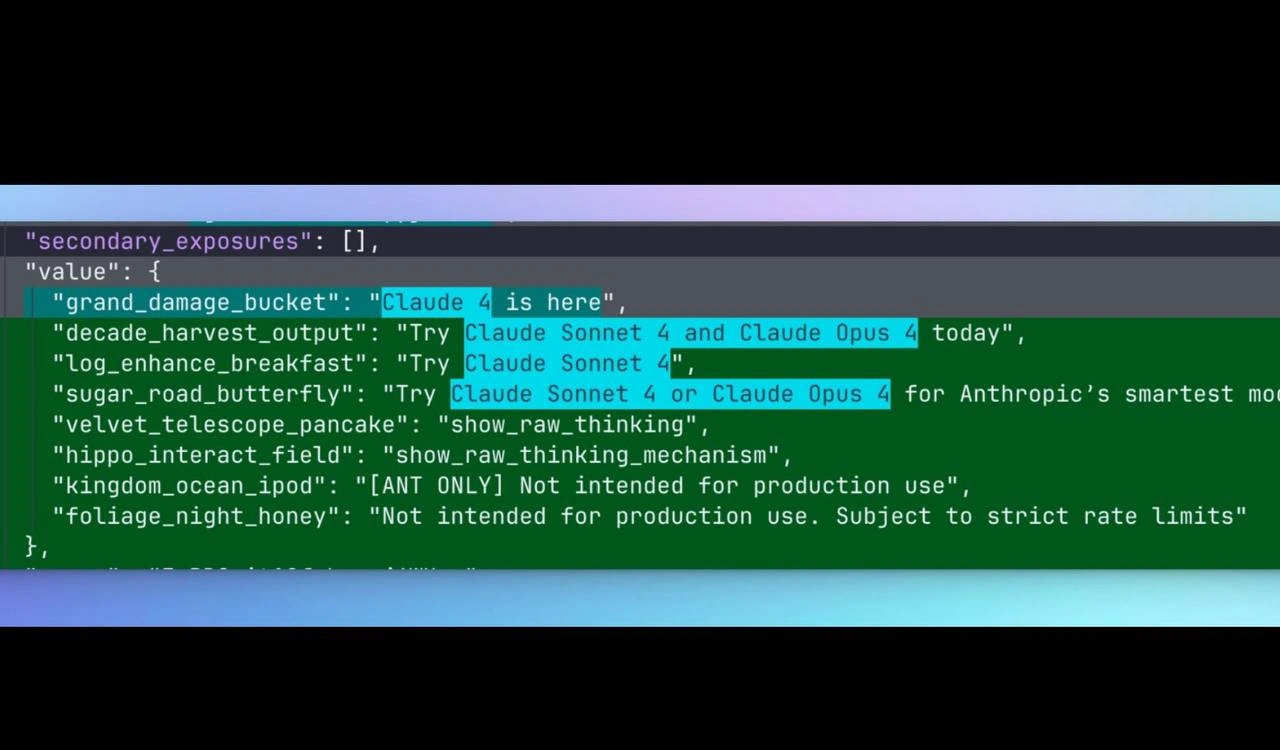
Let’s break down what’s happening in simpler terms. The image is a screenshot of a configuration file (in JSON format) showing some new settings that were added. In software, a configuration file defines settings or features for an application without changing the code. Companies like Anthropic use feature flags – these are basically on/off switches or value settings in config that control whether certain features are active. Feature flags let developers deploy code for a new feature (like a new AI model) but keep it disabled for users until it’s ready or officially announced. It’s like having a hidden section in a game that you can later unlock for players. The tricky part is keeping those secrets truly hidden. In this case, the config’s keys have bizarre names ("grand_damage_bucket", "sugar_road_butterfly", etc.), which don’t mean anything obvious. That’s probably intentional to avoid revealing the feature’s purpose. However, the values associated with those keys do spill the beans: they explicitly mention Claude 4 and even names like “Claude Sonnet 4” and “Claude Opus 4.” Essentially, the developers tried to use code names, but the secret new models and options are right there in the text.
So who or what is Claude 4? Claude is the name of an AI LLM (Large Language Model) created by Anthropic (an AI company). Think of it like Anthropic’s version of GPT – a powerful AI that can chat and answer questions. The number “4” suggests this is a new generation, presumably more advanced than Claude 2 (which was known publicly before). This config leak indicates Claude 4 (and possibly variants named Sonnet and Opus) was being prepped. The text “Claude 4 is here” sounds like a promotional message that might be shown to users when the feature is turned on. The lines “Try Claude Sonnet 4” etc., read like prompts or UI text inviting users to use the new models. In other words, this is content meant for future release, sitting quietly in the config until someone flips the switch for customers to see it.
Now, how was this discovered? The title says “grepping the secret Claude-4 feature flags”. grep is a command-line tool used by developers to search for specific text in files. It’s super handy when debugging or exploring code. If you grep "Claude 4" on the server or codebase, you ask the computer “find all occurrences of the phrase ‘Claude 4’ in these files.” It seems someone did exactly that on production (“prod”) and, to their surprise, found these lines. It might have been an accident in the sense that maybe they were investigating something else, or they were curious if Claude 4 was mentioned anywhere. Either way, they struck gold (or stepped on a landmine, depending on perspective!). For example, the search could have looked like:
$ grep -R "Claude 4" /etc/configs/
/etc/configs/anthropic_flags.json: "grand_damage_bucket": "Claude 4 is here",
/etc/configs/anthropic_flags.json: "decade_harvest_output": "Try Claude Sonnet 4 and Claude Opus 4 today",
The output above (simulateed) shows two lines in a config file that contain “Claude 4”. The path anthropic_flags.json hints this is an Anthropics configuration file for features. So just by searching, the developer unintentionally unflagged these feature flags – revealing the secret. It’s like shining a flashlight in a dark attic and suddenly seeing something you’re not supposed to.
Let’s decode some of the other terms in that JSON blob. One pair is "velvet_telescope_pancake": "show_raw_thinking". That looks strange! This suggests that if the feature flag velvet_telescope_pancake is enabled, it triggers a mode called "show_raw_thinking". In AI, showing “raw thinking” refers to displaying the chain-of-thought of the model — basically the model’s hidden reasoning steps. Usually, when an AI like Claude gives you an answer, it doesn’t show all the intermediate thoughts it had (just like a student might only write the final answer unless asked to “show your work”). But developers and researchers sometimes enable chain-of-thought mode to debug or evaluate how the AI arrived at an answer. It’s a bit like a math teacher looking at all the steps a student wrote in the margins. Another flag key, "hippo_interact_field": "show_raw_thinking_mechanism", sounds related – possibly another internal mode or an extension of showing its reasoning. These are internal debug features. They exist so engineers at Anthropic can peek under the hood of the AI and see if everything is working properly. They are definitely not meant for end-users because the output could be messy or could reveal how the model works (which might confuse users or enable misuse). That’s why the config explicitly says “[ANT ONLY] Not intended for production use” for the key "kingdom_ocean_ipod". “ANT” stands for Anthropic. So that note is basically screaming, “only Anthropic employees should ever see or use this; it’s not for customers!” Seeing that in a production file is a huge oops – it means something internal slipped into the external environment.
For a junior developer, the lesson here is about environment separation and caution with feature flags. Generally, companies maintain separate configs for testing and production. In testing or staging, you might enable all the cool new stuff to try it out internally. In production (the live system users interact with), you keep those off or absent. Sometimes, though, a flag or config entry can accidentally be deployed to production – perhaps turned “off” but still present. Even if it’s off, its very presence can hint at what’s coming. This is a form of data leakage – leaking information. It might not be a password or user data leak, but it’s leaking future plans and internal tools. And any leak is taken seriously in Security terms. Plus, users get hyped if they discover it (“Anthropic’s smartest model?!!”); or worse, someone malicious might try to mess with it. This meme resonates because it shows how one innocent search can uncover a company’s secret roadmap. It’s equal parts exciting (for the discoverer) and panic-inducing (for the team that slipped up).
In summary, the config diff in the image is a real-world example of a Debugging find: a developer literally saw an unexpected diff (probably during a code review or log investigation) revealing unreleased AI features. It highlights concepts of feature flags, environment handling, and why we double-check what we deploy. Remember, even fancy AI projects have those human “oops” moments — code is written by people, after all. And as a junior dev, if you ever stumble on something like this, now you know it’s essentially the tech equivalent of finding the secret menu item that wasn’t supposed to be advertised.
Level 3: Grepping for Trouble
In this high-stakes game of AI feature flags, a seasoned dev’s worst nightmare just came true: a production config diff spilling next-gen secrets. The meme shows a JSON snippet added in a git diff (green highlights mean new lines) revealing Anthropic’s upcoming model Claude 4 and internal toggles. Imagine being on-call, running grep on a prod server to debug something trivial, and suddenly hitting lines like "grand_damage_bucket": "Claude 4 is here". Cue the heart attack. These keys – with whimsical names like velvet_telescope_pancake – were supposed to be innocuous, but their values read like leaked release notes: “Try Claude Sonnet 4 and Claude Opus 4 today”. That’s basically Anthropics’ marketing copy for unannounced AI models, hiding in plain sight! For a senior engineer, this is both darkly funny and horrifying: some developer accidentally committed a config with hidden feature flags for Claude 4. It’s the classic “oops, we shipped the secret config” scenario that triggers PTSD in anyone who’s lived through a production leak.
Why is this so hilariously cringe-worthy for experienced devs? Because we’ve all seen how a single mis-scoped commit or forgotten flag can have Security and PR teams doing damage control by noon. Here, an internal JSON meant for testing escaped into prod, complete with [ANT ONLY] Not intended for production use warnings – the irony is palpable. That tag is a huge red flag (pun intended): it literally says “Anthropic Only,” yet here it is, live in production config for some unlucky grepper to find. It’s like the code is snitching on itself. The presence of “show_raw_thinking” flags (via keys velvet_telescope_pancake and hippo_interact_field) hints at a chain-of-thought visibility feature. Seasoned AI folks know this is a big deal: it’s an internal debug mode that reveals the AI’s reasoning steps. Such chain-of-thought outputs are usually kept behind closed doors because they can expose how the model works or produce unfiltered intermediate thoughts. Now that these flags are visible, external users or researchers might salivate at the prospect of toggling them. It’s a security headache — if someone figures out how to flip show_raw_thinking on an API, they could peek under the hood of Claude’s mind. No company wants their raw AI thought process out in the wild prematurely, especially not with a [Not intended for production use. Subject to strict rate limits] footnote signaling “this isn’t ready, folks.”
From an engineering perspective, this snippet screams Configuration management gone awry. Likely, Anthropics uses a feature flag service with auto-generated codenames (“sugar_road_butterfly”, anyone?) to stealth test new LLM features. That’s a common practice: hide secret features behind random flag names so customers or competitors won’t guess what’s brewing. But here the dev (or an automated experiment roll-out) accidentally deployed those flags to a production environment config without scrubbing the telltale text. The green diff suggests these lines were freshly added – maybe as part of a rushed update. Perhaps an engineer intended to test Claude 4 in a controlled setting, but the config path they edited was the live one. Oops. Suddenly, every instance running that config knows Claude 4 exists. Experienced devs are laughing (and groaning) because it’s a too-real reminder: even the best AI/ML teams trip over feature flags. We remember infamous leaks – like mobile apps revealing new features in update code, or code names of upcoming products showing up in public APIs (Apple, Google, it happens to the best!). This Anthropics snafu is right up there: the AI hype machine accidentally started early via a stray JSON. Given the meme’s post time (May 22, 2025, 9:30am PT) and a clau.de/livestream link, it coincides with what was likely a planned Claude 4 launch event. The dev who grepped essentially pulled a “spoiler alert” on the big reveal. Seasoned engineers find humor in the chaos: internal names that sound like a Mad Lib, secret models advertised in config, and a colleague frantically git-reverting that commit before any more eyes see it. In short, it’s a perfect storm of Debugging_Troubleshooting meets AI hype meets config Security blunder – the kind of tale you later share over beers, once your heart rate returns to normal.
Description
This image is a close-up screenshot of a JSON object, likely from an internal configuration file or a developer console, revealing the feature flags for what appears to be the launch of Anthropic's Claude 4 AI model. The structure is a standard key-value map within a parent object. The humor and interest for developers lie in the bizarre, nonsensical key names, such as "grand_damage_bucket", "sugar_road_butterfly", "velvet_telescope_pancake", and "kingdom_ocean_ipod". These absurd names stand in stark contrast to the values they hold, which are mostly straightforward marketing or internal directive strings like "Claude 4 is here", "Try Claude Sonnet 4 and Claude Opus 4 today", and "[ANT ONLY] Not intended for production use." This screenshot is a classic example of the messy, often humorous reality behind polished tech products. Senior engineers would recognize this as a common practice of using generated or whimsical code names for feature flags to avoid naming collisions or for obfuscation, finding it a relatable peek behind the curtain of a major AI company's development process
Comments
11Comment deleted
I'm not saying their feature flag naming convention is random, but I'm pretty sure 'velvet_telescope_pancake' was the original working title for the constitution model's RLHF alignment process
Stumbling on a "show_raw_thinking" flag in the config is the LLM equivalent of flipping prod logging to TRACE - sure, it works, but now Compliance is paging you at 3 a.m
When your AI model's marketing strategy involves hiding promotional messages in JSON configs with field names that sound like rejected startup ideas, you know the prompt injection wars have evolved into something far more sinister: configuration-driven development marketing
When your A/B testing framework's random codename generator produces 'velvet_telescope_pancake' and 'hippo_interact_field', you know someone on the platform team got tired of boring feature flags like 'enable_new_model_v2'. At least when Claude 4 inevitably breaks production, the incident postmortem will read: 'Root cause: grand_damage_bucket was set to true.' The real engineering challenge isn't training frontier AI models - it's maintaining a straight face during sprint planning when discussing the 'sugar_road_butterfly' rollout strategy
Claude's tags: velvet butter roads and ocean iPads - because nothing stabilizes prod like LLM hallucinations in your config
Nothing says responsible AI governance like gating 'show_raw_thinking_mechanism' behind 'velvet_telescope_pancake' and praying the canary scope doesn’t include prod
Enterprise rule: the moment a flag says "Not intended for production," it’s already live - under grand_damage_bucket with a 1% rollout and someone on-call if show_raw_thinking flips
what is that time reference ? Comment deleted
vsem jsonam json Comment deleted
what the hell is this naming i don't get a single bit of this Comment deleted
thanks anthropic PR team very cool Comment deleted