When Biotech News Hits the Dev Feed: Developers Contemplate 'Vibe Coding' the Human Genome
Why is this IndustryTrends Hype meme funny?
Level 1: When Science Beats You to the Finish Line
Imagine you’re trying to tie your shoelaces, and it’s taking forever. Meanwhile, your friend manages to build a rocket ship and fly to the Moon in the time you’re still fumbling with your laces. 😮 Sounds silly, right? That’s the joke here. In real life, scientists did something incredibly big and amazing (like fixing someone’s DNA to cure an illness) in what feels like less time than it’s taking me to finish a very basic task (getting my work finished because my computer is super slow). We find it funny because the difference is so exaggerated. It’s like saying, “Wow, they accomplished that before I even got this done!” It’s a way to laugh at how slow our thing is going by comparing it to something unbelievably fast and cool. The big feeling behind it is part surprise and part frustration, but turned into humor: sometimes our everyday stuff drags on, while huge exciting things zoom ahead. And seeing that contrast makes us go, “Ha! Of course that would happen to me!”
Level 2: Slow Suite, Fast Science
Let’s break down the joke in simpler terms. On one side, we have CRISPR and prime editing. These are terms from biotechnology. CRISPR (short for Clustered Regularly Interspaced Short Palindromic Repeats) is a groundbreaking tool scientists use to edit genes – basically changing the DNA instructions inside living things. It’s often described as “genetic scissors” because it can cut DNA at a specific spot. The news article in the meme is talking about a new kind of CRISPR called prime editing, which is like an improved version that can not just cut but also paste in new genetic material more accurately. The headline says a world-first trial of this powerful gene-editing treatment was done in a person – meaning they actually tried it on a real human patient (an 18-year-old with a genetic immune disorder). In plainer words: researchers were able to tweak the code of life in someone’s body to fix a medical problem. That’s a huge, exciting scientific breakthrough!
Now, on the other side, the meme mentions “our monolith’s test suite.” In software development, a monolith is a big all-in-one application. Imagine a giant program that does everything together, rather than lots of little programs (services) working independently. Monoliths are common in older systems or legacy projects. They can be powerful, but they tend to get unwieldy as they grow. Along with that comes the test suite – which is basically a collection of all the tests that engineers have written to check that the software is working correctly. This includes unit tests (small, focused tests on individual pieces of code) and integration tests (bigger tests that check if different parts of the system work together). In a large monolith, the test suite can have thousands of test cases. Running all of them can take a lot of time, especially if some tests start up databases, call external systems, or run through real usage scenarios. It’s a bit like having a huge checklist to go through every time you make a change, to be sure nothing else broke.
Now, the joke compares these two things: the CRISPR prime editing trial and the monolith’s test suite. When they say “CRISPR hits human prod before our monolith’s test suite finishes running,” they’re using some fun developer jargon. “Prod” is short for production, which in software means the live environment where users are affected (as opposed to a test or development environment). When something “hits prod,” it means it’s been deployed or released to real users. So calling a human trial “human prod” is metaphorical – it’s like saying they deployed this gene edit to a real live person (which is true!). They’re jokingly treating the patient as if he were a production server getting an update. Meanwhile, our “monolith’s test suite” still running means that back in our software project, the automated tests are still chugging along, not yet finished.
So put it together: A groundbreaking treatment using CRISPR was actually given to a person (that’s huge news) and it all happened faster than the time it’s taking for our software tests to complete. This is funny because usually applying a new gene therapy in a human is a very slow, careful process – it involves years of work. And running software tests is usually considered a quick, routine task in comparison. But here it’s flipped: the routine task (our tests) is comically slow, and the supposedly slow, complex thing (gene editing in humans) happened faster, at least in our perception. It’s hyperbole, of course. We know our test suite isn’t literally slower than multi-year scientific research. The meme is exaggerating to make a point. But anyone who’s dealt with a painfully slow test suite can relate to the feeling that it might as well take years!
For a junior developer or someone new to the field, here’s the relatable scenario: You write some code and you run the tests, expecting to get a quick “all good” or “something failed” so you can move on. But with a big legacy system, you might find yourself waiting and waiting… and waiting. You might open your phone while you wait. Maybe you see a cool news story – say, scientists doing something amazing like curing a disease with gene editing. You’re impressed: “Wow, they can do that now?!” Then you glance back at your screen and realize your tests are still running. It feels ridiculous, right? That’s the feeling this meme captures. It’s the contrast between tech world excitement and tech world tedium. On social media, you see thousands of retweets and likes on that CRISPR news, indicating it went viral — everyone’s hyped about this innovation. Meanwhile, no one is tweeting about your test suite taking 3 hours (except maybe you, sarcastically).
The “hype cycle” aspect is that in technology (and science), big breakthroughs get a lot of attention. CRISPR, prime editing, those are buzzwords in 2025 that people talk about in awe. On the other hand, maintaining or improving a slow software pipeline is not glamorous. It’s important work, but it’s not going to get news articles and massive online engagement. So developers often joke about these everyday pain points by comparing them to big, flashy things. It’s a form of humor that says, “Our job isn’t always as cutting-edge as it might sound; sometimes it’s downright sluggish and boring.”
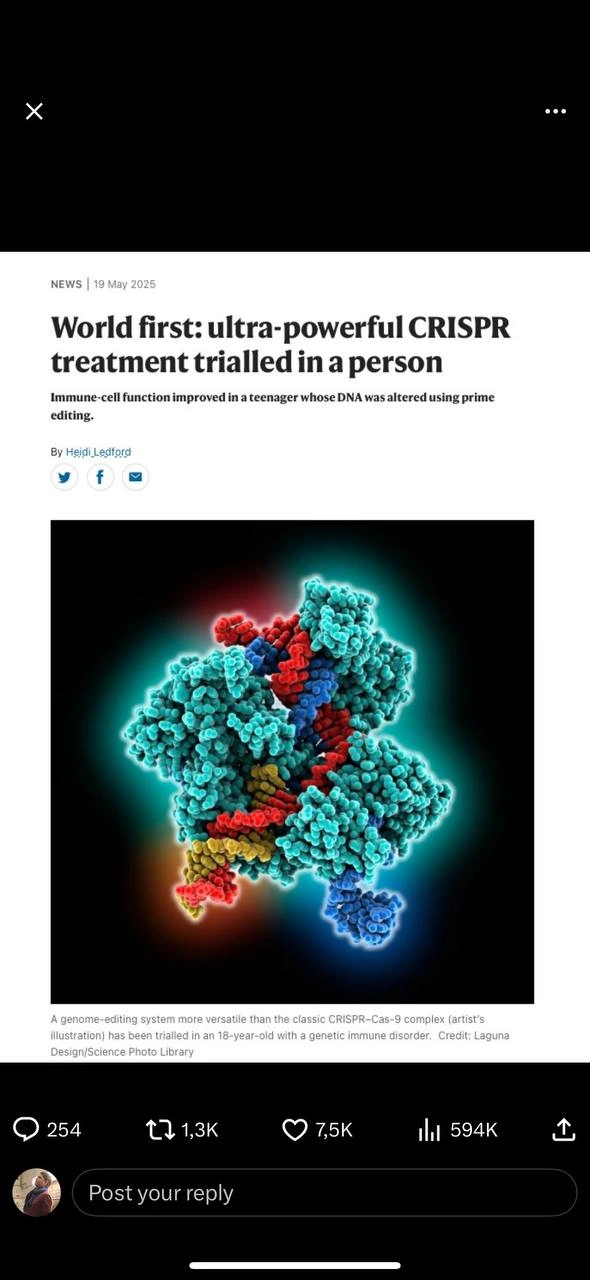
In the image described, you see a glowing 3D model of the CRISPR-Cas9 prime editing complex. It looks high-tech and futuristic (all those colorful coils are like a molecular machine). There’s a big bold headline about the world-first trial. The whole vibe is “look at this amazing new thing happening!” Then there’s us, looking at this on our phone while our work laptop is stuck on test number 978 of 1500. 😅 It’s a moment of tech irony that many find amusing. The phrase “Vibe coding of DNA is coming 🌚” in the post text is another tongue-in-cheek element – it implies that editing DNA might become as casual as coding, which is both exciting and a tiny bit ominous (hence the moon-face emoji, adding a sly, joking tone).
So, boiled down: the meme jokes that science is zooming ahead (they literally changed someone’s DNA!), while our project at work is crawling (our code tests aren’t even done yet). For anyone who has waited on a build or tests, it’s a humorous way to say “boy, this is taking forever.” And it also playfully pokes at how we always hear about cool new tech out in the world, even as our own tech environment feels stuck in the past. It’s both motivational (we should strive to improve things) and simply funny in its exaggeration.
Level 3: CI vs CRISPR: The Race
Why do experienced developers smirk at this meme? It pits the fast-paced hype of scientific innovation against the slow grind of legacy development, in a way only tech folks would frame. The tweet’s headline, “World first: ultra-powerful CRISPR treatment trialled in a person”, reads like a deployment changelog for humanity. By cheekily saying CRISPR “hits human prod,” it treats a groundbreaking medical trial as if the researchers just pushed a new feature to production. And the kicker: that happened before our poor old monolith’s test suite could finish running. The humor comes from this absurd timeline clash. On one hand, a prime editing CRISPR therapy went from lab to a living person (a momentous feat!) seemingly in a snap. On the other, our enterprise app can’t even get past verification tests in that time. It’s a classic bit of TechIrony and a wry nod to the dev community’s shared pain points.
It’s a great bio-tech crossover moment too: gene editing meets dev humor. This meme channels the tech hype cycle we all know. Every few months the news trumpets some revolutionary technology — AI doing creative writing, quantum computers achieving supremacy, SpaceX landing rockets, and here, CRISPR curing diseases. These are the moonshots and industry trends that get everyone buzzing. Meanwhile, back at the office, developers are wrestling with an ancient codebase that’s held together with duct tape and prayers. The contrast is hilarious. We have IndustryTrends on one side and industry reality on the other. It’s like hearing “people are colonizing Mars” while you’re stuck fixing a production bug caused by a 10-year-old regex. Hype vs. humdrum. Big leaps vs. baby steps.
The monolith’s slow test suite is a well-known villain in senior dev war stories. Monolithic applications (common in older, large companies) tend to have huge, interconnected code. Over time, they accumulate a massive test suite – thousands of tests that must all pass before you can safely release new code. Many of these are integration or end-to-end tests: they spin up real databases, call internal APIs, render UI, etc. They’re valuable because they catch real issues, but they’re slow. If you’ve ever waited 45 minutes for all the tests to run, watching logs scroll by, you know the agony. And if some tests are flaky (occasionally failing for unrelated reasons), you might have to rerun them, extending the wait. In some companies, a “full build” with tests might even be scheduled overnight. So developers end up with this frequent experience: you hit run on the test suite, then you have time to grab coffee, chat with a colleague, and scroll through Twitter while the computer churns away. And guess what pops up on Twitter? News of a ultra-powerful CRISPR treatment making history. Cue the facepalm and laughter: the world outside just changed, and my tests are still only 82% done.
Another layer here is the bureaucratic slog versus agile ideals. In theory, software development is supposed to be quick and iterative (Continuous Integration pipelines, rapid releases, “move fast and break things” and all that). In practice, especially with legacy systems, we encounter a lot of friction. There are often additional compliance sign-offs and manual approvals for deploying code in big organizations (for good reason — no one wants to break a production system). It’s funny because the meme implies even the heavy regulatory process of a medical trial (which is famously slow and cautious) managed to conclude faster than our release process. Imagine that: scientists got an ethics committee to approve gene editing in a human faster than we got our QA team to approve this week’s deployment! When a project’s architecture and process are outdated, even tasks that should be routine (like running tests or pushing code) turn into a waiting game. Meanwhile, the cutting-edge stuff, which you’d assume takes ages, is happening at a lightning pace. That role reversal is comedic gold for anyone who’s seen the gap between tech headlines and the grind of enterprise IT.
From an organizational perspective, fixing a slow test suite isn’t glamorous. It’s pure tech debt work. To truly speed it up, you might have to break the monolith into microservices, redesign tests to run in parallel, or invest in better CI infrastructure. These are month- or year-long efforts that don’t produce a flashy demo at the next all-hands meeting. So they often get backlogged while the company focuses on new features or whatever is trendy. Every seasoned dev has heard, “We know the tests are slow, but we’ll address it someday — just not this quarter.” As a result, you keep living with the slow pipeline, making dark jokes about how even prime editing human DNA is quicker. It’s both a coping mechanism and a gentle nudge at management’s priorities. Like, “Hey, the TechHypeCycle is great, but can we please invest a bit in not wasting half the day waiting on tests?”
Historically, many of us have seen this before. A decade ago, the big joke was how long the Windows ISO took to compile or how a build would run overnight on ancient hardware. Fast forward, and thanks to modern tools and cloud CI, many teams have super fast test cycles… but not all. Some of us are still stuck with the old monster of a build. It’s the software equivalent of still driving a rusty old pickup while everyone else is zipping around in electric cars. So when something like this CRISPR news appears, it throws our situation into stark relief. We can’t help but laugh and think, “We’re practically in the Stone Age over here, and those scientists are living in the future.”
And let’s not ignore the human element: the frustration and FOMO developers feel. You’re waiting and waiting for these tests, trying not to lose focus. You see exciting breakthroughs trending online and it’s hard not to compare. It’s almost existential humor — the world is evolving and I’m literally stuck in a loop. Many developers bond over this shared pain: swapping horror stories of the 15-hour build or the test suite that only one beefy server can run. Joking that “they’ll discover aliens before our tests finish” or “I could train a deep learning model in the time it takes to build this app” is our way to vent. This meme nails that feeling using the CRISPR breakthrough as the foil. It says, without saying directly: we know this feel. The whole team can chuckle, half in amusement, half in exasperation, at just how ridiculous the contrast is.
In summary, the meme’s humor comes from flipping expectations. We expect fancy new science to be slow and careful, and routine software tasks to be fast and automated — but reality isn’t always so. It pokes fun at the sluggishness of legacy systems by comparing it to the fastest-moving frontier of science. For the senior devs, it’s a wink and a nod: “Yep, our test suite is that slow.” It’s a reminder that while we’re stuck debugging and waiting on Jenkins, somewhere out there people are literally coding DNA and pushing humanity forward. That mix of humility, irony, and shared suffering is what makes this so relatable and funny.
Level 4: Primed for Production
At the cutting edge of biotech and software, we see an ironic race between genetic code and legacy code. CRISPR is often described as a molecular tool for editing DNA — the classic CRISPR–Cas9 works like a pair of programmable scissors that cut the genome at a specific spot, hoping the cell’s repair processes insert the desired changes. It’s powerful but a bit brute-force, akin to doing a find-and-delete in a codebase and praying the system auto-fills the right fix. The news in the meme is about prime editing, a next-gen CRISPR technique. Instead of making a destructive cut, prime editing attaches a repair template along with the molecular scissors, effectively performing a targeted search-and-replace on the DNA sequence with surgical precision. If CRISPR–Cas9 was like a rough regex substituting text, prime editing is a carefully crafted patch file applying exactly the change we want. It’s almost sci-fi made real — by 2025, scientists are literally debugging the code of life in a teenager’s cells with this method. And remarkably, that genetic patch was just deployed to production in an actual human patient’s immune cells (the ultimate “prod environment” for biotech).
Reaching a first-in-human trial with prime editing required a massive, multi-stage pipeline of research. Think of it like an extreme CI/CD for biology: years of fundamental experiments (unit tests on cells in petri dishes), iterative refinements in animal models (integration tests on mice or monkeys), and rigorous safety reviews by ethics and regulatory committees (QA sign-offs and code review). Only after passing all these gates could they deploy the treatment in an 18-year-old patient with a genetic immune disorder. By May 2025, that pipeline of experiments and approvals moved swiftly enough to alter the teen’s DNA – a groundbreaking prod push in medical science.
Now compare this to our sprawling enterprise monolith. A monolithic application is a giant all-in-one codebase, and over years it accumulates feature upon feature (and plenty of gnarly interdependencies). Running its full test suite end-to-end is a computational slog. Every commit can trigger tens of thousands of test cases — from quick unit tests to heavy integration tests that spin up databases, call services, and simulate user flows. On a well-engineered system you might parallelize these, but on a typical legacy monolith, tests often run serially or on limited infrastructure, taking hours to complete. Each test run is like re-proving the whole program still works, because in a tightly-coupled system even a tiny change might have butterfly effects. We’ve essentially built up so much complexity that verifying one code tweak means re-checking everything. It’s as if our CI server has to rebuild the entire world from scratch just to be sure nothing broke.
So the meme’s absurd scenario has a kernel of truth: scientists managed to hotfix an 18-year-old’s genome with cutting-edge bioengineering in less time than it takes our CI pipeline to tell us our build is green. Editing billions of DNA letters in living cells (with prime editing’s intricate machinery) turned out to be a faster-moving process — at least in this tongue-in-cheek comparison — than our routine software release cycle bogged down by slow tests. It’s a staggering juxtaposition. On one side, humanity is rolling out an update to the operating system of life; on the other, our dev team can’t even get a simple patch through to production without an overnight test run. The fundamental irony is both hilarious and a bit humbling. Biotech leaps are outrunning our legacy loops. Maybe we need some of that innovation in our deployment process — if only refactoring a monolithic codebase were as straightforward as tweaking a single gene! At this rate, curing genetic diseases might actually happen before our test suite finishes and the release finally goes out. It’s a hyperbolic joke, but it spotlights a real truth about complexity: whether in genomes or in software, you have to tackle it head-on. The CRISPR folks found a smarter way to handle DNA edits (prime editing) to overcome biological complexity. Meanwhile, we developers are joking that we might need a similar revolutionary fix to handle our build pipeline complexity. Until then, the race between scientific breakthroughs and finishing a test run continues — and in this meme’s universe, science is winning by a mile.
Description
This image is a screenshot of a post on a social media platform, likely X (formerly Twitter), sharing a news article about a breakthrough in genetic engineering. The article, dated May 19, 2025, is titled "World first: ultra-powerful CRISPR treatment trialled in a person" and details how prime editing was used to alter a teenager's DNA to improve immune-cell function. The post features a vibrant, artist's illustration of the CRISPR-Cas-9 complex interacting with a DNA strand. The social media engagement metrics are visible at the bottom (254 comments, 1.3K retweets, 7.5K likes, 594K views), indicating significant interest. The user's caption, "Vibe coding of DNA is coming 🌚", humorously reframes this complex biological procedure in software development terms. For senior engineers, the humor lies in the analogy of treating the human genome as a legacy codebase that can now be 'refactored' or 'debugged' with advanced tools like CRISPR, blurring the lines between coding silicon and coding life itself

Comments
13Comment deleted
Finally, we have the tools to refactor the 3 billion-year-old spaghetti code in our DNA. My first pull request is to fix the bug where my back starts hurting at age 30
Amazing - scientists can hot-patch a teenager’s genome in vivo, yet our CI still needs a full regression suite just to rename a column
Meanwhile, developers are still using regex to edit strings because 'it's basically the same thing as CRISPR but for code' - except our mutations are called 'production bugs' and we can't blame evolution when things go wrong
Finally, a production deployment where 'testing in prod' literally means testing in a person. At least with CRISPR, you can't just roll back to the previous commit when the merge goes wrong - no git revert for DNA. The ultimate immutable infrastructure: your genome. Hope they had comprehensive unit tests and didn't skip the code review, because this is one deployment where 'move fast and break things' takes on a whole new meaning
Cas9 just got sudo commit access to the oldest unversioned monorepo alive - no PR review, straight to human prod
Prime editing is a schema migration on the human monorepo - touches 3.2B lines, reviewers are the IRB, staging is theoretical, and rollback is a bioethics paper
Prime editing is basically an online schema change on the only production node we’ll ever have - no backups, no rollback, and the observability window is a lifetime
So anyone who is not able to code (and is dumb enough to not be aware of it) is gonna either sterilize himself or kill, wtf, we are bringing (un)natural selection back? Comment deleted
Sadly it would eventually be simplified into an attribute slider + bugfixes Comment deleted
So, only advantages? Comment deleted
Until it goes horribly wrong and patient zero escapes Comment deleted
its natural selection anyways, idiots gonna kill themselves and good ones evolve Comment deleted
The guy looks like he could use some double shot vanilla latte with soy milk while tweeting this from his macbook😊 Comment deleted