The Dystopian Future of Pull Requests: Tipping for a Clean Merge
Why is this VersionControl meme funny?
Level 1: When Merging Feels Like Paying the Bill
Imagine you just finished a big group project at school, and everything went smoothly – no disagreements, no mistakes, everyone’s work fit together perfectly. You feel pretty good about it, right? Now picture that when you go to celebrate, your teacher comes over with a little tip jar and says, “Great job, no errors! Would you like to leave a tip for this flawless homework?” That would be pretty weird! You’d probably laugh because teachers don’t ask for tips when you do your work correctly.
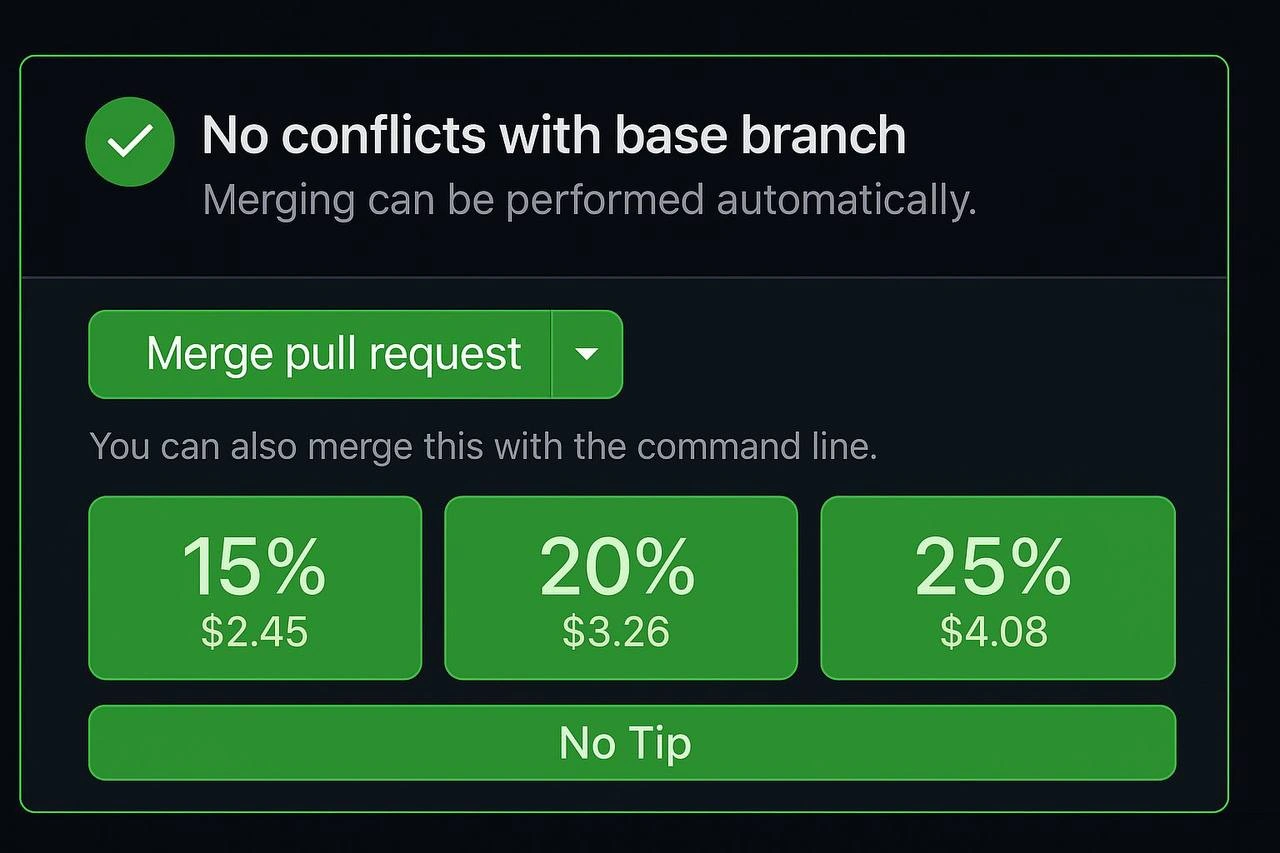
This meme is funny in the same way. In computer coding, “merging” is like putting all the pieces of a group project together. When it says “no conflicts,” it means all the pieces fit without any trouble – kind of like a puzzle that went together perfectly. Normally, you wouldn’t have to do anything extra when that happens; you’d just be happy it worked. But the picture jokes that the website (GitHub) is showing a screen like the ones you see at a coffee shop or restaurant, where it asks if you want to tip some money. Seeing “15% or 20% tip?” pop up in a coding tool is silly because we don’t usually pay money for a good code merge. It’s like your computer is acting like a waiter who brought you a nice, easy meal (the easy code merge) and is now waiting for a tip. We find it funny because it’s putting two very different worlds together – writing code, and paying a tip – in a crazy, imagined way.
Level 2: Tip Jar for Pulls
Let’s break down what’s happening here in simpler terms. In Git (the popular version control system behind GitHub), a merge is when you combine changes from one branch of code into another. A Pull Request (PR) is basically a request to merge your changes – you’re asking the project to pull in your code. Now, branches are like parallel universes of code. The base branch is usually the main line of development (often named “main” or “master”), and your PR has its own branch with new changes. When GitHub says “No conflicts with base branch”, it means that Git has checked your changes against what’s currently in the base branch and found that nothing clashes. In other words, no one edited the same lines of code in incompatible ways. If there were a merge conflict, it’s like two people editing the same sentence differently – Git wouldn’t know which version to keep, so a human would have to resolve it manually. But here, conflict-free means GitHub can merge automatically: you just hit the button and the code from your branch cleanly integrates into the project. That’s why the UI adds “Merging can be performed automatically.” It’s basically saying: “All clear – we can do this merge for you with no manual intervention.”
Now, normally when you see that green “Merge pull request” button, you (or the repository maintainer) would click it to accept the changes. It’s a routine part of a CodeReview process on GitHub: first you review the code changes for quality, and if everything looks good and tests pass, you merge. The whole PullRequestProcess on a platform like GitHub is usually free – free as in beer, and free as in no money needed. GitHub doesn’t charge you per merge or anything, and open-source maintainers certainly don’t expect to get paid for clicking a button. So seeing bright green tip options (15%, 20%, 25%) pop up under the merge button is definitely not normal! It’s a parody, a visual joke copying the style of those digital tipping screens you encounter in cafes and taxis. You know the ones: after you swipe your card, the tablet asks if you want to tip 15%, 20%, 25%, or lets you hit “No Tip” (sometimes while the staff is watching). It can feel a bit pushy in real life.
In this meme scenario, the idea is that GitHub’s interface itself is cheekily asking you to add a tip when merging a PR that had no conflicts. But who would the tip go to? The implication is it’d go to the project’s maintainer or the platform – basically a little monetary “thank you” for the smooth experience. This plays on the fact that many OpenSource project maintainers don’t get paid for their hard work. Often they provide a lot of service (reviewing code, writing documentation, fixing bugs) out of passion. In the real world, some maintainers put a link like “Buy me a coffee” or use GitHub Sponsors so users can donate a few dollars if they want. That’s entirely optional and separate from the code merging process. What this meme does is imagine if that donation step was in-your-face and built into the tools: you click merge and immediately see a tip jar prompt. It’s a humorous exaggeration, mixing the world of DeveloperExperience tooling with the world of waiters and baristas.
For a junior developer or someone new to GitHub, here’s why this is funny: Normally, if your code merges with no conflicts, that’s great news and the merge is just a quick click, no strings attached. The platform never asks you for money during this – that would be like a teacher not charging you when you hand in homework that’s correct. But in the image, it looks like GitHub is cheekily saying, “Hey, that merge went well… how about a little something for the effort?” It’s using the familiar design of a point-of-sale tip screen to make it instantly recognizable. We’ve all seen those suggested tip buttons in everyday life, so we get the joke immediately when they appear in a completely unrelated context (coding!).
To give more context, open source software is usually free to use, and contributions are voluntary. However, because maintainers often aren’t compensated, there’s a running joke (with some truth) that they survive on coffee and goodwill. Words like maintainer_coffee_fund or “tip jar” are lighthearted ways people talk about donating a few bucks to thank them. In fact, GitHub has a “Sponsors” feature where you can pay your favorite open source developers monthly or one-time, but it’s not integrated into merges or PRs in any intrusive way. This meme imagines a far more intrusive (and absurd) integration. It’s basically taking the current trend of tipping for services and applying it where it doesn’t belong.
Also, consider the DeveloperExperience_DX aspect: Developer Experience is all about making tools easy and pleasant for programmers. An interface that asks for payment at merge time would probably be considered a bad UX for contributors – it would surprise and possibly annoy people. That contrast is part of the humor too: GitHub normally prides itself on smooth, efficient workflows for things like code reviews and merges, whereas a pop-up asking “how much would you like to tip?” would be totally out-of-band. It’s like having an ATM fee pop up while you’re doing your work. So the meme is clearly a joke, mixing a real GitHub UI screenshot with a fake tipping interface to create something laughably out-of-place.
In summary, the meme uses the language of Git (merge, branch, conflict) and the language of everyday transactions (tip percentages) to create a funny scenario. It highlights how weird it would be if OpenSourceContribution started to resemble paying a bill at a restaurant. For new developers: don’t worry, GitHub is not actually charging you for merging code 😉 – this is just a playful commentary on funding open source and the prevalence of tipping prompts in modern life. The fact that we instantly recognize both elements (the GitHub interface and the tipping UI) makes it a quick laugh. It’s a nod to the idea that maybe good contributors (who keep their code conflict-free) deserve a tip, or that maintainers wish they could get a tip for dealing with our code. Either way, it’s a parody meant to be taken in jest.
Level 3: Git Gratuities
At first glance, this image looks just like the standard GitHub merge interface we all know from countless Pull Requests. There’s the reassuring green checkmark icon next to “No conflicts with base branch” and the note “Merging can be performed automatically.” In normal Version Control life, that message is pure relief: it means the PR’s code integrates cleanly into the target branch (often main or master) with no pesky merge conflicts. Typically, a developer or repository maintainer would hit the familiar green “Merge pull request” button, maybe breathe a small sigh of relief, and move on. The UI even reminds us “You can also merge this with the command line.” Everything up to this point is the routine PullRequestProcess we expect on GitHub – a straightforward part of the code review workflow in an OpenSource project or any team repo.
But then the meme flips our developer reality on its head: suddenly, under the merge button, we see bright-green buttons prompting for 15% $2.45, 20% $3.26, 25% $4.08, and a big “No Tip” option. These look exactly like the tipping screen prompts you’d encounter on a tablet at a coffee shop or restaurant after you pay your bill. It’s an instant jolt of what-if humor: merging code has become a service with a tip jar attached. The absurdity is golden – in our dystopian future, even a flawless, conflict-free merge isn’t complete until you decide whether to tip the maintainer a few bucks for the “service” of not breaking the codebase.
This mashup is poking fun at two modern experiences many developers know too well: OpenSourceContribution culture and the ubiquity of digital tipping prompts. On the open-source side, it’s well-known that many project maintainers put in long hours for free, subsisting on coffee, passion, and maybe the occasional donation to their maintainer coffee fund. GitHub has even introduced features like GitHub Sponsors to let users support project authors financially. The meme takes that reality and cranks it to satirical extreme: imagine GitHub integrating a point-of-sale style tipping_screen_parody directly into the pull request interface. It’s like a built-in “buy the maintainer a coffee” prompt every time your code merge doesn’t cause headaches. Seasoned devs will laugh (perhaps a bit darkly) at this DeveloperHumor because it feels like a riff on something that could happen. We’ve seen monetization creep into every corner of software (from open-core models to paywalled features in developer tools). Why not cheekily suggest that merging clean code might become a premium “service” worthy of a gratuity? No conflicts? That’ll be 20% gratitude, please.
The humor also leverages our collective experience with DeveloperExperience_DX and guilt-inducing UI patterns. Those bright green tip buttons are deliberately styled to catch your eye – just like real life where the payment tablet flashes generous tip percentages while the barista subtly watches. Here, the implication is the repository might be watching: “Hey, this merge was easy – care to toss a few coins to the project maintainer?” It satirizes an uncomfortable truth: developers do face constant requests for money in other contexts (think of donationware, Patreon links, or even just the nagware that some software uses). Seeing that transplanted into a Git workflow is both hilarious and a tad too real. A veteran coder might jokingly think, “Great, first we had CodeReviewPainPoints and CI/CD pipeline outages, and now even my pull requests are trying to shake me down for pocket change. What’s next, a surcharge for closing issues without reopening them?” The meme lands well because it exaggerates a DeveloperPainPoint that isn’t about code at all – it’s about the growing expectation that everything, even community-driven coding, might turn into a transaction.
From an industry perspective, this image riffs on the trend of monetizing open source projects. Maintaining popular open source libraries can be a thankless job; issues pile up, and everyone wants bug fixes yesterday. Many maintainers have started adding “Donate”, “Sponsor”, or “Buy me a coffee” links to their repo README files. So the idea of a conflict_free_merge_tip is a sarcastic extension of that: you made my life easier by submitting a clean PR, so maybe tip me for my hassling, or conversely, I made your life easier by merging it promptly – tip me for prompt service. It’s clear the meme is tongue-in-cheek: no one expects GitHub to actually roll out a paywall on the Merge button (at least, we hope not – developers would riot!). However, that sliver of plausibility underneath the joke is what makes it extra funny to those of us who’ve been around the block. We remember when software collaboration was purely about merit and volunteerism. Now, in a future where every app and platform finds a monetization angle, a Merge-as-a-Service model with suggested gratuities feels like a sly commentary on where things could go if we’re not careful.
Ultimately, this meme is a witty fusion of developer culture and everyday consumer experience. It highlights a contrast: in coding, a “No conflicts” message is a purely technical victory, whereas in service industries, a smooth experience often ends with a social ritual of tipping. By merging these contexts (no pun intended), the joke delivers a clever critique. It says this is how our dystopian future looks, with a sweetly sarcastic 🥰. And as cynical as it is, you can’t help but chuckle and think: Please, no one give GitHub Ideas any ideas!
Description
This image is a parody screenshot of the GitHub user interface, specifically the section for merging a pull request. The top part looks standard, displaying a green checkmark and the reassuring message: "No conflicts with base branch. Merging can be performed automatically." Below the standard "Merge pull request" button, the interface has been cleverly edited to include a tipping selection menu, similar to what one might find on a food delivery app or point-of-sale system. There are four green, rounded rectangular buttons. Three of them offer percentage-based tips with calculated dollar amounts: "15% / $2.45", "20% / $3.26", and "25% / $4.08". The final button simply says "No Tip". The humor stems from the absurd application of modern 'tip culture' to the software development process, suggesting a future where a clean, conflict-free pull request is not just expected professional conduct but a monetizable service worthy of a gratuity. For experienced developers, it's a satirical commentary on both the immense value of a well-prepared PR and the increasing transactional nature of interactions in the service economy
Comments
17Comment deleted
I'm not worried. The 'No Tip' option just force-pushes with `--no-verify` and deletes the staging database. It's the 'service fee' for ungrateful repo owners
At 25% I expect the maintainer to squash-merge *and* clean up my commit message typos - call it service-oriented architecture
After 15 years of free CI/CD minutes and unlimited public repos, GitHub finally discovered the real money isn't in enterprise licenses or Copilot subscriptions - it's in guilt-tripping developers into tipping for conflict-free merges, because nothing says 'collaborative open source' quite like a 25% gratuity on your git operations
Finally, a UI that accurately reflects the emotional labor of reviewing someone's 3000-line PR that touches 47 files across 12 modules with the commit message 'fixed stuff' - though honestly, even 25% feels low for that kind of architectural archaeology
No conflicts? Tip 25% - in senior dev world, that's rarer than a legacy monolith passing a security audit without refactor
I’ll tip 25% if that button also rebases, squashes, updates the changelog, and closes the Jira ticket
Pretty sure “No Tip” will fail the required status check added by Product
wat?! Comment deleted
Nah i PRd this shit no way I'd tip your "todo: idk what this does, or now doesn't, fix later" Comment deleted
Pro tip: if you don't accept the PR, you will never tip Comment deleted
Unpopular opinion: tipping should not be done at all. Force the corpos to pay their employees well Comment deleted
monke sees 'No conflicts'; monke neuron activation. Comment deleted
20% tip, $3.26 So you gotta pay $16.30 to land the PR? Comment deleted
Tbh though, if github had a built in way to add a bounty on an issue, I would fukken love it. Coming across some annoying bug, seeing that someone already filed an issue, but there's been no progress on it in years... Absolutely I would throw $5 bounty on that shit being fixed if I could This is, of course, assuming it's not a bug I can fix and PR myself. Comment deleted
I know some external services have popped up and died offering this, but it needs to be integrated into github so it's clear and obvious the bounty is there, and so it's one click to throw cash on it, and so I know the company won't just go bust and disappear with the bounties Comment deleted
India once had snakes raging in the streets. They set a bounty for everybody catching and delivering the snakes. it worked, nice... But then people started breeding snakes for the bounty. And when officials realized, they stopped paying. Since then the situation got even worse than before... Comment deleted
Yess, have heard that one. And once they stopped the bounties, they released all the snakes. It definitely could breed issues of "eh, I won't fix bugs until someone pays me", but I dunno Comment deleted