The Evolution of Language Models: From Awkward Base to Polished 'Instruct'
Why is this AI ML meme funny?
Level 1: Bigger Is Bolder
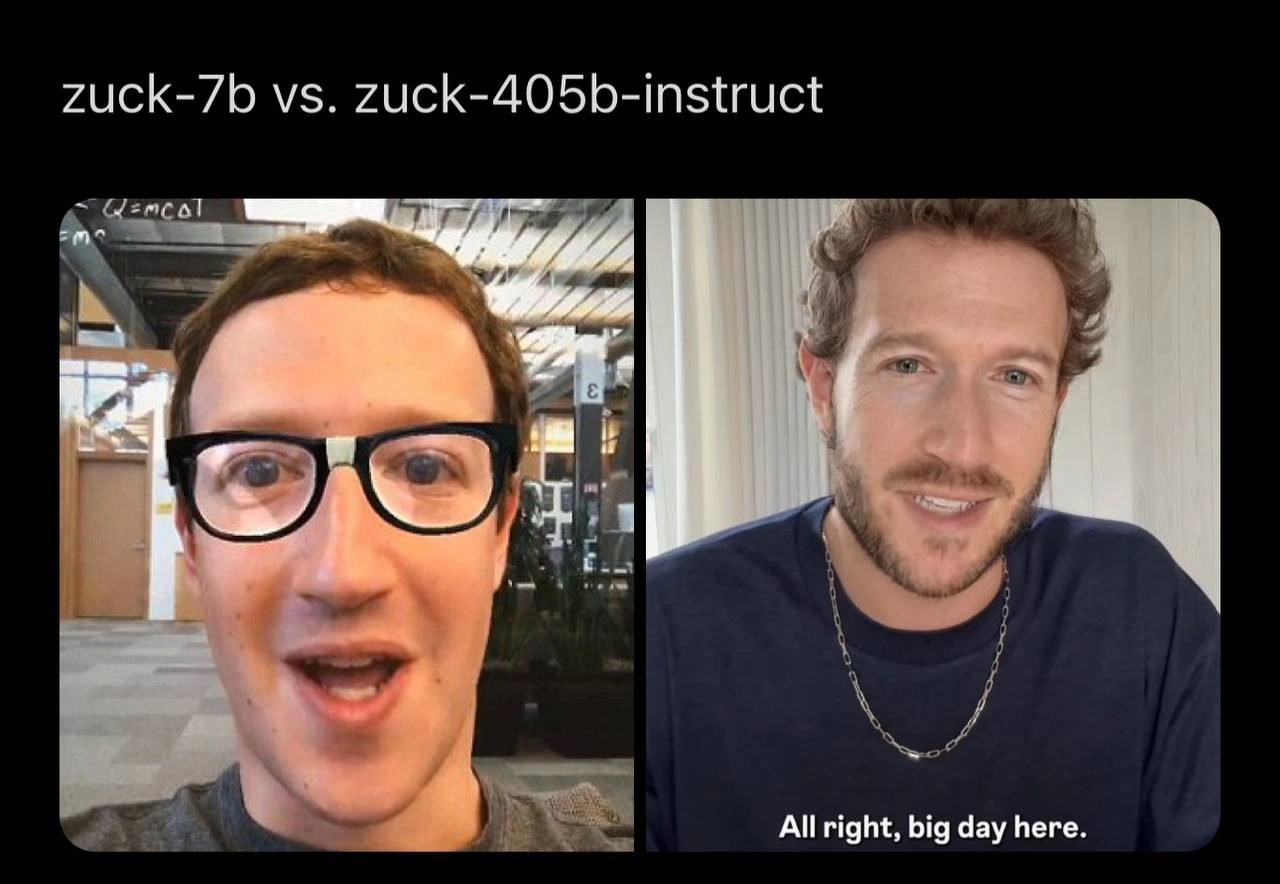
Imagine you have a little robot friend that knows a few things – let’s say it’s the size of a toy and has a small computer brain. It can talk, but it’s sometimes a bit awkward or not very smooth. Now imagine you build a much bigger robot, with a brain that’s hundreds of times more powerful. This big robot has learned a lot more and also took lessons on how to talk nicely to people. What the meme shows is like a before-and-after picture of these two robots using a fun example: the face of Mark Zuckerberg (the boss of Facebook). In the first picture (before), he looks like a normal guy caught in a silly, not-so-great photo – kind of plain and unsure. This is like our small robot with the tiny brain. In the second picture (after), he looks bright, confident, and friendly, almost like a TV host saying, “Alright, big day here we go!” This is like our giant robot with the super brain, who’s very sure of itself. The joke is that by making the AI way, way bigger, we pretend it suddenly became super charming and human-like. It’s funny because in real life, giving a computer more pieces (or parameters) doesn’t literally make it wear a cool necklace and smile – but here we imagine it does! It’s like seeing a nerdy character transform into a superstar just by getting an upgrade. The meme makes us laugh by showing how an AI going from small to huge is as if it went from ordinary to amazing overnight.
Level 2: Bigger Brain, Better Manners
Let’s break down the meme in simpler terms. It’s comparing two AI models (imagine two versions of a chatbot) that are massively different in size: one has 7 billion parameters and the other a whopping 405 billion parameters. In the world of AI, parameters are like the brain cells or the dials in a model that get adjusted during training. The more parameters an LLM (Large Language Model) has, generally the more knowledge or complexity it can hold – kind of like having a bigger brain with more neurons. So a 405B model isn’t just a bit bigger than 7B, it’s hugely bigger (405,000,000,000 vs 7,000,000,000 parameters – that’s about 58 times larger!). To give an analogy, if a 7B model is an encyclopedia with 10 volumes, a 405B model is a library the size of a city block. It’s that much more information-packed (and also that much more computationally heavy).
Now, the meme uses Mark Zuckerberg (“Zuck”) as a fun example. On the left side, when it says zuck-7b, it shows a picture of Mark in a casual, unflattering pose – like a quick selfie at the office. You can see the background is an open-plan office with random desks and plants, and Mark’s wearing a simple t-shirt and those big frame glasses in a silly way. The whole vibe is “awkward webcam chat.” This is meant to represent the 7B-parameter model: basic, no-frills, a bit awkward in how it communicates. In AI terms, a smaller model like that might give you more straightforward or dry answers, maybe making mistakes or not picking up your instructions perfectly. It’s functional, but not charming.
On the right side, we have zuck-405b-instruct. This shows the same person (or at least it’s supposed to be Mark, possibly with an AI face filter or maybe a lookalike) but now he looks polished. The lighting is bright and studio-quality, the background is clean and professional, and he’s even sporting a chain necklace and a nicer shirt. He looks more like a friendly presenter or a YouTuber ready to greet his audience. There’s subtitle text at the bottom that says, “All right, big day here.” That little line is something you’d say when you’re about to start an important event or presentation in a lively way. So, what does this all mean for the AI model? Well, 405b-instruct implies this is not just a larger model but also an instruction-tuned model. Instruction tuning is when we take an AI model and further train it to follow human instructions and respond helpfully. Think of it as teaching the model good etiquette and how to have a friendly conversation. OpenAI did this with GPT-3 to make it better at understanding and obeying prompts, resulting in models like ChatGPT which are very user-friendly. When the meme shows the right image with that quote, it’s illustrating that the big model knows how to talk to you in a personable way. It’s like, “Hello, I’m here and ready to go!” – a huge contrast to the left image which might just blankly answer a question with no fanfare.
So in simpler terms: the meme jokes that by increasing the model from 7 billion to 405 billion parameters and by fine-tuning it to follow instructions, you’ve turned a bland AI into an exciting, charismatic AI. It’s basically a before-and-after comparison. The “before” (7B) is like an early version AI that’s maybe a bit robotic or unimpressive in how it interacts. The “after” (405B instruct) is the new-and-improved version that’s super articulate, engaging, and maybe even has a sense of humor. This reflects a real trend in AI development: recently, we’ve seen that bigger models, trained on more data, can produce much more coherent and context-aware responses. And when you additionally fine-tune them with conversational training (instruction tuning), they become significantly better at understanding what we want and at giving responses that feel helpful or witty.
The term “glow-up” is actually perfect here. On the internet, a “glow-up” means an impressive transformation in appearance or capabilities, usually from something ordinary to something outstanding. That’s exactly what’s being depicted. The left is the unimpressive “pre-glow” state and the right is the “post-glow” state where the AI has apparently leveled up in a big way. The context tags like instruction_tuning_glowup even hint that this transformation is due to the combination of lots more parameters and the instruction tuning process. It’s also referencing the hype in the AI industry: companies (especially ones like Meta, which Mark Zuckerberg leads) are in a race to build bigger and better generative models. Every time a new model comes out with a higher parameter count, tech news headlines go crazy about it. For example, when an open-source community project releases an improved model, you’ll see the community buzzing – this is part of the open_source_llm_hype. People start saying “This new model is so large and fine-tuned, it might feel as fluent as ChatGPT!” The meme is basically a humorous take on those claims.
It also subtly jokes about Mark Zuckerberg’s own persona. Mark isn’t exactly known for being the most charismatic speaker (he’s a brilliant tech CEO, but folks on the internet often tease that he’s a bit stiff or “robotic”). So the idea of a “Zuck model” that goes from 7B to 405B and suddenly has a ton of charm is doubly funny. It’s like saying, “If we want Mark to be more lively, maybe we just need to scale him up with billions more data points and some fine-tuning on how to talk to humans.” Obviously, that’s ridiculous in reality, but that’s the point of the joke. By using Mark’s images, the meme connects the AI model’s improvement to a visual improvement in Mark’s vibe – from plain to charismatic.
For a junior developer or someone new to AI, the key takeaways to understand the meme are:
- Large Language Model (LLM): An AI system that generates text, like ChatGPT. It has parameters (weights) which are tuned with lots of data. More parameters usually mean a more powerful model, but also means it needs more computing power.
- Parameters (7B vs 405B): These numbers (7 billion vs 405 billion) indicate model size. 7B is already big (billions of anything is huge!), but 405B is extremely big. The jump is exaggerated for comedic effect, highlighting how AI folks keep pushing to bigger models.
- Instruction-tuned (instruct): This means the model has had special training to better understand instructions and respond helpfully or safely. It’s like an extra training course for the AI on “how to be a good assistant.” Models that are instruction-tuned tend to give more polished answers.
- Glow-up comparison: The meme shows a before/after using Mark Zuckerberg to make it funny. The “before” is like a basic AI that does the job in a dull way, and the “after” is a super advanced AI that interacts in a very lively, human-like way. The images exaggerate this: from a dorky candid photo to a professional, camera-ready look.
In everyday terms, imagine the left side as a first draft of an essay – it’s okay, it has mistakes and it’s not very engaging. The right side is like the essay after a top-notch editor went through it – now it’s articulate, smooth, maybe even funny. How did we get from the first to the second? In this meme’s story, by massively increasing the “brain size” of the AI and honing its communication skills (that’s the combination of scale + instruction tuning). It’s a humorous way to say “Look, we supercharged the AI and now it’s a whole different beast.”
So for a junior dev or anyone not deeply into AI, the meme is basically one big tech inside-joke. It’s saying: When your model goes from 7B to 405B parameters, it’s like going from a clumsy Mark Zuckerberg selfie to a superstar Mark Zuckerberg on stage. It pokes fun at how every new AI model is introduced as if it’s dramatically more human and polished, just because it’s bigger. And truth be told, in many cases bigger models are better – but the meme winks at us by personifying that improvement in a very visual, relatable way. It’s combining a bit of AI jargon with a universally understood concept of a “makeover.”
Level 3: Massive Model Makeover
The humor here hits home for anyone following the LLM arms race in tech. The meme compares a hypothetical zuck-7b model to a souped-up zuck-405b-instruct model, and the difference is night and day – just like the two pictures. On the left, we have an awkward, unglamorous Mark Zuckerberg (casual selfie angle, harsh office lighting, those somewhat goofy webcam vibes). This is the "before" – it represents a smaller, 7B-parameter AI model. In real terms, 7 billion parameters is actually already quite a lot (imagine a neural network with seven thousand million little knobs to tune), but in the land of large language models, 7B is considered entry-level or mid-tier. A 7B model can hold a decent conversation and do basic tasks, but it’s known to be a bit limited – it might forget facts, produce simpler sentences, or act a tad “stiff.” This is the AI equivalent of Mark Zuckerberg’s on-camera persona being a bit stiff or robotic (the tech community often jokes about Zuck seeming like an AI trying to act human). The left image nails that vibe: it’s like the model just isn’t all that concerned with presentation or flair; it’s functional but bland.
Now, look at the right panel: it’s practically the same person (the meme implies both images are "Zuck") but with a total glow-up. Suddenly he’s in flattering lighting, wearing a navy shirt and even a bit of bling (a chain necklace) – and there’s a subtitle “All right, big day here.” The difference feels like night vs day, or maybe geeky college kid vs polished keynote speaker. This is the "after" – representing the 405B-parameter instruct-tuned model. And wow, what a change! In the AI context, jumping from 7B to 405B parameters is an astronomically large upgrade (approximately 57.9 times more parameters, to be exact – a true parameter count gap flex). It’s as if the model went from having a decent brain to having a galaxy brain. The meme jokingly suggests that with that many parameters, the AI’s personality has gone from awkward to effortlessly charismatic. The subtitle “All right, big day here” reads like the opening line of a confident presenter or maybe an upbeat personal assistant AI that’s eager to help. It’s the kind of friendly, engaging tone you’d expect from a model that’s been heavily instruction-tuned to be user-friendly. In real life, instruction tuning (like what OpenAI did turning GPT-3 into InstructGPT, or Meta fine-tuning LLaMA into conversational models) tends to make AI outputs more organized, polite, and context-aware. So an instruction-tuned 405B beast would presumably address you with enthusiasm and clarity – hence the chipper caption.
For seasoned developers, this side-by-side is hilarious because it caricatures the IndustryTrends_Hype we see in AI right now. There’s a running joke in AIHumor circles: “just add more parameters and you’ll solve AI – profit!” Every few months, some research lab or company announces a new model with even more billions of parameters, trumpeting it as a breakthrough. We went from GPT-2 (1.5B) to GPT-3 (175B) and were blown away. Then Google came out with PaLM (540B) and Meta released LLaMA (up to 65B) for the open source crowd. The numbers keep climbing, and each time, the marketing around these GenerativeModels tends to imply, “This one is so much larger that it’s practically like talking to a real person.” It’s classic AIHypeVsReality material. Insiders know that beyond a certain point, bigger does help but also comes with huge costs: these mega-models require insane amounts of compute to train and run, they’re harder to deploy, and sometimes they only give marginal gains on many tasks. But the hype? Oh, the hype loves a big round number. If your competitor has 100B parameters, you announce 200B just to one-up them in the press release. It’s like the silicon valley version of “mine is bigger than yours,” but with neural networks.
The meme plays on this with the zuck_model_family concept — using Mark Zuckerberg as the poster child (since Meta has been investing heavily in open-source LLMs). The tag zuck-7b vs. zuck-405b-instruct feels like a pretend product comparison. We haven’t actually seen a 405B model from Meta (at least not publicly as of 2024), but there have been rumors and expectations that Meta’s next LLM could be enormous to compete with OpenAI’s latest. So think of this meme as a cheeky preview of a marketing slide: “Here’s our old model vs our new model – look how much more polished the new one is!” The left is basically an early prototype, the right is the polished production version with all the corporate training and PR shine. The “All right, big day here” line even has that corporate announcement energy – like the model’s about to unveil a new feature or product at a conference. Senior devs chuckle because they’ve seen this pattern over and over. It’s reminiscent of how every tech keynote has the before (usually a grainy image or dull stat) and the after (shiny, exciting reveal). Here the before is Zuck looking like a random guy on a webcam; the after is Zuck(?) looking like a confident host ready to sell you the future.
Now, from a practical engineering perspective, we also know that such a leap isn’t trivial. A 7B model is something you might run on a single high-end GPU or even on a beefy laptop if optimized (some enthusiasts run 7B models on their local machines for fun). But a 405B model? That lives in a data center, distributed across potentially dozens of GPUs or a pod of TPUs. Deploying that is a massive undertaking. It’s the kind of thing that would make an on-call engineer break into cold sweat – imagine trying to serve a model that size without things falling over. So the meme could also tickle that cynical veteran part of us: “Sure, just 58x the parameters, what could possibly go wrong in production?!” It’s all fun and games until the OOM (Out-Of-Memory) killer shows up. The meme doesn’t show the technical headaches, of course; it just shows the glamorous result that marketing would highlight. This contrast between the slick image (right panel) and the rough one (left panel) mirrors the contrast between AI hype and the gritty reality of implementation.
Finally, there’s an implicit wink at Mark Zuckerberg himself. Over the years, Mark has been meme-ified as somewhat mechanical or alien in demeanor (people joke about him drinking water in Congress, or his very rehearsed way of speaking in presentations). So using “Zuck” as the model character is no accident – it amplifies the joke. What would it take to turn Mark Z. from awkward to alluring on camera? Apparently, 398 billion more parameters and some fine-tuning! It’s playful ribbing: the zuck-405b-instruct model supposedly has the charm and warmth that perhaps the real Zuck is perceived to lack. In other words, the instruction_tuning_glowup here isn’t just about an AI model – it’s a tongue-in-cheek suggestion that even Mark Zuckerberg would seem more human if we could download a massive upgrade into him. Ouch! But it’s all in good fun. The tech community loves these kinds of in-jokes where a public tech figure is equated with their tech. Given that Meta (Zuck’s company) released LLaMA and spurred a lot of open_source_llm_hype, dubbing an open model “Zuck” is also poking at how Meta’s CEO’s persona is entwined with their AI initiatives.
In summary, the senior-perspective punchline is: we’ve turned the nerdy 7B AI into a suave 405B AI by brute-forcing it with scale and some training magic. And while real engineers know it’s not that simple (and comes with huge caveats), we can’t help but laugh at the exaggerated truth. This meme is a mirror to our industry’s obsession with big numbers – it’s saying “if you thought a 7B model was cool, wait till you see one nearly 60 times larger; it’ll practically wink and charm you on a Zoom call.” It’s absurd, it’s witty, and it hits on that shared understanding among AI folks: bigger models are better in many ways, but the expectation that they become cybernetic Casanovas overnight is straight-up MachineLearningHumor gold.
Level 4: Scaling Is All You Need
At the bleeding edge of AI_ML research, there's a well-known mantra: bigger models yield better results. This meme riffs on that with an absurd jump from a 7B-parameter model to a gargantuan 405B-parameter model. In machine learning theory, there are model scaling laws that suggest as you increase a model’s parameter count (and training data), performance often follows a predictable improvement curve (usually a power-law). Going from 7 billion to 405 billion parameters isn’t just a minor upgrade – it’s a parameter_count_gap so huge that it stretches the imagination (and any GPU cluster’s memory limits). To put it in perspective, if zuck-7b is a compact car, zuck-405b-instruct is a space shuttle. We’re talking about an AI model that would require on the order of hundreds of gigabytes of memory just to store its weights (405 billion parameters, even at 2 bytes each in half-precision, would be roughly 810 GB of data!). Running such a model in practice means distributing it across many high-end GPUs or TPUs – it’s the kind of setup only a tech giant like Zuck (Mark Zuckerberg’s Meta) could afford for now.
Why would anyone pursue a 405B model? According to model_scaling_laws research (like those from OpenAI and DeepMind), larger GenerativeModels can capture more nuanced patterns of language, and sometimes they exhibit emergent abilities – new skills that smaller models lack. For instance, GPT-3 (175B) famously demonstrated few-shot learning abilities that smaller 6B models struggled with; researchers noticed that beyond certain scale thresholds, AI systems suddenly get much better at tasks like coding or analogies. By the time you leap into the few-hundred-billion range, the hypothesis is that the AI’s outputs start feeling more human-like and coherent, approaching that elusive AIHypeVsReality promise of “human-level” performance. The meme exaggerates this idea: the zuck_model_family has apparently gone from a scrappy baseline (7B parameters) to an instruction-following behemoth at 405B, and lo and behold, the AI’s persona has undergone a dramatic metamorphosis. The term “instruct” in zuck-405b-instruct clues us in that this LLM isn’t just bigger, it’s also instruction-tuned – meaning it has been fine-tuned on all those polite, helpful Q&A style prompts to respond more usefully (much like how InstructGPT or ChatGPT was refined from a raw model). Instruction tuning is essentially giving the model a crash course in good manners and following user intentions, often through reinforcement learning from human feedback or supervised fine-tuning on instruction-response pairs. When you combine sheer scale and instruction tuning, the result is expected to be an AI that not only knows a ton (thanks to parameter count) but also knows how to use it in a conversational, helpful way. In theory, it’s the difference between a raw savant and a polished communicator.
Of course, any veteran of IndustryTrends_Hype will note the subtext here: scaling isn’t a magic bullet, and there are diminishing returns. A 405B-parameter model would consume enormous training data — if you don’t have enough high-quality text to train on, you might just get an overfit behemoth that parrots back training data (not exactly the charismatic digital persona marketing teams dream of). There’s also the famous Chinchilla findings (DeepMind’s study) which argued that many earlier large models were actually under-trained for their size – basically saying “hey, if you’ve got 405B weights, you better have proportionally more data, otherwise you’re wasting capacity.” But in the spirit of this meme’s humor, those nuances take a back seat. Instead, they’re spotlighting the almost alchemical belief in the AI world that with enough billions of parameters, your model will glow up from a clunky nerd to a smooth-talking genius. It’s a tongue-in-cheek nod to the open_source_llm_hype where every few months, someone brags about a new model with more zeros on the parameter count as if that alone guarantees “All right, big day here” levels of confidence and capability.
So on this deepest level, the meme is poking fun at the scaling laws arms race. It’s hinting: maybe the secret to an AI with human-level charm is simply throwing an obscene amount of compute at it. The left image (7B) represents the humble beginnings – a model that’s basically Mark Zuckerberg doing a quick selfie in a fluorescent-lit office, a bit awkward and unpolished. The right image (405B instruct) is the theoretical endgame – the same “Zuck” model after an instruction_tuning_glowup and massive scaling, now looking like he’s on a professional video call, well-lit, self-assured, even rocking a stylish chain as if to say “I’ve not only learned your data, I’ve learned style.” The contrast plays into a core AIHumor theme: as if an AI’s personality and presentation improve in a nearly linear (or even exponential) fashion with model size. In reality, a senior engineer knows there’s a lot more involved – but that grain of truth (bigger models do generally perform better) is what makes the exaggeration so clever. We all wink at each other because we recognize both the validity and absurdity of the AIHype: Sure, just scale it up by two orders of magnitude and fine-tune it, and bam – your previously robotic AI is suddenly a charismatic talk show host. If only it were that simple, right?
Description
A two-panel meme comparing different versions of an AI model using photos of Mark Zuckerberg. The title reads: 'zuck-7b vs. zuck-405b-instruct'. The left panel, labeled 'zuck-7b', shows an older, somewhat awkward photo of a clean-shaven Zuckerberg with glasses and a wide-eyed expression. This represents a smaller, 7-billion-parameter base model. The right panel, labeled 'zuck-405b-instruct', shows a more recent, stylized photo of Zuckerberg with a beard, a chain, and a confident smile, with the caption 'All right, big day here.'. This represents a much larger, 405-billion-parameter instruction-tuned model. The humor is a metaphor for the progression of AI models, where the base versions ('-7b') are raw and less refined, while the larger, fine-tuned versions ('-405b-instruct') are more polished, capable, and presented with more confidence, mirroring Zuckerberg's own public image transformation
Comments
9Comment deleted
The base model just outputs 'sweet baby rays' on a loop. The instruct-tuned one has been carefully aligned to never mention the name of its data source: the entire internet
Proof that adding 398 B parameters mostly upgrades the CEO’s lighting rig and subtitle budget - compute clusters optional
The real upgrade from 7B to 405B parameters isn't the model performance - it's finally having enough compute budget to afford a proper chain necklace and professional lighting for your product announcements
When your base model is just regurgitating training data with the social grace of a raw transformer, but after instruction tuning and RLHF, it's suddenly ready for production demos. The 57.8x parameter increase really shows - turns out throwing more compute at the problem does work, just like Meta's data center budget suggested it would
Scaling laws hit different: 7B for the 'just ship it' intern Zuck, 405B for the boardroom heartthrob
zuck-7b fits on a laptop after 4-bit quantization; zuck-405b-instruct fits only after finance approves a new data center - same prompt, different change-management process
7B runs on a 4090; 405B‑instruct runs an all‑hands, drafts the PR‑FAQ, and obliterates your H100 budget
Sumbody paid 4,38 cents Comment deleted
You meant 30'000'000 hamster tokens, didn't you? 😅 Comment deleted