When Design Principles Get Confused with Video Game Protagonists
Why is this DesignPatterns Architecture meme funny?
Level 1: Not That SOLID
Imagine your teacher is talking about something very important called “SOLID”, but you’ve only ever heard the word “solid” when talking about your favorite video game hero. Oops! It’s like a funny mix-up. You thought of Solid Snake, a cool stealth spy from a game, when everyone else was talking about a set of serious coding rules named S.O.L.I.D. It’s as if in class someone asked, “Do you know Python?” meaning the programming language, and you replied, “The only python I know is the big snake at the zoo!” 🐍 Everyone would giggle because you confused a technical term with something totally different but having a similar name.
The heart of this joke is about mixing up meanings. Grown-up programmers have a bunch of rules (called the SOLID principles) to help them write good code – think of these like the golden rules of building with LEGO so your structure doesn’t collapse. But one newbie didn’t know those rules yet. Instead, when he heard “SOLID,” he thought of a video game character with “Solid” in his name. It’s as if someone said “We need to follow the recipe,” and you answered, “Recipe? The only Recipe I know is a character named Recipe in a cartoon!” Silly, right? But also kinda cute and funny.
Why is it funny? Because the junior developer basically said, “I have no idea what you all are talking about, so I’m going to joke about the one Solid I do know.” It’s a bit like using humor when you’re a little lost. The older, more experienced developers laugh, not in a mean way, but because they remember being new and confused too. They find it endearing that instead of pretending to know, this person made a playful reference. It shows confidence and humility at the same time: “I’m new, I don’t know this serious stuff yet, but hey, I know something cool named Solid!”
So, in simple terms: everyone was talking about solid coding principles (serious business), and the newbie cracked a joke about Solid Snake (a game hero). It’s funny like a kid hearing “Java” and thinking of coffee instead of the programming language. The wrong SOLID came to mind, and that lightened the mood. In the end, people laugh and then kindly explain the real meaning. The junior learns something new (what SOLID design principles are) and the seniors get a good chuckle. It’s a happy little moment where a misunderstanding brings folks closer together – turning a potentially embarrassing gap in knowledge into a shared laugh. And that’s a solid outcome for everyone!
Level 2: Single Responsibility vs Single Player
So, what exactly is SOLID (in programming, not in gaming)? SOLID is an acronym for five important object-oriented design principles that help developers create clean, maintainable code. Think of them as guidelines to avoid turning your code into a big mess. The letters stand for:
- Single Responsibility Principle (SRP) – a class or module should have one and only one job. (Example: Instead of one
GameCharacterclass handling rendering, input, and saving to disk all at once, split those duties into separate classes. Each piece should have a single responsibility.) - Open/Closed Principle – code should be open to extension but closed to modification. In practice, that means you can add new features by writing new code, without editing existing code that already works. (Think: adding a new enemy type by subclassing an Enemy base class, rather than changing the base class itself.)
- Liskov Substitution Principle – objects of a superclass should be replaceable with objects of a subclass without breaking the program. In plainer terms, if you have a function expecting an
Animal, it shouldn’t crash if you pass in aDog(assuming Dog is a kind of Animal). Everything that’s true about the general type must also be true for the sub-type. - Interface Segregation Principle – don’t force one class to implement methods it doesn’t use. It’s better to have smaller, specific interfaces than one big “God interface”. (Imagine an interface
IWorkerthat has 10 methods for every possible task – aRobotWorkermight not need aeatLunch()method, right? Split that intoIEaterandIWorkerso each class only signs up for what it actually does.) - Dependency Inversion Principle – high-level modules (big important logic) should not depend on low-level modules (little utility classes); both should depend on abstractions. And those abstractions shouldn’t depend on details. This one’s a bit abstract itself: essentially, you achieve it by introducing interfaces or abstract classes so that both high-level and low-level pieces rely on those, not on each other’s concrete implementation. (For instance: your
GameEngineclass shouldn’t hard-code aFileLogger– instead it uses anILoggerinterface, and you can plug in aFileLoggerorConsoleLoggeras needed. The engine code depends only on the logger interface, not a specific logger class.)
Whew, that’s a lot of terminology! In summary, SOLID principles are all about making your code easier to understand, extend, and maintain without breaking things. They’re like the rules of good architecture in object-oriented programming. When someone in a code review asks “Is this design SOLID?”, they’re not asking if the code is physically solid 😅 – they mean “Does it follow those five SOLID principles?”
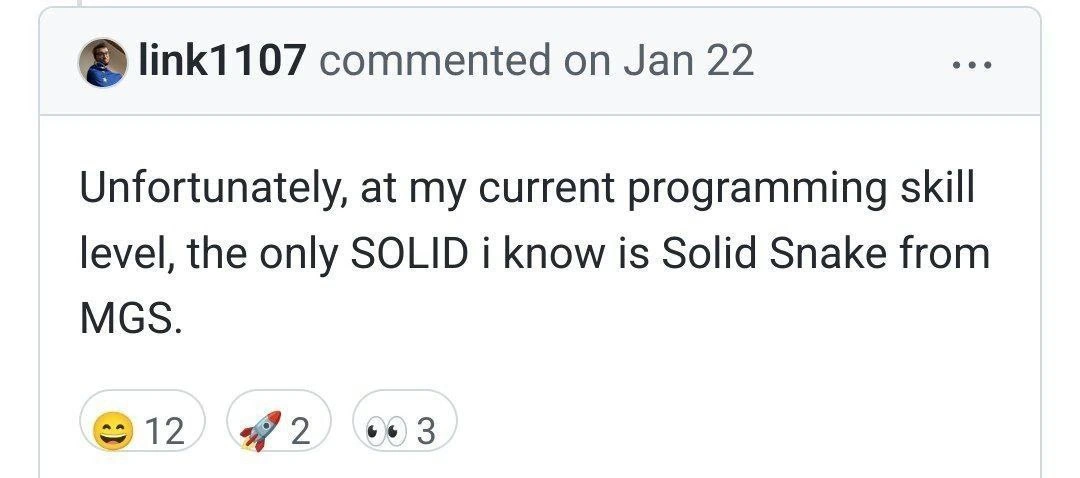
Now, here’s the punchline of the meme: instead of thinking about these software design rules, the junior developer thought of Solid Snake. If you’re not familiar, Solid Snake is a fictional special ops soldier from the famous video game series Metal Gear Solid (MGS). He’s a gruff, headband-wearing hero known for sneaking around enemy bases in a cardboard box (yes, literally!) to complete missions. Solid Snake’s been a gaming icon since the late 90s, especially beloved among techies who were teens or young adults around that time. So, the comment “the only SOLID I know is Solid Snake from MGS” is a playful way of saying “I have no clue about these design principles you speak of; I only recognize the word SOLID from that game I played.” It’s a classic game_reference_in_tech moment. The developer is using something they do know (a game character) to joke about something they don’t (the design principles).
For a junior developer, this scenario is super relatable. Early in your career, you might hear senior teammates throwing around terms like “Did you apply the Single Responsibility Principle here?” or “We need more dependency inversion in this module,” and you’re sitting there wide-eyed 😳 thinking, “I’ve heard of single-player games, but single-responsibility classes?!” It can be intimidating! This meme captures that feeling perfectly. The junior dev addresses their knowledge gap in design patterns with humor, essentially saying “I’m still leveling up my programming skills.” And by invoking Solid Snake, they also kind of flatter the seniors – acknowledging a piece of geek culture that many older devs love. It’s a bit like saying, “Hey, I might not know Uncle Bob’s rules, but I do know Hideo Kojima’s hero!”
In the image, we see this as a social platform comment (it looks like a snippet from maybe LinkedIn, Reddit, or a dev forum) with the username and date. Below the text, there are reaction emojis: a laughing face with 12, a rocket with 2, and eyes with 3. In developer communities, people use these reactions to show how they feel about a comment. The 😂 means a bunch of folks found it funny (12 people, in fact). The 🚀 often means “Great idea” or “This should go viral” – only 2 people clicked that, maybe because it’s more of a joke than an “idea”. And the 👀 (eyes) might mean “I’m watching this” or “Whoa, I relate.” So clearly, the junior’s joke resonated. Other devs are basically saying, “Haha, I’ve been there,” or “I see what you did there.” In a way, those reactions are tiny pats on the back, reassuring the junior that it’s okay not to know everything and thanking them for the laugh.
This meme lives at the intersection of learning and laughing. On one hand, it reminds juniors (and all of us) that there’s always more to learn – things like SOLID principles are important as you grow as a developer. On the other hand, it shows the culture of tech humor: instead of being embarrassed about not knowing, the junior turned it into a light-hearted joke. And guess what? By making that joke, they probably sparked a conversation – you can bet someone replied with “Haha! By the way, here’s a quick rundown of SOLID for you.” In fact, memes like this often start that educational moment. The next time this junior hears “SOLID” in a meeting, they’ll hopefully remember this and think, “Oh right, not the video game kind of solid – the coding kind.” And maybe a helpful senior will slip them a link to a SOLID tutorial after the laughter dies down. That’s how you level up in the dev world: one principle (or one pun) at a time. 💡🎮
Level 3: Solid Snake vs SOLID Code
In a heated design review, imagine a junior dev confessing, “the only SOLID I know is Solid Snake from MGS.” This tongue-in-cheek comment is a mashup of two worlds: software design principles and classic gaming. Seasoned engineers immediately spot the pun: SOLID in coding refers to five foundational object-oriented design principles, while Solid Snake is the stealthy hero of Metal Gear Solid. The humor lands because it highlights a knowledge gap in design patterns using a reference veteran devs grew up with. It’s as if during an architecture discussion about clean code, someone suddenly brings up a video game character – an absurd non sequitur that signals “I’m out of my depth, but I come in peace (and with jokes)”.
Let’s unpack why this is funny to experienced developers. SOLID principles (popularized by Uncle Bob a.k.a. Robert C. Martin) are practically sacred in the DesignPatterns_Architecture playbook. They guide how to structure classes and modules for CodeQuality and maintainability. A senior engineer might ask in a code review, “Is this class following SRP (Single Responsibility Principle)?” Now enter the junior dev who hears “SOLID” and their mind goes not to acronyms, but to a code name from a video game. It’s a classic case of JuniorVsSenior perspectives: the senior expects a sophisticated discussion on abstractions and interfaces, but the junior only has a pop-culture reference to offer. The result? Laughter and a bit of empathetic facepalming.
On one level, this joke pokes fun at how juniors often struggle with high-level design concepts. The commenter is admitting in a self-deprecating way that they haven’t learned these principles yet. Instead of pretending, they cleverly reference Solid Snake, the legendary protagonist from the Metal Gear Solid series, essentially saying “I have no idea what SOLID means in code; all I know is this cool character named Solid.” For senior devs who cut their teeth on 90s games, this reference is pure nostalgia. It’s DeveloperHumor gold: mixing a serious design_principles_pun with a beloved gaming icon. It’s like saying “I don’t know about these fancy rules, but hey, remember that awesome game?” The shared chuckle eases the tension of a design review gone over a newbie’s head.
This meme also underlines a real issue: many devs learn to code by diving into frameworks and projects, but miss out on the theory – the knowledge_gap_in_design_patterns and principles that more experienced engineers take for granted. The result can be messy code that isn’t very “solid” at all (in the normal sense of the word). A seasoned reviewer might quip, “No wonder the codebase needs sneaking around in the dark to fix issues – we’re lacking those SOLID foundations!” The Solid Snake joke adds levity, but it’s a subtle flag: time to teach the team about writing cleaner, more maintainable code.
Finally, the format of the meme – a social media style comment with reaction emojis – gives context. The grinning face 😂 with 12 likes shows many people found it hilarious (likely those who get both the OO design reference and the MGS nod). The little 🚀 and 👀 reactions suggest others saying “This comment took off!” or “I’m watching this thread.” It’s a mini snapshot of dev community culture: one person cracks a nerdy joke in a comment thread, and fellow programmers reward it with emoji applause. In short, the industry in-joke here is strong. We’re laughing with the junior dev because, honestly, we’ve all felt like that at some point – faking our way through a dense design talk, secretly thinking of something completely unrelated. And if that unrelated thing happens to be a legendary video game hero, well, that’s just a SOLID punchline.
Description
A screenshot of a comment from a user named 'link1107' on a platform resembling GitHub, posted on January 22nd. The comment humorously states, 'Unfortunately, at my current programming skill level, the only SOLID i know is Solid Snake from MGS.' Below the text, there are emoji reactions: 12 smiling faces, 2 rockets, and 3 pairs of eyes. The humor comes from a pun that conflates the SOLID principles of object-oriented design (a cornerstone of software architecture) with Solid Snake, the iconic main character from the 'Metal Gear Solid' (MGS) video game franchise. This is a highly relatable joke for developers, especially those early in their careers, as it captures the feeling of knowing more about gaming lore than complex software engineering acronyms

Comments
14Comment deleted
Some engineers spend years mastering SOLID. Others know the important thing is to just stay in the box, avoid detection, and complete the mission. Both are valid approaches to enterprise software
If the only SOLID in your codebase is sneaking past the linter in a cardboard box, your architecture might need more than a codec call
After 20 years in the industry, I've seen countless developers master dependency injection, but still can't inject themselves into a cardboard box without alerting the entire codebase
When your code violates every SOLID principle but at least you can execute a perfect tactical espionage action - turns out 'dependency injection' means something very different in Shadow Moses. The real question is: does Solid Snake follow the Single Responsibility Principle, or is he more of a God Object with stealth, combat, and codec call capabilities all tightly coupled?
SOLID Snake: masters SRP for sneaking, but violates DIP every codec call to Otacon
Every time a team skips SOLID, a 'Utils' class puts on a cardboard box and sneaks into prod as a P1
Most enterprise codebases implement the Metal Gear variant of SOLID - stealth coupling under cardboard‑box abstractions, with a long codec call explaining why OCP was ignored
When you can't even say Comment deleted
What a thrill Comment deleted
That's NAKED 😂 Comment deleted
SOLID is trash to cover-up what j*va has unleashed upon this world. Change my mind. Comment deleted
Igor Link 🫶 Comment deleted
Solid is when you create interface for class, that will never be changed or implemented in another place Comment deleted
colonel, I'm trying to sneak around Comment deleted