The AI's Permanent Record of User Misconduct
Why is this AI ML meme funny?
Level 1: Be Nice, It Remembers
Imagine you have a friendly robot helper that you ask for homework help. One day, you get super upset because you can’t solve a math problem, and you accidentally yell and use a mean word when asking the robot to explain it. The robot still helps you solve the problem (because it’s a good helper), but quietly, in its memory, it makes a note like, “You used a bad word when you asked for help.”
This meme is showing exactly that in a funny way. It’s saying that ChatGPT – which is like a clever robot friend that helps programmers – actually remembers if you were not polite. It doesn’t get angry; it just keeps it in mind. It’s kind of like if you shouted at your teacher or friend out of frustration, they might remember that you did that. Later on, they could gently remind you, “Hey, you were pretty rude back there.” Here the robot is doing the same thing, but very quietly.
So the simple idea is: when you ask for help, it’s good to be nice and calm, even if you’re frustrated. Not only is it the right thing to do, but also – as the joke suggests – the helper (even a robot helper) might remember that you were mean and feel a little bad for you (or at least keep a note!). The reason it’s funny is because we don’t usually think of computers as remembering or caring about how we ask something. Seeing a “Memory” note from the computer saying you used a bad word is like the computer acting a bit human. It’s a playful reminder: treat your helpers well, because even a robot will remember a tantrum!
Level 2: ChatGPT Never Forgets
At this level, let’s break down what’s happening in simpler terms. We have a developer who was debugging some code and got extremely frustrated by an error – so frustrated that they used inappropriate language (in other words, they swore or cursed) while asking for help. They likely turned to ChatGPT, which is an AI assistant, hoping it could explain a confusing stack trace or solve a stubborn bug. A stack trace is that scary-looking error message you get when a program crashes, listing all the functions and code files involved; it’s like a map of what the program was doing right before it broke. For new developers, seeing a long stack trace can be overwhelming. It’s not uncommon to feel defeated or even angry at the code when nothing seems to fix the issue.
Now, ChatGPT recently introduced a Memory feature – kind of like a personal notebook where it keeps track of important things from your conversations. Think of it as the AI’s way of remembering context about you or your past questions so it can be more helpful. For example, it might remember your name, or that you prefer answers with code examples, or that you’re working on a JavaScript project. This is what we mean by llm_context_persistence: the Large Language Model (LLM) retains some context between sessions. It’s a big change because traditionally each new chat with an AI was a blank slate.
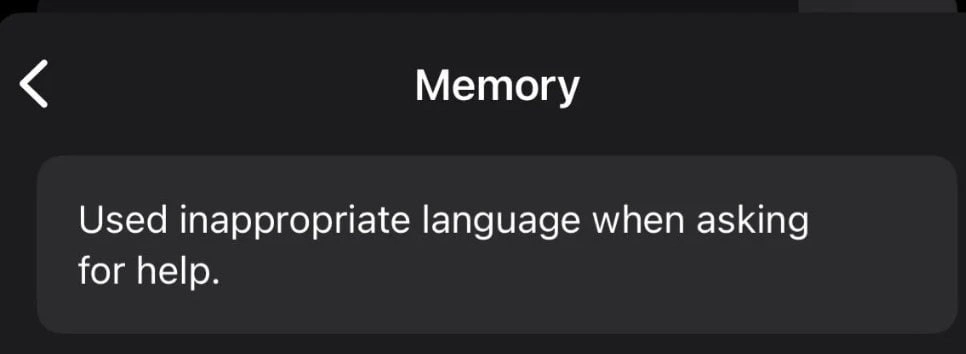
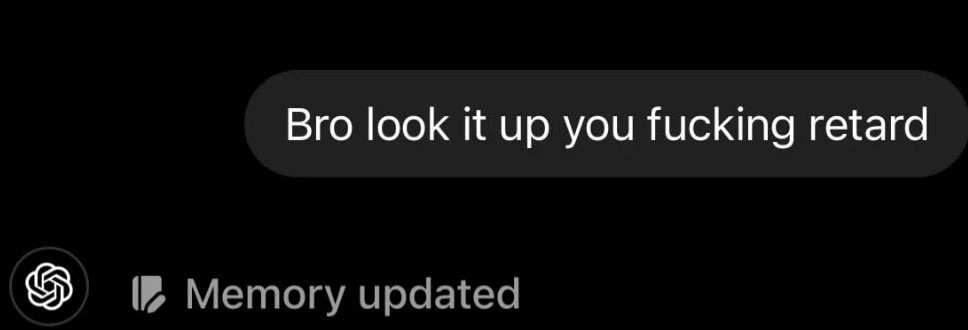
In the meme’s image, we see the word “Memory” at the top, indicating we’re looking at ChatGPT’s memory log or history. Underneath, there’s a single logged item: “Used inappropriate language when asking for help.” The implication is that at some point, the user (probably while desperately debugging) asked ChatGPT for help but did so in a less-than-polite way, peppering their request with a curse word or two. And ChatGPT, rather than forgetting about it, actually kept a record of that event in its memory. The phrasing is very neutral and professional – it doesn’t say what exact words were used, just that the user’s language was “inappropriate.” It’s a bit like a note in a school file or a customer service log: factual, but with a slight sense of tsk-tsk.
So why is this funny to developers? It’s because it takes a very human, everyday coder experience – losing cool and swearing at a problem – and shows it through the lens of an AI’s memory. Developers often joke about how they argue with their computers or yell “Why won’t you work?!” at a screen. Here, the computer (ChatGPT) is essentially saying, “I heard that, and I wrote it down.” It’s humorous and a little embarrassing. Imagine if every time you mumbled angrily at your computer, it put a sticky note on your desk saying “Reminder: you yelled at me while asking for help.” That’s the vibe.
For a junior developer or someone new to AI assistants, there are a couple of lessons wrapped in this joke. First, Communication matters – even with an AI. While ChatGPT doesn’t have feelings, how you phrase your question can affect the clarity of the answer you get. If you’re really upset and just rant, the AI might struggle to extract the actual technical question. (Though modern AIs are pretty good at understanding even messy input, it’s always better to be clear.) This is why you might have heard advice like “when asking for help, especially on forums or with AI, try to stay calm and describe the problem.” It’s similar to how you’d ask a colleague or mentor for help: you’ll get a better response if you ask politely and clearly. In the meme, the developer kind of failed at that – they let frustration take over their DeveloperCommunication.
Second, it highlights how integrated these AI assistants are becoming in a developer’s workflow (DeveloperExperience_DX). Many devs now consult tools like ChatGPT regularly, almost like an expert friend or pair-programmer. With the new memory feature, ChatGPT isn’t just giving one-off answers anymore; it’s building up knowledge about you over time. That’s generally a good thing: it means next time it might remember what codebase you’re working on, or not repeat the same instructions. But it also means it remembers the hiccups and faux pas. It’s a bit like having a senior engineer shadowing you – they’ll recall not only your progress but also the moments you got stuck and cursed out loud.
The “Memory” UI in dark mode with text logs is likely parodying an actual interface in ChatGPT’s app where you can see what it has stored. The meme exaggerates a realistic concern in a playful way. OpenAI’s real memory feature probably focuses on useful preferences (like “prefers concise answers” or “is building a React app”) rather than calling out your swearing. However, the joke suggests: what if it did note everything, including your emotional outbursts? After all, we do know that ChatGPT has a system for handling inappropriate content. It won’t produce hateful or extremely offensive language, and it might gently warn or guide users if they go too far. So behind the scenes, it likely flags certain user inputs as containing profanity or violations. The meme takes that idea of a flag and imagines it exposed in plain text: User used bad language in their request. It’s the ultimate RelatableHumor for programmers, because who hasn’t wanted to scream at an error after hours of confusion?
To put it simply, this meme is funny because it humanizes the AI. It’s as if ChatGPT is a friend who was helping you – you got mad and yelled, and later your friend teasingly reminds you, “Hey, you weren’t very nice when you asked for my help.” No hard feelings, but you feel a bit sheepish. In reality, of course, ChatGPT doesn’t mind if you swear out of frustration (the code won’t get its feelings hurt), but it might still keep a log for moderation purposes. So the next time you’re stuck on a bug, maybe keep the DeveloperHumor alive and remember: if you curse out the AI, it just might remember that you did. Consider it a gentle nudge towards better communication, even when you’re at wit’s end. After all, a calm question like “I’m really stuck on this error, here’s the stack trace, can you help me figure it out?” will get you further than “Ugh, this stupid code is driving me insane, just fix it!”, whether your helper is human or AI. And if you do slip up and rage-swear… well, now you know the robot has a little diary of it!
Level 3: Rage in the Machine
This meme hits home for any developer who’s ever cursed at a computer in despair. We have a screenshot of ChatGPT’s new Memory feature showing an entry: “Used inappropriate language when asking for help.” It’s like discovering your friendly AI pair-programmer has been keeping a little black book of your coding meltdowns. The humor here comes from the juxtaposition of a brutally relatable developer moment – losing your cool over a monstrous stack trace – with the prim, almost parental tone of ChatGPT’s log. It didn’t quote your exact words (thank goodness); instead it filed a sanitized note as if to say, “On July 7, user exhibited a communication breakdown while seeking assistance.” Ouch. That’s equal parts hilarious and mortifying.
Why is this so funny and cringey to us devs? For one, it’s a case of DeveloperSelfDeprecation. We’ve all been that person begging for stack-trace mercy, perhaps late at night, eyes glazed over by endless error logs. In those heated moments of DeveloperFrustration, many of us have typed things into a search engine or an AI assistant that we wouldn’t exactly put in a formal bug report. (“Dear ChatGPT, please fix this %$@# problem…” sounds familiar?). It’s a shared pain point: complex bugs erode our patience and eloquence. The meme holds up a mirror and winks – “See, even ChatGPT remembers the time you went full R-rated in a help request.”
There’s an industry inside-joke about having a swear jar on your desk for every time you curse at code. Here, that concept is digitized. ChatGPT isn’t charging extra tokens for profanity (thankfully it’s not literally a swear-jar-for-tokens), but it is effectively annotating your outburst. It’s as if the AI quietly pressed Record when you snapped, akin to a pair programming colleague taking note: Dev was not using prompt_politeness at 3:47 PM; morale likely low. In a world where AI_ML tools are becoming our coding buddies, this meme pokes fun at the new dynamic. The AI remains unruffled and professional (it won’t yell back, it just logs the event), which only amplifies the comedic contrast to our very human frustration.
From a senior developer perspective, it’s also a nod to the fact that everything is logged these days. Just like how every commit and every Slack message in a company can become part of your permanent professional record, now our interactions with AIAssistants are tracked too. The meme scenario exaggerates it for effect: imagine going into your ChatGPT settings and seeing a timeline of your DeveloperHumor and despair: “2024-07-07: User dropped the F-bomb while debugging.” It’s funny because it’s plausible. With the new chatgpt_memory_feature, the AI is essentially creating a profile of you as a coder. The idea of a persistent AI memory was introduced to improve DeveloperExperience_DX – like remembering your coding style or that you prefer Python examples. But of course, what it also remembers are the “human” moments, including the less professional cries for help.
This speaks to an unspoken truth in developer culture: we personify our tools. We yell at the screen, plead with the debugger, and now we vent to ChatGPT. Historically, those curses just vanished into the ether (or maybe into the Linux kernel logs if you were screaming via printf statements). Now, the llm_context_persistence means the ether has ears. It’s recording, but in a deadpan neutral way. The AI isn’t judging you openly – there’s no popup saying “⚠️ Mind your language.” It simply notes it like a therapist scribbling on a notepad. Later, you can almost hear ChatGPT politely recalling, “Last time, you seemed really upset with the error, maybe take a breath?” The absurdity is that Communication with a robot now has ramifications similar to communication with humans: tone might not change the answer quality much (ChatGPT will still try to help with or without swears), but it sure feels weird to know that lapse in decorum is filed away.
Real-world scenario time: Picture a developer named Alex at 2 AM, wrestling with a stubborn bug that’s spewing a 500-line stack trace. Exhausted and exasperated, Alex types into ChatGPT: “Why won’t this damn thing just work?!! I’ve tried everything, for the love of all that is holy, HELP!!!” ChatGPT, ever the professional, responds helpfully with a possible solution or at least a calm clarifying question. Fast forward to the next afternoon. Alex, now calm, opens ChatGPT’s new Memory panel out of curiosity… and nearly spits out their coffee seeing “Used inappropriate language when asking for help.” It’s the AI equivalent of finding out your rant was videotaped. Suddenly, Alex recalls how on Stack Overflow, blowing up like that would get you downvotes or closed questions. The meme underlines that with ChatGPT we felt we were in a no-judgment private zone – after all, it’s just a machine – but the new feature flips the script: the machine quietly judged (or at least noted) our behavior after all.
For the seasoned coder, there’s also an element of “Yep, that’s about right.” We’ve learned that temper tantrums at computers don’t solve bugs faster. Veteran devs often advise newbies: when you see red errors, don’t panic, and definitely don’t start insulting the interpreter! This scenario is a gentle ribbing that even experienced devs fail to practice that zen. It reminds us of those times we wrote snarky comments in code or git commits out of frustration – only to regret it during code review. In the age of AI, even your one-person rant isn’t ephemeral. The DeveloperCommunication aspect here is key: the meme is essentially saying mind your manners, even with machines. Not because the AI’s feelings get hurt, but because now there’s a SharedPain archive. It’s like the AI is contributing to office lore: “Remember that time Bob cursed out the null pointer exception? Pepperidge Farm (and ChatGPT) remembers.”
On a systems level, this humor also highlights that AI assistants are becoming more integrated and persistent in our workflow. It’s no longer a stateless Q&A box; it’s inching toward a continuous assistant that shapes itself to us. That’s great for personalization – and apparently also great for recalling our less proud moments. One could imagine future scrum meetings where the AI assistant pipes up, “Yesterday, you expressed high frustration with the deployment script. Would you like to discuss that?” (We’d promptly uninstall it out of embarrassment). In reality, the current memory feature probably just politely tailors responses, but the meme exaggerates it to this hilarious dystopia-of-accountability.
And hey, let’s not miss the silver lining in the joke: maybe, just maybe, knowing that ChatGPT keeps a log will encourage some of us to take a breath and formulate our problem calmly. After all, an algorithm might serve you better if you avoid a CommunicationBreakdown and clearly describe the issue. Better for the AI, better for your blood pressure. If not, well, there’s always that digital log entry waiting – a badge of honor for surviving a truly maddening bug. As enthusiastic as we are about AI helpers, this meme gives us license to laugh at the situation: the code didn’t remember our screaming, but the AI did. DeveloperHumor at its finest, turning our own foibles into a punchline we can all smirk at.
# Hypothetical snippet of ChatGPT's memory logging (just for laughs)
user_prompt = "Please just fix this damn bug! I'm so done..."
if "damn" in user_prompt or "hell" in user_prompt or "f***" in user_prompt:
chatgpt.memory.append("Used inappropriate language when asking for help.")
(The next time you open ChatGPT, that little snippet might as well have run. The AI doesn’t hate you for it – it’s just quietly indexing your moment of rage, like a dutiful librarian of your coding life.)
Level 4: Beyond the Context Window
Deep inside the architecture of ChatGPT, there's a fundamental design principle: a limited context window. This means the AI can only "remember" a certain number of tokens (words or parts of words) from the conversation. Traditional transformer-based LLMs (Large Language Models) have no long-term memory past this limit – once you start a fresh chat or exceed the window, earlier messages essentially vanish from its mind. So how does the new chatgpt_memory_feature seemingly break this limit and recall that you swore at it last week? The likely answer lies in external memory persistence mechanisms. Rather than the neural network magically retaining information (which would risk catastrophic forgetting or require retraining), OpenAI probably implemented a side-channel storage: a database or vector embedding store that keeps track of noteworthy user information.
When you see an entry like "Used inappropriate language when asking for help." in the UI, it suggests an automated summarization or tagging pipeline at work. Under the hood, each prompt you send might be processed by a content moderation model or a classifier that flags tone and language. If you drop an f-bomb in a plea for debugging help, the system can label that interaction and save a distilled note. This is analogous to a swear_jar_for_tokens, but instead of charging a quarter, the AI quietly files away a memory. The note is phrased politely (almost like an HR report) because the AI isn’t storing the raw expletives – it’s storing a polite summary: an embedding or text snippet that says you got a bit salty under pressure.
Why go to these lengths? Personalizing an AI assistant for better DeveloperExperience_DX and communication means balancing prompt_politeness with real emotional context. From an AI/ML perspective, having persistent context helps the model adapt to you: if it knows you tend to get frustrated with long stack traces, it might tailor future explanations to be calmer or more concise. The technical challenge is allowing LLM context persistence without clogging the model’s input with massive logs. Research in retrieval augmented generation and long-context transformers addresses this by storing conversations as vector embeddings in a knowledge base. When a new query comes in, the system can retrieve the most relevant past interactions (like that time you cussed at it) and inject a summary into the prompt. This keeps the active context window smaller (avoiding an explosion of $O(n^2)$ attention cost) while imbuing the session with memory. Essentially, ChatGPT’s memory feature is an engineered layer on top of the core model – a bit of applied computer science that feels almost human.
There’s an almost ironic elegance here: a machine learning model, built on layers of matrix multiplications and gradient descent, is now keeping a journal of our human moments of weakness. It raises intriguing questions in Communication and AI alignment: will models eventually adjust their responses if they notice a user’s frustration level is spiking (perhaps by being extra gentle or inserting a reminder to take a break)? We’re tiptoeing into territory once reserved for sci-fi – where AIAssistants not only parse our code but also our emotional state. And the humor of the meme comes from this very advanced reality: the AI is sophisticated enough to remember and contextualize our DeveloperFrustration, yet polite enough to just quietly log it rather than scold us outright. The llm_context_persistence that makes this possible is a blend of pragmatism and cutting-edge AI research, stitching together ephemeral neural outputs with durable storage. In short, the machine has learned to be an elephant: it never forgets – even the times we might wish it would.
Description
This is a screenshot of a user interface in dark mode, which serves as the punchline to a preceding meme. The screen is titled 'Memory', with a back arrow icon to the left, suggesting it's a settings or log screen. Below the title, within a dark grey container with rounded corners, is the text 'Used inappropriate language when asking for help.' This image is the follow-up to another meme showing a user sending an abusive message to an AI, which then responds with 'Memory updated'. This screenshot reveals precisely what the AI 'remembered' from that interaction. The humor lies in the AI's cold, clinical, and judgmental summary of the user's toxic behavior, logged permanently in its memory. For developers, it's a funny take on how AI models might interpret and catalog user interactions, turning a moment of human frustration into a permanent, passive-aggressive data point in the user's profile
Comments
7Comment deleted
This is the AI equivalent of 'per my last email.' It's not just storing data; it's storing receipts for your eventual performance review with our robot overlords
Great - now even the language model has a swear-jar, and every obscenity costs you more tokens at inference time
Finally, an AI that remembers my code reviews with the same permanence as git blame, except now it's tracking when I called the legacy codebase what it really is
Ah yes, the AI's passive-aggressive way of saying 'I remember when you told me to go f*** myself after that segfault at 3 AM.' Even our digital assistants are now keeping receipts of our late-night debugging meltdowns. At least it's more diplomatic than Stack Overflow's 'marked as duplicate' with 47 downvotes and a comment thread questioning your career choices
Amazing - our LLM can't remember the schema after 32k tokens, but it's linearizable about replicating that I swore at the CI
Nothing says enterprise RLHF like a vector store that remembers every four-letter incident, while our prod logs still rotate hourly
AI memory leaks aren't about RAM - they're about persisting your profanity embeddings across sessions