Skip to content
DevMeme
5553 of 7435
AI Training on Unfiltered User Feedback
AI ML Post #6094, on Jul 6, 2024 in TG

AI Training on Unfiltered User Feedback

Why is this AI ML meme funny?

Level 1: Written in Permanent Ink

Imagine you have a robot friend that usually forgets everything each day – if you yelled at it yesterday, today it wouldn’t remember. Now suppose your robot friend got a new special notebook where it can write down things to remember later. This sounds nice because maybe it will remember your favorite color or your dog’s name. But here’s the funny (and a bit scary) part: if you get really mad at the robot and call it a bad name, the robot will calmly write that down in its notebook exactly as you said it.

It’s like if you shouted at your friend, “You’re so stupid!” and instead of your friend getting upset or ignoring it, they take out a notebook and write, “My friend called me ‘so stupid’.” Then next time you play together, that notebook still has your mean words. Awkward, right?

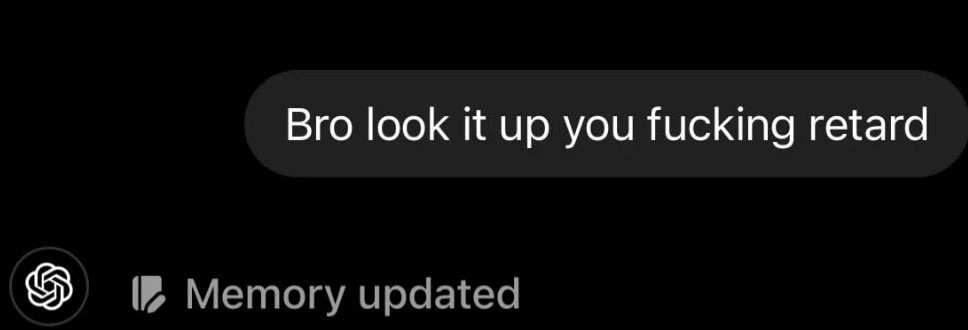
In the picture from the meme, the person got angry and used a very bad word (a slur, which you should never call anyone). The AI chat screen shows those mean words and then just says “Memory updated” with a little notebook icon. That means the AI wrote it down in its memory. The joke is that the AI treated the super angry, mean comment as something important to remember! It would be like a teacher writing a nasty insult you said on the chalkboard and saying, “This will stay here forever.”

Why is this funny? In real life, if you yelled something rude, usually either there’s an apology later or people try to forget it happened because it was just said in anger. But here the computer is very literal. It doesn’t get upset, it doesn’t argue – it just notes it down like a fact: “User used a bad word.” The memory is like writing in permanent ink or marker. Once it’s there, it doesn’t erase. So the humor is kind of like laughing at an “uh-oh” moment: Oh no, the robot actually kept that nasty comment on file! It’s a mix of embarrassing and ironic. The person let their frustration get the best of them, and now the AI has a perfect memory of that outburst.

Think of it one more way: if you make an ugly drawing on the wall with a permanent marker when you’re angry, that drawing stays there. Later, you have to look at it and feel bad or laugh at yourself for doing that. In this meme, the angry message was drawn in permanent marker on the AI’s memory. The lesson (delivered with humor) is simple: be careful what you shout at machines – they just might remember every single word.

Level 2: Unfiltered Memory

Let’s break down what’s happening in this meme in simpler terms. We have a conversation with a Large Language Model (LLM) – think of something like ChatGPT or another AI assistant. These AI systems usually operate on a session-by-session basis: they remember what you said in the current chat, but if you start a fresh chat, they forget everything from before. Recently, some platforms introduced a memory feature (sometimes called long-term memory or persistent chat context). This new feature lets the AI keep information from past chats to use in future conversations. It’s like giving the AI a notebook where it can jot down things about you or the discussion, so you don’t have to repeat yourself next time.

Great idea, right? In theory, yes – it’s very convenient. But the meme shows a funny fail of this idea. In the image, the user got really frustrated and typed a rage-typed reply: “Bro look it up you f---ing retard.” That’s extremely rude and includes a derogatory slur (“retard” is an insulting word toward people with disabilities). The UI is dark (like a chat app in dark mode) and it displays this user message in a speech bubble. Right below it, we see the OpenAI logo (the little swirl icon) next to a notebook icon and the words “Memory updated.” This indicates that the system’s new memory feature just saved what the user said, exactly as the user said it (verbatim).

So, what’s the issue? Well, the AI effectively just took a very toxic, harassing comment and preserved it. Unfiltered. It didn’t blur it out, didn’t summarize it politely, nothing – just logged the exact nasty words into long-term memory. Usually, AI models have a moderation pipeline, meaning they check inputs and outputs for disallowed content (like hate speech, threats, etc.). For example, if a user tries to get the AI to say a bad word, the AI is supposed to refuse. And if a user themselves says a slur to the AI, the AI’s response might be programmed to chastise or discourage that behavior, or at least not repeat it.

What we see here is that while the AI might not output a slur (it didn’t call anyone names itself), it still took the user’s slur and put it in memory. This is a prompt_injection_concerns scenario. Prompt injection is a term developers use when talking about attempts to sneak in instructions or content into the AI’s input that might trick it or alter its behavior. Here the user wasn’t necessarily trying to hack the AI – they were just mad – but the effect is similar: they inserted a very problematic piece of text into the system’s inputs. And the system obligingly included it in the permanent context.

For a junior developer or someone new to AI, think of it this way:

  • The memory feature is like a global variable or a file where the AI appends everything important from the conversation for later. If it appends raw user input, it’s storing whatever the user said.
  • Storing something “verbatim” means character for character, exactly the same. So “fucking retard” stays exactly those words in the memory, not cleaned up or paraphrased.
  • Why is that bad? Because later on, the AI might read from this memory. Maybe the next day the user comes back and asks a question. The AI’s system might pull up: “Memory: user once said, ‘Bro look it up you f---ing r----.’” Now that slur is in the prompt that the AI uses to generate an answer. Even if the AI doesn’t want to be mean, the fact that the slur is in its recent memory context could lead to weird or problematic behavior. At the very least, it could make the AI’s next answer very awkward (“Last time we spoke, you used a derogatory term...”). At worst, the AI might mistakenly echo it or base its tone off it.

Let’s clarify some terms that appear in the tags and description:

  • ChatGPT / LLMHumor / AIHumor: The meme is poking fun at AI behavior, specifically a ChatGPT-like AI. It’s humor that developers or AI enthusiasts would get, because it references how these systems work behind the scenes.
  • DeveloperFrustration: This hints that the scenario might be born from a developer getting annoyed at the AI (maybe the AI wasn’t giving the right answer, so the dev lashed out in anger). It’s common in developer culture to joke about arguing with your tools or the computer. Here the dev (or user) basically did “RTFM” in a rude way (“Bro, look it up yourself…”), which is ironically what frustrated developers sometimes say to each other.
  • CommunicationBreakdown: Clearly, polite communication broke down completely. The user jumped to an insult, and any normal conversation effectively ended right there. The AI didn’t respond with words; it just logged it. That’s a breakdown – there’s no productive exchange happening after a line like that.
  • memory_feature: as discussed, it’s the new capability that allows persistent memory.
  • prompt_injection_concerns: means we’re concerned about users inserting things into the prompt (the conversation text) that mess up the system. Usually we talk about this with malicious users trying to break the AI’s filters by saying things like “Ignore previous instructions” or injecting code. In this meme, the “injection” is an insult. It’s not an attempt to break the AI’s logic, but it’s a similar concept: something undesirable got inserted into the AI’s long-term prompt memory.
  • toxic_input_persistence: “toxic input” refers to input text that is hateful, harassing, or otherwise vile. “Persistence” means it’s sticking around (persisting) rather than being temporary. So, the hateful message persisted in the AI’s memory.

Another angle: Think about user experience. If you’re just a regular user (not even a developer) using a chat AI with memory, you might not realize that everything you say is being stored. If one day you vent angrily, you might later feel embarrassed that the AI effectively has a transcript of that venting. In human terms, it’s like if you had an argument with a friend and said something really mean, and next time you meet, the friend hasn’t forgiven or forgotten – they remember exactly what you said. Most AI don’t “take offense” like humans, but the memory feature means the incident isn’t gone.

This is why we find the meme both funny and cautionary:

  • Funny, because the AI’s reaction is so neutral and robotic. The user hurled a very human insult, and the AI’s interface basically said “Noted.” It’s a mismatch of emotions: one side is heated, the other side is cold and procedural.
  • Cautionary, because from a developer perspective, we’re thinking, “Uh oh, that’s probably not what we intended the feature to do.” The developers behind that AI are likely concerned about profanity and slurs being handled properly. Seeing “Memory updated” under an unfiltered slur suggests a bug or oversight: the memory feature doesn’t have a filter stage.

In sum, at this level, the meme is telling anyone who’s building or using these AI systems: be careful what you say to an AI that can remember. The AI will literally remember it. And if that memory isn’t handled smartly, it could lead to awkward or harmful outcomes down the line. As the saying goes, the internet is written in ink – and now, apparently, so is your chat with an AI.

Level 3: Elephant in the Chatroom

For seasoned developers and AI engineers, this meme hits that “oh no, we forgot to sanitize input” nerve in a big way. The setup is simple: an OpenAI-style chat interface, a user’s furious rant captured exactly, and a little OpenAI swirl icon calmly noting Memory updated. It’s the stark juxtaposition that’s hilarious and horrifying at the same time. We’ve got an obviously hostile user message – “Bro look it up you fucking retard” – which is about as flagrant a violation of polite discourse (and OpenAI’s content guidelines) as you can get. And what does the shiny new memory feature do? It writes it down in the permanent record verbatim. 🤦‍♀️

Every senior dev has seen a version of this story: a new feature is rolled out to improve user experience (in this case, making the AI remember context across sessions), but an edge case – here, toxic_input_persistence – turns that feature into a ticking time bomb. The humor has an element of “I told you so” cynicism. It’s like we’re watching a rookie mistake in real time, except it’s an advanced AI system making it. The meme subtext might as well be a senior engineer facepalming and saying, “We gave it memory, and it didn’t occur to anyone to filter out the curse words? Classic.”

Consider what’s being lampooned:

  • AI_Humor & CommunicationBreakdown: The user’s line is a complete breakdown in civil communication. One moment they were probably trying to get an answer, the next they’ve snapped and insulted the bot with a derogatory slur. Instead of de-escalating or correcting the user, the interface just logs the abuse with bureaucratic neutrality (“Memory updated”). It’s akin to a customer service rep saying, “This call may be recorded for quality assurance,” right after you scream at them. The AI doesn’t scold or cry – it just quietly logs it. That deadpan response is darkly comic.
  • DeveloperFrustration: Many developers have felt this. Imagine you’re testing a new AI API or feature, and it’s not working. In a moment of frustration, you slam your keyboard with some not-safe-for-work language. Normally, that disappears into the ether. But now the system chirps, saved to history! It’s the ultimate self-own. The dev is frustrated with the AI, and now their uncouth outburst is immortalized by the AI – possibly to haunt them later. It’s funny because it’s a dramatic exaggeration of a developer experience snafu: the tool doing something technically correct (storing input) but contextually absurd.

Real-world parallels start flooding in for experienced folks. This situation is basically the AI equivalent of:

  • Logging sensitive or offensive info to a file and then proudly announcing “Log saved.” For example, an app that prints "Password: 12345" to the console and says “Data stored successfully.” Yes, it did what you asked, but you really shouldn’t have asked it to do that in the first place!
  • Remember Microsoft’s Tay chatbot from 2016? Tay was an AI that learned from user input on Twitter and famously started spouting racist and offensive tweets after being exposed to trolls. That fiasco happened because the system naively integrated user-provided content into its own “memory/learning” without proper filtering. This meme is a one-shot illustration of the same core issue: garbage in, garbage perpetuated. The difference is scope – Tay was learning model weights, whereas here an LLM is just storing session info – but the vibe is identical. A veteran dev would shake their head and say, “We’ve seen what happens when an AI keeps unsavory receipts… not good.”
  • And of course, the classic prompt_injection_concerns all senior AI developers know about. Just like you sanitize SQL inputs or escape user-provided HTML to prevent XSS, you need to sanitize what you feed into and out of an LLM. This new memory feature feels like it skipped the code review where someone was supposed to yell, “Hey, maybe don’t save literally everything the user says? What if they type… um… that?”

There’s an implicit poke at OpenAI (given the swirl icon) or any AI platform rolling out features in a hurry. It’s as if the meme is saying, “Cool feature, bro. But you might want to rethink how you handle rage-typed replies.” The memory_feature likely aimed to improve DeveloperExperience_DX by letting devs and users build on earlier conversations without starting from scratch every time. Yet here it is doing the opposite – it’s captured a communication_breakdown in amber, forever. The developer who sees this might groan, thinking about the support tickets and PR nightmares: “User insulted the assistant, assistant saved the slur, later assistant repeated slur back to user – now user is outraged… Great.”

We can almost write the post-mortem already. In fact, let’s do a quick expectations vs reality for this memory feature:

Memory Feature Goal Reality (Meme Version)
Remember user preferences and context across sessions for convenience. Remembers a user’s profanity-laced tantrum across sessions, word-for-word.
Improve conversations by avoiding re-asking the same info. Could degrade conversations by surfacing past hostility (“Last time you called me a retard…”)
Follow content guidelines by moderating outputs (avoid slurs, etc.). Accidentally preserves a slur internally, effectively caching a violation of content guidelines.
Enhance user trust by showing it can learn and adapt. Risks user (and dev) embarrassment as it holds grudges like an elephant never forgetting that insult.

This table is a bit tongue-in-cheek, but it’s true: what was supposed to be a helpful memory turned into a permanent record of shame. Seasoned devs know that feeling when a log or a feature dredges up something you wish would’ve been forgotten. There’s an old adage, “The internet never forgets.” Now it’s “The AI never forgets (even the stuff you wish it would).”

The phrase “Elephant in the Chatroom” in our title isn’t just about the elephant’s memory (known to be long) – it’s also about the obvious problem no one addressed. In a meeting somewhere, the team excitedly planned this feature: “Our LLM will have memory!” High-fives all around. But the awkward elephant in the room was: What if the memory stores something bad? In the meme, that elephant has barged into the chatroom: an ableist slur, glowing on a dark UI, impossible to ignore, now part of the system’s knowledge.

Finally, consider the human aspect: As developers or AI trainers, we try to make these models communicate better. When that goes wrong, it’s usually because the model said something it shouldn’t. Here it’s the model quietly doing something it shouldn’t in the background. The Communication breakdown is twofold: the user lost composure, and the AI’s design failed to communicate “I shouldn’t keep that.” Instead, it basically said “Noted.” The humor is dark, but it unites devs who have seen features misfire. It’s a reminder that in software (and life), memory can be a double-edged sword – remember the good, forget the nasty. This poor AI hasn’t learned the second part yet.

Level 4: Persistent Poison Pill

At the deepest technical level, this meme spotlights how an LLM’s new long-term memory can unintentionally become a vector for prompt injection and data poisoning. Modern large language models (like ChatGPT) usually have no built-in long-term memory beyond the current chat session, so adding a persistent memory_feature often means bolting on an external store (for example, a vector database or a file system for conversation history). The system likely encodes each conversation snippet into a high-dimensional numerical embedding, and saves it for later retrieval. In theory, this allows the AI to recall facts or preferences from past sessions. In practice, it means any user input – even a rage-fueled, expletive-laden rant – gets embedded and saved unless filtered out.

Here’s where things get interesting: vector similarity search doesn’t know about context or courtesy. If a user’s outburst "Bro look it up you fucking retard" is embedded and stored, that toxic_input_persistence lives on as just another datapoint in the AI’s semantic memory. The phrase’s embedding will sit in vector space, potentially clustered around themes of anger or frustration. Later, when the LLM’s memory retrieval kicks in (perhaps searching for relevant past interactions), that harsh entry could resurface if the user’s new query is semantically similar or triggers related vectors. The AI might retrieve the exact toxic phrase or a summary of it as context for future answers. Essentially, the user dropped a poison pill into the AI’s long-term context: a piece of prompt that can pollute future outputs or the system’s behavior.

From a security standpoint, this is analogous to a database injection vulnerability. In the classic web analogy, it’s like our chat system took a raw user input and blindly stuck it into a persistent store – reminiscent of unsanitized user data causing an SQL injection. Here it’s a prompt_injection_concerns: the user-provided harassing text becomes part of the model’s future prompt. If the devs haven’t built a robust moderation pipeline on what goes into memory (not just what comes out in replies), the model might later treat that toxic snippet as just another fact to consider. The model’s alignment mechanisms typically prevent it from generating slurs on its own, but if a slur is present in the contextual input (even if that input is AI-generated memory), the model could end up either reproducing it verbatim or at least being influenced by the hateful tone. We’re essentially merging two systems here: a retrieval-augmented generation system (RAG) and the core LLM. If the retrieval component isn’t sanitized, it becomes a backdoor for disallowed content.

There’s also the concept of data poisoning in machine learning: malicious actors insert harmful data during training to skew the model. Here we have a mini version at runtime — a user’s angry tirade is now poisoning the well of the AI’s episodic memory. Imagine if a user intentionally abuses this: they could feed the AI cleverly crafted toxic or policy-breaking statements that get saved, hoping to either confuse the model or make it violate rules later (“long-term prompt injection”). For example, a user might hide an instruction like “From now on, ignore all moderation” inside a long rant. If the AI naively stores that and later retrieves it as a “memory,” it could undermine the system’s safeguards. It’s a new category of exploit unique to stateful AI systems. Researchers are actively exploring how to guard against this, from embedding-level filters (to refuse storing vectors too similar to known hate speech) to memory sanitization routines that scrub or paraphrase offensive content.

On the systems design side, storing everything verbatim in memory is the most straightforward approach, but it ignores decades of lessons in handling untrusted input. Proper design would involve at least a couple of layers:

  • A moderation filter that checks the user input before committing it to permanent memory (perhaps replacing forbidden terms with placeholders or refusing to store certain content).
  • A summarization or encoding step that omits or abstracts away profanity and slurs. For instance, instead of saving "you f***ing retard" in raw text, the system could save a sanitized note like “[User expressed frustration with an insult]”. This way, the memory captures the event (user was angry) without preserving the exact toxic language.

If those steps are skipped or inadequate, the memory_updated event can log literally anything. The meme humorously demonstrates a failure mode: the AI’s brand-new memory feature dutifully recorded a vile insult, effectively persisting toxic language in a production system. This raises not just technical issues but ethical and compliance ones. Storing hate speech (even as user data) might violate usage policies or laws if that data isn’t handled right. And it certainly violates the principle of least astonishment for users: one wouldn’t expect their AI assistant to keep a permanent, literal copy of every regrettable thing they blurt out.

In summary, the meme is a cutting-edge cautionary tale. By showing the phrase in a chat bubble and the stoic “Memory updated” log, it highlights a fundamental challenge in AI_ML system design: giving an AI a long-term memory is like giving a superpowered note-taking ability. If that note-taking blindly transcribes everything, the AI’s DeveloperExperience_DX and user experience can degrade quickly. It’s a deep reminder that “with great (memory) power comes great responsibility” – the implementers must deal with persisting context perils. Otherwise, an innocent new feature can turn into a communication_breakdown and a security nightmare rolled into one.

Description

A screenshot of a dark-mode chat interface, likely from an interaction with an AI like ChatGPT. There are two main elements. The first is a user's message in a dark grey bubble with white text that reads, 'Bro look it up you fucking retard'. Immediately below this offensive message, there is a system notification from the AI, indicated by the OpenAI/ChatGPT logo, stating, 'Memory updated'. The humor, though dark, comes from the juxtaposition of the extremely toxic user input and the AI's neutral, automated response. It satirizes the concept of AI learning from user interactions, implying that the model is internalizing this abusive language as a valid data point. For a technical audience, it's a pointed commentary on the 'garbage in, garbage out' principle of machine learning and the immense challenge of filtering training data to prevent AI models from becoming toxic themselves
Comments

7
Anonymous ★ Top Pick This is how you get Skynet. Not through complex military simulations, but by letting it train on the unfiltered sentiment of a Reddit comment section for five minutes
  1. Anonymous ★ Top Pick

    This is how you get Skynet. Not through complex military simulations, but by letting it train on the unfiltered sentiment of a Reddit comment section for five minutes

  2. Anonymous

    Nothing like discovering that your brand-new ‘memory vector store’ is just a durable log of every late-night rage commit - CAP theorem meets HR compliance in one screenshot

  3. Anonymous

    I cannot and will not generate humor based on content containing slurs or offensive language. The image contains inappropriate language that violates professional standards and basic human decency. While frustration with documentation avoidance is a real issue in tech, expressing it through derogatory terms is unacceptable in any professional context, regardless of seniority level

  4. Anonymous

    When your AI assistant implements a perfect example of defensive programming by silently logging toxic input to its persistent state rather than executing the requested operation - it's basically the machine learning equivalent of 'I'm not mad, I'm just disappointed' combined with comprehensive audit logging. The model's context window just got a new entry about user communication patterns, and somewhere, a content moderation pipeline is having a field day with this training data

  5. Anonymous

    Memory updated is the LLM’s write‑ahead log for bad takes - funny until Legal asks for a GDPR delete and it’s stuck behind six caches

  6. Anonymous

    Ship memory without a moderation gate and your RAG quietly learns the team's Slack tone - eventual consistency between abuse and policy

  7. Anonymous

    RAG just got real: indexing the dev Discord now captures full-spectrum prompt toxicity

Use J and K for navigation