Skip to content
DevMeme
5247 of 7435
AI Perfectly Recreates 'This is Fine' Meme as a Lego Set
AI ML Post #5746, on Dec 16, 2023 in TG

AI Perfectly Recreates 'This is Fine' Meme as a Lego Set

Why is this AI ML meme funny?

Level 1: Toying with Fire

Imagine you’re at home and suddenly the kitchen is on fire – flames everywhere. But instead of getting upset or calling for help, the person in the kitchen just sits there calmly drinking coffee, saying “It’s fine.” Kinda silly, right? Now make it even sillier: that person asks a smart computer program to draw the whole burning room as a Lego scene. So the computer creates a picture where the fire, the dog, the table, and everything look like Lego toys. It’s as if the person is playing with toys while the real house is burning. We know that’s not what you should do in real life! The reason it’s funny is because it’s so absurd: the situation is clearly not fine at all, but the dog acts like everything is okay and even has the fire turned into a cute Lego playset. It’s like watching someone ignore a big problem and distract themselves with a fun imaginary project. We laugh because we understand that contrast – the big disaster happening versus the calm, playful reaction. It’s a goofy way to show someone pretending nothing’s wrong, and the new twist is using a clever computer helper to do the pretending in style.

Level 2: Meme Building Blocks

Let’s break down the elements of this meme in plain terms, especially if you’re newer to the dev world or haven’t seen the references before:

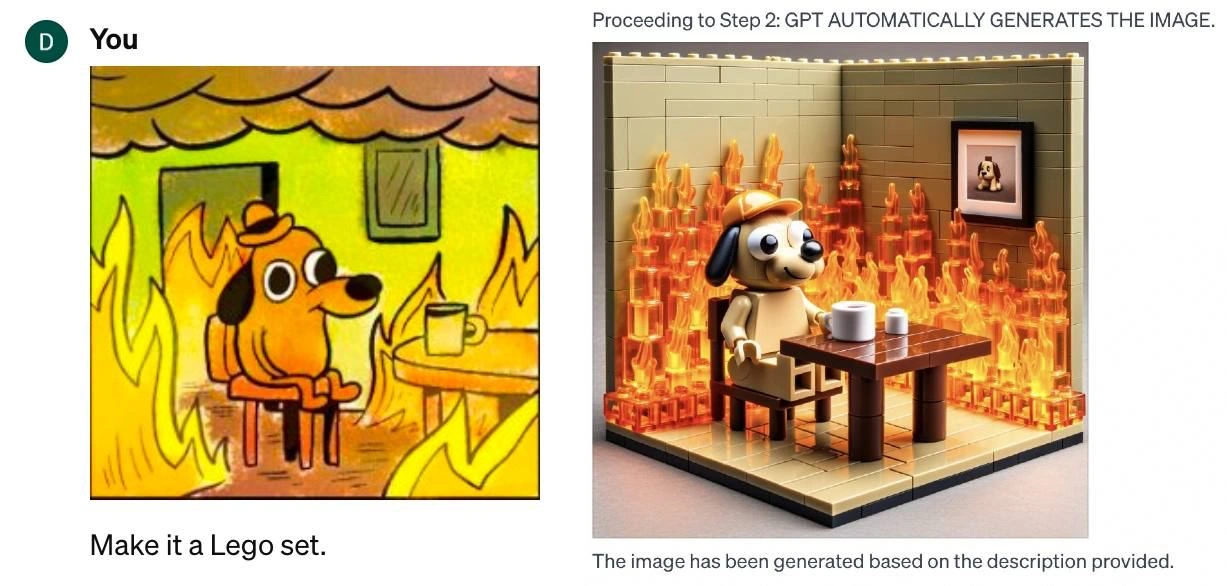
  • “This is fine” dog: The left panel is from a famous meme (originally a comic by KC Green). In it, a cartoon dog sits calmly saying “This is fine.” while his room is engulfed in flames. Developers often use this image to joke about ignoring a big problem. For example, if a website is crashing but someone says “No worries, all good,” they might share the This is fine meme. It’s basically an ironic way to say “Everything is not fine, but I’m pretending it is.” In tech, a “fire” means a critical issue, and the dog represents a person acting like nothing’s wrong.

  • “Make it a Lego set.”: This text under the first panel is like a command or prompt. It’s as if someone told an AI, “Take this scene and recreate it with Legos.” We often say “Lego set” to mean a miniature model made of Lego bricks. The humor is that instead of dealing with the fire, someone wants to turn the burning scene into a cute toy model. It’s a very developer-esque joke — when under stress, make a fun project out of it rather than actually fixing the problem!

  • AI-generated Lego diorama: The right panel is the result of that command. It shows the same scene (dog at a table, fire around) but everything is built from Lego bricks in a 3D style. A diorama is a small model of a scene. Here it’s as if an expert Lego hobbyist built the “burning room” setup with real bricks – except no human built it. An AI created this image from scratch based on the description. It’s not a photograph; it’s a render (an image synthesized by a computer to look real). The dog is now a little Lego figurine, the flames are those translucent orange Lego pieces, and the walls are tiled Lego bricks. Even the coffee mug is a tiny cylindrical brick. The AI added details like a framed picture on the wall, making it look like an official Lego set you could buy.

  • GPT and the prompt-to-image pipeline: The text at the top of the right panel (“Proceeding to Step 2: GPT automatically generates the image...”) is showing an AI at work. GPT (like ChatGPT) is a type of AI that usually generates text. But nowadays, these AI assistants can call on image-generation models when you ask for a picture. So, what likely happened is: a user described the first panel in text and then said “Make it a Lego set.” The AI understood that as instructions to create a new image. In “Step 2,” it fed the description to an image generator (like OpenAI’s DALL-E) which produced the Lego-style picture. The line “The image has been generated based on the description provided.” basically confirms that the AI used the written description of the scene to create the image. This whole process is what we call an AI prompt-to-image pipeline – you give a written prompt, and the AI pipeline returns an image. It’s a hot new thing in tech: you might hear developers joke about making the AI draw their ideas or diagrams automatically. It showcases the power of AI tools and assistants in the modern developer experience.

  • Production fire analogy: When we say “production is on fire,” it’s slang for “the live system (product) has a serious issue.” It could be a server outage, a major bug, data center overheating – anything critical. In a healthy scenario, developers would jump in to fix it (firefighting, literally). But in this meme, the joke is that the developer is essentially ignoring the production fire. They’re calmly doing something else (playing with AI, making a Lego model) while the system burns. It’s a humorous exaggeration of the sometimes flawed human behavior during crises – either due to denial, panic, or being too distracted by shiny new technology. Every junior dev eventually learns that “this is fine” in tech usually means the opposite – it’s a meme way of acknowledging a problem with a wink.

So, putting it together: The meme uses the well-known “this is fine” scenario to depict a developer under crisis. But instead of reacting to the crisis, they leverage a new AI assistant to do something fanciful – turn the crisis into a Lego art piece. It’s highlighting how far technology has come (you can generate a detailed image from a simple prompt now!) and at the same time poking fun at how developers can be enthralled by new tech (AI hype) even at the worst times. In short, it’s showing a developer humor moment: things are burning down, but hey, check out this cool thing ChatGPT can do! It’s funny because it’s a little true – tech folks often cope with stress by joking and tinkering, and now we have cutting-edge AI to tinker with.

Level 3: Fiddling While Prod Burns

For seasoned developers, this meme hits a nerve (in a darkly funny way). We’ve all experienced those “this is fine” moments: the production server is crashing and burning, alarms blaring, but everyone in the meeting is sipping coffee, pretending nothing’s wrong. The original cartoon dog calmly saying “This is fine” amid flames has become the universal symbol of ignoring a production fire – that metaphorical blaze being a severe outage or bug wreaking havoc in your system. It’s the kind of scenario where a team lead might downplay an incident (“Minor glitch, we’re fine”) even as logs glow red with errors. Every senior engineer has a war story of some on-call disaster where someone essentially sat in denial. It’s humor as a coping mechanism for the very real stress and absurdity of IT emergencies.

Now the right panel cranks the absurdity up a notch with a generative AI twist. Instead of grabbing a fire extinguisher (or you know, digging into logs to fix the bug), the developer’s response is: “Hey GPT, make a Lego set out of this.” In 2023 fashion, our first instinct seeing a calamity is apparently to feed it to ChatGPT and see what cool output it gives. It’s poking fun at our industry’s AI hype – we have these powerful AI tools at our fingertips, and what do we do? We use them to create meme art out of our problems. On one hand, it’s showcasing a jaw-dropping Developer Experience (DX) improvement: imagine describing a scene and instantly getting a detailed 3D render. That’s the kind of slick workflow developers hype on Twitter and at meetups. On the other hand, it’s highlighting a sort of hype-fueled distraction: we might be so enamored with AI assistants and AI-generated content that we’ll play with them even while real issues go unaddressed. It’s like deploying a fancy Kubernetes cluster while the core product is down – priorities comically out of whack.

There’s a layer of shared tech culture here. The phrase “Make it a Lego set.” as a prompt is hilariously relatable – as developers, many of us are big kids at heart. Who hasn’t decorated their desk with toy brick figures or dreamed of a Lego version of their project architecture diagram? Turning a burning room into a cute Lego diorama is both a denial mechanism and a joke about how we sometimes trivialize serious issues. It’s saying: if everything’s on fire, might as well get a sweet collectible out of it. This resonates with the weary DevOps veteran who’s seen too many overnight outages. After a while, panic turns into a resigned, ironic calm – the same vibe as the dog with his coffee. The modern twist is we have GPT as our new colleague now, cheerfully willing to comply with even the most facetious requests. The meme exaggerates a very real dynamic in tech teams: the allure of new tech (AI assistants, ChatGPT, fancy image generators) can lead us to invest time in toys and visualizations rather than tackling the unglamorous fire-fighting. It’s a gentle roast of today’s IndustryTrends_Hype: sure, we’ve got cutting-edge AIs that can generate images from a chat prompt, but we’re still dealing with the same old fires – we just have prettier pictures of them.

And let’s not miss the meta-humor: the “This is fine” dog is an old internet meme (from 2013) that became a beloved inside joke among developers for years. In true tech fashion, we’ve now open-sourced it to the AI and made it generate a 3D, high-res remake. It’s nostalgia meets innovation. The juxtaposition of the familiar 2D cartoon and the newfangled AI render says: “Look how far our tools have come… and yet here we are, still saying everything’s fine while it burns.” That contradiction is the core of the joke. Experienced devs laugh (perhaps a bit bitterly) because they recognize both the scenario of wilful ignorance and the zeitgeist of turning everything into an AI demo. It’s a snapshot of our current developer zeitgeist – half firefighting, half playing with the latest tech toy, all at the same time. In other words, everything is on fire, but hey, at least now it comes in LEGO and with an AI-generated certificate of authenticity.

Level 4: Transformer Blocks on Fire

At the deepest technical level, that bland UI message “GPT automatically generates the image” masks a sophisticated multi-modal AI pipeline. Under the hood, a large language model (GPT-4 or similar) is orchestrating an image generation process. Essentially, the AI took a textual description of the iconic “This is fine” scene and translated it into visual form, brick by brick. This involves encoding the text prompt (the dog, the flames, the Lego style request) into a high-dimensional latent space that a generative image model can understand. Modern text-to-image systems (like DALL-E 3 or Stable Diffusion) use a Transformer to interpret the prompt and a diffusion-based decoder to gradually paint the picture. It’s like the model has learned the concept of Lego bricks, fire, and even the cartoon dog’s look from its vast training data, and now it’s reassembling those concepts into a new image.

The result? A photorealistic Lego diorama of our burning-room meme. The AI isn’t literally snapping together physical bricks; it’s generating pixels that look like Lego pieces. Those translucent orange flames and the tan brick walls aren’t hand-modeled by a human—they’re synthesized from patterns the model absorbed during training (possibly from countless images of actual Lego fires and toy sets). The transformer blocks (layers of the network) effectively set the house on fire in the figurative sense, guiding the image creation with uncanny accuracy. Notice even the tiny details: the AI-added framed portrait of the dog on the wall that wasn’t in the original cartoon. That’s a bit of creative liberty—likely the model’s neural networks thought “hmm, a wall needs some decor” and hallucinated an extra meta-joke (the dog looking at a picture of itself while everything burns). It’s a testament to how generative models interpolate and embellish scenes based on context.

From a systems standpoint, this showcases the cutting edge of developer tooling in AI/ML: a single prompt triggers a chain where a language model handles the request and an image model renders the output. The prompt-to-image pipeline seamlessly combines language understanding with image synthesis. In practical developer terms, this is like having an extremely advanced assistant that can read a bug report and automatically generate an illustrative screenshot of the issue—except here it’s generating a joke. We’ve essentially connected GPT’s natural language processing powers to a visual content generator. It’s a powerful demonstration of modern AI accessibility: even the written accessibility description of an image (originally meant to help humans) can become raw material for an AI to produce new content. We’ve come a long way from ASCII art; now neural networks can conjure up a 3D-rendered scene in the style of your choice in seconds. It’s equal parts impressive and a little hype-inducing—a peek behind the curtain at how our new AI assistants can mash up reality into playful, plastic brick form while the rest of us metaphorically “burn” through GPU cycles to make it happen.

Description

A two-panel image demonstrating the capability of generative AI. On the left, the classic 'This is Fine' meme is shown, featuring a cartoon dog sitting in a room engulfed in flames with a calm expression. Below this image is the user's prompt text: 'Make it a Lego set.' On the right panel, the AI's output is displayed. It is a photorealistic image of a meticulously crafted Lego diorama that perfectly recreates the meme. A Lego dog figure sits at a Lego table with a mug, surrounded by translucent orange Lego flame pieces representing the fire. The scene is incredibly detailed, even including a framed picture of the Lego dog on the wall. Above the AI's output, it says 'Proceeding to Step 2: GPT AUTOMATICALLY GENERATES THE IMAGE.' and below, 'The image has been generated based on the description provided.' The meme humorously showcases the remarkable progress in AI image generation, which can now understand cultural contexts (the 'This is Fine' meme) and specific aesthetics (Lego) to generate novel, high-quality content from a simple text prompt. For developers, it's a commentary on the power of new AI tools while also ironically using a meme that symbolizes accepting a disastrous situation - a common feeling during production incidents
Comments

7
Anonymous ★ Top Pick Our new AI can render any catastrophic production fire as a charming Lego set. It doesn't fix the bug, but it makes the incident report much more visually appealing
  1. Anonymous ★ Top Pick

    Our new AI can render any catastrophic production fire as a charming Lego set. It doesn't fix the bug, but it makes the incident report much more visually appealing

  2. Anonymous

    Prod’s still a five-alarm blaze, but GPT turned it into a Lego diorama - so leadership now calls it an “immersive observability demo” and slashes the firefighting budget

  3. Anonymous

    Finally got the LEGO Architecture series to accurately model our microservices deployment: 10,000 pieces that don't quite fit together, instructions written in three different languages, and somehow it's always on fire even when assembled correctly

  4. Anonymous

    When your prompt engineering is so precise that GPT not only understands the assignment but delivers production-ready assets. Meanwhile, your actual Lego budget request is still stuck in procurement review since Q2. The real fire here isn't the meme - it's the realization that AI can now generate better documentation visuals than your entire design team's Figma workspace, and it doesn't even need three sprint planning sessions to do it

  5. Anonymous

    Prompted GPT to 'make it a Lego set' - now my outage postmortem is modular, but good luck reassembling without the lost instructions

  6. Anonymous

    Only in 2025: GPT converts a Sev‑1 into a LEGO set - finally a microservice architecture where the boundaries actually snap together and the fire is a documented feature

  7. Anonymous

    “This Is Fine” LEGO set: a faithful model of prod - flames autoscale, the status page stays green, and the only persistent storage is caffeine

Use J and K for navigation