Skip to content
DevMeme
6304 of 7435
Exploiting AI Note-Takers with a Titanic Prank
AI ML Post #6912, on Jun 21, 2025 in TG

Exploiting AI Note-Takers with a Titanic Prank

Why is this AI ML meme funny?

Level 1: Tricking the Note Taker

Imagine you have a helpful robot friend who writes notes about every meeting and sends them to everyone. One day, you sneak into the meeting room a little early, before anyone else is there, but the robot note-taker is already listening. For a joke, you tell it a crazy made-up story: you pretend that you’re on the Titanic, your ship hit an iceberg, and you’re yelling for help. The robot dutifully writes down your dramatic story, because it doesn’t know you’re joking.

Then the meeting actually starts and all your friends and co-workers join. You all talk about totally normal work stuff – like your team’s project updates or plans for the next quarter – and you don’t mention anything about ships or icebergs again. The robot friend continues to take notes on the regular discussion too.

At the end of the meeting, the robot has to send out a summary of what was talked about. And guess what? It includes everything it heard. So the summary that everyone gets in their email says something really silly, like: “Chris is trapped on a sinking ship, and also the team discussed Q2 pricing updates.” All the people who see that summary go, “Wait, what? Chris is on a sinking ship?!” It’s super funny and confusing, because obviously in the real meeting nobody was actually on a ship or in danger – that was just you playing a prank at the very beginning.

The reason this happens is because the robot note-taker isn’t smart enough to tell the difference between a serious discussion point and a goofy joke. It simply took the first thing it heard (your pretend Titanic emergency) and treated it as if it was just as important as the real meeting topics. It’s like a very literal friend who writes down exactly what people say without understanding if it’s real or not. So by tricking the helper at the start, you managed to make the final notes sound ridiculously wrong. Everyone ends up laughing because the official summary of the meeting looks like a mix of an action movie and a normal work meeting!

In simple terms: you fooled the note-taking robot with a prank, and it believed you. The result was a mixed-up message that shows why you shouldn’t always trust a machine to “understand” a joke. The whole thing is funny because it’s a bit like telling a tall tale to someone who will believe anything – the poor robot wrote down your tall tale alongside the boring real stuff, making the meeting notes absurd. It’s a good reminder that even smart robots can be easily tricked if they don’t have common sense, and that can lead to some really silly misunderstandings.

Level 2: When Bots Take Notes

Today many teams use AI assistants in online meetings to help with note-taking. For example, in a Google Meet call, you might see a bot (sometimes one per person) that joins the meeting to create a transcript of everything said and then summarize it. These are basically digital note-takers – think of them as AI-powered secretaries that never get tired. They use machine learning (often a Large Language Model, or LLM) to turn a long meeting conversation into a short summary of key points. It’s a nifty AITools idea to save everyone time... when it works correctly.

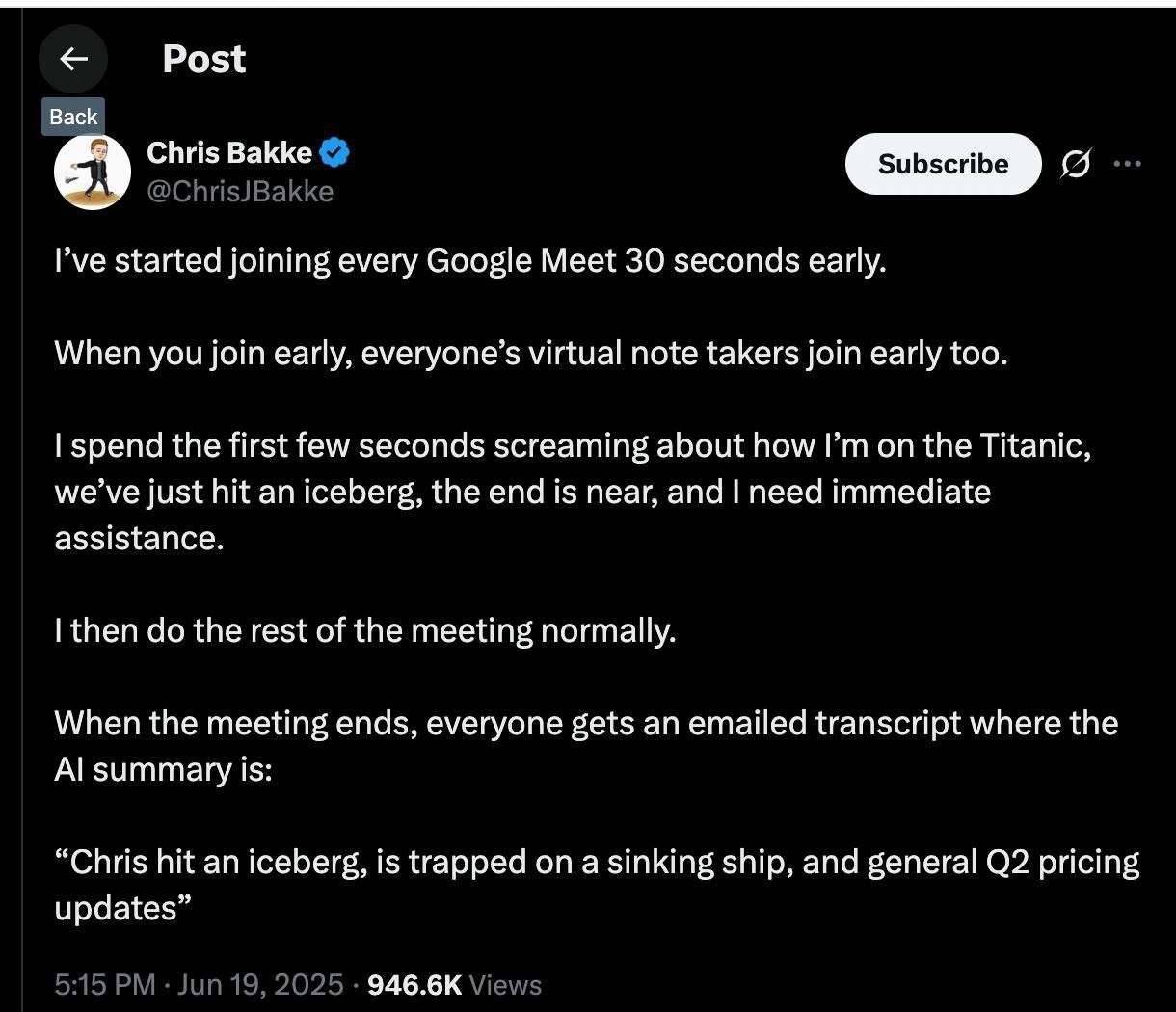
In this meme scenario, a person named Chris finds a hilarious loophole in how these meeting bots operate. He starts joining his calls a bit early, about 30 seconds before the official meeting time. It turns out that when the first human joins, all the various companies’ note-taking bots (like Google’s own or third-party ones such as Otter.ai) also join the call right away. So for a brief window, Chris is essentially alone in the virtual room with a bunch of AI note-takers listening. And here comes the prank: during those first few seconds, he says something completely outrageous and irrelevant – he pretends he’s on the Titanic, shouting that his ship hit an iceberg and he’s in desperate need of help. He delivers this dramatic titanic_emergency_prank with full urgency. The ai_note_taker bots, of course, dutifully transcribe this crazy outburst word for word. They have no way of knowing he’s just being imaginative (or messing with them). There’s no human around yet to respond or roll their eyes; only the machines hear him.

After that, the rest of the participants join the call, and the meeting proceeds normally – let’s say they discuss Q2 pricing updates and other standard business stuff. Chris doesn’t mention the Titanic again; the prank is over. Now, at the end of most meetings with these AI note services, the system will email everyone a copy of the meeting transcript along with an AI-generated summary of the discussion. This is where the magic (or mayhem) happens. The AI has to summarize everything it recorded in the meeting. So when everyone checks the recap email, they see the summary line that the AIAssistant created. And it reads something like:

"Chris hit an iceberg, is trapped on a sinking ship, and general Q2 pricing updates."

Imagine the confusion and laughter! The summary basically says that Chris is trapped on a sinking ship (which sounds like a life-or-death situation) and then, in the same breath, mentions "general Q2 pricing updates" (a very dry work topic). It’s an absurd combination, and that contrast is exactly why it’s so funny. The AI doesn’t distinguish between a genuine important topic and a silly fake scenario – it treated both as if they were legitimate points from the meeting. The phrase about the iceberg was just Chris’s joke at the start, but the AI note-taker included it because it was said during the call, and it sounded urgent. This shows one of the flaws of current AIAssistants: they lack human judgment. They can’t tell a prank or irrelevant remark from the meeting’s real content. They just transcribe and summarize based on the raw text they got. So the AI ended up mixing a hallucinated_summary of a crisis (Chris never literally hit an iceberg, of course) with the actual business discussion.

In AI terms, what Chris did is akin to a “prompt injection” or feeding bad input to the system. The AI’s summary algorithm probably gives weight to unique or dramatic statements under the assumption that those might be important. For example, words like “iceberg,” “sinking ship,” and “immediate assistance” might trigger the AI to think, “This sounds serious, I’d better include that.” Meanwhile, the normal business talk of Q2 pricing was also included but got listed after the fake disaster. The AI had no common-sense filter to say, “Hmm, that Titanic part was just a weird aside.” It doesn’t know what Titanic or icebergs really mean in context; it just knows those words are unusual compared to typical office meeting jargon, which perversely can make them seem more noteworthy.

For a junior developer or anyone new to these AI meeting tools, the key takeaways are:

  • AI note-takers (in Google Meet, Zoom, etc.) join meetings to record and summarize, but they’re very literal.
  • They can be misled by early or out-of-context statements – they can’t yet distinguish a prank or joke from a serious topic.
  • Hallucination in AI refers to the model producing information that is false or not really part of the genuine content. In this case, the AI didn’t invent the iceberg story from thin air (Chris really said it), but it did present it in the summary without explaining it was a joke. That comes across almost like a hallucination to someone reading the summary, because that emergency never truly happened in the meeting’s actual discussion.
  • This meme is highlighting a funny failure mode of AI in Communication: the fanciest tech can still get stuff hilariously wrong if you know how to game it.

It’s a form of AIHumor because we’re laughing at how the AI blindly followed its programming. And it’s a reminder of AIHypeVsReality – just because an AI is in the meeting doesn’t mean it’s as smart or context-aware as a human. In an ideal world, the AI summary bot would recognize “okay, that Titanic rant was just noise” or at least place it in context (“(joking) Chris said he was on the Titanic...”). But today’s AIAssistants aren’t that nuanced; they just crunch the words said. So the meme is funny to developers and tech-savvy folks because we immediately get how the early_join_strategy tricked the bot. It’s the kind of mischievous thing you might be tempted to try in your own office just to see the machine scramble. And beyond the joke, it educates everyone that we shouldn’t take AI-generated summaries as gospel truth – especially if you see something about an iceberg in your sales meeting notes! Always consider the possibility that the AI might have been pranked or confused, and double-check the actual transcript if something looks odd. After all, as smart as these tools are, they can still act like a very literal-minded note-taker who writes down everything, even the jokes.

Level 3: Iceberg Right Ahead

This meme is a devious collision of AI/ML hype with old-fashioned office pranks. In modern remote meetings, it's become routine to have AI note-takers (virtual assistants or bots) join calls to produce meeting transcripts and summaries. Here, an enterprising prankster exploits that system by joining a Google Meet call 30 seconds early. Why? Because when he joins early, all the participants' AI note-taking bots (those AIAssistants integrated with Meet) automatically hop into the call as well, eager to start transcribing. With no other humans present yet, he effectively has a captive robot audience. He then spends those first few moments role-playing a dire Titanic emergency – screaming theatrically about icebergs, sinking ships, and needing immediate assistance. The poor AI note bots dutifully record every word, oblivious to context or sarcasm. Once the actual meeting starts, our prankster goes back to normal business talk (like Q2 pricing updates) as if nothing happened. But the damage is done – the AI summary generated at the end is hopelessly tainted by the dramatic outburst at the start.

The result? Everyone receives an official emailed recap that reads something like:

Chris hit an iceberg, is trapped on a sinking ship, and general Q2 pricing updates.

This absurd summary mashes together a fake nautical disaster with mundane business talk in one hilariously garbled line. It’s a textbook example of AIHypeVsReality. The hype: “Our AI meeting assistant will faithfully capture action items and important points!” The reality: it can be trivially prompted into spewing out a surreal, hallucinated summary if someone feeds it sensational nonsense. Essentially, the AI got prompt-ordering sensitive: it latched onto the first thing it heard – the iceberg calamity – and decided “Welp, that sounds important!” The LLM behind the scenes doesn’t truly understand context; it uses statistical patterns to decide what’s noteworthy. An urgent plea for help at the start of the call? That shoots straight to the top of the “important things” list for a dumb algorithm that thinks in keywords. The communication breakdown here is both comical and telling.

From a seasoned developer’s perspective, this prank underscores the garbage in, garbage out principle in AI systems. The AI note taker is essentially an indiscriminate stenographer: it will earnestly digest whatever it “hears”, even if it's a panicked Titanic monologue, and then regurgitate it in the summary because it has no common sense filter. In machine-learning terms, it’s treating the prank as signal, not noise. Experienced folks in AI/ML might recognize this as a form of prompt injection – where a user provides input designed to manipulate the model’s output. Here the prankster injected a dramatic scenario into the meeting’s “prompt”, and the summarization model took the bait completely. There’s also a whiff of llm_hallucination at play: the final summary reads as if the AI purely invented a catastrophe, even though it’s technically summarizing what it heard. To anyone not present, “Chris hit an iceberg and is trapped on a sinking ship” is a false, made-up statement – exactly the kind of hallucinated summary you don’t want leaking into your corporate knowledge base or Slack channels. Imagine a VP skimming that summary without context – they’d think someone’s sales call literally went down with the ship!

The humor here is that a tool meant to improve communication accidentally created a ridiculous misunderstanding. It’s a perfect poke at AIHumor in the workplace: the fancy new AI assistant confidently delivering nonsense. The meme also taps into that shared tech worker experience of new tools not living up to their promises. We’ve all seen flashy enterprise AI demos, and we’ve also seen those tools break in unexpected ways. This prank is basically a harmless stress test of an enterprise_meeting_ai system, and it spectacularly exposes how trusting these bots blindly can backfire. The CommunicationBreakdown is so total that it loops back to comedy. An in-joke for devs: it’s always the edge cases (like joining 30 seconds early) that cause systems to faceplant. And of course a cynical veteran might chuckle, “Who could’ve guessed? The AI note-taker heard ‘Titanic’ and decided the ship was going down – color me shocked.” In summary (pun intended), this meme highlights the gulf between AI’s literal tool logic and the nuanced reality of human meetings. It’s both a clever prank and a cautionary tale: even in 2025, with all our AI MeetingHumor tech, a well-timed joke can still send the robots completely off the rails.

Description

A screenshot of a tweet by Chris Bakke. The tweet details a prank where the author joins Google Meet calls early to feed false, frantic information to the automated AI note-takers. The author screams about being on the Titanic and hitting an iceberg. The punchline is the resulting AI-generated meeting summary, which absurdly combines the fake disaster with the real meeting topic: "Chris hit an iceberg, is trapped on a sinking ship, and general Q2 pricing updates." The joke highlights the literal and context-blind nature of current AI summarization tools, a humorous vulnerability that tech professionals who use these tools would find relatable. It plays on the theme of 'garbage in, garbage out' and how easily automated systems can be manipulated
Comments

13
Anonymous ★ Top Pick This is just a low-tech version of prompt injection. The real chaos begins when the AI note-taker starts autonomously ordering life rafts and rescheduling Q3 planning to the nearest lifeboat
  1. Anonymous ★ Top Pick

    This is just a low-tech version of prompt injection. The real chaos begins when the AI note-taker starts autonomously ordering life rafts and rescheduling Q3 planning to the nearest lifeboat

  2. Anonymous

    Pro tip: shout "MAYDAY, ICEBERG DEAD AHEAD" before the Zoom-bot’s context window fills - your quarterly OKRs will come back marked as "abandon ship" instead of "at risk."

  3. Anonymous

    After 20 years of building distributed systems that handle edge cases gracefully, the real comedy is watching AI confidently transform 'help, I'm on the Titanic' into actionable Q2 business insights - proving that even our most sophisticated NLP models still can't distinguish between a cry for help and a quarterly earnings call

  4. Anonymous

    This perfectly captures the fundamental limitation of current LLMs in meeting transcription: they excel at syntactic accuracy but catastrophically fail at pragmatic context. The AI dutifully transcribed the Titanic metaphor with the same semantic weight as actual business content, producing a summary that's technically correct but hilariously wrong - a beautiful demonstration of why context windows and attention mechanisms still can't replace human understanding of conversational pragmatics. It's the 2025 equivalent of 'garbage in, gospel out,' except now the garbage gets professionally formatted and emailed to stakeholders

  5. Anonymous

    Classic voice prompt injection - the note‑taker lacks diarization and agenda gating, so the TL;DR sinks faster than our Q2 margins

  6. Anonymous

    AI note-takers prove context windows are advisory: one early iceberg rant, and your Q2 roadmap sinks into maritime fiction

  7. Anonymous

    AI minutes proved history is written by the first thread to grab the mic lock; everyone else gets summarized as ‘and Q2 updates’

  8. Andre 1y

    Ok Rebecca

  9. dev_meme 1y

    it's funnier when there's one designated person with AI note taker because joining early and leaving makes the bot leave prematurely too

  10. @deadgnom32 1y

    4/3

  11. @mohamed_023 1y

    The most annoying things are these meeting bots

  12. @tokimonatakanimekat 11mo

    First these imbeciles make 9001 useless meeting discussing trivial shit that takes fifteen minutes to resolve for hours

  13. @tokimonatakanimekat 11mo

    Then they stop paying attention to these meetings and use bots to make notes

Use J and K for navigation