Modern Digital Infrastructure's Unsung Hero: FFmpeg
Why is this OpenSource meme funny?
Level 1: Even Ferraris Need Fuel
Imagine you see a bunch of super fancy, expensive sports cars – Lamborghinis, Ferraris, Porches – all lined up. They look different and super high-tech, right? But then you notice something funny: when they need to run, every one of them has to stop by the same gas station and fill up with the same fuel that everyday cars use. It’s a bit surprising and a little funny: no matter how special or pricey those cars are, they still rely on plain old gasoline to actually go anywhere.
This meme is making a similar point, but with big video websites. All these famous video platforms (the flashy “sports cars” of the internet world) have awesome features and unique looks. Yet, deep down, they’re all getting their video power from the same source – a common tool called FFmpeg (kind of like the gas in our car example). In other words, no matter how “fancy” or different these streaming services appear, they all depend on that one basic thing to get videos playing smoothly. That’s the joke: it’s a lighthearted reminder that even the biggest, coolest companies rely on some of the very same tools everyone else does. It makes us smile because it shows that underneath all the glamour, they’re all running on the same simple engine.
Level 2: The Swiss Army Knife of Video
Let’s break this down in simpler terms. FFmpeg is an open-source command-line program that’s like the ultimate toolbox for working with video and audio files. If you have a video and you need to convert it to a different format, change its size, or tweak anything about it, FFmpeg can do it. In fact, it can handle video_transcoding (re-encoding video from one format to another), audio processing, streaming, recording – you name it. The meme jokes that every big video platform (think of YouTube, TikTok, Netflix, Instagram, Twitch, etc.) uses this one tool somewhere in their backend (the behind-the-scenes servers and processes that users don’t directly see). The text “pipes through one ffmpeg -i” refers to how you use FFmpeg from the command line: you typically start a command with ffmpeg -i inputfilename to tell it “here’s the input video file.” The joke is saying all these huge companies eventually do exactly that under the hood: feed their videos into an FFmpeg input.
Why would all these different sites use the same thing? Because video encoding and processing is really hard to do from scratch. There are countless video file formats (MP4, MOV, MKV) and compression standards (codecs like H.264, HEVC, VP9, AV1, etc.). Instead of each company reinventing that wheel, they rely on FFmpeg’s code (or libraries derived from it) which already knows how to handle all those formats. It’s a bit like how many web services rely on common infrastructure pieces – for example, lots of sites use the Linux operating system or the Nginx web server internally. Here, FFmpeg is a foundational piece for handling media. It’s part of the content_delivery_stack: when you upload a video to Facebook or YouTube, their backend servers will use a pipeline of software to prepare that video for streaming. That pipeline almost always includes a step where the video is transcoded into standard sizes and qualities. FFmpeg is frequently the engine performing that step.
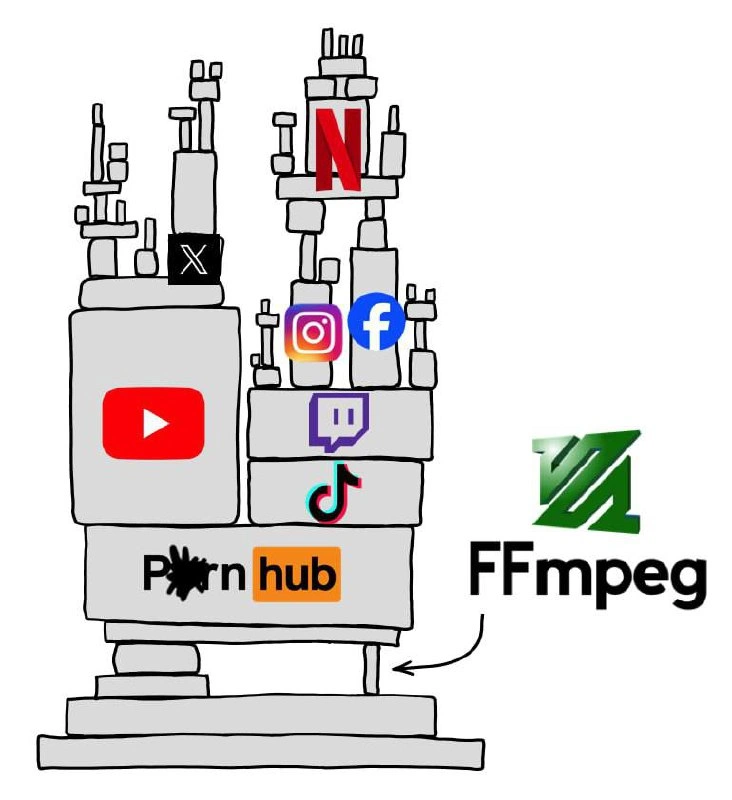
Think of the logos in the drawing: You see YouTube’s red play button, TikTok’s music note, Twitch’s purple icon, Instagram’s colorful camera, Facebook’s blue “f”, Twitter’s X, and Netflix’s big N. These are very different brands – some focus on short clips, some on long movies, some on live streams. But they all have to solve the same technical problem: how to take a source video and make it work well on the internet (smooth playback, manageable file size, compatible with many devices). The shared solution is often FFmpeg. It’s a common dependency for them, meaning it’s a piece of software they all depend on to function properly.
For a junior developer or someone new to this area, it might be surprising that billion-dollar companies use an off-the-shelf open-source tool just like you might in a personal project. But that’s a big part of how the software world works: open_source tools are everywhere, even in giant corporations’ stacks. FFmpeg is free, continuously improved by a community, and very reliable for media processing. Companies might integrate it by calling the ffmpeg program in the background or by using its libraries (like libavcodec) directly in their application code. Either way, the functionality comes from that same source.
Let’s clarify some terms from the tags:
- Backend: This refers to the server-side part of a service. When you upload or watch a video, the backend is what happens on the company’s servers – storing the file, converting it, and sending it to users – as opposed to the frontend (what you see in the app or website).
- Infrastructure: This means the foundational systems and software that keep a platform running. FFmpeg would be considered part of a platform’s infrastructure for handling videos, just like databases and servers are infrastructure for storing and delivering content.
- Media encoding / Transcoding: Encoding is compressing/formatting a video or audio into a specific format (like making a large raw video into an H.264 compressed MP4). Transcoding usually means taking an existing encoded file and converting it to a different format or bitrate. For example, you upload a huge 4K video, and the service transcodes it into a 1080p version, a 720p version, etc., for smoother streaming.
- Streaming pipeline: This is the sequence of steps that happen to a video from the moment it’s uploaded to the moment it’s streamed to viewers. Steps can include uploading, virus checking, encoding to multiple resolutions, storing, and then delivering via CDNs (Content Delivery Networks). FFmpeg is a key tool in the encoding step of that pipeline.
- Command line tools: FFmpeg is used via the command line (text commands) rather than a graphical interface. Engineers automate it by scripting these commands to run whenever needed. That
ffmpeg -isyntax in the meme is basically how you start an FFmpeg job with an input file. - Common dependency: This means something that many projects or systems all rely on. Here, FFmpeg is a common dependency across many seemingly unrelated companies. It’s like a common foundation stone in lots of buildings – if that stone has an issue, all the buildings would feel it. The meme has a wink towards this by stacking all those company “tanks” on top of the same base.
All of this builds up the humor: If you peek into the backstage of these big platforms, you’ll find a very familiar tool whirring away. It humanizes the giants – they use the same kind of handy utilities that everyday developers use. Many new developers first encounter FFmpeg when they need to compress a video or convert an odd .mkv file to .mp4 – you run a quick ffmpeg command on your PC. Now imagine, at a massive scale, Facebook or TikTok doing essentially that millions of times a day! It’s kind of cool. And if you’ve ever struggled to get an FFmpeg command just right (tweaking flags for quality, dealing with an error because a codec wasn’t supported), you can appreciate that engineers at these companies have fought those battles too. That sense of shared pain and inside knowledge is exactly why the meme is both funny and satisfying: it’s saying “Psst, all those fancy video sites? They’re using the same magic wand for video that we do.”
Level 3: One Pipe Fits All
At the highest level, this meme humorously exposes a hidden truth of streaming infrastructure: all these massive video platforms – from social media reels to premium streaming – ultimately rely on the same humble FFmpeg process deep in their backend. The cartoon shows a giant refinery-like contraption with tanks labeled as YouTube, TikTok, Twitch, Instagram, Facebook, X (Twitter), Netflix, even an adult video site at the base (cheekily scribbled out). This towering stack of brand logos feeds into an arrow pointing at the green FFmpeg logo. It’s portraying a streaming_pipeline where every company’s shiny custom system eventually pipes through one core command: ffmpeg -i. In other words, behind each billion-dollar video service is the same open-source video transcoder doing the heavy lifting.
This strikes a chord with experienced engineers because it’s both ironic and true. You’d think each tech giant has its own ultra-optimized proprietary media pipeline. In reality, they all tap into the common_dependency of FFmpeg (or its libraries) for video transcoding and media_encoding. It’s the Swiss Army knife of digital video: a single tool that can decode, encode, and stream virtually any format. Why reinvent the wheel (or the codec) when FFmpeg’s decades of development have already solved it? The meme distills that shared reliance into one image: a monolithic refinery of user content where all the pipes converge on FFmpeg as the final processing unit.
From a senior developer’s perspective, this is funny because it’s plausible. In many backend infrastructure designs, when a user uploads a video, the system will spin up an FFmpeg job to convert that raw clip into standardized streaming formats (say, H.264 video + AAC audio in an MP4 container) at multiple resolutions. All those logos have vastly different front-end experiences and audiences, yet under the hood their content_delivery_stack has a very similar step: “Run FFmpeg here to encode the video.” It’s a tech industry inside joke that even the most cutting-edge platforms depend on a good old command-line tool maintained by the open source community. The phrase “pipes through one ffmpeg -i” plays on Unix pipe syntax and FFmpeg’s input flag -i, implying that all data flows into the same program. It’s a bit like discovering a fleet of luxury cars all use the same cheap engine part — an amusing equalizer for those of us in on the secret.
Engineers also recognize a hint of a single_point_of_failure_joke here. If FFmpeg has a bug or suddenly went away, a whole lot of streaming services would be in trouble simultaneously. In reality, companies often fork or vendor the FFmpeg code (partly to avoid GPL license issues and to tweak performance), but the essence is the same. This shared backbone creates a kind of “dependency monoculture”. We’ve seen parallels before: e.g., when a vulnerability in OpenSSL (Heartbleed) hit, everyone scrambled because it was everywhere. The meme exaggerates for effect — it’s not literally one FFmpeg instance running the entire internet — but it captures the absurd unity underlying these disparate platforms. Every senior dev who’s scripted a video pipeline or handled tooling for media will chuckle, remembering that moment they realized “Yep, our fancy microservice architecture still shells out to ffmpeg.”
To make it concrete, imagine what the code behind these platforms might look like when processing videos:
# Hypothetical example of a video processing step in a backend service
for video in uploaded_videos:
# Call FFmpeg to transcode the video into standard streaming formats
subprocess.run([
"ffmpeg", "-i", video.input_path, # input file (raw upload)
"-c:v", "libx264", # encode video with H.264 codec
"-c:a", "aac", # encode audio with AAC codec
"-preset", "fast", # speed/quality preset for encoding
"-b:v", "2000k", # target video bitrate (2 Mbps for example)
video.output_path_mp4 # output file path for the processed MP4
])
Even if the codebases of YouTube or Netflix are far more complex, deep down there’s a similar backend_foundation step happening. It might be wrapped in microservices, running on the cloud with scaling, or using GPU acceleration — but conceptually, one transcoder to rule them all. The humor isn’t in mocking these platforms, but in highlighting a shared pain and dependence: Many of us have wrestled with the exact same FFmpeg commands and quirks when building anything with video. There’s a sense of camaraderie knowing that, say, an engineer at Facebook or TikTok likely googled the same error message or struggled with the same codec parameter that you did in your small project. In the end, the meme wittily reminds us that no matter how bespoke and high-budget a video service is, it probably leans on the open_source world’s trusty transcoder. All those fancy pipes still drain into the same green FFmpeg tank at the bottom. It’s a testament to open-source software’s ubiquity and an inside joke about the true plumbing of the internet’s video empire.
Description
A cartoon illustration in the style of the popular XKCD webcomic depicts a massive, precarious structure representing the modern digital media landscape. This tower is composed of stacked blocks, each adorned with the logo of a major video or social media platform, including YouTube, Netflix, X (formerly Twitter), Instagram, Facebook, Twitch, TikTok, and Pornhub. The entire colossal structure is shown teetering on a single, comically small pillar. An arrow points to this tiny support, identifying it as 'FFmpeg'. The meme powerfully visualizes the immense reliance of the world's largest tech companies on a single, open-source software library for video and audio processing. It's a commentary on critical dependencies, the often-invisible backbone of the internet, and the potential fragility of an ecosystem built on such foundational, yet under-resourced, projects
Comments
19Comment deleted
They say it's turtles all the way down, but for video, it's just one overworked, underfunded FFmpeg instance holding up the entire internet
Proof that the true monolith in our microservice era is a single static binary compiled in 2004
After 20 years in the industry, you realize every video platform's architecture diagram is just a fancy wrapper around FFmpeg with a CDN and some JavaScript sprinkled on top - and the only real innovation is figuring out new ways to blame the codec when things go wrong
Every architect knows the uncomfortable truth: your billion-dollar streaming platform with its microservices, Kubernetes clusters, and ML recommendation engines is ultimately just a fancy wrapper around a 20-year-old C library maintained by a handful of volunteers. FFmpeg is the load-bearing open source project that makes every PM's roadmap possible - yet somehow never appears in the architecture diagrams shown to executives
FFmpeg: the CLI relic holding petabyte-scale streaming empires aloft, courtesy of Pornhub's commit velocity outpacing VCs
Most “video platforms” are microservices, CDNs, billing…and a single ffmpeg command we pray never segfaults
Most 'proprietary media platforms' are a queue, an autoscaler, and the sacred incantation: 'ffmpeg -i input -c:v libx264 -preset medium -f hls' - the rest is dashboards for when one flag changes
Good to know that pornhub is foundation of YouTube, Netflix, TikTok and Twitch :-D Comment deleted
Where did video previews first appear? Wasn't yt or twitch that's for sure Comment deleted
"the internet is a communications tool used the world over where people can come together to bitch about movies and share pornography with one another" ben vaffleck Comment deleted
https://youtu.be/j6eFNRKEROw?si=2PApcx3ICy6I_2Oz Comment deleted
i use ffmpreg Comment deleted
So funny, still no decent bindings for it Comment deleted
yeah, that's a shame Comment deleted
People use it by triggering the CLI Comment deleted
Yeah its funny, like ffmpeg started as an example of use libav libraries hahahaha Comment deleted
T Comment deleted
Its time. Comment deleted
https://youtu.be/9kaIXkImCAM?feature=shared Comment deleted