Skip to content
DevMeme
4821 of 7435
Recruiter wants a 'ninja developer' - candidate channels true mercenary spirit back
Career HR Post #5281, on Jun 29, 2023 in TG

Recruiter wants a 'ninja developer' - candidate channels true mercenary spirit back

Why is this Career HR meme funny?

Level 1: Cool Word Confusion

Imagine your teacher says, “I need a homework ninja to help me clean up all these assignments!” 📝 They mean it as a fun way to call you super helpful and skilled (like a ninja who’s really good at sneaking around getting things done). But you grin and reply, “Sure, I’ll do the work only if you pay me in candy, and after that I’ll disappear!” Now your teacher is not happy. They meant “ninja” as a nice compliment for being a great helper, but you took it to mean a real ninja who only works for a reward and isn’t loyal to anyone. You turned a cool word into a selfish twist. It’s funny because you used the real meaning of the word in a way that your teacher didn’t expect. In the same way, the company in the meme called the developer a “ninja” to mean “amazing worker,” and the developer joked back that a ninja would just work for themselves. That little mix-up — using a fancy word and having it misunderstood on purpose — is why the meme makes people laugh.

Level 2: Buzzword Breakdown

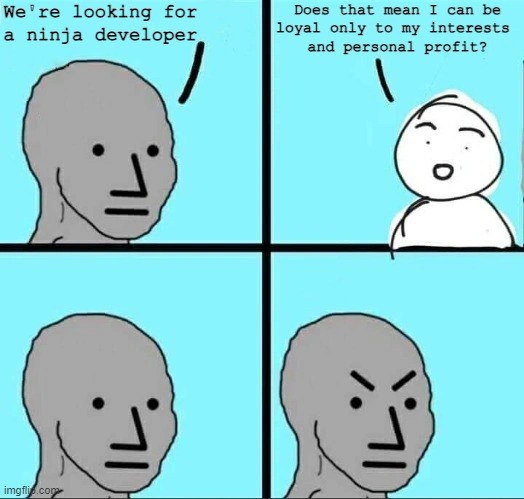
Let’s break down what’s happening in this meme in simpler terms. In the first panel, a recruiter (the hiring person, depicted as a grey NPC character) says, “We’re looking for a ninja developer.” This phrase is a common buzzword in tech job postings. Calling someone a “ninja” in a job ad is a trendy way to say “we want an extremely skilled developer who can do a lot of things.” It’s meant to be a compliment, implying the developer is as swift and capable as a ninja. Companies often use fun labels like this to make a job sound exciting. Similar titles you might hear are “rockstar developer” or “guru programmer,” which basically mean “a really great programmer.” These terms are not literal; there’s obviously no sword or stage guitar involved, and they don’t refer to actual martial arts or music skills. They’re just colorful ways to say “expert.”

Now, in the second panel, the candidate (person applying for the job) replies, “Does that mean I can be loyal only to my interests and personal profit?” This response is poking at the literal meaning of “ninja.” Why would the candidate mention being “loyal only to my interests”? Well, in history, a ninja wasn’t loyal to any one lord or kingdom. Ninjas were like mercenaries – people who did jobs (often spying or fighting) for whoever paid them, rather than out of loyalty or honor. So a ninja might complete a mission for gold and then move on to the next employer. By saying this, the candidate is joking, “If you want a ninja, does that mean I get to act like a mercenary who just cares about being paid and not about the company’s cause?”

This joke highlights a loyalty_vs_profit issue. The company, by using the word “ninja,” imagines a developer who will be super dedicated, working stealthily and effectively for the company’s goals (like a ninja on a mission for a master). That implies a sense of loyalty or at least commitment. But the candidate twists it: a real historical ninja would have no loyalty except to their own gain. So the candidate is basically saying, “I’ll be as committed to you as a real ninja would be – which isn’t very committed at all, unless you keep the rewards coming.” It’s a witty way to point out the mismatch in expectations.

In the last two panels, the recruiter’s face goes blank and then angry. The grey NPC face is used here to represent the recruiter being a bit robotic or unoriginal. (In internet memes, NPC stands for Non-Player Character, meaning a character that just repeats preset lines, like in a video game.) The recruiter used a trendy phrase without thinking, and the candidate’s literal interpretation caught them off guard. The blank stare in panel 3 shows the recruiter not knowing how to respond, and the angry face in panel 4 shows they’re annoyed or embarrassed. The recruiter probably meant “ninja” purely as a positive term and wasn’t expecting to have the actual meaning of the word thrown back at them. This is a classic recruiter_language_gap moment: the recruiter speaks in buzzwords, the developer hears something else entirely.

For a junior developer or someone new to these terms, here’s the scoop: calling someone a “ninja developer” is just corporate slang. It usually implies the company wants a programmer who can handle a wide variety of tasks, solve problems quickly, and maybe put in a lot of effort (even extra hours) willingly. It’s part of CorporateCulture in some places to use fun titles to attract talent or show that the team is “cool.” However, an experienced developer (a senior_engineer_perspective) might think, “Hmm, they said ninja… do they expect me to work odd hours, tackle impossible tasks alone, and be happy with just a fancy title instead of proper support or pay?” In other words, seniors have learned to read between the lines. They know that sometimes companies use words like that to gloss over real job challenges.

This meme’s joke works because it teaches a little lesson in a funny way: If a company uses a buzzword like “ninja” without understanding it, they might accidentally imply something they didn’t intend. It also highlights an employee_employer_expectation_mismatch. The employer (through the recruiter) expects the candidate to be flattered and say, “Yes, I’m a coding ninja! I will give my all for this team.” Meanwhile, the candidate (especially if they’ve been around the industry) is thinking, “I’ll do a great job, sure, but I’m ultimately here for my career, salary, and growth.” The candidate’s quip about being loyal to personal profit is a tongue-in-cheek way to remind the employer that employees have their own interests too.

In summary, the meme is showing the contrast between hype and reality in hiring. The term “ninja developer” (hype) meets a real-world logical interpretation (reality), and it causes a funny conflict. It’s a lighthearted way to say: fancy labels won’t trick savvy developers, and if you ask for a ninja, don’t be shocked if they act like a ninja!

Level 3: Loyalty Not Included

This four-panel comic serves up CareerHumor with a side of cold truth. In panel 1, a deadpan recruiter NPC (the generic grey Non-Player Character meme face) drops the tired line: “We’re looking for a ninja developer.” Any veteran engineer can already hear the TechBuzzwords alarms ringing. We’ve seen this BuzzwordBingo card before – companies trying to hype a coding job with flashy titles like “ninja,” “rockstar,” or “guru.” It’s meant to imply an elite developer who eats impossible tasks for breakfast and stays fiercely loyal to the mission.

But then comes the twist in panel 2: the cheerful candidate asks, “Does that mean I can be loyal only to my interests and personal profit?” 🔥 Ouch. That one-liner is a shuriken of sarcasm straight to the heart of the job ad. Why is it so effective? Because it weaponizes the company’s own metaphor. In real history, ninjas (shinobi) were essentially mercenaries – spies and assassins for hire. They had skills and secrecy, yes, but loyalty was not part of the package; a ninja served whoever paid them best. By literally interpreting “ninja developer” as “mercenary coder,” the candidate exposes the brand-reality gap in the recruiter’s request. The company was hoping “ninja” would mean “ultra-dedicated 10x engineer who lives and breathes code for us,” but the candidate flips it to “hired gun who will disappear as soon as a better offer comes.” That stark contrast lands like an exploding smoke bomb.

Now the humor really lands because it’s painfully relatable. Panel 3 shows the recruiter’s blank stare – their script wasn’t prepared for this. Panel 4, the NPC’s brows furrow in anger, effectively saying, “Hey, that’s not what I meant!” Too late. The buzzword backfired. We’re witnessing a classic recruiter language gap: corporate HR lingo colliding with an engineer’s literal, cynical translation. Seasoned devs are chuckling because we’ve all rolled our eyes at postings seeking “code ninjas” or “full-stack wizards.” It’s HiringHumor 101: the fanciest titles often come from companies with, shall we say, less-than-fancy salaries or expectations of round-the-clock devotion. The meme calls out that disconnect in one perfect zinger.

Let’s decode a few of these job-title buzzwords that get thrown around, and how a jaded developer might read them:

Buzzword Title Recruiter Intends Cynic Reads
Ninja Developer Versatile, stealthy problem-solver; works magic quietly behind the scenes Mercenary coder for hire; loyalty ends with the paycheck
Rockstar Programmer Brilliant superstar who will dazzle the team and 10x the project Egotistical solo act; might show up late and smash a keyboard or two (rockstar lifestyle 🤘)
Guru Engineer All-knowing tech sage who can guide the team with wisdom Know-it-all who speaks in riddles; not exactly hands-on when the grunt work calls

See the pattern? In each case, the CorporateCulture buzzword is meant to flatter and entice, while the seasoned engineer’s translation highlights the potential downside or literal truth. IndustryTrends_Hype like this has been around for ages – one era’s “webmaster guru” is another era’s “ninja rockstar.” Companies think these terms make a job sound exciting and ultra-skilled. But to those of us who’ve been in the trenches, it often signals employee-employer expectation mismatch. It can be a hint that the role might demand superhero-level effort without superhero-level support. No wonder experienced devs approach these listings with a healthy dose of skepticism.

The use of the NPC meme format here is spot on. The grey NPC character represents someone mindlessly repeating what they’ve been programmed to say – in this case, a recruiter parroting trendy job_ad_buzzwords without thinking through the meaning. The recruiter’s line was on autopilot; “ninja developer” probably came straight out of some HR template or BuzzwordBingo playbook. The candidate’s retort basically hacks that program by injecting real-world logic (and a senior_engineer_perspective). It’s the kind of snarky comeback that many of us have thought in interviews or team meetings when we hear meaningless jargon, but wouldn’t dare say out loud if we want the job. The meme lets us live vicariously through that bold truth-telling moment.

Ultimately, this comic nails a truth about CorporateCulture in tech: if you’re going to use a fancy metaphor to hype up a role, be ready for it to be taken to its logical conclusion. Tech veterans know that at the end of the day, employment is a transaction. Companies talk about “family” and “loyalty,” but layoffs and turnover tell a different story. So when a recruiter asks for a “ninja”, an experienced developer might indeed be thinking, “Sure, I’ll solve your problems like a silent assassin... and then slip away to the next mission if it suits me.” The joke lands because it flips the power dynamic: the company’s cheesy attempt to inspire loyalty is met with the developer’s mercenary mindset. It’s a humorous reminder that buzzwords can mask reality, but they can’t escape it. And if you call for a ninja, you just might get one – loyalty not included. 🥷💼

Description

Four-panel NPC comic on a cyan background. Panel 1 (top-left): grey, expressionless NPC head says, “We’re looking for a ninja developer.” Panel 2 (top-right): a simple white, round-headed figure smiles and asks, “Does that mean I can be loyal only to my interests and personal profit?” Panel 3 (bottom-left): NPC stares blankly. Panel 4 (bottom-right): NPC now has angry, furrowed eyebrows. The humor skewers corporate job ads that deploy buzzy titles like “ninja” to signal elite dedication while ignoring that a historical ninja was, in fact, a contract killer for hire - spotlighting the brand-reality gap veteran engineers roll their eyes at

Comments

14
Anonymous ★ Top Pick If you advertise for a “ninja,” don’t act surprised when they refactor your monolith at 2 a.m., send an invoice in kanji, and vanish after a `git push --force`
  1. Anonymous ★ Top Pick

    If you advertise for a “ninja,” don’t act surprised when they refactor your monolith at 2 a.m., send an invoice in kanji, and vanish after a `git push --force`

  2. Anonymous

    After twenty years of watching "ninja rockstar unicorn" job posts, I've realized they want someone who works in the shadows for feudal lord compensation while they keep all the venture capital loot

  3. Anonymous

    Ah yes, the 'ninja developer' - because nothing says 'we value work-life balance and reasonable expectations' quite like comparing your job opening to a feudal-era assassin who worked in the shadows, had no personal life, and whose primary loyalty was to whoever paid them. The candidate's response perfectly captures the cognitive dissonance: if you want someone with ninja-level skills who works for equity and 'passion,' you're essentially asking for a mercenary who optimizes for personal gain - which is exactly what senior engineers do when they job-hop every 18 months for 30% raises. The recruiter's angry silence in the final panel? That's the sound of someone realizing their job posting just got deconstructed by someone who actually read it literally

  4. Anonymous

    A JD that says “ninja” is a code smell for principal - agent misalignment; unless compensation is strongly consistent (cash now), expect eventual consistency in my loyalty

  5. Anonymous

    If you post for a “ninja developer,” don’t be shocked when they apply Kubernetes scheduling to their career - if incentives aren’t sticky, the pod reschedules to a higher‑paying node

  6. Anonymous

    Recruiters want ninja devs for unwavering loyalty; candidates hear 'mercenary contractor' - stealthily optimizing for the highest bid

  7. @l94888u 3y

    What does it mean originally? When I see ninja in the context of programming I only think about the build system with this name

    1. @BotMike 3y

      "Ninja Developers don’t limit themselves to just one programming language or one technology stack; they are ‘developer polyglots.’ The Ninja is an expert in a particular programming language, but is comfortable using any other language. They know how to navigate the various stacks in order to solve whatever technical challenge they come across." © a random website

  8. @BotMike 3y

    i.e. a regular programmer

    1. @AlexAparnev 3y

      programmer crushing prod without been detected is better fits into term "ninja developer"))

      1. @SamsonovAnton 3y

        I thought ninja developers just work remotely and thus cannot be seen by collegues — they can only be observed indirectly through their contributions.

        1. @AlexAparnev 3y

          sounds like dark matter)

    2. @theu_u 3y

      Yeah, the funniest thing is that non ninjas simply does not exist or cant afford buying food

  9. @Vlasoov 3y

    Dude just needs to look on contributors: https://github.com/ninja-build/ninja

Use J and K for navigation