AI Apocalypse Hype vs. My Model's Identity Crisis
Why is this AI ML meme funny?
Level 1: Big Fear, Small Problem
Imagine you have a little kitten and your friend is suddenly convinced this kitten will grow into a giant lion and gobble up the whole neighborhood. They’re yelling and terrified: "This tiny cat is going to destroy the world!" Sounds silly, right? You know the kitten is harmless and still learning how to behave. In reality, you’re just trying to teach it not to scratch the couch or knock over its water bowl. Your friend’s fear is huge and wild (a city-destroying lion!), but your actual problem is small and ordinary (a naughty little kitten).
This meme is just like that scenario. Some people are freaking out about an imaginary evil AI taking over, while the poor programmer is just dealing with a simple mix-up – his computer program can’t even tell a cat from a dog correctly. The joke is funny because of that big difference: one side imagines a monster that isn’t there at all, and the other side is dealing with a tiny everyday mistake. The fear is enormous and far-fetched, but the reality is simple and a bit silly.
Level 2: Teaching AI the Difference
Let’s break down what’s happening in the meme for those newer to machine learning. On the left side, people are yelling about AI destroying the world. They probably got this idea from sci-fi movies or sensational news articles. On the right side, we have the reality for an AI developer: an AI program that’s supposed to tell cats and dogs apart is making a silly mistake. It looked at a picture of a cat and said “Dog.” This is a very down-to-earth problem in AI – nothing to do with evil robots, just a computer program messing up a basic task!
The AI in question is likely a neural network, which is a type of program loosely inspired by the human brain. You feed it a bunch of labeled examples (say, thousands of cat photos and dog photos, each tagged with the correct answer “cat” or “dog”), and it “learns” patterns from those. After this training, you give it a new image and ask it to predict the label. This process is called image classification because the program is classifying an image into a category. When it works, it’s pretty cool — show the model a new cat photo, and it will often say “Cat” with high confidence. But when it doesn’t work, you get funny errors like the one in the meme.
So why might a neural network call a cat a dog? A few common reasons:
- Training data issues: Maybe the data used to train the AI had some mistakes. If some cat pictures were accidentally labeled as “dog” in the training set, the AI can get confused. Or maybe it just didn’t see enough variety of cat images. If it saw mostly brown cats during training, then a white cat (like the one in the meme) might throw it off, and it guesses “dog” because it’s seen more dogs of that color.
- Bias in learning: Neural networks look for patterns, but sometimes they pick up wrong patterns. For example, if many dog photos during training had a green background (grass) and many cat photos had indoor backgrounds, the AI might weirdly think “green background = dog”. So if it sees a cat sitting on a lawn, it might wrongly label it as a dog because of the grass! This kind of learned bias isn’t the AI’s fault — it just reflects quirks in the training data.
- Overfitting: This is a fancy term that means the model memorized its training examples too closely and isn’t generalizing well. It’s as if a student only memorized answers to specific practice questions — if the exam question is slightly different, they get it wrong. If our AI memorized the specific dogs and cats it saw during training, anything that doesn’t match those memory patterns might fool it. Overfitting often leads to weird errors on new data, like mixing up animals it hasn’t seen before.
Now, the developer’s job (as shown by the right panel caption “Me wondering why...”) is to debug this AI model and figure out what went wrong. Debugging an AI model is a bit different from debugging normal code. With regular software, a bug might be a mistake in a line of code that you can fix once you spot it. With a neural network, the "mistake" isn’t in an obvious line of code – it’s somewhere in the millions of internal numbers (weights) that the model learned, or in the data that trained it. So how do we tackle it? We might:
- Check the data: Are the labels correct? Do we have enough cat images and dog images, and are they diverse enough? Often, improving the dataset (fixing labels or adding more examples) can help.
- Tune the training: Perhaps train the model for more epochs (iterations), or use a different architecture, or adjust parameters. For example, we might use techniques to prevent overfitting (like regularization or data augmentation – basically tricks to make the model generalize better rather than memorize).
- Inspect the model’s attention: We have tools that let us see which part of the image the neural network was focusing on. If we use one of these and discover the model was looking at the salad in front of the cat and not the cat itself, that would explain things! (Maybe in the training data, lots of dog photos were outdoors or near green plants, and the model associated greenery with dogs.) If we know what misled it, we can try to fix it – maybe by retraining with more balanced data or adjusting the model.
To illustrate how such a mistake might appear in code, imagine we have a function classify_image that should tell us if an image is a cat or dog:
result = classify_image("white_cat_with_salad.jpg")
print("The model thinks this is a:", result)
# Expected output: "Cat"
# Actual output: "Dog" 🐕🤦♂️
In this pseudo-code, we fed the image of the white cat from the meme into our model. We expected it to say "Cat", but it printed "Dog". The little dog emoji and facepalm are how an AI developer feels in that moment! It’s not the end of the world – it just tells us our model isn’t as smart as we hoped yet, and we have more work to do.
This meme’s punchline is actually a teaching moment: it reminds us that current AI has limitations. It can do some tasks well (like recognize lots of images correctly) but it’s far from perfect and certainly not some magical brain that understands everything. So when someone with no tech background is screaming, "Your AI is going to destroy humanity!", the ML engineer is probably thinking, "I wish it were that advanced – meanwhile, I’m over here trying to get it to simply tell a cat from a dog!"
In short, the left side of the meme shows an exaggerated fear (people worrying about an AI like it’s a sci-fi villain), and the right side shows the funny reality (the AI can’t even get a simple cat vs. dog problem right). The humor comes from that huge gap between what people think AI is and what AI is actually doing in real life. Even a basic machine learning model can make goofy mistakes, so we’re definitely not at the stage of an AI apocalypse anytime soon!
Level 3: The Cat-Dog Confusion Matrix
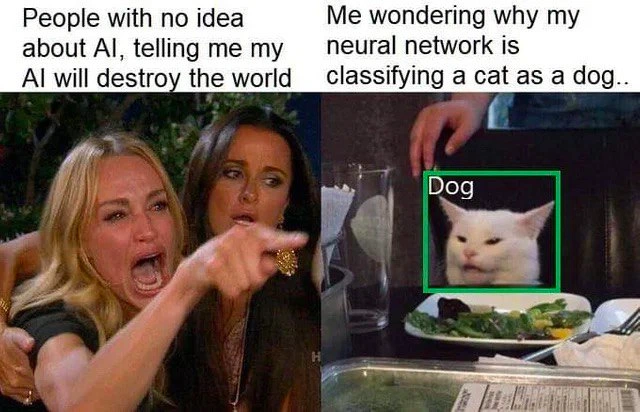
For anyone who has spent time building or debugging machine learning models, this meme hits a nerve. It perfectly contrasts AI hype vs reality. On the left, we have people (often non-technical stakeholders or the general public) dramatically freaking out about AI doom – basically imagining your work is the next Skynet. On the right, we have you, the developer, staring at a trivial yet stubborn bug: your neural network thinks a cat is a dog. The meme repurposes the famous woman yelling at a cat format to exaggerate this disconnect. The furious pointing woman represents the uninformed hysteria ("Your AI will destroy us all!"), while the calm, confused white cat at the dinner table represents the ML practitioner (or the model itself) facing a mundane classification flop. The cat even has a green detection box labeled "Dog" around its face, a visual nod to a typical computer vision fail. It’s both frustrating and comical – essentially a cat-astrophe (pardon the pun) for our poor model’s accuracy. In fact, it’s exactly the kind of image you'd find on a developer humor forum: a supposedly smart classifier making a dumb mistake.
In the daily life of AI/ML engineers, this scenario is all too familiar. We’re not busy containing an evil intelligence – we’re usually combing through training data trying to figure out if some mislabeled images or weird biases are causing these errors. The humor here comes from shared experience: everyone in computer vision has had that "why on Earth is it calling this a dog?!" moment. Maybe the model was trained mostly on dog photos and only a few cat photos, so it's biased to blurt out "dog" whenever it’s unsure. Maybe somebody on the data labeling team accidentally tagged a bunch of cat images as "dog" (oops!). Or perhaps the network architecture isn't capturing the right features: for example, it might key off fur color or background scenery rather than the actual shape of the animal, leading to mistakes when those factors differ. This is a classic AI limitations story: even with lots of data and fancy algorithms, neural nets can be brittle and surprisingly stupid about edge cases.
The confusion matrix reference in the level title is a wink at how we evaluate classifiers. A confusion matrix is basically a table showing how often the model confuses one class for another. A good model would have high numbers on the diagonals (cat→cat, dog→dog) and low numbers off-diagonal (cat→dog errors, dog→cat errors). Seeing "cat classified as dog" is literally one of those off-diagonal mistakes – a goof we aim to minimize, but one that inevitably shows up. And it's funny because while we’re agonizing over that last 1% of accuracy (getting rid of those mistakes), people out there are worrying about AI going 100% rogue.
The meme underscores an AIHypeVsReality gulf that senior developers know well. In meetings or family gatherings, we often have to temper expectations: "No, Grandma, my pet detector app isn't going to suddenly decide to launch the nukes. It can barely tell Fluffy apart from Fido." There’s an almost cathartic relatability in this image. We chuckle because we’ve been on the receiving end of both sides: the alarmist questions from non-tech folks and the head-scratching frustration at a neural network’s silly bug.
It's also a nod to how debugging bugs in AI is very different from debugging traditional software. You can’t step through the code with a debugger in the usual way to find a single wrong line; instead, you have to play detective with data and statistics. For example, you might notice the model performs fine on normal cat photos, but consistently messes up on cats that are photographed in strange lighting or from an odd angle. A senior engineer might suspect overfitting immediately: perhaps the model learned dogs always appear outdoors in the training set, so an indoor animal seems unfamiliar and it guesses “cat” or vice versa. Or they might suspect a training data bias: maybe the label "Dog" was far more common in the dataset, so the model developed a habit of over-predicting "Dog" for anything vaguely ambiguous. These are patterns we've seen time and again in the field.
By pointing out the absurd contrast (end-of-the-world predictions vs. a mis-labeled cat), the meme is also quietly poking fun at the tech narrative. We’ve all seen breathless headlines like "AI Beats Humans At X, Y, Z!" or Hollywood scenes of AI turning evil overnight. But the day-to-day reality? It’s more like:
"Model v3.2 – still thinks cat is dog, need to gather more data and double-check the augmentation pipeline."
The humor here is both laughing at ourselves (for how far we are from sci-fi AI) and at the hype (for not understanding what current AI actually is). A seasoned developer knows that progress in AI is real but incremental – and often pretty messy. There’s no big red button that suddenly grants your model world domination capabilities. More often, there’s a Jupyter notebook with dozens of experiments trying to fix one stubborn misclassification.
In the end, this meme resonates because it captures a kind of cognitive dissonance in the AI world. It says: while outsiders fear an AI Terminator, insiders are wrestling with an AI "terminology error." The only thing getting “destroyed” here is maybe our pride (like when your demo fails and the system labels the CEO’s cat as “Dog”). That gulf between what people think we’re doing and what we’re actually doing is both hilarious and humbling in the world of tech.
Level 4: Singularity vs Softmax
At the frontier of AI research and myth, we often see a dramatic gulf between what people imagine and what engineers actually wrestle with. The left panel hints at the grandiose panic about an AI singularity – the sci-fi scenario where an intelligent machine becomes so powerful it could terminate outsmart humanity. These fears, stoked by movies like The Terminator and sensational media, assume today's AI systems have a path to omnipotence. The reality in the right panel couldn’t be more contrasting: an algorithm that can’t even correctly classify a simple image of a household pet. Instead of an all-knowing Skynet, we have a convolutional neural network (CNN) struggling with basic object recognition. The meme labels the cat as "Dog" inside a green bounding box – a textbook classification error in computer vision. This isn't a genocidal robot uprising; it's a confused matrix of weights failing a Turing test for house pets.
Why does this misclassification happen at a deep technical level? Today's image classifiers use layers of neurons detecting patterns (edges, textures, shapes) and then a final softmax layer to decide the most likely label. This softmax outputs a probability distribution over classes – essentially, the network might be saying "I'm 51% sure this is a dog and 49% sure it's a cat," and thus it picks "Dog". Under the hood, it's all linear algebra: multiplying the pixel data by learned weight matrices, adding biases, and applying non-linear activation functions. If the feature representations the network learned for "cat" and "dog" overlap or are biased, slight perturbations can tip the outcome. Perhaps the model latched onto an irrelevant feature (like the shape of the salad or the color white, which might have appeared often with "dog" in training data). In machine learning theory, this touches on the bias-variance tradeoff: the model might be biased toward labeling something "dog" if it saw many more dogs during training, or it might have high variance causing unpredictable errors on new images. There’s even the concept of overfitting – maybe the network memorized specifics of its training dog images and now misgeneralizes that memory to this poor cat. Fundamentally, a CNN doesn’t truly understand what a "cat" or "dog" is; it just matches patterns it has seen before. So if our training data was skewed or our model capacity limited, the classifier’s internal representation might place this cat outside the fuzzy boundary of "cat" and into "dog" territory.
Meanwhile, the people shouting about world-destroying AI are conflating these narrow, task-specific algorithms with a hypothetical Artificial General Intelligence (AGI). The difference is enormous. Our cat-vs-dog classifier is a narrow AI – extremely limited, unable to do anything beyond its one trick, basically a clever curve-fitting system. In contrast, the feared AGI would need to reason broadly across domains and have agency, creativity, and possibly even survival instinct – qualities nothing in our real-world ML models possesses. There’s an entire field of AI safety and alignment that ponders how to ensure a super-intelligent AI’s goals align with human values. But worrying about a classifier overthrowing humanity is like worrying that your calculator will plot to take over the world because it can do multiplication faster than you. The meme humorously highlights this discrepancy: the alignment problem we ML engineers face isn’t a rebellious AI turning evil – it’s simply aligning our models’ predictions with reality (like getting it to consistently recognize a cat as a cat instead of a dog).
The technical irony is rich: contemporary neural networks are universal function approximators – in theory, they can represent incredibly complex decision boundaries given enough data and compute (thanks to proofs in the realm of the Universal Approximation Theorem). Yet, in practice, they remain fragile and domain-specific. They can defeat world champions in Go or StarCraft (narrow tasks with clear rules), but also can be tripped up by a tiny image glitch or an unusual cat at a funny angle. Researchers have shown that by adding a nearly imperceptible noise pattern to a cat image, you can fool a high-performing model into thinking that cat is, say, a guacamole or a fire truck. These are known as adversarial examples, and they expose how differently machines "see" compared to humans. For an engineer, debugging why the network calls a cat “dog” might involve diving into layers of neurons or analyzing the training dataset for flaws. But it’s not like debugging regular code – you can’t pinpoint a single line that’s wrong. Instead, you probe the model’s behavior: you might generate a confusion matrix to quantify how often cats are mis-labeled as dogs, visualize intermediate activations, or use techniques like Grad-CAM to guess which part of the image misled the network. You might discover the model is paying attention to the wrong things – maybe it learned to associate the presence of a chair or the table salad with “dog” because in the training set dogs often appeared in photos with that context and cats didn’t.
Thus, on a theoretical and practical level, this meme captures a core truth in AI/ML: we are nowhere near building a doomsday AI when even our best deep learning models stumble on elementary tasks. The phrase "my AI will destroy the world" becomes almost a dark joke among practitioners — if only our models were that competent! More often, we’re the ones “destroying” things (like our sanity, or some perfectly good training data) as we iterate trying to fix these silly errors. In the end, the contrast between an imagined super-intelligent overlord and a bumbling image classifier is both a reality check and a source of sly humor. It’s a reminder that behind all the hype, real AI work is painstaking, math-and-data-driven debugging, where the scariest outcome is usually just a mislabeled cat, not the apocalypse.
Description
A two-panel meme using the 'Woman Yelling at a Cat' format. The left panel features a distraught Taylor Armstrong from 'The Real Housewives of Beverly Hills', with the text overlay: "People with no idea about AI, telling me my AI will destroy the world". The right panel shows the unimpressed Smudge the Cat at a dinner table. A green object detection bounding box is drawn around the cat, incorrectly labeling it as "Dog". The text above this panel reads: "Me wondering why my neural network is classifying a cat as a dog..". The meme humorously juxtaposes the grandiose, often dystopian public perception of artificial intelligence with the mundane and frustrating reality faced by developers. While outsiders fear a super-intelligent takeover, the practitioner is stuck debugging a fundamental classification error, highlighting the significant gap between AI hype and its actual capabilities
Comments
7Comment deleted
The world is worried about general AI achieving consciousness, but I'll only be impressed when my image classification model can tell the difference between a cat and a dog without needing a dataset the size of the Library of Alexandria
Management keeps pitching “Skynet by next quarter,” and I’m still wrestling with a confusion matrix that labels every cat as a dog - let’s hit double-digit recall before we schedule the apocalypse
After 20 years of explaining why my model needs more than 10 training samples, I'm now explaining why it can't tell a cat from a dog despite having 10 million samples
When stakeholders are worried about your AI achieving sentience and taking over the world, but you're still trying to figure out why your ResNet thinks every white fluffy thing is a Samoyed. Turns out the real existential threat isn't AGI - it's explaining to management why you need another three weeks and a better labeled dataset to distinguish cats from dogs with >95% accuracy
Doomers fear Skynet; I fear the day my convnet finally learns ginger cats aren't retrievers - after three epochs of data drift
Everyone’s worried AI will destroy the world; mine just destroys the confusion matrix - thanks to shortcut learning, a dinner plate makes every cat a dog
Before we worry about alignment, I just want a classifier that survives train/serve skew and stops giving 0.98 ‘dog’ to a cat because the salad became a spurious feature