Just One More LLM Bro I Promise We'll Achieve AGI
Why is this AI ML meme funny?
Level 1: Bigger Isn’t Always Better
Imagine you want to solve a small problem, like cleaning a little spill on the floor. Instead of using a paper towel, you decide to build a giant cleaning robot that’s as big as a house. You tell your parents, “I promise, just let me build this one more huge robot and we’ll never have to clean again!” You spend tons of time, use up all the electricity, and make a huge machine that circles around the whole neighborhood. In the end, yes, the robot cleans the spill – maybe a few seconds faster than you could have done it by hand. 🤖✨ But was it worth it? You went through all that trouble and used so many resources, just to save a few seconds.
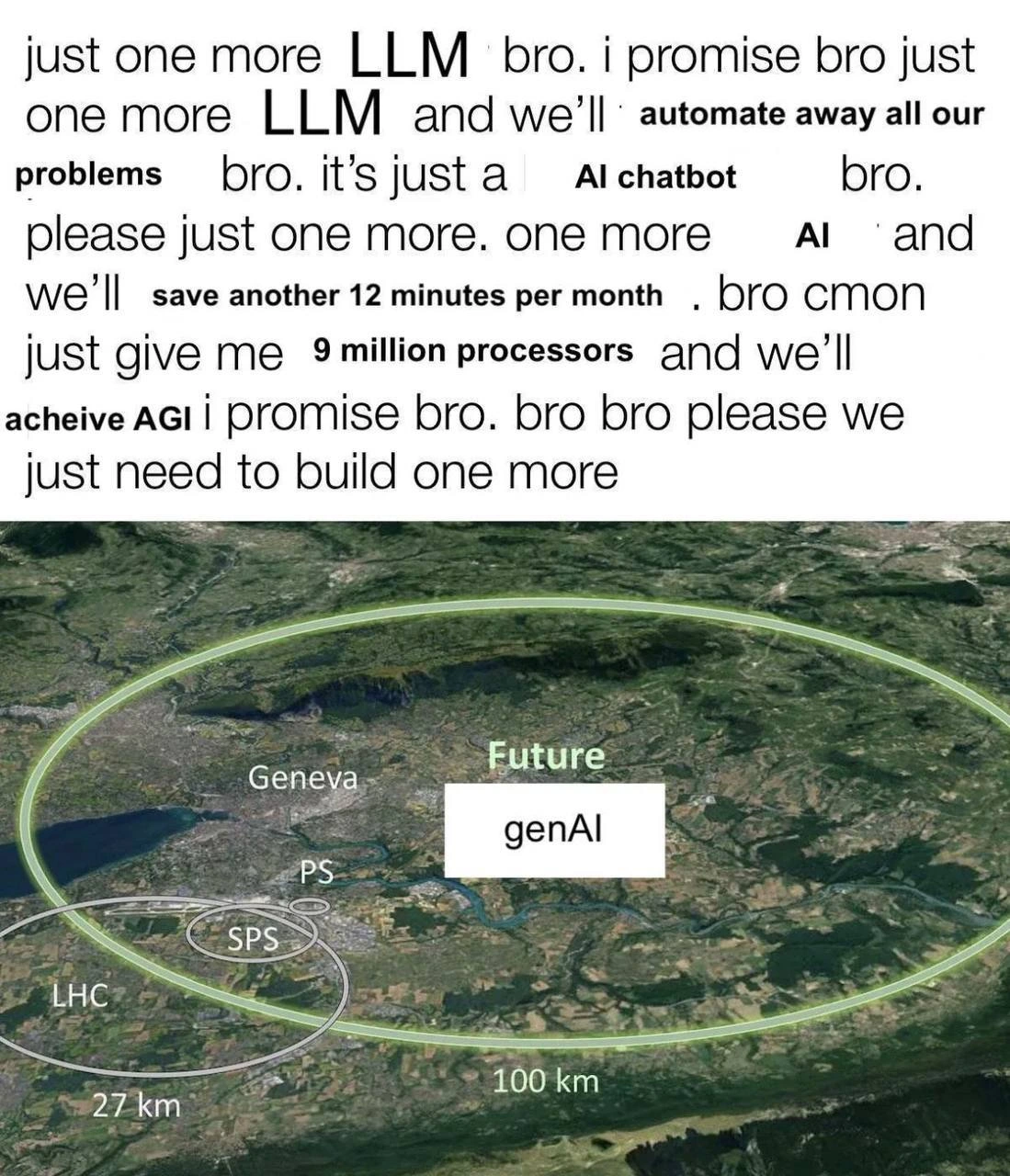
This meme is joking about the same kind of silly situation, but with computers and AI. It’s saying some people always want a bigger and more complicated computer program (an AI) to solve problems, even if it only helps a tiny bit. They keep saying “just one more, just a little bigger!” like someone who keeps asking for a bigger vacuum to clean a tiny mess. The top part with all the text is that person begging for a bigger solution (“bro, just one more, I promise it’ll fix everything!”). The bottom picture shows an enormous circle (100 km around!) drawn on a map, which is a ridiculously big machine for AI. It’s like drawing a plan for a cleaning robot as big as a whole city.
The funny (and simple) message is: bigger isn’t always better. Sometimes people get carried away, trying to use an insanely big tool to solve a small problem. It makes us laugh because it’s obviously over-the-top. Just like you’d laugh if someone built a rocket to go to the grocery store, we laugh at the idea of needing a city-sized computer to save a few minutes of work. In real life, it reminds us to be practical: the biggest solution isn’t always the smartest one, especially if it’s only giving a tiny benefit.
Level 2: Hype Buzzwords Unpacked
Let’s break down the meme in simpler terms, especially if you’re not deeply familiar with the jargon:
- LLM (Large Language Model) – This is a type of AI model that’s trained on tons of text data. Think of models like GPT-4 or other chatbots that can generate human-like text. They’re “large” because they have billions of parameters (settings learned from data). In the meme’s text, the guy keeps saying “one more LLM” as if adding another gigantic text-processing AI to the mix will solve everything. It’s like saying “one more super-smart chatbot and all our problems go away.”
- “Automate away all our problems” – Automation means using technology to do tasks so people don’t have to. The meme jokes that someone is claiming a chatbot or AI can automate all their problems. That’s a huge exaggeration. In reality, you might automate a specific task (like scheduling meetings or filtering emails), but you can’t just automate everything magically with one chatbot. This phrasing highlights the AIHype – the overpromise that AI will instantly fix everything.
- “Just a AI chatbot” – Probably meant to read “just an AI chatbot.” The speaker is downplaying what they’re asking for, as if it’s no big deal: “It’s just an AI chatbot, bro.” In truth, building and running a sophisticated AI chatbot is a big deal – it’s complex and expensive. But hype-guy talks about it like it’s as casual as asking for a cup of coffee. That contrast is part of the humor.
- Save “another 12 minutes per month” – This line is a sarcastic jab at the results. It implies that after deploying some fancy AI, the net gain was only 12 minutes saved per month. That is barely anything! By quoting such a trivial time saving, the meme emphasizes how the benefit of these big AI projects can be ridiculously small compared to what was promised (or compared to the effort invested). It’s highlighting marginal_productivity_gains – a fancy term for “a very small improvement in productivity.”
- Processors and GPUs – The meme mentions “9 million processors.” Processors (CPUs) or GPUs (graphics processing units used for AI) are the hardware that runs these models. Modern AI models often need thousands of GPUs working in parallel to train in a reasonable time. Saying millions is an exaggeration to be funny, but it hints at how crazy the resource demands have become. In real life, we talk about needing maybe a few hundred or a few thousand top-tier GPUs for cutting-edge model training. The meme character asking for 9 million is like a child asking for the moon – it’s intentionally over-the-top to mock the compute_budget_bloat (meaning budgets for compute power getting out of hand). There’s also an irony here: lately there’s been a GPU shortage – so many people want GPUs for AI (and gaming, and crypto before) that it’s hard to get them. So imagine someone asking for millions of them when companies struggle to acquire just tens or hundreds; it’s comically unrealistic.
- AGI (Artificial General Intelligence) – This is the big dream in AI: a machine that can understand or learn any intellectual task that a human can, essentially a truly general, smart AI (like you see in sci-fi movies). We do not have AGI yet; current AIs are narrow (good at specific tasks they were trained on, not good at everything). In the meme, the person says “we’ll achieve AGI, I promise bro.” That’s highlighting how every new AI breakthrough claims to be a step toward this grand goal, sometimes overhyping what it can actually do. It’s the ultimate promise that people throw in to justify massive projects: “Sure, it’s expensive, but it might lead to AGI!” The meme is winking and saying, “Haven’t we heard that a bit too often?”
- Geneva map & CERN rings – The bottom image is a real satellite view of the area around Geneva, Switzerland. CERN is located there – that’s the European Organization for Nuclear Research, famous for huge particle accelerators. The gray rings labeled “LHC 27 km”, “SPS”, “PS” are actual accelerator rings (the LHC is the Large Hadron Collider, a 27-km circular tunnel where particles are smashed together at high speeds for physics experiments). The meme adds a giant green ring, 100 km in circumference, labeled “Future genAI”. This is a parody of proposals to build a Future Circular Collider (a real concept in physics) – but here they’ve relabeled it for genAI (generative AI). Essentially, it jokingly suggests building a 100-kilometer wide computer for AI. This absurd visual gag conveys how each new generation of AI projects seems to require a bigger and bigger scale, almost as if we will need something as grand as a new collider to support them.
- “Future genAI” – “genAI” stands for generative AI, which is the type of AI that creates content (like text, images, etc.) – for example, ChatGPT, DALL-E, Midjourney are generative AIs. By calling it Future genAI, the meme implies a future project dedicated to generative AI that’s as massive as CERN’s future collider. It’s a way to poke fun at both the ambition of AI projects and the tendency to always look to the “next big thing.”
- exascale_training – The term exascale refers to computing systems capable of at least $10^{18}$ operations per second (that’s a billion billion operations). “Exascale training” would mean training AI models on computing platforms of that unbelievable power. This is relevant because only extremely large supercomputers (often government-funded or corporate mega-clusters) even approach exascale. The meme’s ask for millions of processors and a 100-km facility hints that to get the next improvement, we’d need exascale-class (or beyond) computing. It’s like saying “Yeah, we might need the next NASA-sized computer project to train our next AI.” For a junior developer or someone new to these terms: exascale is just a way to say “really, really huge computing power.”
- Hype vs Reality – The overall joke is about the difference between what hype promises and what reality delivers. AIHypeVsReality is even one of the tags. In simple terms: some people talk as if AI is magic and will do everything (“hype”). But when you actually build and deploy it, you often get only a small benefit, and sometimes new headaches (“reality”). This meme uses exaggeration to make that clear. The excited text is the hype (promising world-changing outcomes with just a bit more AI), and the absurd image of a 100-km machine for a tiny productivity gain is the reality check (that it’s overkill).
Think of it this way: the meme is a cautionary joke. It’s telling us, “Look how crazy it sounds to keep pushing for a bigger solution without questioning the payoff.” For a junior dev, it’s a humorous introduction to the idea of over-engineering – solving a problem in such a complicated, over-the-top way that it’s laughable. If you’ve just started in tech, you might not have seen a 100-km collider proposal 😄, but you might have seen smaller examples: like using a super fancy 10-framework stack to build a simple website. The meme is that idea blown up to gigantic proportions using AI as the context.
In summary, this meme is explaining (with humor) that chasing the next big AI relentlessly can get ridiculous. It’s laden with buzzwords – LLM, AGI, genAI – but it’s actually making a pretty down-to-earth point: We should be mindful of diminishing returns. Every new model or system we add should ideally give us a significant benefit. If we’re at the point of asking for “millions of processors” to save “minutes per month,” maybe we’ve lost the plot. It’s a lesson that bigger isn’t automatically better, wrapped in satire. And importantly for newcomers: don’t be intimidated by the buzzwords; here they’re deliberately overblown to make you laugh. The seasoned devs are laughing with you at how absurd it sounds when you lay it out like this.
Level 3: Collider-Class Overengineering
“just one more LLM bro. i promise bro just one more LLM and we’ll automate away all our problems bro... please just one more. one more AI and we’ll save another 12 minutes per month... bro c’mon just give me 9 million processors and we’ll achieve AGI i promise bro...”
This chaotic plea flooding the top half of the meme is instantly recognizable to seasoned engineers. It’s the voice of the hype-driven tech bro, turned up to 11. We’ve all met that colleague (or that startup founder) who insists the next new technology will solve everything. The meme humorously condenses that persona: he’s practically begging — “just one more AI model, just a few more GPUs, trust me bro!” — like an addict chasing the next fix. The experienced folks reading this are nodding (or facepalming) because they’ve sat through meetings or pitches exactly like this, minus the explicit “bro” perhaps. The promise “we’ll automate away all our problems” is a huge red flag; it screams AIHype and oversimplification. Senior engineers know that automating even one complex task is hard, let alone all our problems. And yet, in the real world, it’s common to hear something only slightly less absurd: “If we just integrate AI here or build our own LLM, we could eliminate this whole category of work!” Spoiler: it rarely pans out that perfectly.
The meme zeroes in on overengineering in pursuit of marginal gains. The bottom image featuring CERN’s accelerator rings (the LHC, SPS, PS) with a gigantic “Future genAI” ring drawn around them is a brilliant visualization of over-the-top solutions. It’s saying, “Look how ridiculous this is getting — we’re proposing collider-class infrastructure to run our machine learning.” To a senior dev, this immediately brings to mind all the times a solution’s complexity was out of proportion to the problem. It’s like using a rocket launcher to kill a fly. In software terms, perhaps someone suggested refactoring a simple script into a distributed microservice architecture with five databases just in case of future scale, when in reality it never needed that complexity. Here, the “100-km AI collider” is that overkill scenario: an insanely big system to maybe save “12 minutes per month” of work. That figure – 12 minutes a month – is so deliberately trivial it makes us laugh. We can almost hear the senior engineer in the room asking, “We’re spending how much to save what, exactly?”.
This resonates strongly in today’s IndustryTrends_Hype context. Many companies have been caught in the AI gold rush, pouring resources into ever-bigger models because it’s trendy, without a clear ROI. A senior dev might recall how, after GPT-3’s release, every product suddenly needed “GPT inside” – whether or not it made sense. Maybe your project manager said, “We can reduce support tickets if we put a chatbot on it, let’s use the biggest model!” Next thing you know, you’re provisioning a cluster of A100 GPUs for a customer service bot that ends up slightly better than the old FAQ page. Hype_vs_Reality moments like these are exactly what the meme is lampooning.
Let’s break down the specific elements that seasoned engineers chuckle at:
- “Just one more LLM” – The implication that we’ve already added several AI models and none solved everything, but hey, one more will do it. This is a classic silver-bullet fallacy. It’s like a developer saying “just one more library/framework and the app will be perfect,” repeated ad nauseam.
- Promises of automating everything – Bold claims, usually made by someone who doesn’t have to implement or maintain the system. We’ve learned to be wary of “automate all our problems.” It often ends with a half-baked script or model that covers 5% of cases and breaks on the rest, while the team now has an extra system to babysit.
- “Just give me 9 million processors” – An outrageous ask that highlights the compute_budget_bloat issue. Seniors recall how requests for resources balloon: a prototype runs on one machine, the production version needs a hundred, the next version asks for a thousand GPUs. It escalates quickly. Nine million processors is obviously hyperbole (no one really has that, outside of maybe global distributed networks), but it mirrors how each new state-of-the-art AI demands more CPUs/GPUs than the last. There’s humor in the honesty: yes, it feels like they’re asking for millions of cores sometimes!
- “We’ll achieve AGI, I promise” – Ah, the agi_promise_pitch. Every few years someone claims their system is on the verge of true general intelligence, just fund it a bit more. Senior folks have seen AIHype cycles come and go (remember the AI winter? the expert systems hype? more recently, how self-driving was “3 years away” for a decade). So an excited promise of imminent AGI sets off our skepticism. The meme uses it ironically – the over-eager character promises the moon to justify his extravagant ask.
Now, the imagery of the collider rings around Geneva: that’s a nod to how in scientific research, bigger projects yield smaller incremental discoveries. The Large Hadron Collider was built to find particles like the Higgs boson. Success! But if we want new physics now, some propose an even bigger 100-km collider for marginal gains (if any). In the software/dev world, a senior engineer reads that and thinks of huge refactors or infrastructure overhauls that promised big improvements but delivered marginal benefits. It’s “collider-scale” overengineering indeed. Crucially, seniors know that maintaining such a beast is a nightmare. A collider-scale AI system would be incredibly complex to keep running: distributed compute, specialized cooling, network latency issues, constant hardware failures – an on-call rotation from hell. The meme doesn’t spell that out, but we feel it implicitly. It’s the gpu_shortage_irony too: after you agree to build this monster, good luck actually buying those GPUs or keeping them from melting down. We’ve seen even modest ML pipelines get out of hand with costs and reliability; a project of that scope would be a money pit and a single point of failure the size of a city.
In sum, this level (Level 3) analysis is seeing the meme as a send-up of tech’s overengineering culture and the wild AI hype cycle. It’s funny because it’s true-ish: behind the exaggeration, real teams have indeed chased giant models for tiny gains. The meme exaggerates to remind us how absurd it looks from the outside. A senior developer might laugh, but also sigh, remembering a time they had to deploy a massive Kubernetes cluster for an “AI initiative” that didn’t pan out, or when they watched budget get burned on GPU instances for a project that could have been a simple cron job. GenerativeModels and AI tools are powerful, but they’re not magic – and this meme is a cathartic acknowledgment of that reality. It’s basically the engineering equivalent of someone saying, “We built a spaceship to go to the corner store,” and all the experienced folks shaking their heads at the overkill.
For a quick visual summary of the hype vs. reality at play, consider:
| Grand AI Plan | What’s Promised (Hype) | What Actually Happens (Reality) |
|---|---|---|
| “One More Huge LLM” – Train the next giant model | “It will solve everything! Maybe even write all our code.” | Slight quality improvement in responses; still makes mistakes, needs human oversight |
| “Add Millions of GPUs” – Throw hardware at it | “Unlimited automation and productivity!” | Unlimited budget burn 🔥 and ops complexity, for a modest speed-up in one workflow |
| “Build a 100-km AI Collider” – Moonshot project | “True AGI, a revolution in tech!” | True headache for engineers maintaining it, revolutionizes the electric bill more than the business |
The table above humorously contrasts the grandiose pitches vs reality. It echoes what the meme conveys in text and image form. Ultimately, Collider-Class Overengineering is the senior perspective label for this meme: we see an absurd proposal that feels uncomfortably similar to real situations where hype-fueled projects grew out of control. And we laugh (perhaps a bit bitterly), because we’ve lived through scaled-up solutions that outpaced their actual usefulness. The meme is a gentle reminder: just because we can scale something to extreme sizes doesn’t always mean we should. Sometimes the most senior engineering move is to say, “No, bro, we actually don’t need one more LLM – let’s optimize what we have.” 😉
Level 4: The AGI Asymptote
At the cutting edge of AI research, there’s a belief that scaling up LLMs (Large Language Models) will eventually unlock something akin to general intelligence. This meme pokes fun at that idea by cranking it to absurd levels. In theoretical terms, the pursuit of AGI (Artificial General Intelligence) via brute-force scaling follows an asymptotic curve: each increase in model size or compute yields ever smaller improvements. According to published LLM scaling laws, if you double the number of parameters or training data, you might see performance improve, but not double – more like a tiny incremental bump. The returns diminish as you approach an invisible ceiling (the AGI asymptote). The top text’s frantic “just one more LLM... we’ll automate away all our problems bro... achieve AGI i promise bro” is a tongue-in-cheek reference to the notion that emergent abilities will magically appear if we just go 10× bigger. It’s humor by way of exaggeration: as if the holy grail of AI is always one more colossal model away, receding like a mathematical limit we never quite reach.
To even attempt this next giant leap, one would need exascale_training capacity – that is, the ability to perform on the order of $10^{18}$ operations per second. We’re talking computing power that only the world’s top supercomputers are just beginning to achieve. Training a state-of-the-art LLM already takes petaflops of compute over weeks; the meme jokingly asks for “9 million processors,” hinting that a future model might demand a globally distributed cluster of GPUs/TPUs so massive it rivals the infrastructure of big science projects. In fact, the bottom image overlaying a 100 km green ring around Geneva is a riff on CERN’s Large Hadron Collider (LHC) (which is “only” 27 km). This satirically proposes a “Future genAI Collider” – a computing facility so vast that it circles a city. The comparison isn’t just visual hyperbole; it underscores how crazy the scaling has become. Just as experimental physicists plan ever-bigger colliders to smash particles at higher energies, AI labs keep stacking more layers and more nodes to crunch data at higher scales, chasing diminishing rewards. The meme punches up the absurdity: a collider-size computer to train an AI that maybe writes emails 5% better or saves “12 minutes per month.”
From a systems perspective, such a 100-km AI cluster would face real physical limits. Communication latency becomes a factor when your machine spans kilometers – even at the speed of light, a signal takes over 300 microseconds to go 100 km. Synchronizing millions of processors spread in a ring could bottleneck on the speed of light! It’s a playful way to hint that we’re pushing on fundamental limits (latency, bandwidth, energy dissipation) much like particle physics does. Power consumption would be astronomical: the LHC consumes ~150 MW of power; a comparably sized AI collider could draw on the same order of magnitude, considering tens of thousands of high-end GPUs sipping hundreds of watts each. Compute_budget_bloat isn’t just a financial metaphor here, it’s literal – we’d need the budget of a small nation (and its power grid) to run “one more LLM” at this scale. Researchers talk about models with trillions of parameters, but to train and run them, we’re essentially talking data center-level operations or beyond. The meme cleverly connects that dot with the CERN image: it’s saying “The way AI folks demand resources now, they might as well build a new collider!”
In academic circles, this joke touches on debates about the scaling-laws arms race. One side argues that bigger models + more data = better intelligence, following smooth power-law trends (until we hit some fundamental barrier). Another side points out the marginal returns and the unsolved problems that scale alone can’t fix (like model alignment, interpretability, or the fact that marginal_productivity_gains from automation can plateau). The line about saving “another 12 minutes per month” highlights an economic reality: you might pour millions of dollars in compute to slightly improve an AI assistant that maybe shaves a few minutes off someone’s tasks. It’s an absurd cost-benefit inversion. In theory, if AGI were truly achieved, the returns would be huge – but if each step towards it costs exponentially more for linearly smaller gains, you start to suspect AGI might be an asymptote: always approached, never fully attained, at least not by overengineering in scale alone. The meme distills this complex mix of computer science and economics into a visual gag: ever-growing compute requirements chasing an elusive goal. It’s both a nerdy nod to how scaling laws work and a skeptical jab at the idea that “one more giant push” will instantly cross the finish line to fully general AI. In short, Level 4 exposes the almost cosmic scale (literally collider-sized) of what “just one more LLM” entails, hinting that we’re flirting with the outer limits of technology and sanity for dubious payoff.
Description
Two-panel meme combining a 'just one more bro' copypasta format with an aerial view of CERN's Large Hadron Collider near Geneva. The top panel features scattered text in varying sizes reading 'just one more LLM bro. i promise bro just one more LLM and we'll automate away all our problems bro. it's just a AI chatbot bro. please just one more. one more AI and we'll save another 12 minutes per month. bro cmon just give me 9 million processors and we'll acheive AGI i promise bro. bro bro please we just need to build one more.' The bottom panel shows the CERN facility with concentric rings labeled LHC (27 km), SPS, PS, and a massive outer ring labeled 'Future genAI' spanning 100 km, implying the next AI project will require a particle-accelerator-scale facility

Comments
9Comment deleted
The next frontier of AI research: a 100km supercollider that smashes tokens together at relativistic speeds, producing exotic particles called 'useful outputs' with a half-life of one quarterly earnings call
They say the Future GenAI Collider will finally allow us to achieve AGI, or at the very least, generate boilerplate code that's only off by one dimension
Remember when particle physicists thought a 100-km ring was ambitious? Hold my H100 cluster - my business case saves twelve minutes a month
When your AI infrastructure roadmap makes particle physicists look fiscally responsible, you know you've achieved peak Silicon Valley - at least CERN actually found the Higgs boson instead of just promising it would emerge with more compute
The meme brilliantly captures the AI industry's trajectory: we've gone from 'move fast and break things' to 'build a 100km particle accelerator to save 12 minutes per month.' It's the ultimate expression of the sunk cost fallacy meets Moore's Law on steroids - where each incremental improvement in LLM capability requires exponentially more compute, energy, and infrastructure. The comparison to CERN is particularly apt: both involve massive circular structures, enormous energy consumption, and promises of fundamental breakthroughs. The difference? CERN actually discovered the Higgs boson, while we're still trying to get ChatGPT to consistently count the 'r's in 'strawberry.' The real AGI might just be the friends we bankrupted along the way trying to train GPT-7
CERN smashes particles for physics; we smash GPUs for 'just one more' parameter until the singularity or the power grid fails
Our AGI roadmap now follows collider physics: increase circumference until emergent properties appear - unfortunately CAP still applies, and the CFO isn’t an available replica
Our roadmap translates scaling laws into civil engineering: a 100 km training loop around Geneva, nine million processors, and AGI redefined as “Actually Gross Investment” to save 12 minutes per month
CERN: Comment deleted