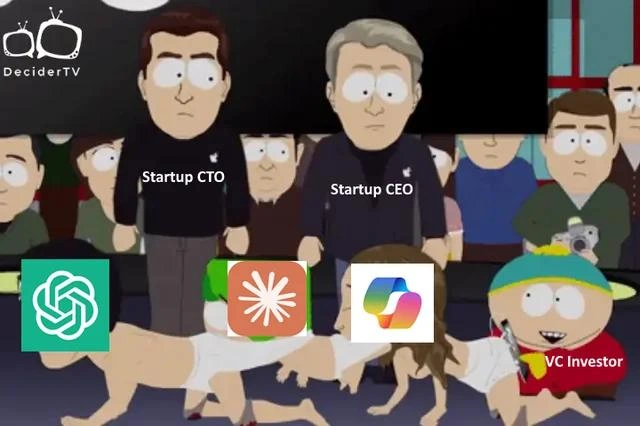
Startup CTO and CEO Showing Off AI Wrapper to VC Investor South Park Style
Why is this Startup meme funny?
Level 1: Monkey See, Monkey Do
Imagine three kids in class playing a game of copycat. The first kid writes an essay. The second kid copies the first kid’s essay almost word for word, maybe just changing the title. The third kid copies the second kid’s version and adds a fancy cover page with glitter. Now the teacher comes in, sees the third kid’s nicely presented essay with the glittery cover and says, “Wow, this is amazing! You get the prize!” 😃 The third kid is smiling like they accomplished something great, the second kid is just happy to be included, and the first kid (who actually wrote the content) is basically doing all the real work but nobody really notices that.
This is funny and a bit silly, right? The teacher is impressed by the shiny presentation and the fact that the essay is labeled as the latest cool project, but in truth the main content was just copied down the line. Each kid in the chain is basically doing “monkey see, monkey do” – just imitating or passing on what they got from the one before. And the one at the end, who did the least original work, is getting the most praise because it looks the fanciest and has the trendy buzzword on it.
Now, instead of kids, think of those as apps or companies. The first one (ChatGPT) creates something, the second one takes it and adds a little, the third one packages it up nicely. And an investor (like the teacher in the story) is super excited about that third one because it’s labeled “AI-powered” and looks all fancy, even though it’s basically just using the first one’s work. It’s like a food chain of ideas: each one feeds on the previous one. The meme makes it gross and cartoonish (with people literally connected in a line) to make us laugh and say “eww, that’s messed up.” But the core idea is simple: sometimes people just copy a trend and add very little of their own, yet they all act like it’s something revolutionary. We find it funny because it’s true – and seeing it depicted in such an over-the-top way makes the truth very clear (and a bit gross-funny!). It’s a way of saying, “Everyone’s just following the leader and feeding off the same thing, and it’s kind of ridiculous, don’t you think?”
Level 2: Feeding on Output
Let’s break down what’s going on here in simpler terms. The meme image shows three people literally joined together, each with a different app logo on them. This represents a chain of AI tools where the output of one is the input for the next – essentially each one is feeding on the previous one’s output. It’s a visual way to say: this startup is just stacking AI services.
The first person (at the front of the chain) has the green swirl logo of ChatGPT. ChatGPT is an LLM (Large Language Model) developed by OpenAI. It’s basically a very advanced chatbot or text generator that can answer questions, write paragraphs, and much more. In this chain, ChatGPT is the one actually coming up with original content or answers from scratch (based on its huge training on human text). Think of it as the primary “producer” in this line-up.
The second person in line, with an orange burst logo on them, represents another AI service or tool that comes after ChatGPT. This could be something like a specialized model or an app that takes ChatGPT’s text and does something with it. For example, maybe it’s an AI that turns a text description into an image (an image generator), or maybe it’s a program that takes the text and pulls specific data out, or formats it. The exact logo isn’t a well-known one like ChatGPT’s, but it’s shown in a similar style – suggesting it’s another generative AI or a related service in the chain.
The third person (the last in the chain) has a multicolored squares icon. This likely stands for the startup’s own product – the final application that the end-user interacts with. By the time we get to this third stage, you can imagine the startup’s app is basically taking whatever the previous AI gave it and presenting it nicely to users (maybe with a pretty interface or a specific use-case twist). This person being last in the chain means they only get to work with whatever the second one passes along. They’re not creating much new content; they’re packaging it.
Standing behind these three human chain segments, we see two figures labeled Startup CTO and Startup CEO. Those titles mean Chief Technology Officer and Chief Executive Officer – basically the tech lead and the business lead of a startup company. In the meme, these two are presumably the ones who came up with this chained concoction. They are watching over this human-centipede chain of AI tools like they’re supervising an assembly line. The CEO (likely the guy on the right in the suit) is responsible for the business and strategy – he’s probably happy because he can tell investors “we use multiple AI models, it’s very cutting-edge!” The CTO (the guy on the left) is the one who actually had to set up this tech stack – connecting ChatGPT to the next service to the next. They might be proud (or pretending everything’s okay) even though this setup is, as the picture suggests, kind of a mess behind the scenes.
On the far right of the image, we have a little cartoon kid character (that’s Eric Cartman from South Park) dressed as a VC Investor. VC stands for Venture Capitalist, which is basically an investor who provides money to startups in exchange for a stake in the company. This investor is shown grinning eagerly at the horrible chain of people. Why is he happy? Because in this satire, the investor only sees the buzzwords and the promised results (“Wow, it’s using ChatGPT and other AI – take my money!”) and isn’t bothered by how the sausage is made, so to speak. Cartman being the investor is an in-joke because Cartman is known for being selfish, short-sighted, and just wanting to get what he wants – a bit like an investor who just wants in on the hot new AI trend without thinking too much about the ethics or stability.
The whole scene is referencing a South Park episode that itself parodied a horror movie called The Human Centipede. In that movie (and the South Park parody “HumancentiPad”), people are forcibly attached mouth-to-bum in a line – a very gross and shocking concept. Here, the meme uses that shock factor to make a point about how AI startups are sometimes chained together. Each person in the chain only gets to “eat” what the one in front of them provides – which in tech terms means each service is completely dependent on the output of the previous one. It’s an extreme way to visualize a dependency_chain in software. Normally, software dependencies are things like one module relying on another, or one service calling another’s API. It’s usually not gross – it’s just data passing through. But by drawing it as a human centipede, the meme is saying: “Hey, this pattern might be more messed up than it looks.” It’s pointing out the absurdity and potential nastiness of building a product that is basically just a chain of other products.
Now, why would a startup do this, and why would an investor be excited about it? This comes down to the current AI hype. “Hype” means a lot of excitement and talk around something, often exaggerating its importance. There is a huge hype around generative AI (like ChatGPT and similar models) – everyone’s talking about how it can revolutionize industries. Because of that, investors (VCs) really want to put money into any company that has “AI” in its pitch. Startups know this, so they are highly motivated to incorporate AI into their products somehow – sometimes in any way possible, even if it’s a bit superficial. This is what we call a perverse incentive: the reward (funding, in this case) is so strongly tied to using the buzzword tech that companies will do awkward things to claim they’re doing AI. In an ideal world, a startup would build its own core technology and have solid control over it. But during a hype cycle, you might instead see many companies just quickly cobbling together whatever AI tools are at hand so they can say, “Yes, we too have an AI-powered platform!” It’s much faster to do that by calling existing APIs (like OpenAI’s) than to develop a large AI model from scratch.
For example, imagine a small startup wants to make an “AI tutor” app. They don’t have the time or money to train a whole new AI from nothing. So what do they do? They use an API (a way to use someone else’s software over the internet) to send students’ questions to ChatGPT (that’s stage 1 – ChatGPT does the heavy work of answering). Then they might use another service to check the answer or add something (stage 2 – maybe formatting the answer nicely, or pulling an image to go with it). Finally, their app (stage 3) displays this answer to the user with a nice interface and maybe a few extra tips. The user and the investor see a cool AI tutor app. But under the hood, it’s basically ChatGPT (made by OpenAI) doing most of the tutoring, plus a bit of glue code connecting things. The meme humorously illustrates this as a literal supply chain of content: each AI in the chain “swallows” the output of the previous and passes something on.
Let’s clarify some terms that have come up:
- Generative AI: This refers to AI systems that generate content. ChatGPT is generative AI because it generates text. There are other forms too, like generative image AIs (e.g., DALL-E or Stable Diffusion) that generate pictures. In our context, each part of the chain is some kind of generative or processing AI creating or transforming content.
- OpenAI: A company that created ChatGPT, one of the most famous AI models. OpenAI offers access to its AI via an API, so developers can integrate ChatGPT into their own apps. Many startups in 2023-2025 did exactly that.
- LLM (Large Language Model): A type of AI model that’s very large (trained on tons of text data) and can understand/generate language. ChatGPT, GPT-4, Google's PaLM, etc., are all LLMs. When people say “we use an LLM in our app,” they often mean they call an API like OpenAI’s to get some language task done.
- Startup Culture: This is the environment and mindset in startup companies – often fast-moving, trying new things, sometimes a bit “fake it till you make it.” In startup culture, if the trend is AI, everyone will try to align with that trend to attract users and investors. That can lead to a lot of similar products and a bit of groupthink.
- Hype Cycle: A concept (coined by Gartner, a research firm) that describes how new technologies become highly inflated in expectations (everyone thinks it will solve everything), then reality hits and the hype dies down (people realize the limitations), and eventually the tech finds a more stable, realistic place in the world. We’re in the inflated expectation phase for generative AI in this meme – so much hype that even absurd ideas get funding.
- Dependency: In software, a dependency means one piece of software relies on another. If Service B depends on Service A, that means B needs A’s output or functionality to work. In the image, each person represents a dependent service. The second depends on the first (ChatGPT) – it can’t do anything until it gets something from ChatGPT. The third depends on the second – it’s waiting for whatever the second passes along. This chain of dependencies means if ChatGPT (the first) has an issue or gives bad output, the whole chain suffers. It’s like dominoes.
- Perverse Incentives: This means the incentives (rewards, motivations) are such that they encourage a bad or weird outcome. Here, the incentive is “get funded by showing off AI usage.” The perverse outcome is startups doing things that might not actually be technically sound (like chaining a bunch of stuff they don’t control) just to say they did it.
The meme is essentially shining a light (in a very exaggerated, cartoonish way) on how a lot of AI startups in this hype era have very little proprietary tech of their own. They’re more like assemblers or middle-men: taking one company’s AI output and passing it to another’s, then delivering it with a shiny ribbon on top. Developers who know how the sausage is made find this funny because those startups often market themselves as if they invented a super advanced AI (“We have a state-of-the-art machine learning platform!”) when in fact they’re just using someone else’s state-of-the-art model via API. It’s a bit like a schoolkid who buys a science project kit, puts it together, and then claims to have built a rocket from scratch – and the judge (the investor) gives them first prize for it. 😅
So, in simpler terms: the first “person” (ChatGPT) in the chain is doing the actual thinking. The second person is like “okay, I’ll take that result and add my own little twist.” The third person is like “I’ll take that and show it to the world as our product.” And the bosses and investor are standing there looking proud and excited. The humor (and criticism) is that this chain is awkward and has no real new creation by the second or third person, yet everyone is acting like it’s the coolest innovation ever. If any one of those pieces stops working (say ChatGPT has an outage), the whole chain fails – just like if the person at the front stops, everyone behind can’t move. It’s both a technical mess (so many dependencies) and a commentary on startup behavior during an AI craze.
Level 3: LLMs All the Way Down
Now let’s peel back the curtain on the industry humor. This meme is basically calling out the AI startup hype cycle in the most grotesque way possible. Each person in the “human centipede” chain represents a component of a modern generative AI startup’s stack. The leftmost victim with the green swirl logo is clearly ChatGPT (OpenAI’s famous LLM). They’re at the front because, let’s face it, OpenAI’s model is doing the heavy lifting – generating the actual intelligence or content. The middle figure with the orange burst logo likely stands for some intermediate AI service or tool (perhaps a fine-tuning service, a prompt orchestration layer like LangChain, or maybe an image generator). The rightmost poor soul with the multicolor squares icon is another product or service downstream – possibly the startup’s own app that the end-user interacts with. In essence, this is a dependency chain visual: each startup or tool feeds off the previous one’s output. Just like in the infamous Human Centipede horror concept (and the South Park parody “HumancentiPad”), the arrangement is perverse and unnatural – each segment can only consume whatever the previous segment produces. 😝
Why is this hilarious (and horrifying) to seasoned developers? Because it’s a spot-on parody of how many VC-funded AI startups actually operate right now. Everyone and their dog is launching a “generative AI” app, but under the hood most of them are just calling OpenAI’s API or another base model, then doing a trivial bit of processing, and maybe calling a second API. It’s LLMs all the way down. The meme exaggerates it as a literal human_centipede_meme to hammer home how ridiculous and (literally) distasteful this stacking can be. The Startup CEO and Startup CTO characters standing behind the centipede chain are basically patting themselves on the back for creating this “innovative” tech stack. In reality, gluing other people’s AI services together into a Frankencode monstrosity is a far cry from real innovation – it’s more like tech taxidermy. But in a hype-driven market, the appearance of cutting-edge tech can attract huge funding. And that’s where Cartman—err, the VC Investor on the side—comes in, grinning eagerly. He’s the caricature of a venture capitalist who doesn’t really care how the sausage (or in this case, the AI output) gets made, as long as the pitch deck says AIHype, LLM, and “revolutionary synergy” somewhere.
This meme is poking fun at founder_investor_dynamics in the AI gold rush. The perverse incentives are strong: VCs hear that generative AI is the hot new thing, so they throw money at anything that smells like it. Startups, hungry for funding, contort themselves to fit that mold – even if it means effectively becoming a thin layer on top of someone else’s model. Why build your own intelligence from scratch (which is hard, time-consuming, and risky) when you can just strap yourself mouth-to-output to an existing LLM and call it a day? Need an image to accompany the text? Pipe the text from GPT into a text-to-image model and voila, you’re now an “AI-powered image generation platform”. Need some memory or data lookup? Feed the GPT’s output into a vector database or another API. It’s a AI tool stack assembled faster than you can say “series A funding.” The end product often amounts to a fancy wrapper around OpenAI’s brain, with maybe a sprinkle of fine-tuning or prompt engineering as seasoning.
The humor has an edge of cynicism because those of us who’ve been around the block can’t help but notice the pattern. This isn’t the first hype train we’ve ridden. Remember the blockchain frenzy when every app suddenly needed a blockchain? Or the IoT craze when even your toaster had to be “smart”? A lot of those startups were similarly stacked on existing tech, adding one flimsy layer of “differentiation” – and a lot of them collapsed when the StartupHypeCycle moved on. Here we go again, but with machine learning. There’s even a running joke among devs that many “AI startups” are just OpenAI wrappers “proprietary AI platforms.” The meme nails this joke by literally wrapping three people in a chain of dependency. It’s an industry trend caricature: AIIndustryTrends gone mad.
Real-world scenarios? They’re everywhere:
- A company says it built an “AI coding assistant,” but really it’s calling the GitHub Copilot API (which is powered by OpenAI) and adding a cute UI.
- Another launches an “AI lawyer” chatbot – surprise, it’s just GPT-4 under the hood, maybe with a few legal documents in its prompt.
- There was a flood of “AI content” startups where essentially a Python script takes your input, sends it to ChatGPT, maybe rephrases the output slightly (to pretend they’re doing something), then displays it as the app’s result. Each one pitched as “using cutting-edge AI to revolutionize $X,” each one raised a few million because investors didn’t want to miss out on the next ChatGPT.
That works for a while… until everyone realizes they’re all feeding off the same source. It’s a startup_hype_cycle in full swing: initial excitement, too many copycats, eventual burnout. The meme’s grotesque chain implies these startups are literally feeding on each other’s output, which isn’t far from truth: some startups even call multiple third-party AI APIs in sequence. It’s like an AI assembly line where each station is a black box you rented. The GenerativeAI app logo cluster on each part of the centipede shows real logos to hammer it home – these are recognizable products being chained. This isn’t pure fiction; it’s exaggeration of a genuine trend.
From a senior engineer perspective, we also cringe because we know how fragile this all is. Integrating one external AI service is hard enough – you have to deal with rate limits, uptime issues, weird outputs, model updates breaking your prompt tuning, AIHypeCycle inflated expectations, you name it. Now imagine debugging a production incident where multiple AI services are calling each other in series. Which one produced the gibberish that confused the next? Good luck unraveling that at 3 AM. It’s the new “dependency hell”, except now your dependencies are immense neural networks with nondeterministic behavior. And guess what, none of those are under your control. If OpenAI has an outage or jacks up their prices, your “revolutionary startup” is dead in the water experiencing technical difficulties. The meme’s dark humor is that the CTO and CEO are proudly watching this grotesque contraption they built, seemingly oblivious to how untenable it is long-term – much like many real startup founders deep in the Kool-Aid.
Let’s not forget the south_park_reference: Cartman as the VC investor is a brilliant choice. In South Park, Cartman is the selfish, short-sighted character who would totally fund a monstrosity if it made him look cool or rich. Here he’s drooling over the human-AI-centipede, grinning widely. It’s a perfect stand-in for VCs chasing the latest trend without considering the ugliness underneath. “Oh, three AI buzzwords chained together? Shut up and take my money!” It’s venturecapitalfunding driven by FOMO. And the CEO/CTO are happy to oblige, because hey, they get the bag $$ while the hype is hot.
To sum up this level: the meme mixes StartupHumor with horror satire to critique how generative AI startups build on one another in a hype frenzy. The reason we find it funny (in a face-palming way) is because it’s true enough. The industry has created a perverse incentive loop: VCs reward superficial AI integration with massive valuations, which encourages more startups to do the same shallow integrations. It’s a chain feeding on its own output – an AI Ouroboros, or as shown here, an AI human centipede. The situation is so absurd that the only adequate metaphor was something this grotesque. And if you’re a grizzled developer who’s seen grandiose promises flop before, you’re probably smirking through the slight nausea. After all, we’ve seen this AIHype movie before, just never played out so graphically.
(Oh, and one more thing for the truly initiated: the South Park “HumancentiPad” parody was originally poking fun at people blindly agreeing to Apple’s terms of service – leading to a nightmare scenario. In this meme, the blind acceptance is on the part of investors and startups swallowing each other’s outputs without question. It’s satire layered on satire, like a multi-layer network of humor.)
# Pseudocode of the "AI Centipede" startup product:
def handle_user_request(input_text):
# First segment: call foundation LLM (e.g., OpenAI GPT)
result1 = openai_api.call_completion(input_text)
# Second segment: call another service with GPT's output
result2 = other_ai_service.transform(result1)
# Third segment: maybe do minor touch-ups and return
result3 = f"{result2}\n(Delivered by Our AI Product™)"
return result3
# Essentially, each resultN feeds into the next call.
# The startup's 'secret sauce' is mostly someone else's AI. Yummy.
| What the Startup Claims | What Actually Happens |
|---|---|
| “Revolutionary AI architecture” | Chain of API calls glued together |
| “Our proprietary ML model” | A fine-tuned prompt for ChatGPT |
| “Seamless AI pipeline” | Fragile mouth-to-output coupling |
| “Disruptive innovation” | A fancy UI on top of existing tech |
| “Huge valuation from VCs” | Huge OpenAI API bill each month 😅 |
Level 4: Cascading Uncertainty Pipeline
At the deepest technical level, this meme highlights a cascaded pipeline of AI models – essentially a chain of black-box algorithms feeding one into the next. In a perfect world, you could compose multiple Large Language Models (LLMs) and get a sum of their best abilities. But in reality, each stage in this chain introduces noise, latency, and error propagation. It's analogous to compressing an image over and over – every generation degrades quality. Here, the first model (like OpenAI’s ChatGPT) produces text with some uncertainty; the second model then interprets that output (adding its own randomness), and so on. The entropy compounds. Mathematically, if each model in the chain has, say, a 90% chance of being correct on its own, three of them in series might leave you with only about $0.9^3 \approx 72%$ reliability (and that’s assuming their mistakes aren’t correlated, which in practice is hopelessly optimistic). This is a cascading uncertainty problem: errors and ambiguities from upstream become the input for downstream, often amplifying misinterpretations.
Critically, these models aren’t designed for sequential coupling – there’s no backpropagation or joint training across company boundaries. The output of one LLM is free-form human language (or maybe some JSON if we’re lucky), not a rigorously defined API contract. So the second model might latch onto irrelevant facets of the first model’s output or get confused by its quirks. Each link is basically guessing what the previous link meant. In control theory terms, there’s no feedback loop or error correction here – just open-loop chaining of uncertain processes. It’s the polar opposite of a robust, formally verifiable system. If you’ve ever seen GPT start rambling off-topic, imagine feeding that ramble into another GPT-like system – the drift can grow unbounded.
Performance-wise, a chain like this is a nightmare of accumulated latency. Each API call adds network overhead and processing time. Two or three passes through giant neural networks could mean your single user query now takes several seconds (or more) to run, and costs triple in API fees. From a systems perspective, this is basically a serial bottleneck with multiple single points of failure. The uptime of the whole chain is the product of each component’s uptime – so if each service manages 99% availability, three in a row yield about 97% combined (and that’s not counting all the new ways integration can fail). It’s reminiscent of a fragile microservices architecture where every additional hop is another thing on fire at 3 AM when one provider has an outage or rate-limit.
It’s also worth noting the information loss at each step. The first model might have a rich internal representation of the user’s query, but when it outputs a plain string, a lot of that structured nuance is lost. The next model only sees that string, not the original context or intent except as encoded in text. This is a lossy transformation. Chaining models like this without a shared understanding is, in theoretical terms, forcing a complex high-dimensional state through a very low-bandwidth channel (natural language text). It’s like communicating the state of a whole database by reading it out loud and having someone else type it back in – of course details and precision get lost. The meme’s grotesque mouth-to-back visual is a darkly comedic metaphor for this kind of haphazard coupling: there’s no graceful data handoff, just one output grotesquely becoming the next input.
In summary, from a deep tech perspective, this “AI centipede” underscores fundamental issues of pipeline design in machine learning systems. We’re essentially witnessing an untrained composite system – a chain with no global objective function, no end-to-end optimization. Each part is a complex, probabilistic function in its own right, and simply chaining them violates the principle of minimizing unnecessary transformations. The humor (tinged with horror) here is that no serious computer science theory would endorse gluing models together like this without careful controls – it’s almost guaranteed to be suboptimal or outright unstable. Yet in the frenzy of AI hype, this kind of kludge becomes not only common, but funded. The meme cranks that absurdity up to 11 by comparing it to a literal human-centipede scenario, implying that such an AI pipeline is just as cursed from a theoretical standpoint as it is from a visceral one. 🐛🤖
Description
A South Park meme showing two characters labeled 'Startup CTO' and 'Startup CEO' (styled as Steve Jobs-like figures in black turtlenecks) presenting AI product logos to a smaller character labeled 'VC Investor' (Cartman). The logos on display are ChatGPT (OpenAI, green icon), NotebookLM or Claude (orange starburst icon), and Apple Intelligence (colorful pinwheel logo). The DeciderTV watermark is visible. The meme satirizes how startups pitch AI wrapper products to investors, essentially just stacking existing AI APIs and calling it innovation
Comments
8Comment deleted
Our startup is disrupting the AI space by wrapping three different AI APIs in a fourth AI that decides which wrapper to use -- we're calling it Artificial Artificial Intelligence
Our stack is robust: the head is a GPT-4 API call, the middle is a Zapier webhook, and the tail is a Stripe subscription. The VCs called it 'a revolutionary end-to-end digestion of the AI value chain.'
If your business model is just piping ChatGPT into ever-shinier wrappers until a VC shouts “unicorn,” congrats - you’ve launched HCaaS: Human Centipede-as-a-Service
The real MVP here is the startup that's just a ChatGPT wrapper with a $50M valuation - because nothing says 'disruptive innovation' like adding a UI to someone else's API and calling it proprietary technology while your burn rate exceeds the cost of GPT-4 tokens by 1000x
The three-body problem in physics is famously unsolvable - much like the startup dynamic where the CTO wants to rebuild everything in Rust, the CEO promised the impossible to close the round, and the VC just wants their 10x return by next quarter. At least in physics, the bodies don't argue about tech stack choices during the heat death of the universe
Series A OKR: “Go AI‑first.” CTO plan: chain three incompatible LLM SaaS behind rate limits, label it “platform architecture” in the deck, and pray the tokens last through demo day
Perfect separation of concerns: execs at the org chart layer, VCs debugging infra from the floor
Congratulations, you’ve built a ‘platform’ where ChatGPT calls Zapier calls a copilot - latency adds, failure domains multiply, and the only proprietary asset is the pitch deck