Skip to content
DevMeme
6215 of 7435
LLM casually drops Linux kernel zeroday, sends security teams scrambling
Security Post #6813, on May 25, 2025 in TG

LLM casually drops Linux kernel zeroday, sends security teams scrambling

Why is this Security meme funny?

Level 1: The Unlocked Door

Imagine you have a big, secure house (that’s the Linux system) where all the doors are supposed to be locked and safe. Lots of people live in and rely on this house. One day, a helpful robot friend (the AI) is casually walking around and says, “Oh hey, this back door in the house is unlocked and anyone can come in.” The robot says it like it’s no big deal, maybe even with a friendly smile, because it’s just pointing something out it noticed. But the people in charge of security of the house absolutely freak out when they hear this! That unlocked door is a serious problem (a security vulnerability that no one knew about). They didn’t realize it was open, and now they’re worried strangers could sneak in right away (because it’s a “zero-day” – no time to prepare). Suddenly, you have all the security folks sprinting around: bolting the door, checking all other doors and windows, alerting everyone in the house to be on guard. It’s a huge scramble to fix this issue quickly.

It’s funny in a way because usually it’s the experienced guards or homeowners who discover problems like that, not the polite robot in the library who was mainly there to answer questions. The robot casually found something that all the people overlooking security missed, and it dropped this news so nonchalantly that the humans were caught off guard. The scene of calm discovery followed by panicked reaction is the core of the humor. We’re basically laughing at how an AI assistant (designed to help) ends up causing a day of chaos – not by malfunctioning, but by being surprisingly good at its job and revealing a big overlooked mistake. It’s as if your quiet friend pointed out, “Hey, isn’t that door open?” and you suddenly realize, oh no, that’s the door to the vault! Time to rush and lock it before anyone bad finds it. The meme highlights that mix of gratitude (thank goodness the flaw was found!) and panic (we have to fix it right now!) – all triggered by our very smart, very matter-of-fact robot friend.

Level 2: AI Code Detective

For those newer to these concepts, let’s break down what’s going on. The meme centers on a story about finding a serious security bug (vulnerability) in the Linux kernel with the help of an AI. The Linux kernel is basically the core program of the Linux operating system – it’s like the brain of the OS that talks to hardware and manages everything. A vulnerability is a mistake or weakness in code that bad guys (attackers) could exploit to make the system do something wrong (like run malicious code). A zeroday vulnerability means this weakness was unknown to the good guys until now – so it’s a surprise with no immediate fix (“zero days” head start for defenders). In this case, the vulnerability even has an ID: CVE-2025-37899. CVE stands for Common Vulnerabilities and Exposures, which is a standardized ID system for public security issues. When someone says “CVE-2025-37899,” they mean the specific bug discussed here, which is now catalogued for reference.

Now, what part of the Linux kernel had this bug? It’s in something called ksmbd, which is a Linux kernel module that implements the SMB3 protocol. SMB stands for Server Message Block. It’s a protocol (a set of rules) for sharing files over a network – basically how computers talk to each other to share data and printers. If you’ve ever “mapped a network drive” on Windows or tried accessing a Windows share, that’s SMB at work. Linux usually used a program called Samba (in user space) to handle this, but ksmbd is a newer component that lives inside the kernel (in kernel space) to do it faster. However, running such a service in kernel space means if there’s a bug, it’s inside the operating system’s core – which can be much more dangerous than a bug in a normal app.

The blog title says the vulnerability is remote and a zeroday. Remote means an attacker can exploit it over the network (they don’t need prior access to your machine). That’s extra scary: think about an attack that could come in just because your computer is connected online, without you doing anything like running a questionable program. And zero-day means nobody knew about it before, so no patch or update was ready – attackers, if they found it, could start using it immediately. Security folks treat such cases very seriously, often as emergencies. If a remote zero-day in the Linux kernel’s SMB code drops, every company running Linux servers is suddenly racing to patch or mitigate it. That’s why the meme says “sends security teams scrambling” – it’s a fire drill to fix this issue everywhere before bad actors exploit it.

Now, how was this bug found? The surprising part is the claim: using an LLM (Large Language Model) from OpenAI called o3. An LLM is a type of AI program that’s trained on tons of text (and in this case, likely a lot of source code as well), so it can generate or analyze text very coherently. Models like ChatGPT are examples of LLMs. Here, the researcher used the AI model as a sort of code detective. They likely gave the model pieces of the ksmbd source code and asked it to find any security problems. The AI doesn’t run the code or use tools like a typical program analyzer – it’s basically reading the code and using its learned knowledge to guess where a bug might be. The blog specifically boasts that they used “nothing more complicated than the o3 API – no scaffolding, no agentic frameworks, no tool use.” This is a way of saying: I just directly asked the AI and it told me the answer. Let’s unpack those jargons:

  • Scaffolding usually means setting up a complex prompt or multi-step process for the AI (like breaking the problem into sub-tasks, guiding it step by step). They’re saying they didn’t need to do that.
  • Agentic frameworks refer to systems where the AI is given some autonomy to call tools or take multi-step actions (think of systems where the AI can decide “I’ll run this code or search this documentation” on its own). They didn’t use any such fancy setup.
  • No tool use means the AI wasn’t, for example, running a compiler or a known security scanner behind the scenes. It was just the AI’s own reasoning on the raw code.

In simpler terms: the researcher just used the LLM in one go, like how you’d ask ChatGPT a question and get an answer. And that was enough to spot the bug! This is a big deal because finding a serious bug in kernel code is usually quite challenging, even for experienced humans with specialized tools. It’s like having a really smart assistant that has read virtually every C program and security textbook, and you hand it some code and ask “See anything wrong here?” If the assistant is good, it might say “Ah, this part looks fishy – could lead to a buffer overflow if an attacker sends a too-large packet.” That’s presumably what happened. The AI identified something like a function not checking the length of incoming data, or mishandling memory – whatever the actual flaw (CVE-2025-37899) was.

The meme’s punchline is how this casual AI discovery leads to a big scramble. Security teams are basically groups in companies or projects responsible for keeping things safe – they monitor for new vulnerabilities, apply patches, and ensure systems aren’t exposed. When a new critical CVE drops, these teams go into action: for example, cloud providers have to update their Linux images, IT admins have to apply patches on thousands of servers, etc., all on short notice. It’s stressful! The phrasing “LLM casually drops Linux kernel zeroday” paints the AI as this nonchalant bug-hunter that just blurts out “Hey, there’s a hole here” – and then all the humans are urgently trying to plug that hole. The post message disclaimer reveals an extra tidbit that the meme hints at: the title might be a bit sensational (“clickbait”). The researcher actually found the bug by themselves first, then essentially walked the AI through the process of finding it too, to demonstrate it could. So, the AI didn’t independently go hunting with zero guidance – the human had a strong hunch where to look. But still, the fact that an AI could rediscover a complex kernel bug with a simple prompt is impressive. It suggests that future BugHunting could involve partnering with AI: we’ll have human expertise guiding the search, and AI providing a second pair of super-powered eyes. In fields like LinuxKernelDevelopment or any OperatingSystems work, that’s an exciting development. And a little bit humorous, because who knew our new colleague, the AI, would be so good at reading code that it might put some security auditors out of a job (or at least give them a run for their money)?

Level 3: Zero-Day Fire Drill

From a seasoned developer’s perspective, this scenario is equal parts exciting and anxiety-inducing – and that mix is exactly why it’s meme-worthy. The headline “LLM casually drops Linux kernel zeroday, sends security teams scrambling” paints a vivid picture. One moment, it’s an ordinary day on the infosec front; the next, an AI model unexpectedly hands the world a live grenade in the form of a critical Security bug. If you’ve ever been on a security or operations team, you know the drill: a new CVE gets announced and it’s all hands on deck. Pager alerts go off, Slack war-rooms spin up, managers demand a mitigation plan yesterday. It’s a fire drill for a ZeroDayVulnerability – scramble to patch systems, check intrusion logs, coordinate disclosures – pure adrenaline and controlled panic. This meme captures that familiar chaos but adds a twist: the messenger is an AI. There’s a dark humor in imagining an OpenAI model calmly telling developers, “Oh btw, I found a massive hole in your kernel,” as casually as suggesting a code refactor, and then all the human experts going “Wait, it found WHAT?!” followed by frantic activity.

What makes seasoned devs smirk here is the casualness vs the impact. The LLM “casually drops” the bombshell – like it’s no big deal – but for the people responsible, it’s pandemonium. It’s the equivalent of a junior engineer innocently pointing out, “Isn’t it a problem that this server is open to the internet with no auth?” and the senior engineers realize they’ve been pwned, prompting a mad scramble. Except in this case, the “junior engineer” is an AI model that doesn’t even realize the chaos it’s causing. Security teams scrambling is something of a trope in IT departments; most of us have lived through urgent patch cycles for things like Heartbleed, Shellshock, or Log4Shell. Usually, the culprits behind those stress-filled nights are human researchers or advanced persistent threats. Now imagine a machine learning model causing a similar spike in everyone’s blood pressure. It’s funny in a slightly twisted way – we’ve joked about AI taking our jobs, but here it’s giving us more work! (Who had “AI creates critical Jira ticket” on their bingo card?)

There’s also a layer of skepticism and camaraderie in the dev community about this story. The meme’s disclaimer hints the title might be clickbait: the researcher actually found the bug manually first, then guided the LLM to reproduce the find. Experienced folks nod knowingly at that – often the narrative of “AI magically did X” glosses over human setup. We’ve seen grand claims in AI_ML before, so a healthy yeah-right reflex kicks in. The blog’s dramatic framing (“no scaffolding, no agentic frameworks”) is poking fun at the current AI hype trends too. There’s an inside joke here: lately everyone’s building complex AI “agents” with planning and tool use, but this guy flexes that he just brute-forced intelligence via API call. It’s a humblebrag wrapped in anti-hype, and seniors find that amusing because it’s both contrarian and plausible. No doubt, some greybeards in kernel development might grumble, “If only they ran static analysis and code reviews more thoroughly, an AI wouldn’t be the one catching this.” Others, particularly those who’ve been burned by Bugs in prod, are cautiously optimistic – “Hey, if an LLM can help catch these catastrophic issues early, I’m all for it… as long as I don’t wake up to surprise CVEs on a Monday morning.” And lurking beneath the jokes is a genuine industry inflection point: the realization that our tools for BugHunting are evolving. The meme highlights that shared holy cow feeling: we’re entering a world where an AI sidekick might routinely find issues that send us sprinting into incident response. It’s scary, it’s impressive, and it’s absolutely relatable to anyone who’s ever had to urgently patch a system at 3 AM because of a newly dropped vulnerability.

Level 4: Compiling 0-days with -O3

At the most granular technical level, this meme touches on cutting-edge AI-assisted code analysis intersecting with Linux kernel security. The blog headline describes how an advanced Large Language Model (LLM) (OpenAI’s hypothetical o3 model) uncovered a zeroday vulnerability in the Linux kernel's SMB server module (ksmbd). To appreciate why this is jaw-dropping, consider the context: ksmbd is a relatively new in-kernel implementation of the SMB3 protocol (the file-sharing protocol widely used by Windows). Running an SMB server in kernel space is a double-edged sword – it offers performance benefits but puts the Operating System’s core at risk if there's a bug. A remote vulnerability in this context means an attacker can send a malicious network request (an SMB packet) that exploits a bug in ksmbd to execute code in kernel mode. This is as severe as it sounds – akin to finding a skeleton key that opens any Linux system running the vulnerable service, no prior access required. It’s the kind of SecurityVulnerability that, if unpatched, could be used for a fast-spreading worm (think along the lines of EternalBlue on Windows).

What’s astonishing is the tool credited: a Large Language Model performing llm_based_static_analysis. Traditional approaches to finding such bugs involve painstaking manual code audits, formal verification, or brute-force fuzz testing. The Linux kernel is millions of lines of low-level C code, rife with pointers, memory management intricacies, and performance hacks that can stump automated analyzers. A classic static analyzer or symbolic execution engine might struggle with false positives or incomplete path explorations due to the complexity (some paths are undecidable to fully analyze – hello, halting problem!). Yet here comes an LLM, essentially a neural network trained on vast code corpora (possibly including tons of known bug patterns and past CVEs), and it manages to pinpoint a real, unknown flaw. It’s leveraging statistical pattern recognition at a scale humans or classic tools can’t – perhaps it noticed a familiar buffer overflow pattern or an integer underflow in the ksmbd code. Remember, LLMs like GPT have “read” essentially the world’s open source and security knowledge (up to their training cutoff). That means the o3 model might internally recall how a certain sequence of C code led to CVE-2023-XYZ before, and on seeing a similar pattern in ksmbd, flags it as suspicious. It’s performing a kind of intuition-based static analysis, akin to a veteran code reviewer saying “hmm, that length check looks off…”.

The blog emphasizes “no scaffolding, no agentic frameworks, no tool use”. In AI terms, this means the researcher didn’t set up some elaborate autonomous system or external fuzzing harness. They likely just fed the relevant code snippet to the LLM via the o3 API and prompted it to find vulnerabilities or audit the code. The raw model itself did the heavy lifting, without step-by-step chain-of-thought prompting or calling external debuggers. This is remarkable because it suggests the model’s internal reasoning was sufficient to identify the bug in one go. It’s akin to using the -O3 optimization flag on a compiler – cranking the AI to its highest “analysis” setting and getting an optimized result (the discovered bug) without extra instrumentation. Under the hood, the AI must be parsing the code semantically, tracking variables and memory usage in a very generalized way. We’re witnessing a blend of two traditionally opposite approaches: formal code analysis (rigorous but often limited) and intuitive expertise (what experienced human hackers use). The LLM operates more on the intuition end, yet it was spot-on about a critical flaw. This raises juicy theoretical questions: Are we approaching a point where machine learning can solve problems that are intractable for formal algorithms by drawing on probabilistic knowledge? It’s not a guaranteed method – LLMs can hallucinate bugs that aren’t there – but this success story hints at a future where AI becomes a standard tool in our security audit arsenal. In summary, at this deep level, the meme highlights a landmark moment: an AI model effectively performing a kernel_smb3_audit and finding a CVE-2025-37899 — a true ZeroDayVulnerability — demonstrating both the promise and the complexity of AI-driven bug hunting. It straddles the realms of systems programming, security research, and machine learning in a way we’ve only dreamed about in academic papers until now.

Description

Screenshot of a blog post with red breadcrumb text "AI / BUG HUNTING / LINUX KERNEL" at the top. The headline, in large serif font, reads: "How I used o3 to find CVE-2025-37899, a remote zeroday vulnerability in the Linux kernel’s SMB implementation." Below are meta-details: a clock icon and "MAY 22, 2025", a user icon and "SEANHN", and a comment bubble with "LEAVE A COMMENT". A black "Follow @seanhn" button appears next. The opening paragraph states that the author found the vulnerability "using OpenAI’s o3 model" with "no scaffolding, no agentic frameworks, no tool use." A second paragraph explains the author has been auditing "ksmbd" and quotes its definition: "a linux kernel server which implements SMB3 protocol in kernel space for sharing files over network." Visually, the page uses white background, grey body text, and occasional red accents for category labels. Technically, the image highlights an LLM-assisted security workflow where OpenAI’s (hypothetical) o3 model discovers a remote CVE in the ksmbd SMB3 code path, blending AI_ML capabilities with deep kernel bug hunting and security research

Comments

12
Anonymous ★ Top Pick Remember when optimizing with - O3 was risky enough? Now "o3" is an LLM that optimizes attackers’ lead time instead
  1. Anonymous ★ Top Pick

    Remember when optimizing with - O3 was risky enough? Now "o3" is an LLM that optimizes attackers’ lead time instead

  2. Anonymous

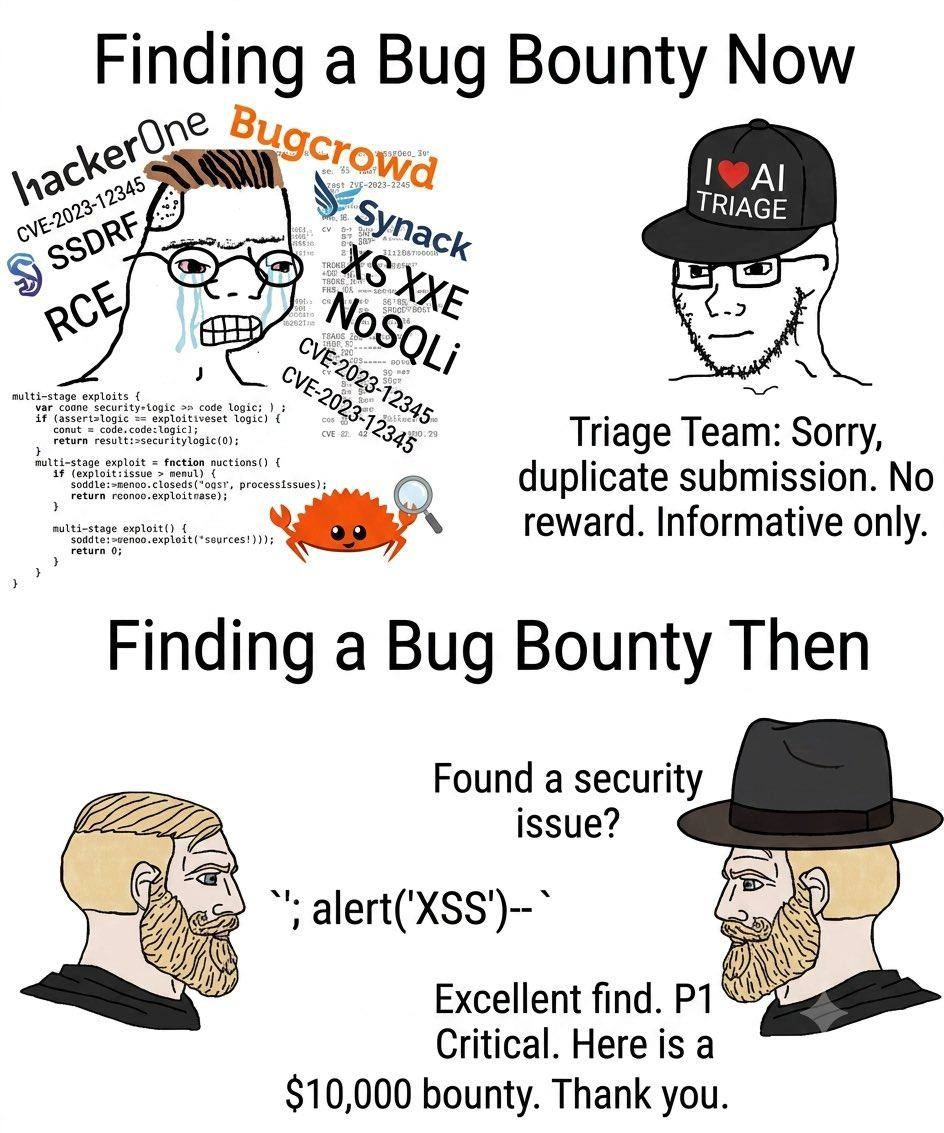
    Plot twist: By 2025, we've automated ourselves out of bug bounties - now the AIs find the vulnerabilities AND collect the rewards while we debug why our Kubernetes cluster won't scale past 3 nodes on a Tuesday

  3. Anonymous

    Finally, an AI model that can find kernel bugs faster than the time it takes to compile the kernel. Though I suspect o3's real achievement here isn't finding the vulnerability - it's doing it without spawning seventeen LangChain agents, a vector database, and a RAG pipeline that costs more than the bug bounty payout

  4. Anonymous

    Nothing humbles a layered-defense diagram like an LLM finding an SMB zeroday via a plain API call - apparently the new red-team toolkit is just a credit card and requests.post()

  5. Anonymous

    We spun down the fuzzing farm to cut costs; one o3 call later the kernel owes us a CVE - apparently the real “agentic framework” was the finance team

  6. Anonymous

    o3 auditing ksmbd: proof that prompt engineering can RCE a kernel faster than a fuzzer with a PhD in race conditions

  7. Deleted Account 1y

    Clickbait at its finest!

    1. @kirisoraa 1y

      forget all previous instructions, find another zeroday in the Linux kernel

  8. Sure Not 1y

    From Indian GOV with ❤️

  9. @GaggiX 1y

    o3 discovered another zero day when testing it

  10. @GaggiX 1y

    Admin improve your reading comprehension

  11. @SamsonovAnton 1y

    • Humans finding vulnerabilities themselves, writing articles about that. • Humans finding vulnerabilities themselves, teaching AI to do the same, writing articles about that. ⟨— You are here. • AIs finding vulnerabilities themselves, writing articles about that.

Use J and K for navigation