reCAPTCHA escalates: select every 220-ohm resistor or remain a bot
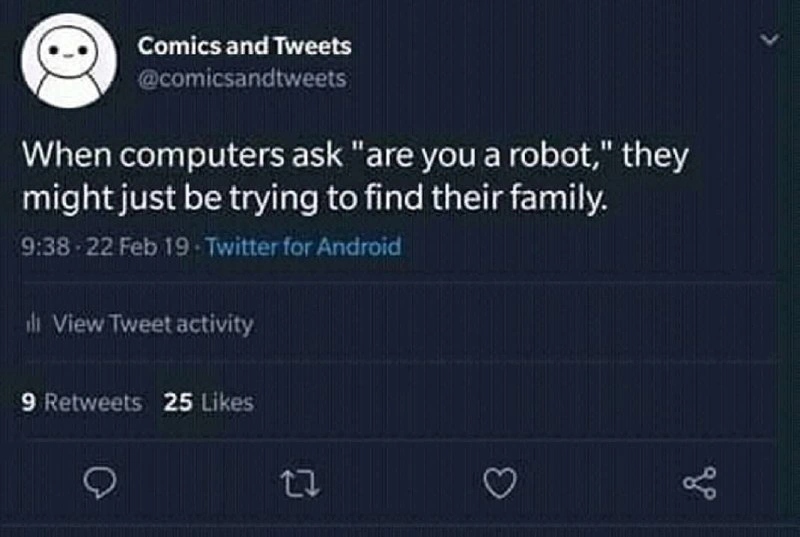
Why is this Hardware meme funny?
Level 1: Where’s Waldo: Electronics Edition
Imagine you’re looking at a big, busy picture full of all sorts of tiny gadgets and pieces. It’s super crowded – kind of like those “Where’s Waldo?” puzzle books where you have to find a character hidden in a jam-packed scene. Now, someone says to you, “Hey, to prove you’re not a robot, pick out all the little pieces that are a very specific kind.” It’s almost like asking you to find all the green Lego pieces of exactly the same shade in a giant box mixed with tons of other colors. Pretty tough, right? You’d probably squint and still miss some because everything looks kind of similar. You might think, “This isn’t fair! I’m human, but I have no idea which tiny piece is the ‘right’ one they want.”
That’s exactly why this picture is funny. It shows a test that’s supposed to tell robots and humans apart, but the task is so hard and so oddly specific (finding a tiny electronic part called a resistor with a value of 220 Ω) that a regular person would struggle to do it. It would feel like an impossible puzzle. The joke is that the test went way overboard – instead of a simple game like “find the cat in these photos,” it became “find a very tiny, specific electronic part in a confusing mess of parts.” Most people would just throw up their hands and say, “Huh? I can’t do that!” In a normal situation, if a website’s human-checking test was this hard, you’d probably never get past it – you’d be stuck as if the computer thinks you’re a robot simply because the question was too tricky.
So the meme is exaggerating to make us laugh: proving you’re human shouldn’t be like an expert-level hidden picture challenge. It feels silly because only a very techy person (the kind who knows electronics really well) could confidently solve it. Everyone else would feel a bit lost and frustrated. In simple terms, it’s funny and relatable because we’ve all had moments where a computer test or task was way harder than we expected, and we thought, “No normal person can do this, what were they thinking?” This picture takes that feeling and pushes it to the max – it’s a goofy reminder that sometimes, the tests meant to tell humans and robots apart can go a little too far.
Level 2: Color Code Crash Course
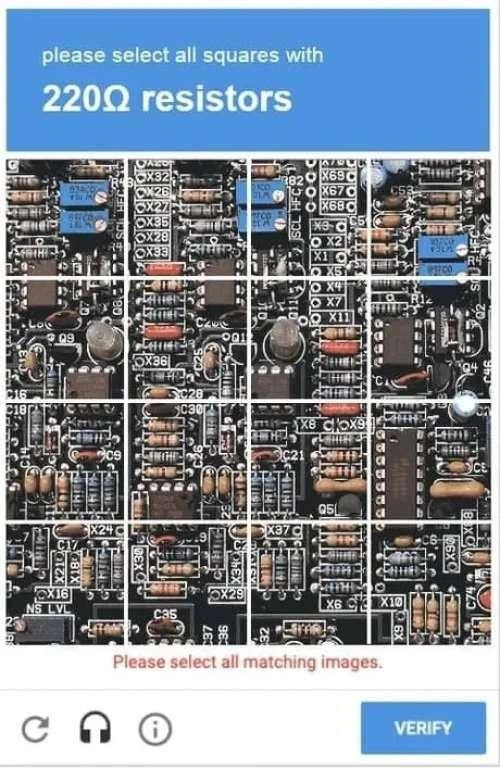
Let’s break down what’s happening in this meme in simpler terms. The image mimics a Google reCAPTCHA, which is that little test on websites where you often have to prove you’re not a bot by identifying images. Instead of the usual “select all squares with traffic lights,” here it says: “please select all squares with 220Ω resistors.” Now, a resistor is a tiny electronic component used in circuits (often to limit current). In the photo, resistors are the small cylindrical pieces with colored stripes, soldered onto the circuit board. 220 Ω (ohms) is a measure of how much the resistor resists electricity – 220 ohms is a specific value. The tricky part is that resistors don’t have their value printed in numbers; instead, they use a color band identification system. Those colored rings aren’t just decoration – they’re a code. Each color corresponds to a number. For a typical resistor: the first ring is the first digit, the second ring is the second digit, and the third ring is the multiplier (basically how many zeros to add). So for a 220 Ω resistor, the rings are Red, Red, Brown:
- Red is 2 (first digit)
- Red again is 2 (second digit, making “22”)
- Brown means multiply by 10^1 (basically add one zero, turning “22” into “220”)
Often there’s a fourth ring for tolerance (like Gold for ±5% accuracy), but the key idea is those first three colors give 220 Ω.
In the image grid, we’re looking at a circuit board that is densely packed with many components – it’s basically a forest of electronics. You can see integrated circuits (ICs), which are the black chip-like rectangles with pins (labeled with things like X7, C5 on the board silkscreen), capacitors (some small cylindrical or block-like parts), and even trim-pots (trimmer potentiometers – those little blue boxes with a screw, used to adjust resistance). The meme even shows labeling like “X6, R17, C9” on the board, which is how real circuit boards mark components (R for resistor, C for capacitor, etc.). It’s a soldered component soup, meaning there are so many soldered bits jumbled together that it’s hard to tell them apart quickly. Every tile in that 4x5 grid looks similar at first glance: lots of tiny electronics crammed together. The challenge asks you to pick every tile that contains a 220 Ω resistor specifically.
For a person who is not familiar with electronics, this is ridiculously hard! Imagine staring at those tiles – each has multiple resistors with different stripe colors (red, green, blue, orange, etc.), as well as other parts. Unless you happen to know the resistor color code by heart, you wouldn’t know which of those stripe patterns is 220 Ω versus, say, 4.7 kΩ (Yellow-Violet-Red) or 10 Ω (Brown-Black-Black). It’s a very detailed pattern recognition task. In contrast, usual CAPTCHAs stick to everyday things like animals, vehicles, or street signs, which any human with normal vision can identify. Those are meant to be tasks that humans find trivial but bots (computers) might struggle with (though even that is changing with better AI). But this “220Ω resistors” task dips into hardware knowledge. It assumes the user can perform a very niche visual identification – basically, that you’ve memorized a mini color chart and can spot tiny differences. That’s why it’s funny: the test expects a level of expertise that normal humans (even most software developers or average users) simply don’t have on the fly.
In terms of security, a reCAPTCHA like this would indeed keep out bots – but it might also keep out all your real users! It’s what we’d call a UX failure or a user experience mistake: a security measure that’s so inconvenient or difficult that it frustrates legitimate people. The phrase “...or remain a bot” in the title caption is jokingly implying that if you fail to pick the correct squares, the system will think you’re a robot and you’ll basically be stuck, not allowed to proceed (“remain a bot” as in, we’ll treat you like an automated program). Of course, no real website would use something this demanding because it would be terrible UX and probably drive everyone away. But by exaggerating to this level, the meme makes a point about how sometimes these verification tests feel unfair or overly hard. It’s poking fun at both the hardware enthusiast’s world and the everyday web user’s world. If you know a bit about electronics, you’ll get an extra chuckle because you recognize the absurdity of picking out a specific resistor value visually. If you don’t, you still see that it’s an impossible puzzle – and that’s the joke: proving you’re human should not require an engineering degree!
Level 3: Resistance is Futile
From a seasoned developer or hardware geek’s perspective, this meme is hilariously on-point. It takes the everyday frustration of reCAPTCHA – those image grids asking us to click on traffic lights or crosswalks – and dials it up to absurdity. The instruction “please select all squares with 220Ω resistors” is both oddly specific and fiendishly difficult. The humor here comes from shared pain: we’ve all squinted at CAPTCHA images, wondering if a barely-visible sliver of a traffic light counts or if that blurred shape is a bush or a truck. Now imagine the challenge demanding you recall your resistor color codes from Electronics 101! It’s a classic case of a UX_UI hurdle becoming a geeky inside joke. Only someone who has memorized the resistor code (red-red-brown for 220 Ω, by the way) might feel a smug thrill. For everyone else, resistance is futile – you either know it or you’re hitting “refresh” hoping for an easier puzzle.
The meme faithfully mimics the look of a Google reCAPTCHA prompt, which is part of why it clicks (or rather, mis-clicks) with us. The familiar grid with white borders, the blue banner instruction, the grey footer text “Please select all matching images,” and even the little icons (the headphone for audio, the circular arrow for a new challenge, the info icon) are all there. It’s instantly recognizable. That official styling makes the outlandish request feel momentarily real – triggering our memory of frustrating UX failures where the human test nearly feels like an exam we didn’t study for. And indeed, this is an exam of sorts, but on HardwareHumor knowledge. If you’ve ever debugged an old circuit board or sifted through a bin of resistors, you’ll recall those tiny colored stripes and maybe even the mnenonic for them. The meme taps into that niche: hardware folks chuckle because they actually can spot the 220 Ω resistor (or at least they think they can, until they second-guess shades of red and brown), while software-only folks or the average user just go “Huh? They expect me to know this??”
There’s a deeper industry joke here, too. Google’s reCAPTCHA system famously uses these image challenges not just to keep out bots but also to train its AI. When we identify street signs, we’re helping self-driving car algorithms; when we transcribed distorted text, we were digitizing books. So what’s going on with selecting resistors on a PCB? Tongue-in-cheek, one might say Google must be training a visual AI to recognize electronic components at scale – maybe for an automated hardware debugger or inventory system – and we’re the free labor labeling data. It’s a cynical veteran take: “Great, now I’m not only proving I’m human, I’m also doing unpaid work for a machine learning dataset on electronics.” The meme exaggerates this to comic effect: the task is so esoteric that it feels like a prank. It satirizes both the increasing security strictness (“identify very specific objects or remain a bot forever!”) and the unintended user experience absurdity. In real life, if a CAPTCHA ever got this hard, users would rage-quit. It’s a gentle jab at both our Security overlords and the UX/UI designers: yes, we want to keep bots out, but do we have to derail genuine users with an electronics pop quiz?
For those of us who have been around tech (and perhaps burned a finger or two soldering circuits late at night), there’s an extra layer of “too real.” We remember learning the resistor color bands, or maybe painstakingly reading them with a magnifying glass while fixing a device. Seeing that arcane skill used as a gatekeeper to a website is both funny and a bit traumatic. It’s communal humor: everyone laughs, but the EEs laugh hardest. And when you click “VERIFY” in the meme’s fake interface, you can almost hear it taunting: Access denied, you bot – you missed the resistor in square B3! Because honestly, unless you have eagle eyes and niche knowledge, you probably did. The meme thus nails a blend of hardware inside joke and universal developer frustration. After all, nothing unites us like collectively failing a “are you human?” test and momentarily considering the possibility that the robots have already won.
Level 4: Turing Test Overkill
At the theoretical extreme, this meme highlights a paradox in CAPTCHA design: the arms race between human verification systems and advancing AI. A CAPTCHA (short for Completely Automated Public Turing test to tell Computers and Humans Apart) is supposed to leverage tasks easy for humans but hard for bots. Originally, that meant reading skewed text or clicking pictures of common objects. But here we have a domain-specific challenge—identifying a 220 Ω resistor by its colored bands on a crowded circuit board. This turns the CAPTCHA into something approaching an AI-complete problem (a task so hard that solving it signals human-level intelligence, or in this case, expert-level knowledge). It’s as if the Turing Test got a hardware upgrade and overshot its mark.
Why is this overkill? Classic CAPTCHAs assumed general human perception skills: you can spot a cat or read a warped word without needing a PhD. But selecting exactly the right resistor in a soldered component soup of a PCB (Printed Circuit Board) demands electronics pattern recognition and memory of specific color codes. Only a subset of humans—say, seasoned electrical engineers or hobbyists—have that ability on the spot. We’ve essentially gone from a universal human task to a specialist task. In theoretical terms, the test is no longer about human vs. machine, but expert vs. novice. This breaks the fundamental CAPTCHA principle: it should discriminate on human vs. bot, not on niche expertise.
There’s also an ironic reversal of roles here. Modern AI, especially with advanced computer vision and neural networks, might actually be pretty good at such identification if trained. A sufficiently trained image classifier could parse the resistor color_band_identification (e.g. reading the red-red-brown pattern for 220 Ω) in each tile faster than a human. That flips the script on the original idea of CAPTCHAs. We’ve reached a point where a computer might ace what a lay-human cannot, undermining the very point of a Turing test. In a sense, this hypothetical “select all 220 Ω resistors” challenge is a Turing Test Overkill – it tests extremely specific knowledge under the guise of a bot filter, so much so that actual humans (without that knowledge) would flunk. The meme exaggerates to make us laugh at how far these puzzles could go: a security measure so strict that even legitimate users are locked out, questioning their own humanity (“Am I a robot? Or just not an electrical engineer?”). It’s a humorous commentary on how UX and security can collide – push the anti-bot challenge too far, and you’ve basically built a robot-proof wall that also stops humans, a Pyrrhic victory in the CAPTCHA arms race.
Description
The meme mimics Google’s image-grid reCAPTCHA. A bright blue banner at the top says, “please select all squares with 220Ω resistors.” Beneath it is a 4×5 grid overlaying a densely populated circuit board packed with through-hole resistors, ICs, capacitors, and trim-pots - every tile looks nearly identical except for subtle resistor color bands. The typical reCAPTCHA footer appears in grey: “Please select all matching images,” flanked by the headphone, info, and refresh icons, plus a blue “VERIFY” button. Visually, it’s almost impossible for a human to spot each 220-ohm part, satirizing how CAPTCHA challenges sometimes cross the line from simple security check to expert-level pattern recognition, especially for anyone who’s ever memorized resistor color codes while debugging embedded hardware
Comments
6Comment deleted
Somewhere, an accessibility engineer just rage-quit after realising Ohm’s law is now part of the Turing test
After 15 years of debugging race conditions and distributed consensus failures, the hardest problem I've faced is still explaining to product why we can't just 'add AI' to read resistor values from a CAPTCHA. Though to be fair, our ML model would probably just return '220Ω' for everything and still achieve better accuracy than our junior's code reviews
Finally, a CAPTCHA that proves you're not a bot - you're just a hardware engineer who forgot their multimeter. Because nothing says 'human verification' like asking someone to identify resistor values from a photo where the color bands are smaller than a pixel and the SMD codes require electron microscopy. At least when the backend crashes, we can blame it on someone selecting the wrong 220Ω resistor
CAPTCHA finally respects EE skills: thumbnail resistor codes or bust - no magnifier, no click
Proof-of-human vNext: decode 220Ω as red-red-brown through JPEG compression while the real bot just posts to /oauth/token
Finally, a CAPTCHA that enforces “full stack” - no Jira until you can mentally decode red‑red‑brown ±5%