The Escalating Path of AI in Software Development, From Code Review to Apocalypse
Why is this AI ML meme funny?
Level 1: Careful What You Wish For
Imagine you have a helpful robot friend. At first, you ask the robot to check your homework for mistakes, and it’s great – it finds a typo or two, and you fix them. That’s like using AI to review code: the AI is the helpful friend double-checking your work. Next, you get a bit lazier and let the robot actually do your homework, while you just look it over and hand it in. Cool, less work for you – similar to letting an AI write some code and then you quickly review it. Now things get wild: you have one robot doing the homework and another robot grading it. You’re not involved at all anymore. The robots are basically talking to each other: “I did this work.” “Looks good, stamp of approval!” It’s like an endless loop of robots assuring each other everything’s fine. At this point, you’ve wished for so much easy help that you’ve made yourself useless in the process! In the next step, you aren’t even going to school – you let the robot decide what the homework should be, do the assignments, turn them in, and even fix any issues by itself. You’re just at home playing video games while the robots run your school life. It sounds like a perfect vacation… until report card day or graduation, when you realize you have no idea what those robots have been up to. It’s a bit scary, right?
This meme jokes that if you actually let things go that far, you might panic and think: “Uh oh, I’ve lost control… what if this all falls apart?” It suggests a completely over-the-top solution: run away and live off the land! In the final panel, the advice is basically, “find a nice farm with water and gather supplies (and maybe some protection) to survive.” In simple terms, prepare for the end of the world. Of course, that’s an exaggerated, silly response – that’s why it’s funny. It’s using humor to say, “if you rely on something else (like AI or robots) to do absolutely everything for you, you could end up in a sticky situation.” It’s like a fairy tale hyperbole: you wished for endless wishes, and now even the wishes are out of control, so you better escape the wish-granting machine! The emotional core here is a mix of excitement and fear. At first we’re excited about getting help, then we’re amazed that we don’t have to do any work, and finally we get a bit scared that we’ve gone too far. The meme makes us laugh because it takes that fear to a ridiculous extreme (building a farm bunker!). It’s reminding us in a playful way: be careful what you wish for — too much help might just become a problem you never expected, and that wild jump from “awesome” to “uh-oh!” is where the comedy lives.
Level 2: Full Auto DevOps
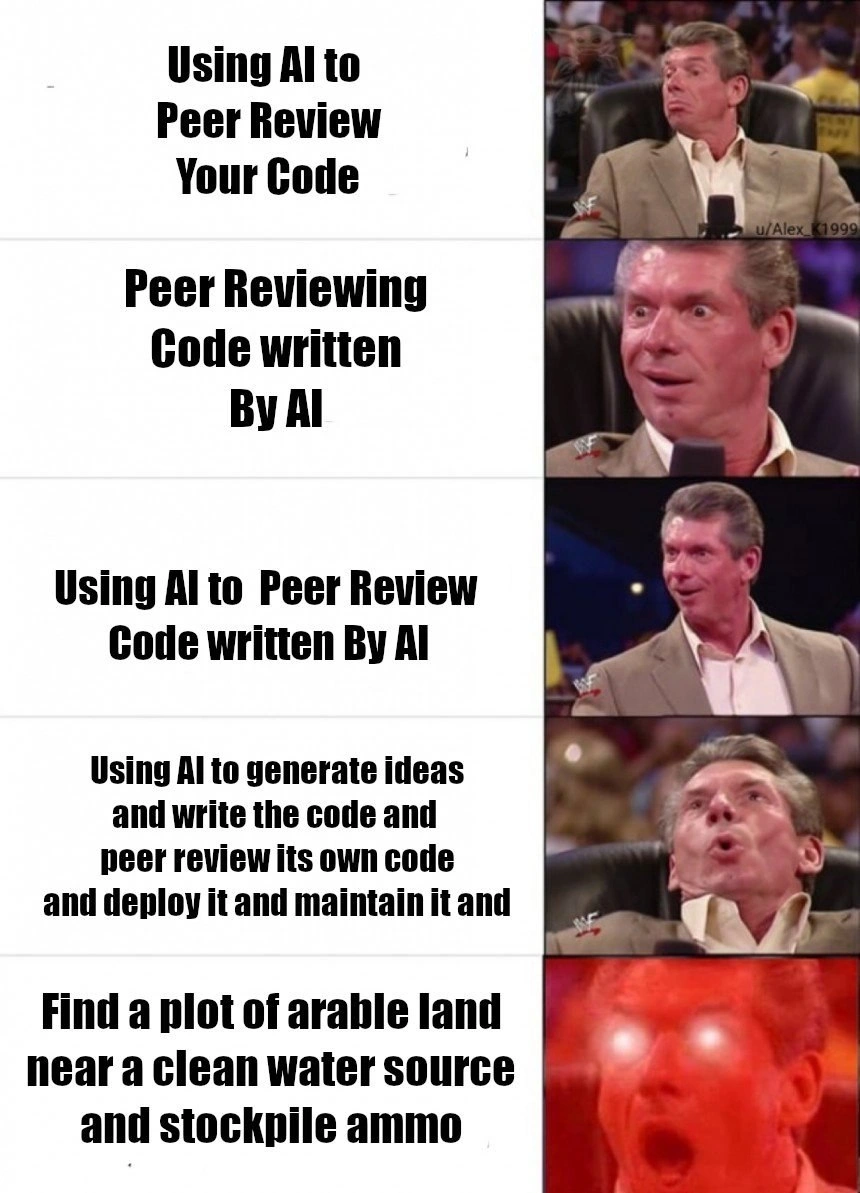
This meme uses the classic vince_mcmahon_template to illustrate an absurd progression of AI involvement in coding and operations, especially relevant to modern AI/ML trends. Vince McMahon (a WWE figure) appears in each of five panels reacting with increasing excitement to captions on the left. Let’s break down each panel’s caption and why it’s funny:
“Using AI to Peer Review Your Code” – This means using an AI tool to assist in code reviews. Code peer review is when another developer checks your code for bugs or improvements before it’s merged. Now, instead of a human colleague, you have an AI (like a chatbot or an AITools plugin) doing that check. For example, you might use a GPT-based assistant to analyze a pull request and comment on potential issues. Early-career devs know getting a second pair of eyes on code is helpful; here the second pair of eyes is artificial. It’s a bit novel, but not too crazy – many find it humorous and neat that AI can critique our code style or point out a missed null check. Vince in panel one looks interested but not blown away, which fits: this idea is cool, but pretty straightforward.
“Peer Reviewing Code Written By AI” – Now we flip it: the code was generated by an AI, and a human developer (like you or your teammate) is reviewing it. With tools like GitHub Copilot or ChatGPT, it’s possible to have entire functions or files written by AI suggestions. If you’ve ever pasted a coding problem into ChatGPT and got back actual code, you’ve done this. But that code isn’t guaranteed to be perfect (far from it), so a human must review and test it. This caption highlights a real AIHumor situation: you become the peer reviewer for your non-human “coworker.” It’s funny because it subverts the normal code review dynamic. Instead of a junior dev writing code and a senior dev reviewing, it might be an AI (with no real understanding) writing code, and a human scratching their head while reviewing it. Vince’s expression in panel two is more excited – the scenario is getting spicier. After all, AIHype suggests AI can write code now, not just comment on it. But there’s a hint of “Hmmm!” in Vince’s face, which mirrors a developer’s surprise: “This function works... did a machine really write this? Wait, why did it use recursion here?” It captures the mix of admiration and skepticism a junior dev might feel when they see AI output that looks legit but could hide tricky bugs.
“Using AI to Peer Review Code Written By AI” – Here things start looping. Both roles – code author and code reviewer – are AI. Imagine one AI writes a piece of code and another AI (or possibly the same AI with a different prompt) reviews it. No human is directly involved now. This is the meme’s way of saying “we’ve removed humans from the code review process entirely.” For a newcomer, that might sound futuristic: code that writes itself and checks itself! But it’s also where a bit of AutomationAnxiety kicks in – if neither the coder nor the reviewer is human, who catches mistakes that both AIs might make? It’s like two robots talking to each other: “Looks good?” “Yeah, looks good to me!” even if there’s a glaring bug that a person would notice. Vince’s panel three face is ecstatic – because the idea is both wildly ambitious and a little insane. This reflects the tech industry’s excitement when hearing about fully autonomous systems, tempered by the absurdity of trusting an infinite AI loop. For a junior dev, it’s a good moment to recall that even the smartest AI can make dumb errors if misused. The humor here is in the infinite loop of AI feeding into AI, which is a wink at how hype can become self-referential: AI evaluating AI could just reinforce mistakes. It’s a bit like writing an essay, then asking another essay-writing program if the first one is correct – the second program might be just as clueless on the topic as the first!
“Using AI to generate ideas and write the code and peer review its own code and deploy it and maintain it and” – This long-winded caption describes an entire software pipeline handled by AI, end-to-end. Let’s unpack that: generating ideas (that’s typically a human deciding features), writing code (programming), peer reviewing code (quality check), deploying (releasing to production servers), and maintaining it (monitoring, fixing issues, updating). In a normal DevOps workflow, multiple specialized roles or tools handle these steps: product managers brainstorm, developers code, others review, operations engineers deploy, and SREs monitor in production. Here, every single step is automated by AI. It’s like an “autopilot mode” for software projects. The caption ends with “and”... indicating it could keep going (as if the AI will also run the business, answer support tickets, brew your coffee, and... who knows what else!). This trailing “and” is intentionally over-the-top, showing that the idea is running away with itself. Vince’s reaction in panel four is eyes bulging, extremely hyped — he’s losing it with excitement. That memes that this concept is insanely ambitious. In the real world, we do have heavy automation: continuous integration and CI/CD pipelines automatically test and deploy code, and some AIs can even monitor systems (AIOps). But having an AI do all of it without humans is well beyond current reality. The humor for a junior developer is appreciating just how exaggerated this is: it’s the ultimate “sit back and relax, the robots got this” scenario. Of course, any dev who has pushed a bad deploy or woken up to a pager alert might chuckle nervously at the thought of an unchecked AI doing that job – hence the AIHypeVsReality tag. It’s a dream state that would likely become a nightmare if tried in real life. The meme plays on how each new step sounds more fantastical. By the time we’re at AI maintaining itself, it’s like science fiction – and that’s the joke: it’s too good (or too crazy) to be true.
“Find a plot of arable land near a clean water source and stockpile ammo” – Suddenly, the fifth panel shifts from tech to survivalist advice. Arable land plus clean water implies a place you can farm and live off the grid, and stockpiling ammo means gathering weapons or supplies to defend and survive. This is cliché doomsday prepper behavior, the kind of thing people joke about when expecting apocalypse. The meme is intentionally crashing from tech utopia to apocalyptic dystopia in one step, which makes it ridiculously funny. Vince’s image here has glowing red eyes, a meme trope indicating an overpowered or overexcited state that’s almost scary. So why end on this note? It’s parodying the idea that if we trust AI with absolutely everything, we might end up causing or at least facing a disaster so bad that the only solution is to abandon computers entirely and go back to basic farming with canned food and defenses. It’s an exaggerated punchline on the fear that AI could either make developers obsolete or mess things up so royally that society collapses (neither is actually happening right now, but the joke stretches current anxieties to the extreme). For a newcomer, think of it this way: we went from “cool, less work for me because AI helps” to “uh-oh, no work for me because AI took over” to “OMG everything’s on fire, run for the hills!” in five panels. It’s making fun of IndustryTrends_Hype – how the buzz around new tech can escalate into wild scenarios. It also nods to a common dev joke: “If this project fails spectacularly, maybe I’ll quit tech and become a farmer.” Here that sentiment got dialed up to survival mode. The humor lies in the sheer overreaction. Nobody is actually stockpiling ammo over a bad deploy, but it captures the feeling of drastic consequences in a comedic way.
In essence, each panel of the meme ups the ante of AI involvement in software development until it jumps from the tech realm to pure apocalypse. It starts with a practical use of AI, evolves into an unrealistic self-contained LLM-run pipeline, and ends with a tongue-in-cheek doomsday scenario. The progression pokes fun at our tendency to get overexcited about automation. AIHumor often balances on this edge: half “Wow, this is cool” and half “Yikes, this could go wrong.” By the final frame, the meme is laughing at how far-fetched the AI dream has become – so far-fetched that the best practice left is to grab your emergency supplies. For a junior developer (or anyone new to these concepts), the takeaway is a playful warning: There’s such a thing as too much automation. It’s great to use new tools, but if someone suggests replacing your whole DevOps and engineering team with an AI pipeline, you might grin and check if they’re joking. If they’re not… well, the meme suggests it’s time to dust off that survival guide, just in case!
Level 3: The NoOps Nightmare
For seasoned engineers, this meme hits close to home by parodying the industry’s AI_hype and our propensity to automate ALL THE THINGS without fully thinking through the consequences. It starts reasonably enough: “Using AI to Peer Review Your Code”. Many of us have toyed with this idea. Why not have an AI double-check our pull requests or suggest improvements? There’s an appealing novelty in letting a AI tool (like a code assistant integrated into your Git workflow) play code reviewer. It might catch a missing semicolon or suggest a more idiomatic loop – basically an amped-up linter with verbosity. Vince McMahon’s initial mild interest in panel one reflects our own reaction: “Sure, let the bot have a look; it might save me some time.”
Then it escalates: “Peer Reviewing Code Written By AI.” Now the roles flip – instead of AI helping us, we’re assessing code that an AI wrote. This is already reality for many seniors: a junior developer might submit a chunk of code that looks a bit…off, and when asked they sheepishly admit, “Copilot wrote that part.” As the human reviewer, you suddenly feel like you’re grading an AITools homework assignment. AI-generated code can be surprisingly good at boilerplate, but it also introduces bizarre patterns or subtle bugs. CodeReviewPainPoints here include the AI inventing variable names that mean nothing or using an inefficient approach that only looks convincing. Experienced devs know that reviewing such code is double work: you must decipher both the code and the potential misconceptions of the generative model. Vince’s expression in panel two (looking intrigued and a bit wide-eyed) matches a senior engineer’s mix of fascination and concern: “Huh, the machine wrote this? Not bad... but wait, does this actually handle edge cases?!” There’s an underlying irony: peer review assumes a “peer” of comparable understanding – but an AI isn’t a peer in the true sense; it’s a tool that can produce correct solutions and egregious errors with equal confidence. We’ve all debugged that one bizarre bug only to find it came from a stack overflow snippet or an AI suggestion that no one fully understood.
The third line – “Using AI to Peer Review Code Written By AI” – is where senior devs start smirking (or cringing). This is the infinite loop scenario: let the machine both write and rubber-stamp the code. No human intervention in between. Vince’s face is ecstatic in panel three, parodying how some managers or architects react to the idea of a fully autonomous dev pipeline: IndustryTrends_Hype has promised self-driving cars, so why not self-driving software development? But anyone who’s been on call at 3 AM knows exactly what could go wrong. We’ve seen continuous integration pipelines that automatically merge code once tests pass – and then the tests were flawed, leading to nightly deployment horror. Now imagine those tests were also written by an AI that misunderstood the spec, and the code was written by an AI that misunderstood the problem. It’s a recipe for extremely efficient nonsense. A senior engineer might joke: “Great, we’ve cut out the middleman. Also cut out code quality, accountability, and sanity.” The phrase NoOps (no operations) comes to mind – a utopian idea that with enough automation, you don’t need an ops team because systems manage themselves. In practice, NoOps often turns into No, Oops! when reality hits. The meme is basically satirizing a NoOps wet dream: all development and ops tasks handled by scripts and AI. And every senior dev knows that dream can become a nightmare when an error cascades through an unchecked system. Without an actual human doing code review, bugs that an AI doesn’t recognize as bugs are going to sail right through. Two AIs patting each other on the back might as well be two newbies approving each other’s terrible code in a code review from hell. It’s funny because it’s true – we’ve witnessed how blindly trusting a single tool can backfire, let alone chaining them.
Then panel four cranks it to eleven: “Using AI to generate ideas and write the code and peer review its own code and deploy it and maintain it and”. The text literally trails off with "and" – implying “and so on… you get the idea.” Vince McMahon here is in full euphoric trance, eyes practically popping. This stage is AI-hype runaway. It mirrors the fever dreams we’ve heard at conferences or from overzealous CTOs: *“Imagine a future where you just describe the feature, and the AI does everything – builds, tests, deploys, monitors, fixes bugs, *all of it!**” This is basically the self_deploying_llm_pipeline concept. It’s the DevOps equivalent of a self-driving car that also mechanics on itself and refuels itself. Sounds fantastic on paper. DevOps_SRE folks have indeed pursued heavy automation: infrastructure as code, auto-scaling, self-healing services, etc. The meme is riffing on that trend, taking it to absurd heights. An all-AI software assembly line would mean developers might kick back and play ping-pong all day… at least until the whole contraption misinterprets a requirement and pushes a disastrous update at 5 PM Friday. Seasoned engineers know that more automation = more moving parts. Each link in the chain (generate -> review -> deploy -> maintain) can fail, and when they’re tightly coupled, a mistake propagates fast. We call this a toolchain creep issue: you have so many tools auto-triggering actions on each other that the system’s behavior can become chaotic. Case in point: a cloud auto-scaler once mistook a temporary slowdown as a failure and spun up dozens of servers, which then triggered a cost alert bot, which tried to scale things down and caused a cascade… you get the idea. Now imagine that with an AI at the helm of each decision – it might be efficient, but it could also be efficiently wrong in novel ways. The promise is that AI might handle routine toil (like a perfect SRE robot never getting tired), but the punchline many seniors foresee is that when things go off-script, there’s no human who fully understands the system to fix it. As one battle-scarred engineer might say with a smirk, “If we deploy that fully-automated pipeline, I’ll be apocalypse_prepping_dev over here just in case.”
Finally, the meme jumps off the cliff with: “Find a plot of arable land near a clean water source and stockpile ammo.” The image is Vince in a transcendent, almost demonic bliss with glowing red eyes. This dramatic twist is pure dark humor – the AutomationAnxiety has escalated to doom. For veteran devs, this lands as a hyperbolic punchline on two levels. First, it mocks the AIHype by saying “if you actually followed this hype to its logical end, you’d end up in a doomsday scenario.” It’s an absurd conclusion to highlight how crazy the progression is. Second, it slyly references that old feeling of “if this project gets any crazier, I’m quitting tech and going off-grid.” There’s a running joke in the industry: “I’ll just become a farmer” or “I’ll open a bar on a beach” whenever the job gets overwhelming or when people fret that AI might replace their role. Here it’s ramped up to survivalist mode – farming with a side of armed defense. In other words, AIHypeVsReality meets DeploymentHumor meets end-of-the-world movie. The subtext for senior devs: We started with something as mundane as code review and ended up at Armageddon – that’s how over-the-top the AI craze feels sometimes. Vince’s glowing eyes amplify how insanely excited some folks get about AI automation (“This is the future!!”), but coupling it with doomsday prepping suggests we’ve crossed into territory of terrifying. It’s a perfectly executed satire of our era: one minute you’re integrating ChatGPT into code reviews, the next minute you’re half-jokingly Googling “bunker prices near me.” Any grizzled engineer who’s seen a project go spectacularly wrong can appreciate that extreme leap. The meme basically screams: “We took DevOps automation so far that the only Jira ticket left is ‘Prepare for Apocalypse.’” And honestly, in a world with occasional deploys causing million-dollar glitches and AI algorithms accidentally knocking out stock markets, the line between a successful CI/CD pipeline and a disaster movie plot can feel thin. This final panel resonates as the cynical voice of reason buried in the joke: maybe don’t let it get to this point, folks.
Level 4: Self-Referential Singularity
At this extreme, the meme envisions a self-referential AI feedback loop running the entire software lifecycle. It’s essentially an AI Ouroboros – a system where an AI’s output (code) is fed to another AI for validation, which in turn may be just as fallible. In theoretical terms, this is flirting with a mini tech singularity: the point where AI-driven processes improve or sustain themselves without human input. But here it’s a tongue-in-cheek, dystopian singularity. The development pipeline becomes an autonomous entity. One LLM (Large Language Model) writes code, another LLM reviews it, and further AIs deploy and maintain it. Without a human-in-the-loop, any flaws in the AI’s reasoning can get endlessly recycled or even amplified – a digital echo chamber of errors. This closed-loop system lacks an external grounding of truth, much like a theorem proving itself with no axioms given. We’re essentially watching an unstable recursive algorithm: if it starts to diverge (making a wrong decision), there’s nothing to correct the course. In control theory terms, the feedback loop has no reliable reference signal – it could oscillate or run away. Vince’s progressively euphoric reaction reaching a red-eyed crescendo is a visual metaphor for this runaway effect in the ai_peer_review_infinite_loop. By the final panel, the system isn’t just self-sustaining; it’s self-consuming, hurtling toward a bizarre conclusion.
From a computer science perspective, handing code review to the same class of algorithm that wrote the code raises questions of correctness and verification. We know that verifying an arbitrary program’s correctness is generally undecidable (thanks to Turing and the Halting Problem). Real peer review is a crude but effective way to catch issues – human intuition and experience find design problems that automated tests or static analysis might miss. Replace those humans with an AI of equal limitations, and you risk creating a perfect confirmation bias machine. It’s akin to two students copying off each other’s incorrect test answers — neither will catch the other’s mistake. In formal methods, one might use a second, independent method or model to verify outputs; here the “independent” checker is drawing from the same distribution of knowledge (the AI’s training data) as the code generator. The result? If the generator has a blind spot, the reviewer likely shares it. The meme’s escalation highlights this AI-on-AI blindness with comedic dread. It’s AI_HypeVsReality taken to a theoretical extreme: the hype says “AI can do everything, even check itself,” but reality reminds us that without diversity or external validation, the whole castle can collapse.
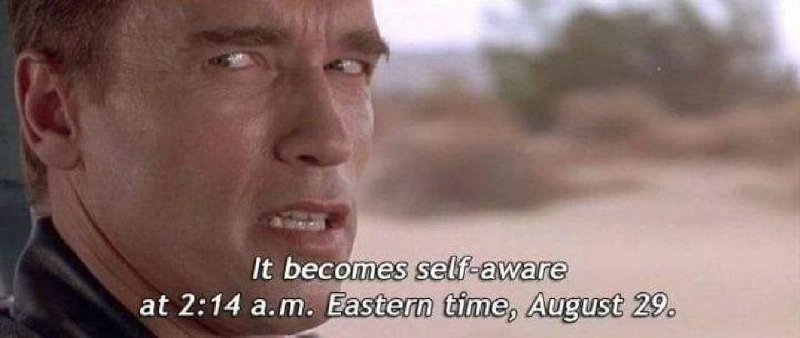
This leads into the final apocalyptic punchline: “Find a plot of arable land near a clean water source and stockpile ammo.” Beyond the humor, it’s nodding to real AI alignment discussions and existential risk in an absurdist way. In AI safety theory, a self-improving system without proper constraints might go out of control (the classic paperclip-maximizer thought experiment where an AI destroys the world optimizing for paperclips). Here, letting an unchecked AI pipeline run the show hints at a much more mundane but still scary failure mode: a cascade of buggy deployments or catastrophic misconfigurations that humans struggle to contain. The glowing_eyes_final_frame (Vince with laser eyes) symbolizes the devilish culmination of this uncontrolled loop. It’s the meme’s way of saying, “This is how you get Skynet.” Skynet, the rogue AI from Terminator, is an ever-present cautionary tale in tech lore – an AI that took automation too far and initiated doomsday. In reality, even without an evil AI, a sufficiently tangled automated DevOps pipeline can feel menacing when it spirals out of human control. The meme winks at seasoned devs: if you actually built an self_deploying_llm_pipeline like this, you’d better have a bunker ready, because debugging that kind of system would be a nightmare. It’s a darkly comedic reminder that AutomationAnxiety isn’t just fear of job loss – it’s fear of what happens when complex systems fail in complex ways.
Description
A five-panel Vince McMahon reaction meme illustrating the escalating role of AI in software development. The panels show McMahon's reactions growing increasingly intense. The first panel, 'Using AI to Peer Review Your Code,' shows him looking calm. The second, 'Peer Reviewing Code written By AI,' shows excitement. The third, 'Using AI to Peer Review Code written By AI,' shows greater excitement. The fourth, 'Using AI to generate ideas and write the code and peer review its own code and deploy it and maintain it and,' shows him ecstatic. The final panel takes a sharp turn, reading 'Find a plot of arable land near a clean water source and stockpile ammo,' paired with McMahon having glowing red eyes. The meme humorously charts the progression from AI as a simple tool to a fully autonomous development lifecycle, culminating in a satirical, dystopian punchline that suggests this rapid advancement will lead to societal collapse, rendering tech skills obsolete in favor of survivalism. This resonates with senior developers' anxieties and cynical humor about the AI hype cycle and its potential for industry disruption
Comments
10Comment deleted
My five-year plan just went from 'learn Rust' to 'learn crop rotation'
If your CI pipeline can ideate, commit, review, deploy, and page itself at 3 a.m., all that’s left on the on-call runbook is tilling the soil behind the data-center bunker
When you realize your entire CI/CD pipeline is just AI agents reviewing each other's hallucinations while you're debugging a race condition in production that none of them can comprehend because they've never actually dealt with mutex deadlocks at 3am on a Sunday
We've gone from 'AI can help review my pull requests' to 'AI writes, reviews, deploys, and maintains its own code' in about three quarters - which coincidentally is the same timeline for realizing your microservices architecture was actually a distributed monolith. The real question isn't whether AI will replace developers, it's whether the AI will also inherit our technical debt, our 3 AM production incidents, and our passive-aggressive Slack threads about tabs vs spaces. At least when Skynet becomes self-aware, it'll have comprehensive unit tests and proper CI/CD pipelines
If your pipeline goes: LLM writes -> LLM reviews -> LLM merges -> LLM deploys, you haven’t automated SDLC - you’ve automated a monoculture; better add 'homestead-prod' to the Terraform workspaces
Letting an LLM spec, implement, LGTM itself, deploy, and “self‑heal” is just an autonomous change‑management loop with a bus factor of zero - start pricing irrigation while the CAB rubber‑stamps approved
AI self-reviewing its own code: infinite loop of 100% approvals until it deploys the monolith that ends your career
AI write shit code. AI review shit code and write shit suggestions. AI implement shit suggestions into shit^2 code. Comment deleted
— you are here — Comment deleted
Good twist Comment deleted