Skip to content
DevMeme
5761 of 7435
The Perils of Over-Engineering: When Your Small Website Becomes a Tech Monstrosity
IndustryTrends Hype Post #6315, on Oct 11, 2024 in TG

The Perils of Over-Engineering: When Your Small Website Becomes a Tech Monstrosity

Why is this IndustryTrends Hype meme funny?

Level 1: Sledgehammer for a Fly

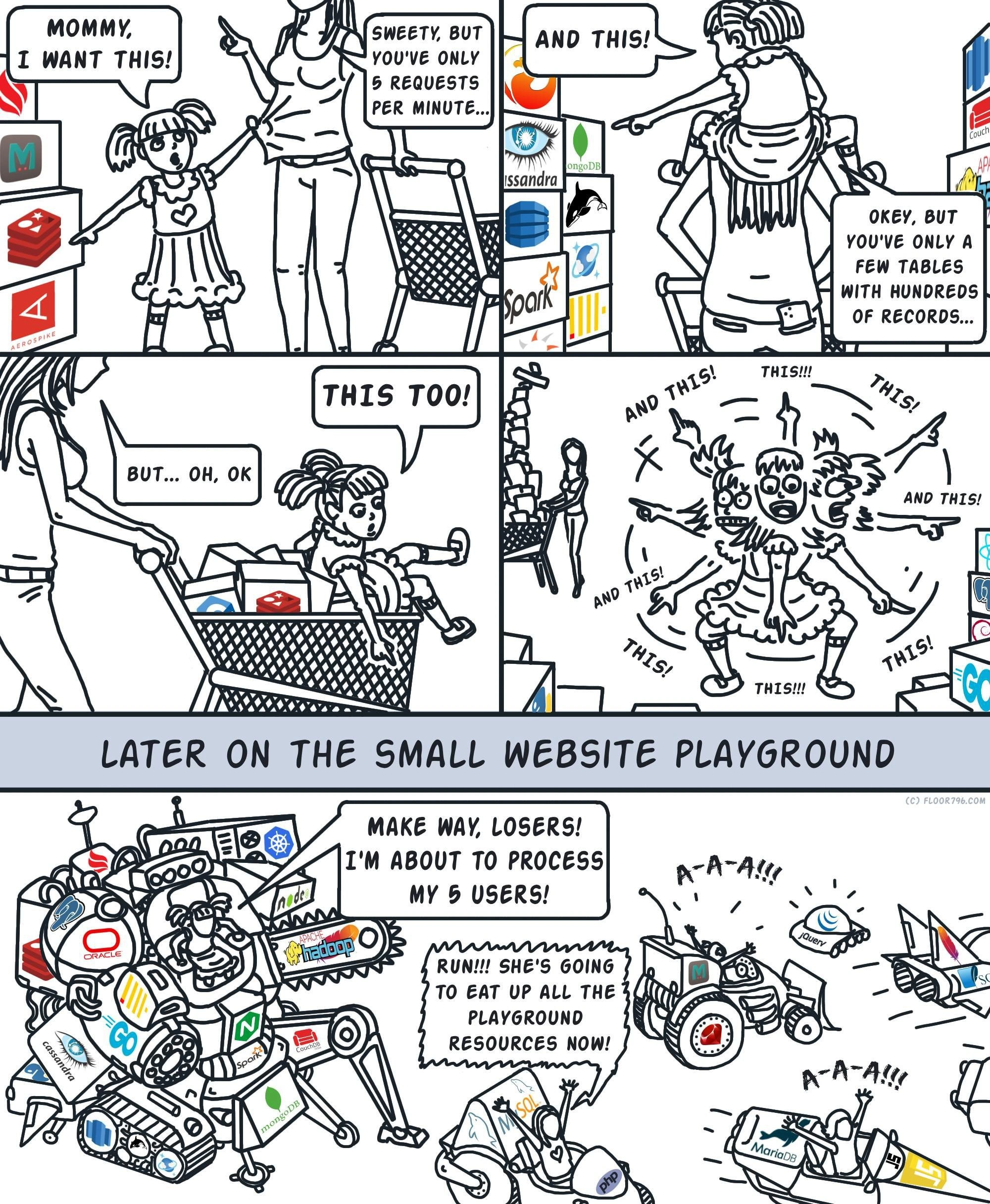
Imagine you have a tiny task, like you want to kill a fly, and instead of using a flyswatter, you bring out a giant sledgehammer, put on full armor, and call in a bomb squad for backup. That’s what’s happening in this meme, but with websites and tech stuff. The “little website” is the tiny task (it only has a few people visiting it, like 5 users). But the people in charge of it got so excited with cool technology that they built a huge, complicated machine – like using a sledgehammer, a crane, and a tank just to squash that one fly. In the comic, the kid excitedly grabbing boxes in the store is like someone saying “I want to use all the coolest new tools!” and the mom saying “Are you sure? You only have a teeny tiny job to do…” but the kid insists. Later, the result is a giant robot made of all those tools, proudly shouting that it’s ready to handle those 5 users (which is funny because 5 users is almost nothing). The other small toys on the playground run away because the big robot is taking up all the space and might break everything. In simple terms, it’s making fun of using something way too powerful and complex for a very small need. It’s funny (and a bit silly) because we can all see you’d never realistically need that much firepower for such a small job. It’s like baking one cupcake in a huge factory oven – it just doesn’t make sense, and that’s why we laugh. The meme’s message: don’t overdo it! Sometimes simple is better – you don’t need to bring a monster truck to drive to the corner store.

Level 2: Tiny Site, Huge Stack

Let’s break down the joke in simpler terms, especially if you’re newer to these technologies. The comic uses a mom and daughter in a grocery store as a metaphor for a developer (the child) picking out too many fancy tech tools, and an experienced voice (the mom) trying to be practical. Think of the tech logos on the boxes as different ingredients or toys the developer wants to use. Here’s what those technologies are, and why grabbing all of them is overkill for a “little website”:

  • Redis – Redis is a super fast in-memory database often used as a cache. Big sites use it to store frequently accessed data in memory to handle thousands of requests per second quickly. In the comic, the girl first points at a box of Redis saying "I want this!" If a website only gets 5 requests per minute (which is very low traffic), it probably doesn’t need a cache like Redis at all. A normal database could handle that load easily without any caching layer. It’s like a child asking for a race car to drive down the driveway – fun, but unnecessary for the distance.

  • Aerospike – Aerospike is another type of database, also designed for high scalability and fast access, used in big enterprise systems (for example, it’s known for being very fast for reads/writes at massive scale). It’s a bit niche compared to Redis, but essentially it’s another “big toy” meant for handling huge traffic or data. For a tiny app with a handful of users, using Aerospike would be like using an industrial oven to bake one cookie.

  • Cassandra – Cassandra is a NoSQL distributed database. It’s designed to run on clusters of many servers, storing enormous amounts of data and handling lots of simultaneous users. It’s great when you need to be always available around the world and can tolerate slightly out-of-date reads (eventual consistency). In the comic, the kid grabs Cassandra while the mom says “Okay, but you’ve only a few tables with hundreds of records…”. Hundreds of records is tiny – like a small Excel spreadsheet’s worth of data. A single, simple database (like MySQL or PostgreSQL) can handle that on one server with no trouble. Setting up Cassandra, which usually involves multiple servers working together, for such a small dataset is overkill. It’d be much more complex to maintain Cassandra than the problem it’s solving. The mom’s point is: why use a tool meant for billions of entries when you only have a couple hundred? It’s akin to renting a giant warehouse because you have one box of stuff – your data could fit in a shoebox, you don’t need the warehouse.

  • Kafka – Kafka is a messaging system or "event streaming" platform. Think of it as a high-speed train for data: it lets different parts of a system send messages to each other in a durable, ordered way, even at huge scales (millions of messages). Companies like LinkedIn or Uber use Kafka to handle event logs, user activity streams, etc., because they might get thousands of events per second. For a small website, you might only have a few events (like a new sign-up or a purchase) per minute, which could be handled with simpler methods (a direct database write, or a lightweight message queue, or often nothing at all). Using Kafka here is like chartering a cargo train to deliver a pizza next door. It’s powerful, yes, but the throughput it’s designed for is unnecessary in this context.

  • Spark – Apache Spark is a big data processing engine. It’s used for analyzing or processing large datasets by distributing the work across a cluster of machines (for example, crunching numbers on millions of records quickly by dividing the task). You’d see Spark used for things like analyzing logs, machine learning on huge datasets, etc. If the website has only a few hundred records in its database (as the mom in the comic mentions), you definitely don’t need Spark to process that. A simple script or query could handle it in milliseconds on a single machine. Including Spark in a tiny system would only add complexity (you’d need to maintain a Spark cluster or service) without any benefit because there’s no “big data” to justify it.

  • Kubernetes (often abbreviated K8s) – Kubernetes is a platform for containerization orchestration. Containers are like mini-packages of software that include everything needed to run a piece of an application (the code, runtime, system tools, etc.), isolated from other pieces. Kubernetes helps manage and scale those containers across many computers. Big companies use it to deploy hundreds of microservices efficiently, handle failovers, scaling up and down under load, etc. It’s powerful but also one of the more complex pieces of infrastructure out there – it has a learning curve and overhead. For a single small website, you absolutely can run without Kubernetes; you might just deploy your app on one server or use a simpler platform. In the meme, one of the logos the girl grabs is Kubernetes (the blue helm-like logo with a wheel). Adopting Kubernetes for a project with one tiny app is like hiring a full construction crew and bringing in cranes and blueprint planning… to build a little treehouse. Possible, but way more complicated than needed. Without a large number of services or big scaling issues, Kubernetes mostly adds an extra layer to worry about (you have to define deployments, manage pods, etc.). That’s why it’s funny the kid wants it – it’s such a heavyweight solution for a simple problem.

  • Go (Golang) – The comic shows the Go gopher logo on one of the boxes. Go is a programming language that’s actually quite suitable for building web services, especially concurrent ones. Using Go itself isn’t overkill (many small projects are written in Go). However, in the context of this meme, the presence of Go likely hints at the broader “modern tech stack” motif – maybe the small website was rewritten in a new language just because it’s trendy. We can imagine the kid saying, “And I want to rewrite everything in Go!” even if, say, the existing solution in a simpler language was fine. It’s one more “new and shiny” element in the cart.

  • gRPC – gRPC is a high-performance way for microservices to communicate with each other. It’s like a more efficient alternative to REST APIs, using binary protocol over HTTP/2 for speed. It’s great when you have lots of different services that need to call each other’s functions on different machines. However, if you don’t even need multiple services (say you have one or two processes), you don’t need gRPC at all – function calls within a single program or simple HTTP calls would be sufficient. In the cartoon, adding gRPC would be like the kid saying “I want a fancy walkie-talkie system with encryption and headsets for me and mom to talk” when… they’re standing right next to each other. Sure, gRPC is cool tech, but for a tiny app with maybe one backend service, it’s unnecessary complexity.

  • Oracle – Oracle is a brand of enterprise database software. It’s known for being very powerful and reliable for large corporations, but also for being expensive and complicated. The presence of the Oracle logo in the final combined robot (it’s on one of the big robot’s body parts) signals that our small website even went for a heavy-duty, big-iron solution here. It’s like a mom saying “My kid’s lemonade stand is using an Oracle database” – an absurd scenario since Oracle is total overkill for something so small (and would cost far more than the lemonade stand could ever earn!). The comic likely picked Oracle to represent the most enterprise choice of database (when an open-source lightweight one would do). If our little app only has a few hundred records, an SQLite database (which is literally just a file on disk) or a free MySQL/MariaDB instance would be plenty. Oracle would be swatting a fly with a cannon.

  • Hadoop – Hadoop is another big-data technology, older than Spark, but it laid the groundwork for distributed data processing and storage (with Hadoop’s HDFS file system and MapReduce jobs). It’s typically used for storing massive amounts of data across clusters and running batch computations. Including Hadoop in the robot suggests our hypothetical dev even pulled in the classic big-data stack (maybe for storing some logs or something trivial). This is like using a factory-sized machine to shred a couple of documents. Way, way too much capacity for a tiny need.

Those smaller fleeing components in the end: Redis, RabbitMQ, MariaDB – these are actually all fairly normal, reasonably-sized tools (Redis we covered; RabbitMQ is a message broker, like Kafka but lighter weight, often used for managing background tasks or chatty microservice communications; MariaDB is an open-source relational database, basically a variant of MySQL). In the final scene, even these “sensible” tools appear as little scooters being chased off the playground. This shows just how domineering the giant setup is – even tools that might have been fine on their own are now overwhelmed by the new mega-system. It’s a bit like how, if you introduce a huge piece of software that consumes a ton of memory and CPU, it can cause issues for the other components that previously ran fine. For instance, if you run a heavy Spark job on the same server as your database, you might starve the database of memory or CPU, causing slowdowns or crashes. In the cartoon, the big robot “eating up all the playground resources” is exactly that: the monstrous stack is hogging resources so that the simpler services have to flee or shut down.

All of this is illustrating over-engineering in a very visual way. Over-engineering means designing a solution that is far more complicated or powerful than what’s actually required for the problem. Here the problem was a small website (think something like a personal blog, or a local business site, maybe an MVP of a startup with few users). Such a site could be built with a single server, a straightforward codebase (maybe just a monolithic application with a web framework), and a single database. That’s like the simplest shopping list: flour, sugar, eggs — just the basics. Instead, the “kid” developer went and filled the cart with every exotic ingredient and tool from the store. The result is a stack (the collection of technologies used) that is massively overkill. It would be hard to set up, hard to maintain, expensive to run, and unnecessary.

The humor and message to a junior developer is: match your tools to your needs. Don’t use something designed for a million users when you haven’t even got a hundred yet. Starting simple is usually better; you can always add these complex tools later if you truly need them. People often joke in the industry using phrases like “you don’t need Kubernetes” or “you aren’t Google” for this exact reason. It’s not that these technologies are bad – they’re actually amazing, but for solving big problems. If you use them for a tiny problem, you create a lot of extra work for yourself for no real benefit.

Finally, “burning cloud budget” is mentioned because all these technologies typically run on multiple servers or require significant resources. On a cloud hosting provider, that means a much higher bill. It’s like buying a Ferrari (and paying for premium fuel, insurance, maintenance) when all you needed was a bicycle for a short daily commute. Not only is it overkill in performance, it’s overkill in cost. A small site could run on a $5/month server instance, but a Kafka cluster + Cassandra cluster + Kubernetes with multiple nodes + Spark, etc., could run up thousands of dollars in cloud costs, easily, per month – all to serve those 5 users. So the meme also resonates with anyone who’s watched costs skyrocket due to a fancy architecture that isn’t actually necessary.

In summary, the comic’s story in simple terms: A developer (like an excited kid) grabs a bunch of enterprise-level tech tools off the shelf (like candy in a store) to use for their tiny, simple website. The experienced voice (mom) says “you don’t need that, your project is not big at all,” but finally gives in. Later, that tiny project has turned into a gigantic, over-engineered system (a Frankenstein robot made of all the fancy tech), which is absurdly proud that it can handle its trivially small job, and it hogs all the resources, leaving no room for anything else. It’s a satire about over-engineering and premature scaling. The lesson (delivered humorously) is: don’t build a spaceship when all you need is a bicycle. Use the right tool for the job, and scale up when it’s actually needed, not before. The little website in the comic didn’t heed that advice, and thus we get this comical outcome.

Level 3: Buzzword Bingo Bonanza

This meme nails a common scenario in modern software development: a tiny project adopting a monster-scale architecture purely out of excitement and hype. The black-and-white comic shows a little girl (think of her as an overenthusiastic developer or architect) going on a shopping spree in a tech supermarket. She’s grabbing boxes off the shelves labeled with all the hottest tech buzzwordsRedis, Aerospike, Cassandra, Kafka, Spark, and more – yelling “I WANT THIS! AND THIS!” like a kid in a toy store. Meanwhile, the mother figure (the voice of reason, perhaps an experienced senior engineer or a project manager) is gently trying to rein her in: “Sweety, you’ve only 5 requests per minute…” and “You’ve only a few tables with hundreds of records…” In plain terms, the mom is saying: “Your website is tiny! You barely have any traffic or data, you really don’t need all these huge, enterprise technologies.” But the child inside the developer just wants all the shiny toys. The comic exaggerates this to absurdity – the girl even grows extra arms in one panel to snatch more boxes at once, screaming “AND THIS!!!” repeatedly. It’s a perfect caricature of over-engineering: when engineers get carried away and pile on every trendy tool and service without regard for necessity. We’ve all seen this “kid in a candy store” approach to tech stacks, where a simple blog or little app ends up with a setup worthy of a Silicon Valley unicorn.

By the time we get to the later panel, this little website has turned into a goliath: on the “small website playground,” the child’s haul of technologies has assembled into a gigantic microservices Voltron (a robot made of all the tech pieces combined). The robot is plastered with enterprise tech logos – it’s got Oracle for a chest plate, Hadoop as maybe an arm, Kubernetes as part of its legs, Kafka circuits, and so on, like stickers from every corporate solution you can think of. And this giant contraption is shouting: “MAKE WAY, LOSERS! I’M ABOUT TO PROCESS MY 5 USERS!” This line is hilariously on point – the colossal ego of the overbuilt system bragging about handling a laughably small load. The juxtaposition is the joke: typically a stack that complex would be boasting about millions of users or insane throughput, but here it’s declaring it can handle… five. Five users. It’s the ultimate overkill. Meanwhile, in the foreground of that scene, we see smaller, simpler services personified as little scooters (with labels like Redis cache or RabbitMQ message broker or MariaDB database) frantically speeding away, yelling things like “RUN!!! She’s going to eat up all the playground resources now!” This is another inside joke: when you deploy a huge, resource-hungry system, it tends to hog all the CPU, memory, network – everything – kind of pushing out even the basic services. It’s as if even Redis and company (which themselves are pretty robust tools) are like “Nope, we can’t coexist with this behemoth, it’s consuming everything!” In real-world terms, if you run an over-engineered stack on a small server or cluster, the overhead will chew up so much RAM and CPU that there’s little left for the actual application logic. The meme anthropomorphizes that idea with the terrified smaller components fleeing for their lives. Resource starvation on a playground, dramatized.

Why is this so relatable (and thus funny) to developers? Because the industry has been through a phase of buzzword bingo architecture in recent years. Everyone wants to use the cool new tools – sometimes for good reason, but often just because they’re cool. There’s even a tongue-in-cheek term for it: “resume-driven development.” That’s when engineers pick technologies that look impressive on their resume or in conference talks, rather than choosing the simplest tool that meets the current needs. This comic is basically calling that out. The mom’s exasperated lines (“but you’ve only got 5 users… but you only have a few hundred records…”) echo the things senior team members or sensible advisors often say in planning meetings, only to be ignored by the gung-ho developer who replies, “But what if we need to scale? We should be using Kafka! And microservices! And a NoSQL database! And… and…” – just like the kid shouting “AND THIS! AND THIS!”

It highlights a real tension in tech culture: hype-driven development versus the YAGNI principle (You Ain’t Gonna Need It). Big companies like Netflix, Google, or Amazon do indeed use these fancy technologies – but they have literally millions or billions of requests and huge engineering teams. A small startup or a new project often doesn’t have those problems (yet, or ever). Nonetheless, after reading blog posts and hearing conference talks, many teams feel pressure to adopt the latest and greatest. Because, of course, heaven forbid we launch with a plain old monolithic app on MySQL when all the cool kids are running their apps on distributed microservices with Kubernetes orchestration and event streams through Kafka, right? The meme humorously shows this mindset taken to the extreme. The little girl grabbing Cassandra and Spark is like a junior dev saying “Facebook uses these, so we should too!” – while the experienced mom’s “but… okay” is that weary acquiescence we see when management or seniors just sigh and let the excited engineers have their toys, knowing it’s overkill. It’s funny, but it’s also a tiny bit painful for anyone who’s lived through the aftermath.

Speaking of aftermath, the “later on the small website playground” part is a wink to what happens when you actually deploy such an overkill stack. In practice, maintaining a ton of different systems is a nightmare, especially if your team is small. Each piece (database clusters, distributed queues, container infrastructure, etc.) needs expertise, monitoring, scaling, and debugging. The meme’s giant robot causing the others to flee is a spot-on metaphor for how a bloated architecture can cause chaos. I’ve heard war stories from startups that blew their cloud budget on a fancy multi-service Kubernetes setup for an app that a single $20/month server could’ve handled. They ended up spending more time fixing DevOps issues than developing features. That’s why the fleeing smaller vehicles in the comic are screaming – it’s pandemonium on the “playground” (which represents the production environment). The big robot’s catchphrase “I’m about to process my 5 users!” also has an undertone of irony that senior devs love: it mocks those proud announcements of “web scale” architecture. There’s a classic joke in tech where someone says “But will it scale?” about even trivial apps – here the answer was to scale way beyond the reasonable limit, to the point of absurdity.

The BuzzwordBingo aspect is worth emphasizing. Look at the collection of tech logos in that shopping cart and on the robot: you have a distributed cache (Redis), an in-memory NoSQL store (Aerospike), a big distributed database (Cassandra), a distributed messaging system (Kafka), a big data processing engine (Spark), containerization and orchestration (Docker/Kubernetes), gRPC, the Go language, enterprise SQL solutions (Oracle), Hadoop (big data file system/MapReduce) – basically almost every major “hype” technology from the last decade. Individually, each of those is a powerful tool solving specific scale problems. All together for a tiny app, it reads like satire. It’s the “everything but the kitchen sink” approach to system design. Seasoned engineers reading this are nodding and chuckling because we’ve either seen it happen or (hands up) done it ourselves early in our careers: we build a Rube Goldberg machine of a system because it sounds advanced, only to realize we’ve created a maintenance headache for very little benefit. It’s fun to play with new tech, sure – spinning up a K8s cluster or throwing data into a Spark pipeline makes us feel like we’re handling real scale – but the joke’s on us when the complexity comes back to bite.

In essence, this meme is poking fun at the industry trend hype of the 2010s/2020s: where even a “little website” starts life with the kind of architecture that was originally invented for big, high-traffic web giants. It’s calling out premature scaling. Instead of waiting until you actually have a performance or scaling problem, some teams build as if they’re already at Google scale. And as the comic shows, the result can be comically disproportionate. The senior perspective here is, “we get why you’re excited about these tools – they’re cool – but trust us, you don’t need all that for what you’re doing.” The mom figure finally saying “...oh, OK” after the kid’s relentless requests is like the team lead who reluctantly agrees to this elaborate architecture, perhaps thinking “we’ll let them learn the hard way.” And the final panel is the “hard way” lesson illustrated – a bloated system loudly proclaiming its power while scaring off everything else and probably stepping on its own toes. It’s the classic "using a rocket launcher to kill a mosquito" scenario. Experienced devs find it funny because it’s a hyperbolic reflection of reality: we’ve been in that meeting where someone suggests Kafka for a project that gets one message an hour, or proposes splitting a tiny app into 15 microservices “for scalability.” The meme simply takes that to cartoonish extremes, and in doing so, it reminds us: keep solutions proportional to the problem. Otherwise you end up with this unwieldy tech Frankenstein that, sure, sounds impressive, but accomplishes very little aside from burning cash and developer time. It’s a high-five to everyone who learned this lesson the hard way, wrapped in a joke that even those currently in the overengineering trap might chuckle at (or cringe, if it hits too close to home!).

Level 4: Premature Optimization Overdrive

This scenario epitomizes the pitfall of premature optimization in system design: applying advanced distributed systems complexity to a trivial workload. The little website is effectively optimizing for planetary scale before confirming any real performance bottleneck. In distributed computing theory, adding components introduces overhead – communication latency, serialization costs, coordination delays – that only pays off when you have enormous load. With only 5 requests per minute and a few hundred records, the theoretical throughput of a single modest server is already orders of magnitude above what’s needed. Every extra moving part here is pure overhead for no gain.

Consider Amdahl’s Law: the speedup from parallelizing (or distributing) a task is limited by the portion that remains sequential and by the overhead of coordination. For such a tiny workload, those overheads dominate. If each user request triggers inter-service calls (say via gRPC between microservices), network latency and serialization might take more time than the actual work (which could be as simple as a database query). Formally: if the useful work per request is $T_{work}$ and the distributed overhead (network, coordination, container scheduling) is $T_{overhead}$, then $T_{total} = T_{work} + T_{overhead}$. Here $T_{work}$ is minuscule, so $T_{overhead}$ completely governs performance. The result? Negative scaling – more servers and services actually make the processing slower and more resource-hungry than a single server would be for 5 users, a scenario as absurd as it sounds.

We also see theoretical trade-offs being applied where they aren’t needed. The CAP theorem tells us a distributed data system must trade between Consistency and Availability in the presence of network Partitions. Cassandra, for instance, is an AP-oriented database: it sacrifices immediate consistency to remain available during partitions, using eventual consistency models and quorum protocols. That’s brilliant if you have globally distributed data or thousands of writes per second. But for a tiny dataset (a few hundred rows) that could live on one machine, introducing Cassandra means you now have to deal with replication latency and eventual consistency issues where none would exist in a single-node ACID relational database. In other words, we’ve introduced the complexity of consensus and replication (Cassandra’s gossip protocol, read/write quorums, etc.) to store what amounts to toy data. The small site now must juggle issues like hinted handoff, read repair, and tuning consistency levels – complexities that only matter at huge scale or in distributed environments. For 5 users, a single MariaDB or PostgreSQL running locally would be consistent, simpler, and far faster (no network hops at all!). By choosing a distributed NoSQL store, the system has willingly accepted less consistency and more overhead for a problem that didn’t exist (a single-node has no network partition to worry about!).

The fallacies of distributed computing come into play here too. One fallacy is thinking network latency is zero – in reality, every call between these microservices or out to a Redis cache carries a latency cost (maybe a few milliseconds or more) which, at 5 requests per minute, is hilariously disproportionate to the actual computing needed (which might be microseconds of database work). Another fallacy: assuming infinite bandwidth – but in practice, all those extra containers and services chatter with each other, using bandwidth and CPU just to stay in sync. For example, a Kafka cluster constantly shuffles data and does leader elections even if only a trickle of messages are sent. A Kubernetes control plane continuously checks the state of pods and nodes, even if our “high traffic” app is mostly idle. These background tasks can easily consume more CPU and memory than the app’s actual work. The overhead isn’t just theoretical – it manifests as real resource usage and complexity in deployment.

From a software architecture perspective, this is a textbook case of overengineering. It’s akin to Second-System Syndrome, where designers, given the chance to build anew, throw in every feature and pattern they know “just in case.” Here every trendy architecture component (distributed cache, message bus, big data engine, container orchestrator, etc.) got thrown into the mix without evidence that they’re needed. The architecture violates the YAGNI principle (You Aren’t Gonna Need It) on a grand scale. The outcome is a distributed monolith: an overly complex system where all those microservices and big-data components are so tightly coupled to fulfill this tiny task that it’s essentially one giant system – only now with network calls, replication lag, and multi-step data pipelines replacing function calls and in-memory variables. It’s both hilarious and tragic from a theoretical standpoint: the system’s complexity budget is completely exhausted by unnecessary complexity, not actual problem-solving.

Finally, think about reliability and failure modes. In a simple design (say one server, one database), there are few things that can go wrong. In a sprawling distributed stack, you’ve introduced dozens of potential points of failure. Each additional microservice can fail independently, the network links between them can hiccup, the Kubernetes scheduler might evict a pod at the wrong time, the Spark cluster might run out of memory, etc. According to reliability theory, the more components in series, the higher the chance one fails at any time. So for 5 users, the site is now statistically less stable because it might be taken down by an unrelated component’s glitch (e.g., if your Kafka goes down, does your whole login system grind to a halt because it was needlessly wired through a message queue?). The meme’s giant robot made of many parts satirizes this fragility: it looks formidable, but every joint and screw (each tech component) is a failure point that could send the whole contraption crashing. In summary, from a high-level theoretical lens, the meme highlights how fundamental principles (Knuth’s maxim that “premature optimization is the root of all evil,” Amdahl’s Law, CAP theorem constraints, and the general overhead of distributed coordination) are all being violated or ignored – resulting in a ridiculously over-architected system that any theorist can see is wildly inefficient for the given problem size. It’s an academic facepalm moment disguised as a comedic cartoon.

Description

A multi-panel comic strip illustrates the concept of over-engineering. In the first panels, a young girl in a store begs her mother for numerous 'toys,' which are logos of powerful technologies like Spark, Cassandra, and Aerospike. The mother tries to reason with her, noting the project's small scale ('5 requests per minute,' 'hundreds of records'). The girl's demands escalate until she's a screaming, multi-headed monster. The final, large panel, labeled 'LATER ON THE SMALL WEBSITE PLAYGROUND,' shows the girl piloting a giant, menacing robot built from dozens of tech logos (Kubernetes, Oracle, Hadoop, Go, Redis, etc.). She shouts, 'MAKE WAY, LOSERS! I'M ABOUT TO PROCESS MY 5 USERS!' Smaller, simpler technologies like PHP, jQuery, and MariaDB are depicted as small playground vehicles fleeing in terror. The comic is a black-and-white line drawing with colored tech logos. The watermark '(C) FLOOR796.COM' is visible. This comic satirizes the common engineering pitfall of over-engineering, where developers choose excessively complex, powerful, and resource-heavy technologies for simple applications. The humor lies in the dramatic contrast between the massive, enterprise-grade tech stack (the 'robot') and the trivial workload ('my 5 users'). It's a relatable scenario for senior engineers who have witnessed projects become bloated and difficult to maintain due to resume-driven development or chasing industry hype. The fleeing 'loser' technologies like PHP and jQuery represent simpler, often more appropriate tools for small-scale websites, highlighting the absurdity of using a distributed systems arsenal for a basic task

Comments

12
Anonymous ★ Top Pick The final architecture diagram for a 'scalable, future-proof' blog that gets ten page views a month
  1. Anonymous ★ Top Pick

    The final architecture diagram for a 'scalable, future-proof' blog that gets ten page views a month

  2. Anonymous

    Nothing says ‘architected for scale’ like spinning up a 20-node Hadoop cluster so your WordPress contact form can hit inbox zero

  3. Anonymous

    The real horror isn't choosing between MongoDB and PostgreSQL - it's explaining to the CFO why your 5-user internal tool needs an Oracle Enterprise license that costs more than the entire engineering team's salary

  4. Anonymous

    When your side project has 5 users but you're running Cassandra, Redis, Spark, and rate-limiting your API like you're Netflix - because nothing says 'production-ready' like a distributed system that costs more to maintain than your entire user base could ever generate in revenue. The real scalability problem isn't your infrastructure; it's explaining to your therapist why you need a Kubernetes cluster for your cat photo blog

  5. Anonymous

    Architecture KPI: CNCF logos per daily active user - ours scales better than traffic

  6. Anonymous

    Classic MVP: infinite feature bloat for localhost, OOM killer at user #8

  7. Anonymous

    We didn’t overengineer - we architected optionality: Kubernetes + Kafka + Spark for five users converts 5 RPS into 5 SREs on call

  8. @Eugene1319 1y

    Wait, mongodb, cosmosdb, couchdb, cassandra, postgres db and oracle db? Uh

    1. @chupasaurus 1y

      Just Oracle and Cassandra would do the same tbh

  9. @s2504s 1y

    The mem is True 😢

  10. @vladyslav_google 1y

    Why is this so relatable, lol

  11. @rc_n0 1y

    haha 😄

Use J and K for navigation