Applying Algorithmic Optimization to Relationship Problems
Why is this Interviews meme funny?
Level 1: Feelings Are Not Puzzles
Imagine you have a favorite hobby or game that you just love so much that it’s all you want to talk about. Let’s say you’re really into solving puzzles. Now, suppose your best friend or your brother/sister feels sad because you’re spending all your time on those puzzles and not enough time with them. They might say, “I’m upset because all you ever do is those puzzles.” That’s a real feeling they have – they miss you or feel ignored. Now, how silly would it be if you replied, “Okay, give me 45 minutes, I bet I can solve this and make you happy,” and then you go back to your puzzle? That wouldn’t work, right? They’d probably be even more upset because you’re treating their feelings like another riddle to solve rather than actually caring about them.
That’s exactly what’s happening in this meme, but with coding problems (called LeetCode problems) instead of puzzles. The boyfriend is basically only thinking about his coding practice, and when his girlfriend says she’s unhappy about it, he responds as if her feelings are a coding problem he can fix on a timer. It’s funny because we all kind of know that you can’t fix someone’s feelings with a quick solution like you fix a math problem. If your friend is sad, you usually should listen to them or give them a hug, not say “I’ll solve you in 45 minutes.” The boyfriend’s answer shows he doesn’t get it – he’s treating a relationship like it’s a computer program. That’s like trying to use a calculator to fix a broken toy; it just doesn’t match the problem.
So in simple terms: the girlfriend wants him to pay attention to her and not just do his coding all the time. He, however, talks about it like it’s a game or a test he can beat if she times him. It’s as if he hears her emotions and goes, “Ah, another challenge! I will find the best answer!” instead of saying something normal like “I’m sorry, let’s talk.” We find that funny (and a little absurd) because he’s using the wrong approach. Feelings aren’t puzzles with a right answer – they are more like needing time, empathy, and care. The meme makes us laugh by showing a guy who is super smart with computers but pretty clueless about the right way to handle his girlfriend’s heart. In real life, you can’t just “optimize” or speed-run an apology. Sometimes, you have to step away from the computer mindset and just be a caring partner or friend. That’s the sweet and silly truth this meme is pointing out: not everything in life can be solved like a coding problem, especially not matters of love and friendship.
Level 2: Coding vs Communication
Now let’s break down the joke in more straightforward terms. This meme is funny to developers because it mixes up coding interview behavior with a real-life relationship issue. Here are the key pieces to understand:
LeetCode: This is an online platform where programmers practice solving coding problems. Many developers use LeetCode to prepare for technical job interviews (especially at big tech companies). A typical LeetCode problem might ask you to, say, find the shortest path in a grid, or determine if a list of numbers has two that add up to a target (the classic “two-sum” problem). These problems test your knowledge of algorithms and data structures – you often need to find an efficient solution and discuss its Big O notation (which means how the solution’s run time or memory use grows as the input grows). For example, an algorithm might run in O(n) time (grows linearly with input size) or O(n^2) time (grows with the square of input size). In coding interviews, optimal solutions are those with the best Big O (fastest or least memory usage), and candidates usually have about 30-45 minutes to solve each problem.
“All you talk about is LeetCode”: This line suggests the boyfriend has become obsessed with these programming puzzles. Perhaps he’s constantly discussing the latest tricky problem he solved or keeps referencing CS fundamentals like graph theory and Big O even in casual chats. To someone not into programming (a non-technical partner), this can be really boring or alienating. Imagine if your friend only ever talks about one video game they play – after a while, you’d feel left out or tired of the topic. The girlfriend in the meme is expressing exactly that frustration: their relationship is suffering because he’s mentally always in “coding mode.”
“It’s a serious problem in our relationship.”: Here, she’s using “problem” in the normal sense (an issue or conflict between them). But the meme sets up a pun because problem can also mean a coding challenge. This is where the developer brain of the boyfriend goes into overdrive: he hears “problem” and probably can’t resist trying to solve it methodically. Instead of recognizing “she’s upset, I should listen,” he sees it like a bug report or a task: relationship problem detected, must find solution. This is a misunderstanding of communication – she’s likely looking for an emotional response (attention, change in behavior, an apology), not a quick fix algorithm.
“Babe, just give me 45 minutes.”: To non-engineers, 45 minutes might sound random, but in tech this number is very familiar. 45 minutes is a common length for a coding interview or a timed practice session on LeetCode. The boyfriend is treating the conversation like it’s one of his programming challenges – as if he’s saying, “Hold on, I’ll handle this like I handle a coding test.” He effectively wants to time-box the discussion (limit it to a fixed period) like he’d time-box solving a code puzzle. In relationships though, telling someone to wait while you “solve” their feelings in exactly 45 minutes is pretty absurd! Serious talks don’t work on a countdown; this shows how disconnected his approach is from her expectations.
“I can find an optimal solution to this problem.”: In coding terms, an optimal solution means the best, most efficient answer to a given problem. For example, if the problem is to sort a list, an optimal solution might be using
merge sortwith O(n log n) efficiency, as opposed to a slower O(n^2) method. Developers are trained to seek optimal solutions for coding problems because it’s a measure of skill and good engineering. However, in a relationship, there isn’t usually a single “optimal solution” that magically makes everything perfect. You can’t just input some formula or perform a quick action to guarantee your partner is happy. This line is the crux of the joke: he’s applying a very technical mindset to an emotional situation. It sounds as silly as someone saying, “Don’t worry, I’ll fix our friendship with the perfect equation.” For a junior developer or someone new to these terms, the humor comes from realizing he is conflating two very different worlds. It highlights a common social hiccup for STEM-minded folks – sometimes we try to logically solve feelings, when instead we should empathize or talk things out.NP-complete problem: This part of the title (“turns your relationship into an NP-complete problem”) is basically a fancy way to say “an extremely hard problem with no easy fix.” NP-complete is a term from computer science theory used to describe problems that are really tough to solve (we defined it above in simpler terms). By joking that the relationship has become NP-complete, the meme implies the situation with his partner has become computationally (and emotionally) complicated. It’s tongue-in-cheek: no one literally thinks of their relationship issues in these terms, but the boyfriend’s actions make it as if he does. If a junior dev isn’t deeply familiar with NP-complete, just think of it as a scholarly way to label something “probably unsolvable quickly.” So the girlfriend is basically saying the relationship is in trouble (“serious problem”), and the boyfriend’s internal response is “challenge accepted – I’ll compute the answer!”
To put this into perspective, let’s contrast the two approaches at play:
| Developer’s Approach | Partner’s Perspective |
|---|---|
| Treats the issue like a coding task with a clear solution to find. (“I must solve this logically.”) |
Feels it’s an emotional matter requiring understanding and care. * (“I want you to hear me out and change, not just ‘fix’ it instantly.”)* |
| Assumes there’s a single optimal solution (like a right answer) if he just thinks hard for 45 minutes. | Knows that relationships aren’t about one-time solutions; they need ongoing effort, compromise, and no set time limit. |
| Uses technical jargon (LeetCode, optimal solution, NP-complete) and thinks in terms of efficiency and algorithms. | Probably doesn’t understand or care about those terms, and finds such talk off-putting when upset. She’d prefer simple, sincere communication (e.g. “I’m sorry, let’s spend more time together.”). |
| Time-boxes the “talk” like a sprint or coding interview – expecting to wrap it up neatly. | Is hurt that he’s not immediately addressing her feelings. Emotional issues often require open-ended time and cannot be rushed to fit a schedule. |
From a learning standpoint, the meme is a playful illustration of why soft skills (like communication and empathy) are important alongside technical skills. A new developer might chuckle at this and also take note: talking to non-technical friends or partners the same way you talk to a computer or a colleague in stand-up can lead to confusion or frustration. Terms like Big O notation or NP-complete might earn you nerd points with fellow coders, but they won’t win you any arguments at home! The tags like DeveloperRelationships and WorkLifeBalanceTips point to real-world lessons: balancing your passion for coding with quality time for relationships is key. If all your conversations are starting to sound like code review or algorithm analysis, it might be time to step back – not everything in life needs to be optimized or turned into a learning exercise.
Finally, let’s clarify why this scenario is funny in simple terms: The boyfriend is basically using the wrong tool for the job. He’s treating a heart-to-heart conversation as if it were a programming problem set by an interviewer. It’s like he’s trying to debug his relationship in the same way he’d debug a program, or thinking he can “algorithm” his way out of girlfriend trouble. To a junior dev (or anyone really), this is humorous because it’s an obvious miscommunication. We, as the audience, see the mismatch: she speaks the language of feelings, he replies in the language of code. The InterviewHumor lies in that mismatch. Picture someone responding to “I feel hurt” with “I’ll run an optimization on that” – it’s comically inappropriate. Thus, the meme gently pokes fun at developers (especially those deep in interview prep or leetcode addiction) who sometimes struggle to switch off their analytical brains and simply be present and emotionally aware.
Level 3: Unhandled NonTechnicalPartnerException
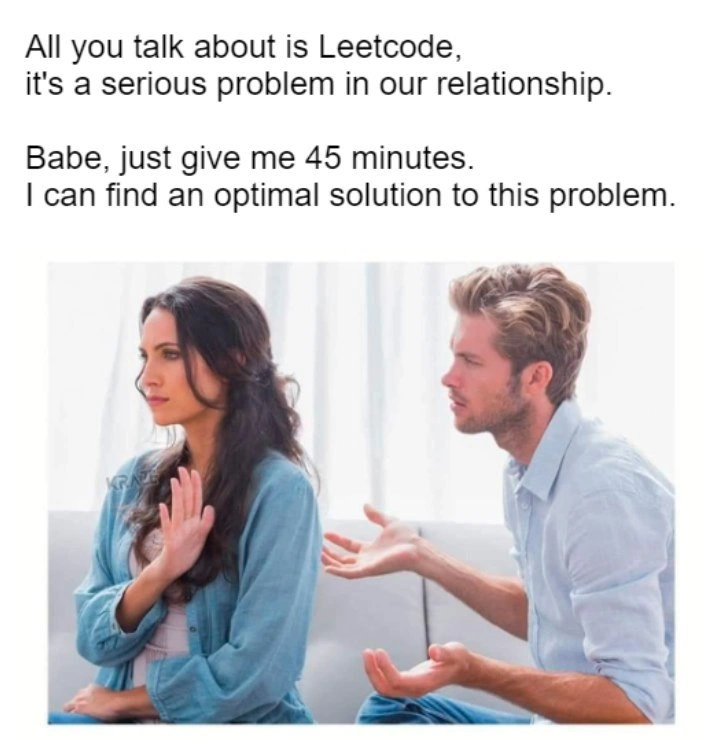
Stepping down to a seasoned developer’s perspective, this meme highlights the all-too-familiar clash between engineering mindset and real-life communication. The humor arises from the boyfriend acting like a software engineer 24/7 – applying his interview prep habits and algorithmic thinking to a relationship problem. The scenario is a classic case of misusing a hammer (coding skills) on a screw (emotional issues). In the image, the woman is clearly upset, saying “All you talk about is LeetCode, it’s a serious problem in our relationship.” That’s a heartfelt, human complaint about work-life balance (or rather, study-life balance): she feels neglected and probably overwhelmed by his singular focus on coding puzzles. The man’s response? “Babe, just give me 45 minutes. I can find an optimal solution to this problem.” This line is dripping with InterviewHumor – it’s exactly what a geek immersed in LeetCode problems would say, turning an emotional discussion into a mock coding challenge.
For a senior developer or anyone experienced in tech culture, several layers of satire are apparent here:
LeetCode Addiction: The meme riffs on the phenomenon of leetcode_addiction, where a developer becomes so engrossed in practicing coding problems (for job interviews or personal challenge) that it seeps into their everyday thoughts and conversations. The boyfriend seems to have one thing on his mind: data structures, algorithms, and cracking the next problem set. His partner’s complaint “All you talk about is LeetCode” is something many people dating techies might jokingly relate to. It signals he’s been neglecting normal relationship interaction in favor of endless coding drills. This is a tongue-in-cheek nod to how intense interview prep can consume a person – a well-intended pursuit (landing a better job) spirals into an obsession.
Optimal Solution Mindset vs. Emotional Needs: In engineering, we prize finding the optimal solution: the fastest algorithm, the least resource-intensive method. This optimal_solution_mindset permeates how developers approach problems – we’re trained to think every issue has a logical solution if we break it down. The boyfriend embodies this: he hears “serious problem in our relationship” and immediately jumps into problem-solving mode. 45 minutes is a sly reference to the standard length of a coding interview round or a timed algorithm design challenge. He basically treats his partner’s feelings as a LeetCode problem that he can debug or optimize within a fixed time window. To an experienced dev, this is hilariously misguided. It’s like trying to use a greedy algorithm to patch up an argument – grabbing a quick fix (maybe a flashy apology or a promise) hoping it yields an optimal outcome, without truly addressing the complexity beneath. Real relationships aren’t a leet code problem with unit tests you either pass or fail; there is no single “right answer” that maximizes happiness for all time. By focusing on an “optimal solution,” he’s missing the point that his partner likely just wants to be heard and valued, not solved.
Time-boxed Debugging of Feelings: The phrase “just give me 45 minutes” is rich with satire. In software teams, especially Agile environments, we often time-box tasks – allocate a fixed time to try something (like debugging a tricky bug for an hour, then reconsider). The boyfriend is treating this conflict like a piece of code throwing an exception that he can debug in a short session. This is a time_boxed_debugging approach to an emotional situation. From a senior perspective, it’s funny because we recognize the pattern: engineers sometimes try to schedule and compartmentalize even the intangible parts of life. But an argument with your partner isn’t a Jira ticket you can close in one sprint! There’s irony in imagining a stand-up meeting for their relationship: “I’ll resolve the non_technical_partner_exception in the next 45-minute sprint.” Of course, human emotions don’t adhere to sprint velocity. The humor (and cringe) is in knowing that trying to rush a sincere talk with someone you love because you think everything can be fixed on a tight deadline is a recipe for failure. It’s as absurd as telling your crying friend, “I’ve allocated 30 minutes to cheer you up, starting… now!”
“Unhandled NonTechnicalPartnerException”: This phrase isn’t in the image text, but it perfectly encapsulates the scenario from a coder’s viewpoint. In programming, an Unhandled Exception occurs when an error pops up that the code doesn’t know how to deal with, causing a crash. Here we have a NonTechnicalPartnerException – a playful made-up error type hinting that the partner doesn’t understand or respond to the technical jargon and approach. The boyfriend’s error is that he’s treating his partner like an API that will return a predictable output (“Thanks for the optimal solution, dear!”) after his input of logic and time. But instead, his approach throws an exception – she’s not having it. A seasoned developer will chuckle at this concept: he failed to catch (understand) the exception (her emotional needs) because he never wrote that part in his “relationship code.” In plainer terms, he didn’t switch out of engineer mode to communicate in a human way, so his plan crashes. This is a gentle poke at the stereotype that some engineers lack social skills or emotional intelligence, defaulting to rational problem-solving when what’s needed is empathy.
Big O vs Big Emotions: The tags hint at Big O notation, which devs use constantly in LeetCode and interviews to describe algorithm efficiency (
O(n),O(n log n), etc.). The boyfriend’s head is clearly full of Big O analyses – he probably narrates his day with complexity estimates (“Cooking dinner in O(n) time as n ingredients…”). But here’s the rub: you can’t measure emotional complexity on the same scale. A senior dev reading this might joke that the “time complexity” of resolving a relationship fight is more likeO(n^n)(extremely high) because every relationship history detail multiplies the complexity. The boyfriend is looking for an optimal algorithm as if minimizing runtime or steps, whereas his girlfriend is concerned about the quality of interaction, not how computationally efficient his response is. It’s a witty juxtaposition: he’s worried about optimizing, she’s upset about prioritizing (or lack thereof). The conflicting mindsets – algorithmic optimization vs emotional fulfillment – strike a chord with anyone who’s tried to balance intense technical projects with personal life.Interview Prep Culture Commentary: On another level, this meme satirizes the tech interview grind. Many in the software industry will recognize how prepping for big tech interviews (Google, Amazon, etc.) often means solving countless LeetCode problems and talking about little else. It can indeed strain one’s DeveloperLifestyle and relationships, because effective WorkLifeBalanceTips often say “have non-coding hobbies, spend time with loved ones,” but the pressure to land that dream job can push those tips aside. The boyfriend’s behavior, comic as it is, reflects a real pitfall: treating loved ones like just another part of your efficiency regimen. A senior developer has likely seen or experienced the burnout and tunnel-vision that come with all-night coding or interview prep marathons. The meme exaggerates it to the point of absurdity (nobody literally says they’ll optimize an argument in 45 minutes… right? 🙃), but it resonates because the exaggeration is rooted in truth. We’ve heard of friends or colleagues whose partners complained “he only talks about algorithms and code,” or of people scheduling life around coding practice sessions. This is the InterviewHumor shining through – it’s funny because it’s uncomfortably relatable in the tech world.
To a seasoned eye, the meme is both a laugh and a gentle facepalm. It’s a reminder that humans aren’t programs. The developer in the meme is applying textbook solutions (as if his girlfriend were a leetcode problem titled "SeriousRelationshipIssue.java") where he should be applying emotional intelligence. The text on the image reaffirms the comedic contrast: serious problem in our relationship vs. optimal solution in 45 minutes. Those two mindsets are oil and water. We laugh because we’ve perhaps been there in small ways – catching ourselves explaining something in tech jargon to a blank-faced partner, or trying to “fix” a loved one’s bad day with solutions when they just wanted comfort. The meme holds up a mirror to the dev community: in our quest to solve problems logically, we sometimes commit a type error, treating people like code. The senior-perspective lesson tucked under the humor? Not everything in life can be optimized or debugged; sometimes you have to step away from the whiteboard and just listen. And if you don’t, well, that’s one algorithm you’re bound to fail.
Level 4: NP-hard Emotions
At the most theoretical level, this meme humorously frames a relationship conflict as an NP-complete problem, a concept from computational complexity theory. In computer science, NP-complete problems (like the famous Travelling Salesman, 3-SAT, or Knapsack problems) are those notorious challenges that have no known efficient solution – the only way to find an optimal solution is often to brute-force through exponentially many possibilities. They belong to complexity class NP (nondeterministic polynomial time) and are as hard as any problem in NP; if you solve one NP-complete problem quickly (in polynomial time), you could essentially solve all NP problems quickly (implying P = NP, one of the biggest unsolved questions in CS).
In the meme, the boyfriend is treating his love life like a tough algorithmic puzzle. By saying “give me 45 minutes, I can find an optimal solution”, he’s implicitly casting their relationship issues as a hard computational problem that he can crack within a typical coding interview time limit. The phrase NP-complete here is a geeky hyperbole: it suggests their relationship problem is as difficult as the hardest algorithm design challenges known. Real NP-complete problems (like planning the perfect route for the Traveling Salesman or solving a complex Sudoku) tend to blow up in complexity as they grow – the time to solve can grow exponentially (often on the order of O(2^n) or worse). The joke is that he’s optimistically acting like a relationship snafu can be “solved” with the same approach one might use for a LeetCode puzzle, even though emotionally it’s as intractable as an NP-hard problem with a huge input size.
This is amusing to those with a CS fundamentals background because he’s effectively claiming he’ll crack an NP-complete problem optimally in a short, fixed time – a feat roughly equivalent to proving P = NP (and likely earning a Millennium Prize!). It highlights the absurdity of applying computational problem-solving to human emotions: there’s no polynomial-time algorithm for winning an argument with a hurt partner. If love and emotions were an algorithmic problem, they’d be filled with an astronomically large number of states (feelings, memories, hopes) that don’t neatly reduce to binary variables. Solving such a “relationship_optimization” would require exploring countless combinations of apologies, compromises, and understanding – akin to brute-forcing every possible solution path. Just as an NP-complete puzzle often forces you to explore exponential possibilities for the true optimum, a strained relationship might need open-ended effort and empathy, not a quick formula. The boyfriend’s optimal_solution_mindset is comically out-of-place: it’s like he’s trying to run a deterministic algorithm on a nondeterministic problem domain.
His confidence in finding “an optimal solution” in 45 minutes also satirizes the ritual of coding interviews. In those interviews (often prepped for on LeetCode), candidates are expected to devise an optimal or near-optimal algorithm under tight time constraints. The meme exaggerates this mindset – he’s reducing a complex interpersonal conflict to an algorithmic challenge with a clear-cut optimal answer. In theory, even if you had a well-defined objective function for “relationship happiness,” optimizing it would be a multi-variable, NP-hard problem (humorously akin to the Traveling Salesman Problem of navigating feelings or a Boolean satisfiability problem of meeting both partners’ needs). By invoking “NP-complete”, the meme taps into a deep well of computer science irony: the guy might as well be trying to solve an undecidable problem or a halting-problem of love if he thinks raw computation can mend hurt feelings on a schedule. The reference tickles the brain of anyone who knows how intractable NP-complete problems are – we immediately get that the boyfriend’s approach is as doomed (and mathematically absurd) as trying to brute-force a solution to a massively complex puzzle while the clock ticks down.
In summary at this deep technical layer: the humor comes from conflating emotional conflict with computational complexity. It’s a delightful clash of domains – treating love like it’s subject to the rules of Big O notation and complexity classes. The boyfriend behaves as if relationship issues have an efficient algorithmic solution, ignoring that NP-hard truth: no algorithm will magically yield a quick, perfect resolution to matters of the heart (unless he discovers some groundbreaking algorithm modern science hasn’t found!). His partner’s frustration is the real-world equivalent of an NP-hard problem: too complex for a naive quick fix. The meme winks at those of us who spent nights studying algorithm complexity – we instantly recognize that a “relationship = NP-complete” analogy means “there’s no easy solution, buddy”. It’s a clever, nerdy exaggeration that underscores just how inappropriate and ineffective this logical, time-boxed approach is when applied to the exponential complexity of human feelings.
Description
A meme featuring a stock photo of a couple in conflict. The woman, looking away with a dismissive hand gesture, says, 'All you talk about is Leetcode, it's a serious problem in our relationship.' The man, looking earnest and slightly confused, replies, 'Babe, just give me 45 minutes. I can find an optimal solution to this problem.' The humor arises from the programmer's quintessential mistake of applying rigid, logical, problem-solving frameworks to complex emotional issues. His response perfectly mirrors the language and constraints of a typical coding interview challenge (e.g., Leetcode), where finding an 'optimal solution' within a time limit is the goal. For senior developers, this meme is a relatable and humorous take on the tunnel vision that can occur during intense periods of job preparation or deep focus, where every problem starts to look like a nail for their algorithmic hammer, highlighting a common blind spot in engineer-to-human communication
Comments
15Comment deleted
He's still trying to figure out the time-space complexity of their arguments
The real back-tracking algorithm isn’t on LeetCode - it’s explaining to your partner why O(log n) cuddle time should satisfy SLA
He's about to discover that relationship problems have O(n!) complexity where n is the number of things you did wrong in the past five years, and memoization just makes it worse
When you've spent so long optimizing for O(log n) that you forget relationships require O(n²) emotional investment - and no amount of dynamic programming will memoize your way out of this one. The real edge case here is thinking you can binary search your way to relationship stability
Relationships: the one NP-hard problem where no dynamic programming memoization saves you from the timeout of endless Leetcode monologues
Optimizing for Big-O instead of SLOs - no DP in 45 minutes fixes a long-running, stateful relationship with changing requirements
Relationships are NP-hard with evolving requirements - skip the 45‑minute optimal search and run an iterative, feedback-driven heuristic with decent observability
Leetcode is a cancer of the hiring process, and it definitely doesn't show the problem solving skills of a software engineer. Change my mind Comment deleted
What does? Comment deleted
Showing your pet project, which solves some real-life business problem (or at least, imitation of it, if we are talking about some fintech apps). Reviewing, what technologies/frameworks were used, what if the reason of this choice. What could be improved, e.t.c Comment deleted
and then bro hits yuo with that O(n!) code 💀🙏🙏 Comment deleted
Yeah, could be. But it's not necessary to spend 24/7 on solving pointless tasks "in vaccum" in order to understand what is Big O notation, and acknowledge some of the common patterns on how not to write code (not to put triple nested loop, for example). Companies nowadays, especially tech giants, like Google, created a cult around stupidly memorising patterns from Leetecode just to pass an algorithmic interview. And what's even worse, that many companies, which are definitely NOT Google (or any other MAANG company) by any means, inherited that stupid algo brainfuck with livecoding. And then they will whine about how "cAnDiDaTeS NoWaDaYs aRe sO TeChNiCaLlY UnPrEpArEd.". Comment deleted
leetcode will at least indicate that your knowledge of complexities are not limited to only theories but that you also practiced a lot and more confident in solving problems Comment deleted
That's debatable. Some HR could assume if you have a big pet project you'll spend a lot of free time on it and will be less productive at work 🫣 Comment deleted
But should I really look for a job if I have a project that solves a real life business problem? Besides, most companies usually ask questions that you listed in addition to algorithmic ones Comment deleted