Merging long-lived branches feels like dropping Mentos into a Coke tank
Why is this VersionControl meme funny?
Level 1: Big Fizzy Mess
Imagine you and your friend each have a separate toy castle you’ve been building without talking to each other. One day, you decide to connect these two half-castles into one big castle. But uh-oh — your half has a door where your friend’s half has a wall, and your friend built a tall tower that now blocks a road on your half. When you try to put them together, nothing fits and pieces start popping off. It turns into a big mess, and you both look at it like, “Whoa, that exploded!”
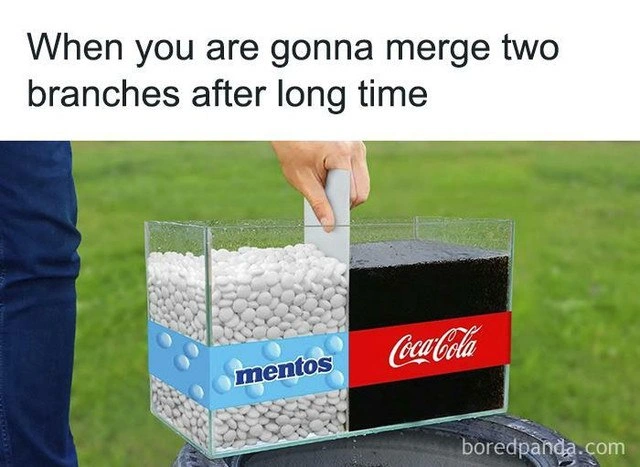
That’s exactly what this funny picture is showing, but with candy and soda to make it even clearer. On one side, there’s a bunch of Mentos candies (those mint candies) and on the other side there’s a tank full of Coca-Cola. If you’ve ever seen what happens when Mentos candies drop into Coke, you know it foams up super fast and spills everywhere, like a bubbly volcano. In the picture, a person is lifting the divider that’s keeping them apart. The text says this is like “merging two branches after a long time.” In simpler words: it’s comparing mixing code that’s been kept separate for too long to mixing Mentos and Coke. You just know it’s going to erupt!
It’s funny because everyone can see the chaos coming – it’s both exciting and scary in a silly way. The poor programmer (like the person pulling the divider) is about to have a big sticky soda mess to clean up. Developers laugh at this because it’s so true to their experience: if they wait too long to combine their work, they get a crazy surprise and a lot of trouble, kind of like a soda explosion. Even if you’re not a programmer, you can understand the joke: don’t put things off for too long, or you might end up with a big fizzy mess!
Level 2: Explosive Code Merge
Let’s break down what’s happening here in simpler terms. Git is a popular tool used in VersionControl to manage and track code. It allows developers to create branches, which are like separate copies of the code where one can work on new features or fixes without disturbing the main code. Think of a branch as a sandbox or a parallel timeline of your project. For example, say you want to add a new level to a game: you’d create a branch (let’s call it new-level), build the level there, and later merge it back into the main project once it’s ready.
A long-lived branch is a branch that has been lingering out there for a long time, accumulating changes while the main branch (often called master or main) also keeps moving forward with other people’s updates. Over time, the two branches drift farther apart. It’s like two friends writing separate chapters of a story without talking to each other – unsurprisingly, their chapters might not fit together when merged. The longer the branches live separately, the more different they become. This difference is what makes merging them after a long time so risky and volatile (just like how keeping Mentos and Coke apart builds up the anticipation for a big reaction once mixed).
Merging in Git is the act of combining the changes from one branch into another. If only one person changed the code, merging is usually straightforward. But in a team, multiple branches mean multiple people changing possibly the same parts of code in parallel. When you finally say “merge these two branches,” Git will go through each file and line that’s been touched on both sides and try to figure out how to blend them. If the branches don’t touch the same code, Git can easily put the changes together (this is called a “fast-forward” or a clean merge). However, if both branches edited the same line or section in different ways, Git gets confused – it doesn’t know which version to keep. This situation is a merge conflict.
A merge conflict is basically Git waving a flag saying, “I have two conflicting changes here, I need a human to decide what to do.” When that happens, Git stops right in the middle of the merge and marks the conflict in the affected files. For example, let’s say the main branch and your feature branch both changed the same line of code differently. Git will insert special markers in the file to show you the two versions, like this:
<<<<<<< HEAD (main branch)
int threshold = calculateThreshold(data);
=======
int threshold = computeThreshold(data);
>>>>>>> feature-branch
// ^^^ Merge conflict: two different implementations for the same line
In the snippet above (using a diff format), the code between <<<<<<< HEAD and ======= came from the HEAD (your current branch, e.g. main), and the code between ======= and >>>>>>> feature-branch came from the other branch you’re trying to merge (named feature-branch). The developer’s job is to resolve the conflict by deciding which code (or what combination) is correct and then deleting these markers. When you have a long-lived branch, you don’t just get one conflict like this — you might get hundreds of them across many files. It’s like every Mentos candy is dropping into the Coke one by one, each causing a mini eruption, and you have to clean up each fizzy overflow manually. 😅
Now, the meme shows this in a single image. On the left, we have a bunch of Mentos candies behind a glass labeled “mentos,” and on the right, a big tank of Coca-Cola behind a “Coca-Cola” label. A person’s hand is lifting the divider that currently keeps the Mentos and Coke apart. The caption on the meme says, “When you are gonna merge two branches after long time.” This setup is a perfect analogy: the two branches of code are represented by the two separated substances. Each side by itself is stable — Mentos sitting quietly, Coke just being soda. Similarly, each branch of code on its own seems to work fine. But the moment you merge them (i.e., remove the divider), those Mentos are going to drop into the Coke and BOOM! – an explosive reaction occurs. In real life, Mentos candies cause soda to rapidly fizz and overflow everywhere (a classic messy experiment many of us have seen). In the coding world, merging two out-of-sync branches causes a cascade of conflicts, errors, and surprises to overflow your workflow. It’s a big, sudden mess that the developer has to deal with.
This is funny to developers because it’s a dramatisation of a very real problem. If you’ve ever opened a Pull Request on GitHub to merge a branch that hasn’t caught up with main in a long time, you know the anxiety. Reviewers see thousands of line changes, CI tests start failing, and you get hit with merge conflict alerts — it’s like a soda explosion in your code. You’ll hear developers jokingly refer to this situation as “integration hell” or “merge madness.” There’s even a common best practice: “merge early, merge often” to avoid this scenario. That means it’s better to keep integrating your changes frequently (so differences stay small and manageable) rather than procrastinating the integration. It’s much easier to clean up a small fizzy overflow (one or two conflicts) than a whole tank erupting at once. In other words, dropping one Mentos in a soda might give a little fizz that you can quickly wipe up; dumping an entire pack of Mentos in at once will send a geyser of soda to the ceiling!
So, the meme is a light-hearted warning. It highlights the importance of good branch management strategy in a comical way. Developers who see this chuckle because they’ve been there: they’ve felt that mix of dread and hilarity seeing someone remove that “safety divider” after far too long. It captures a slice of DeveloperExperience_DX – those painful lessons you learn about coordinating code with your team. And even if you’re new to coding, the image of a Mentos-Coke eruption is an easy way to understand “This merge is going to be a big, crazy deal.” It’s both a joke and a teaching moment: don’t let your code branches drift apart for too long, or you’ll be in for a messy merge!
Level 3: Integration Hell in a Bottle
When two long-lived branches finally unite, it’s like a Mentos-and-Coke experiment for your codebase. In the meme’s image, we see a clear container with a divider: one side packed with Mentos candy (white, harmless-looking pellets) and the other filled with dark fizzy Coca-Cola. This divider is about to be yanked out, analogous to hitting the big red merge button on two branches that have been isolated for ages. Any seasoned developer knows this feeling: the moment of suspense before all hell breaks loose.
In Git (the ubiquitous distributed version control system), merging branches that have diverged for a long time is notorious for triggering an explosion of merge conflicts. Each branch has been a parallel universe of development: features added, functions renamed, maybe entire modules re-architected. By the time you attempt to combine them, their histories have significantly diverged. Git’s merge algorithm will try to automatically reconcile changes by doing a three-way merge (using the common ancestor as a base). But after a long separation, the two branches often disagree on many of the same lines of code. It’s as if each Mentos in that tank represents a conflicting change, and the Coke represents the volatile mix of the main codebase — remove the barrier, and you get a foaming cascade of conflicts. Integration_hell gets unleashed as dozens of <<<<< HEAD and >>>>> conflict markers spew out into your project files, much like soda foam overflowing everywhere.
Why is this so chaotic? Imagine one branch silently refactored a core class (renamed methods, changed APIs) while the other branch built new features on the old interface. Or perhaps both branches coincidentally fixed the same bug in two different ways. The result is that each branch’s code can be fundamentally at odds with the other. When you finally merge, GitBranching reality hits: the version control system thrashes trying to reconcile two alternate histories. The humor here is that everyone knows what’s coming — just like dropping Mentos into Coke, combining huge disparate code changes has an inevitably explosive outcome. It’s a true merge_pain. The text above the image, “When you are gonna merge two branches after long time,” captures that ominous moment of bracing yourself.
For veteran developers, this meme elicits a pained, knowing laugh. It satirizes the classic big-bang integration disaster. In the bad old days of long release cycles, teams might develop in isolation for weeks or months (hello, feature branches that live forever) and then try to integrate everything at the end — often right before a deadline. The result? Broken builds, frantic bug fixing, late nights, and a lot of “how did this ever work?” moments. It’s basically the software equivalent of a lab explosion. This is why modern teams invest in good BranchManagementStrategy and continuous integration (CI): merging small changes frequently (adding one Mentos at a time, so to speak) to avoid building up that explosive pressure. The meme’s brilliance is pairing a universally understood chaotic reaction with a developer scenario we’d all rather avoid. It’s funny because it’s true — every experienced dev has either witnessed or cleaned up after a merge that erupted in conflicts. It’s comedic catharsis for anyone who’s been in the trenches diffing hundreds of files after merging a huge branch. The Mentos and Coke metaphor says it all: delayed_integration is a recipe for an eruption, and you’re gonna need more than a mop to clean up the aftermath in your repository.
Description
The meme shows a photo of a rectangular glass container split down the middle by a removable divider. On the left side are dozens of white Mentos candies with a blue "mentos" label on the glass; on the right side is dark Coca-Cola with a red "Coca-Cola" label. A hand is pulling the divider upward, about to let the two volatile substances collide. Above the image, large text reads: "When you are gonna merge two branches after long time." The visual joke equates the explosive Mentos-in-Coke reaction with the chaos and merge-conflict explosion that often happens when two Git branches diverge for too long before integration
Comments
11Comment deleted
Merging that ten-month “just a quick spike” branch is the Git equivalent of dropping Mentos in production - CI pipelines start foaming, conflict markers geyser past 10k, and some optimist still asks, “Couldn’t we just rebase?”
The real explosive reaction happens when you realize the 'small refactor' on main branch touched every file the feature branch modified, and now your IDE looks like a Christmas tree of conflict markers while the PM asks if you can still ship by EOD
This perfectly captures the moment of existential dread when you realize your 6-month-old feature branch has 847 commits behind main, and your carefully crafted architectural decisions are about to collide with three major refactors, two dependency upgrades, and that one developer who 'fixed' the entire codebase formatting. The explosion isn't the merge itself - it's explaining to your PM why the 'simple merge' will take three days and require a team-wide code freeze
Monorepo + two quarters of drift: git merge becomes a Mentos demo - schema drift meets dependency foam, and the only fast-forward is the rollback
Weeks of drift plus a "merge" is offline replication without a CRDT - enjoy the CI geyser
Merging branches diverged since the last release: Mentos in Coke erupts predictably; your diff does so with 50 files changed across 10k lines
1 mentos + coke = awesome fun - but this case with the two insane amounts of mentos and coke… it won’t do anything - just look for it on youTube, as this is not a funny meme 🤷♂️ Comment deleted
I think it specifically needs a bottle-like structure to react like usual. Comment deleted
if the opening on the top is too big, it's just gonna bubble a bit and that's it. You need to trap the CO₂ like the children in my basement Comment deleted
oh dear… Comment deleted
maybe 😏 but this one won’t do the trick Comment deleted