Skip to content
DevMeme
6342 of 7435
The Emotional Rollercoaster of Debugging Packet Loss
Networking Post #6955, on Jul 16, 2025 in TG

The Emotional Rollercoaster of Debugging Packet Loss

Why is this Networking meme funny?

Level 1: From Sad to Glad

Imagine you’re trying to talk to your friend, but you can’t reach them – you keep calling out “Hello, hello?” and there’s no answer. 😟 You feel worried and upset because you really need to talk to them. Then, all of a sudden, your friend shows up and says “Hi, I’m here!” 😃. You’d go from feeling super sad to super happy in one second, right? That’s exactly the feeling this meme is showing, but with computers and an engineer.

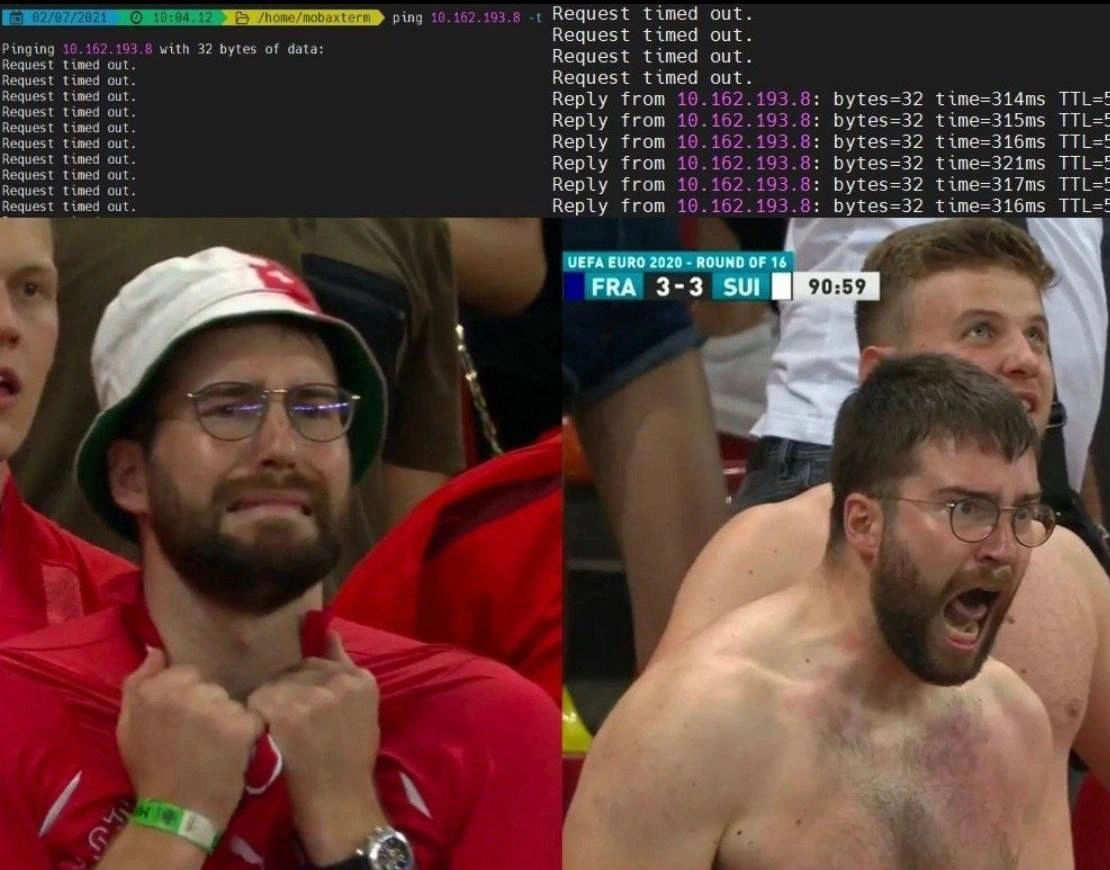
In the top part, the computer was “silent” (not answering the engineer’s call, which is the ping). The words “Request timed out.” are like the silence or no-answer – the computer didn’t respond. The engineer is really concerned, kind of like when you think your toy is broken or your friend is missing. In the bottom-left picture, that man in red (a soccer fan from Switzerland) is making a very worried face, almost crying, because he thinks his team is about to lose a big game. That’s the same way the engineer feels when the computer is not responding at all.

Now look at the next part: suddenly the computer answers! The screen shows “Reply from 10.162.193.8…” which means the computer finally said “I’m here, I’m here!” The problem is fixed! The bottom-right picture shows the same fan a few seconds later, and now he’s extremely happy – he even pulled off his shirt and is yelling in joy. He’s celebrating because his team just scored a goal at the last minute, making him go from totally hopeless to unbelievably excited.

This meme is funny because it shows that engineers can feel just as emotional as sports fans when something important happens. One moment the engineer was as sad and stressed as can be, and the next moment he’s as happy as a person whose team just made an epic comeback. It’s a simple from sad to glad story. You don’t even need to understand computers to get it: something bad was happening, then it turned good unexpectedly, and our “hero” reacted with dramatic joy. Just like you might jump up and down when you fix a toy that was stuck, or when you find something precious you thought you lost, the engineer is over the moon when the computer comes back online. The shirt flying off is just a silly way to show how incredibly happy he is. 🎉 In short, the meme is saying: “I was terrified and about to cry, but then things worked out and I couldn’t be happier!” It’s a big happy ending, with a tech twist.

Level 2: Connectivity Lost and Found

Let’s break down what’s happening in this meme in simpler terms. The top images show a terminal (command-line window) where an engineer is running the ping command:

$ ping 10.162.193.8
Pinging 10.162.193.8 with 32 bytes of data:
Request timed out.
Request timed out.
Request timed out.
Reply from 10.162.193.8: bytes=32 time=314ms TTL=55
Reply from 10.162.193.8: bytes=32 time=315ms TTL=55

In plain English, ping is a basic networking tool that asks another computer “Are you there?” by sending a small packet of data. If the other computer is reachable and awake, it answers back with a reply. In the snippet above, Request timed out. means the ping’s question got no answer – the target computer at 10.162.193.8 didn’t respond in time. This usually means that machine is either offline, too slow, or there’s some network problem blocking the path. You can imagine calling someone and just getting silence; that’s the feeling here. We see multiple timeouts in a row, suggesting the problem persisted for a bit (several seconds at least).

Suddenly, we see “Reply from 10.162.193.8 … time=314ms”. That’s the moment the target answered. The ping finally got a response, with a round-trip time of 314 milliseconds (ms). 314ms is a third of a second – not super fast, possibly indicating the network was a bit sluggish or took a detour, but the key part is it replied. The TTL=55 is a technical detail (Time To Live) that isn’t super important here except it hints how far away the machine might be in network terms. The main point: the connection was down, and now it’s up. Connectivity lost, and then found again.

Now, who’s running this ping and why do they care so much? Likely a Site Reliability Engineer (SRE) or devops person who is on call, meaning they’re responsible for fixing issues that happen in production (the live, user-facing environment). If something in production goes wrong (like a server goes down), an alert goes off – often via a service like PagerDuty – waking the on-call engineer. In our meme scenario, imagine it’s late at night and this engineer got a page that some internal service at 10.162.193.8 wasn’t reachable. They hop on their computer, open a MobaXterm session (a popular terminal tool), and start pinging that IP to gauge what’s happening. Every “Request timed out” is making them more anxious because it confirms the service is indeed unreachable. This is the Debugging_Troubleshooting phase where they’re trying to pinpoint the issue. Maybe they’re also checking logs or network monitors in parallel, but nothing is more visceral than a simple ping test failing — it’s the simplest sign of “we have a problem”.

The bottom half of the meme uses images from a UEFA Euro 2020 soccer match (France vs Switzerland, Round of 16). The swiss_fan_meme became famous because TV captured this Swiss fan’s extreme emotional swing: in one moment (left picture) he’s on the verge of tears, clutching his team jersey with a distraught face, thinking all is lost as the clock ticks 90+ minutes with a tied game (or fearing loss). In the next moment (right picture), Switzerland scores and he’s overjoyed – he ripped off his shirt in celebration, screaming with absolute jubilation. He’s literally shirtless and ecstatic. The meme caption jokes, “That moment the ping replies and your SRE shirt vanishes,” directly comparing the SRE to this fan. The SRE’s “shirt” in question is figurative – if the engineer was wearing an SRE team t-shirt, it just might fly off in that euphoric moment of victory when the system comes back online! It’s a humorous exaggeration, of course. Realistically, most on-call engineers won’t actually strip their clothes off when an incident resolves 🕺. But emotionally, they might want to!

So, in summary, the meme paints a picture of an OncallLife incident: first, utter fear and stress (like a sports fan watching their team about to lose) as the pings keep timing out. Then, incredible relief and joy (like seeing a last-second goal) when a ping finally succeeds. It’s DevOpsHumor because it takes a very real situation in IT – frantically troubleshooting a network outage – and uses a funny real-life sports analogy to show how it feels. Even if you’re a junior developer or just learning about production support, you can probably imagine the scenario. Think of times you’ve had a system not work, then suddenly start working again – that flip from frustration to “Yesss!” is exactly what’s captured here. The networking terms (ping, latency, timeout) are basically the technical backdrop for what is a human moment of despair turning into celebration. The meme cleverly ties the dry world of CLI tools and DebuggingFrustration to the high emotions of a football match. And honestly, anyone who’s waited on a slow internet connection or a crashed game to reconnect has tasted a bit of this feeling.

Level 3: On-Call Rollercoaster

For anyone who’s been the on-call SRE (Site Reliability Engineer) during a production outage, this meme hits like a shot of espresso. It perfectly maps the emotional rollercoaster of a ProductionIncidents war room onto the famous Swiss fan’s despair-to-ecstasy moment. On the left, we have the terminal output monotonously repeating “Request timed out.” – each line a gut-punch of panic as your service isn’t responding. This is the DebuggingFrustration phase: you’re checking every cable, scrutinizing firewall rules, maybe muttering “it’s always DNS” even though you know you’re pinging an IP (10.162.193.8 is clearly an internal_subnet address, no DNS needed here). The bottom-left image of the Switzerland supporter clutching his jersey with tearful eyes says it all – that’s the exact face of an engineer watching monitor graphs flatline or a ping cursor blinking with no reply. It’s the “oh no, we’re down” moment, complete with racing heart and a quick prayer to the uptime gods.

Then comes the flip. In the top-right, out of nowhere, the terminal erupts in a flurry of successful ping replies. The text turns from white to purple (in the screenshot’s color scheme), as line after line reports Reply from 10.162.193.8: bytes=32 time=... TTL=55. Translation: host is alive! Packets are coming through. That is the all-clear. In an ops bridge at 3 AM, this is when you hear someone shout, “I got a reply! It’s back up!” and the whole team collectively exhales. The bottom-right image – the same fan now shirtless, screaming in triumphant joy – is a one-to-one mirror of the SRE team’s reaction. The meme’s caption “That moment the ping replies and your SRE shirt vanishes” is cheeky and literal: our Swiss fan yanked off his red jersey in celebration, and we imagine our SRE doing the same with whatever company on-call shirt they’ve been sweating in. It’s DevOpsHumor at its finest, depicting how an 80-byte ICMP packet can induce stadium-level euphoria in an operations engineer.

Why is this so funny to those in the know? Because it’s OncallLife distilled to a meme. The stakes in that Euro 2020 match were sky-high – Switzerland was on the verge of elimination until a last-minute goal. Likewise, in a critical outage, every minute feels like an hour and you’re bracing for the worst (customer complaints, pager alarms escalating, maybe your boss awake on the call). The moment connectivity is restored – whether by your fix or spontaneously (which, let’s be honest, happens a lot: things just start working again and you’re not sure why) – is pure elation. It’s the tech equivalent of scoring that 90th-minute equalizer. One second, you’re contemplating the collapse of half your architecture; the next, you see green across your dashboards and want to do a victory lap in the office. That fan_emotional_swing from panic to jubilation is genuinely what it feels like to resolve a major outage.

The meme resonates especially with senior engineers because they’ve lived this scenario multiple times. They know the unspoken rule: celebrate quietly, because the fight might not be over – but for that instant, you better believe we’re all internally the shirtless Swiss superfan. After hours of tension, seeing a ping succeed is almost tear-jerking. Sure, a true veteran will later scrutinize those 314ms responses and comb the logs to understand the root cause (and write up the inevitable incident post-mortem). But in the heat of the moment, when that first icmp_echo_reply comes through, it’s pure, unfiltered relief. The meme is tongue-in-cheek proof that even the grizzled, cynical ops folks have a sports fan inside them – one who will scream and throw their shirt in the air when “service up!” flashes on the scoreboard.

Level 4: Partition Palpitations

At the deepest technical level, this meme highlights the unforgiving reality of network partitions and the heart-racing drama they cause. In distributed systems theory, one of the classic fallacies is assuming the network is reliable. Here, the endless Request timed out. messages are a textbook illustration of that fallacy biting hard. The ping 10.162.193.8 command is sending out ICMP Echo Request packets into the void of an internal network, and for agonizing seconds nothing comes back – a 100% packet_loss situation. This could indicate a transient network failure: perhaps a core switch crashed or a routing table freaked out. In practical terms, the target host was partitioned away, unreachable just like an isolated node in a distributed cluster. Seasoned SREs know this is the “P” in the CAP theorem (Consistency, Availability, Partition tolerance) playing out in real time – you can’t escape physics and faulty cables.

Notice the moment of resurrection: suddenly purple text lines Reply from 10.162.193.8: bytes=32 time=314ms TTL=55 appear. That’s an icmp_echo_reply finally getting through, likely after some low-level network convergence. A senior network engineer might infer that a dynamic routing protocol (say OSPF or BGP) just healed the path. The relatively high time=314ms and the peculiar TTL=55 hint that the packets took a long detour through many hops (each hop decrements the TTL). In other words, the network found a non-optimal but working route to that internal_subnet. This is a mini connectivity_restored miracle: one second the address was a black hole, the next second the packets find their way home. It’s like a broken circuit snapping back in place, or a partitioned database node rejoining the cluster after consensus. To a battle-scarred engineer, those ping replies are as thrilling as a heartbeat restarting – the system’s pulse is back!

Under the hood, countless things could have happened to cause this whiplash. Perhaps an ARP cache timed out and had to refresh, or a misconfigured firewall rule was suddenly fixed, or the intern tripped on a cable a flapping switch stabilized. Regardless, the fundamental lesson stands: Networking issues can be capricious, and even simple CLI tools like ping surface deep truths about system resilience. A Site Reliability Engineer knows to expect these blips in OnCall_ProductionIssues – designing for them with retries and failovers – but when they hit at 3 AM, no amount of design stops the surge of adrenaline. This meme captures that exact moment when the impossible problem suddenly connectivity_restored itself. It’s a nod to both the unforgiving complexity of our networks and the almost primal relief when the system comes back from the dead. In essence, the “ping” became a defibrillator for our sanity, and that purple text is the sweet ECG spike saying “it lives!”

Description

This is a three-part meme that juxtaposes a technical problem with a raw emotional reaction. The top panel shows a dark-themed terminal window running a continuous ping command (`ping 10.162.193.8 -t`). The output begins with a long series of 'Request timed out.' messages, indicating a network connectivity failure. The bottom-left panel features the first half of the 'Stressed Swiss Fan' meme: a man with glasses and a white bucket hat, wearing a red shirt, looks extremely anxious and is nervously clutching his collar. This image is aligned with the ping failures. The bottom-right panel displays the second half of the meme: the same fan, now shirtless, is yelling triumphantly. This image is aligned with the latter part of the terminal output, which now shows successful 'Reply from 10.162.193.8' messages with latency details. A small overlay in the right panel shows a football score 'FRA 3-3 SUI' at 90:59, indicating the meme's origin from a UEFA Euro 2020 match. The meme perfectly captures the agonizing tension and sudden, explosive relief experienced by developers or SREs when troubleshooting an intermittent network issue. The moment the pings start replying is a universal symbol of hope and success in the world of IT

Comments

9
Anonymous ★ Top Pick There are two states of network debugging: 'It's definitely DNS' and the sheer, unadulterated bliss of seeing that first TTL=5x after a sea of 'Request timed out'
  1. Anonymous ★ Top Pick

    There are two states of network debugging: 'It's definitely DNS' and the sheer, unadulterated bliss of seeing that first TTL=5x after a sea of 'Request timed out'

  2. Anonymous

    Nothing upgrades an SRE’s mood faster than watching a wall of “Request timed out” flip to 300-ms ICMP echoes - suddenly the post-mortem needs a dress code

  3. Anonymous

    The only thing worse than debugging a distributed system at 3am is watching your stream buffer during injury time of a penalty shootout - at least with the distributed system, you can blame eventual consistency instead of your ISP

  4. Anonymous

    The five stages of network troubleshooting: denial (it's probably DNS), anger (why is everything timing out?), bargaining (please just one successful ping), depression (I'll have to check the physical layer), and acceptance (oh, it's responding now - time to pretend I knew what I was doing all along). That 314ms latency though? Still filing a ticket

  5. Anonymous

    Eight timeouts, then 300ms replies - BGP clearly heard the incident bridge spin up and reconverged out of shame

  6. Anonymous

    31ms LAN pings with a rogue timeout: the networking CAP theorem picking partition tolerance right as your leaderboard query flakes

  7. Anonymous

    After 90 minutes of “Request timed out,” replies arrive with 316ms RTT and a TTL lower than my patience - classic on-call fix: wait for the firewall to actually propagate

  8. @ArtTwink 0y

    Mobaxterm? 5 years old meme? wow

    1. @Agent1378 11mo

      You call this old? Now, that's old!⬆️

Use J and K for navigation