Skip to content
DevMeme
4717 of 7435
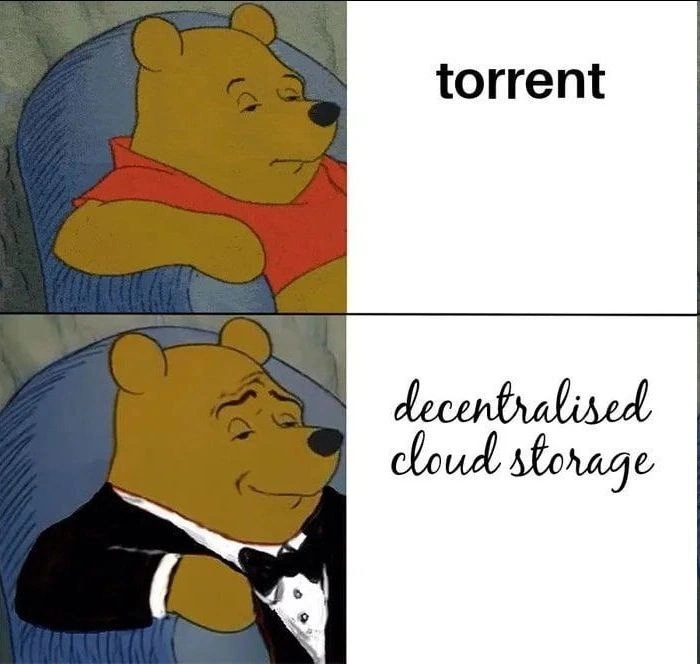
Rebranding torrents as sophisticated “decentralised cloud storage” for tech buzzword points
Storage Post #5168, on May 2, 2023 in TG

Rebranding torrents as sophisticated “decentralised cloud storage” for tech buzzword points

Why is this Storage meme funny?

Level 1: Fancy Name, Same Idea

Imagine you want to bake cookies, but you don’t have all the ingredients. You go to one neighbor for eggs, another neighbor for sugar, and a third for flour. In the end, you’ve gathered everything you need from lots of people and you bake your cookies. In simple terms, you shared resources with friends to get something done. Now, think of someone describing this very normal situation in a really fancy way: “I’ve implemented a decentralized baking supply network for cookie production.” 😄 That’s just a grand way of saying “I borrowed ingredients from multiple neighbors.” It’s the same idea dressed up with big words. The meme is joking about that. Calling torrents “decentralised cloud storage” is like using a fancy label for something ordinary – it doesn’t change the cookies, it just makes people think it’s a high-tech new idea when it’s really the same friendly neighbor sharing in a tuxedo.

Level 2: Peer-to-Peer Primer

Let’s break down the terms in this meme. Torrent (short for the BitTorrent protocol) is a method of downloading and sharing files by connecting directly to other people’s computers rather than from one big server. It’s a form of peer-to-peer (P2P) storage and sharing. In a normal download, you might fetch a file from, say, Google Drive or another single website (that’s client-server model: your computer is the client, Google’s server sends the file). In torrenting, your computer (using a BitTorrent client program like μTorrent or Transmission) simultaneously downloads bits of the file from many other users (peers) who already have those bits, and also uploads bits to others. All these peers collectively form a swarm distributing the file. There’s no central machine that holds the entire file; instead, the file is split into pieces among everyone. This is what we mean by distributed storage or decentralized sharing – the file comes from a network of users rather than one place. It’s very efficient and resilient: even if one source goes offline, you can get missing pieces from another source. This concept has been around for a while and is exactly how BitTorrent works behind the scenes.

Now, cloud storage generally means storing files on remote servers accessible over the internet – typically provided by companies (like Amazon S3, Dropbox, Google Cloud). When you use cloud storage in the conventional sense, you’re still usually getting your file from a data center (just “someone else’s computer” in a big building). It’s centralized in the sense that one company or service provider is in charge of those servers. Decentralised cloud storage is a fancy phrase implying that the storage is cloud-like (available online, scalable) but not controlled by any one company or location – instead, it’s spread across lots of ordinary computers (decentralized). If that sounds a bit like how torrents use lots of peers, that’s exactly the connection the meme is highlighting. It’s basically saying: “Hey, torrents are already a decentralized way to store/transmit files…we just never called it ‘cloud’.”

In the meme image, Winnie-the-Pooh is used to symbolize this difference in attitude. In the top panel, Pooh looks bored and the label is just “torrent” in plain text – implying people see it as nothing special or even something sketchy. In the bottom panel, Pooh is all dressed up in a tuxedo, looking proud, next to the words “decentralised cloud storage” written in an elegant font – implying this sounds impressive and modern. It’s the same Pooh, just like it’s the same underlying idea, but rebranding it makes it appear new and sophisticated. The meme humorously points out how just changing terminology can change people’s perception.

Let’s clarify a few terms to ensure everything’s clear:

  • Peer-to-peer (P2P): This means computers (peers) talk directly to each other and share resources, rather than all connecting to a single central server. In a P2P file sharing context, everyone downloading is also potentially uploading to others. BitTorrent is a peer-to-peer protocol for sharing files.
  • BitTorrent client: This is a program that implements the torrent protocol, managing connections to many peers. It handles downloading pieces of the file and uploading pieces you have to others. Examples include μTorrent, qBittorrent, or Transmission. The client also verifies each piece by its hash to ensure it’s not corrupted or tampered with.
  • Decentralized storage: Generally, storage that isn’t in one place. Multiple computers or nodes hold parts of the data. Decentralized is similar to distributed in this context – the data is spread out. No single company has all the control; ideally, anyone can contribute their disk space to the network.
  • Buzzword: A trendy term or jargon that’s used more to impress than to explain. “Cloud”, “decentralized”, “blockchain” – these became buzzwords because they’re fashionable to mention, sometimes to the point of being overused. Buzzword Bingo is a joking game where people track how many buzzwords get said in, say, a tech conference talk or a product announcement – hit enough of them and bingo! The phrase “decentralised cloud storage” is almost comically loaded with buzzwords, as if it was designed to make tech executives sit up and take notice.
  • Rebranding: Changing the name or image of a product/idea to appeal to a different audience or to seem new. In tech, rebranding often happens when a concept that might have a poor reputation or simply been forgotten is presented again with a new name. Here, torrent technology (which some associate with piracy or old-school tech) is reintroduced as decentralized cloud storage (which sounds cutting-edge and enterprise-ready).

The meme’s text itself doesn’t mention blockchain or specific technologies beyond “decentralised cloud storage,” but in current tech trends, this phrase is often associated with blockchain or Web3 projects. For example, IPFS (InterPlanetary File System) is often described as decentralized web or storage: it lets users host and get files from each other, using content identifiers (hashes) to find stuff instead of location addresses. That’s very akin to how torrents use magnet links (which contain a hash) to find the file in a swarm of peers. Filecoin builds on that by adding a cryptocurrency reward: people earn tokens for providing storage space and bandwidth, which is basically rewarding what torrent seeders have done voluntarily for years. So if you hear someone boast about a “blockchain-based decentralized storage network with incentive layers,” you can think: Oh, so a fancy torrent network where people get paid. It’s not to say these new systems have zero innovation – they do solve certain problems like long-term availability and search indexing in interesting ways – but the core idea of many computers collectively storing and sharing data isn’t new at all.

In short, torrent = decentralized cloud storage in plainer terms. Both involve distributing files across many nodes. The meme is a light-hearted way to point out that sometimes tech folks just give something a more sophisticated name to make it sound new or important. Winnie-the-Pooh’s casual vs. fancy attire drives home that contrast visually. A torrent by any other name is still doing the peer-to-peer storage dance, but calling it “cloud” certainly makes it sound fluffier!

Level 3: BitTorrent’s Black Tie Affair

In the top panel of this Winnie-the-Pooh meme, we see plain old “torrent” in unadorned text, with Pooh looking indifferent in his usual red shirt. In the bottom panel, Pooh is donned in a tuxedo with a smug grin, next to the phrase “decentralised cloud storage” in elegant script. The humor comes from the absurd rebranding: it’s the same thing presented in two ways – one plain and one dripping with buzzwords. Essentially, the meme is calling out how tech folks sometimes take a familiar concept like BitTorrent and give it a fancier name to earn buzzword points. Pooh putting on a tuxedo doesn’t transform him into a different bear; likewise, calling torrents “cloud” anything doesn’t change what they are under the hood. It’s a classic case of old wine in a new bottle (or an old bear in a new suit).

Why is this funny to developers? Because we’ve all seen the industry do this. The BitTorrent protocol has been around since the early 2000s, enabling peer-to-peer file sharing among computers (peers) without a central server. It’s a proven technology: efficient, scalable, and battle-tested (whether for downloading the latest Linux distro or, uh, totally legal movie files). But say “torrent” in a corporate meeting and you might get side-eyes – torrents carry a whiff of piracy and underground tech culture. Enter the rebrand: call the same mechanism “decentralised cloud storage” and suddenly it sounds like a legit enterprise solution or a hot new startup. It’s like someone took a scruffy, effective tool and gave it a corporate makeover to impress the suits. Buzzwords to the rescue! In tech circles, we jokingly play Buzzword Bingo – counting how many trendy terms like “cloud”, “decentralized”, “blockchain”, or “web3” get dropped in a single pitch. Here, the phrase “decentralised cloud storage” hits multiple buzzwords in one go, enough to make any Tech Buzzwords scoreboard light up.

This meme nails a real IndustryTrend: hype-driven renaming. We saw it happen once “cloud” became the magic word – everything previously known as “online” or “hosted” suddenly became “cloud-based”. Now with the rise of blockchain and web3 hype, decentralization is the glamorous term du jour. So, the peer-to-peer file sharing that we simply called torrenting is being marketed as decentralized storage or distributed cloud. It’s not even an exaggeration: projects like IPFS (which stands for InterPlanetary File System, because why have one buzzword when you can have two?) essentially use a P2P network to share files, much like torrents do. And Filecoin builds on IPFS by adding crypto payments to encourage people to host files (basically paying “seeders” with tokens). The technology itself – splitting files into pieces, sharing across many nodes, using hashes to identify content – is straight from the BitTorrent playbook. The difference is all in presentation and extra layers of marketing spin. Filecoin’s whitepaper doesn’t say “it’s like torrents with blockchain”; it invents new terms and wears a tuxedo of complex language to sound revolutionary.

Developers with some history in the field have a mix of amusement and exasperation about this. We remember earlier P2P systems: Napster in 1999 (central index, got shut down), then Gnutella and eDonkey (early decentralized networks), then BitTorrent’s rise around 2003 solving a lot of scalability issues. Back then, nobody called it “cloud” – it was just file sharing. Fast forward to the late 2010s and 2020s: decentralized architectures came back in vogue thanks to blockchain fever. Suddenly, if you have an old idea and want funding, you sprinkle words like decentralized, web3, maybe blockchain, and you’ve got yourself a hot pitch. It’s the same cycle seasoned devs have seen before: take something that works, give it a new name that aligns with the latest trend, and claim you’ve invented the future. The meme’s joke is exactly that – torrents haven’t fundamentally changed, but by rebranding them as a cloud service, you try to ride the hype wave.

Let’s break down the rebrand in practical terms: what do we call things in a torrent vs in the glossy brochure version?

  • A single torrent file or magnet link becomes part of a distributed ledger or content address in the new parlance. (Basically, the way to find the file in the network.)
  • The swarm of peers and seeders (people’s computers sharing pieces) is now a network of storage nodes contributing to a decentralized cloud.
  • “I’m downloading a file via torrent” turns into “I’m retrieving data from a decentralized cloud storage network.” (One could almost hear the self-satisfied tone.)

It’s comically the same process with a coat of polish. A senior developer reading a whitepaper that uses flowery terms like “distributed node synergy” and “cloud mesh” might lean back and realize, “Hold on… this is just BitTorrent with extra steps.” In fact, one popular online joke phrased it as: “So basically, Filecoin is paying people to seed torrents… with blockchain.” – which is on point.

To be fair, the rebranding isn’t purely smoke and mirrors. New decentralized storage platforms often attempt to tackle some shortcomings of plain torrents. For instance, BitTorrent doesn’t guarantee files stay online forever – if no peer is seeding a particular file, it becomes unavailable. The new solutions address this by incentivizing storage (paying those tokens) so that files stick around, aiming for a more persistent storage akin to what we expect from a cloud service. They may also offer easier content lookup or caching layers. But do these merits justify the grandiloquent terminology? Often the marketing of these systems oversells how revolutionary they are, glossing over that they owe a huge debt to earlier P2P networks. A cynical veteran engineer might chuckle because it feels like déjà vu: we’re solving problems that were mostly solved a decade ago, just with more complex infrastructure and verbose terminology.

Organizationally, there’s also a bit of “presentation is everything.” If you go to your manager and propose using BitTorrent to deploy files to users, they might balk: torrent sounds like risk, illegality, uncontrolled. But pitch it as “a decentralized content distribution network leveraging peer contributions” and suddenly it sounds innovative (they might not even realize you just described a torrent network in fancy terms). There’s a tongue-in-cheek saying in tech: call it something else and it’s like you invented it anew. This meme points out that absurdity. It resonates especially with those who’ve weathered multiple hype cycles in tech. We’ve gone from “peer-to-peer” being a dirty word after the Napster days, to P2P being reborn as “blockchain” or “decentralized web” where it’s cool again.

So, the bottom line of the joke: Rebranding an established idea with buzzwords can change perceptions dramatically, even if the underlying DistributedStorage idea hasn’t changed at all. It’s a wink and a nudge to every developer who’s had to sit through a meeting where higher-ups gush about a “new” solution that is, in reality, a well-worn solution with a fresh coat of paint. Winnie-the-Pooh in a tuxedo is the perfect avatar for that – it’s the same lovable Pooh Bear, just dressed up to impress. Or as the meme implies: torrent, by any other name, would work as sweet – but it sure sounds fancier dressed as “Decentralised Cloud Storage.”

Level 4: Merkle Trees & Hash Tables

Under the tuxedo branding, the core distributed systems tech remains unchanged. At a theoretical level, torrent networks and these so-called decentralised storage platforms rely on the same pillars: Distributed Hash Tables (DHTs) for peer discovery and Merkle trees for data integrity. In BitTorrent, for example, the Kademlia DHT algorithm helps peers locate file pieces without any central tracker, effectively creating a self-organizing index of who has what chunk. This is a textbook peer-to-peer approach: every node contributes to a global lookup table, avoiding any single point of control. Meanwhile, each file is split into blocks, and each block is verified by a cryptographic hash (often using SHA algorithms). Classic torrent .torrent metadata or magnet links contain these hashes (an infohash or piece hashes), which function much like content fingerprints. Some systems even arrange these hashes into a Merkle tree, a hierarchical hash structure, so that peers can verify pieces of pieces in a large file. The Merkle DAG used by IPFS (InterPlanetary File System) is a modern example: it’s essentially a generalized Merkle tree (a Directed Acyclic Graph of hashes) that links chunks of data together by their hashes.

Why all this hashing and distributed lookup? It provides content-addressable storage. Instead of pointing to a location on a specific server, data is addressed by what it is (its hash) so any node storing that data can serve it. This means authenticity is guaranteed mathematically: if a peer tries to send bogus data, your BitTorrent client (or IPFS node) will hash it and notice a mismatch, rejecting it. No central authority is needed to police the content – the integrity check is baked into the protocol. This design echoes principles from academic distributed systems research: eliminating single points of failure and enabling trustless cooperation among nodes. It leans on the same cryptographic primitives and algorithms that underpin things like blockchain, minus the heavy transaction ledger. In fact, the blockchain buzzword often thrown in with “decentralised storage” usually adds an incentive or consensus layer on top of these existing techniques. For example, Filecoin introduces a blockchain to reward nodes for storing data, using proofs of replication and spacetime (fancy cryptographic proofs) to ensure they actually hold the bits they claim to. But fundamentally, whether it’s BitTorrent swarms or a Web3 storage network, the heavy lifting is done by distributed hash tables routing requests to the right peers, and by cryptographic hashes ensuring the data you get is the data you wanted. The joke in this meme is that all the sophisticated jargon in the world doesn’t change these underlying computer science fundamentals – it just dresses them up in a tuxedo, so to speak.

Description

Two-panel Winnie-the-Pooh meme. Top panel: a casually dressed Pooh leans back with an indifferent expression; to the right in plain sans-serif text it says “torrent”. Bottom panel: Pooh now wears a black tuxedo jacket and bow tie, smiling smugly; to the right, in elegant cursive script, it reads “decentralised cloud storage”. The joke highlights how the peer-to-peer file-sharing concept behind torrents is being repackaged with fancier cloud-native, Web3-style terminology to sound modern and enterprise-friendly, poking fun at hype-driven rebranding in distributed storage and blockchain circles

Comments

7
Anonymous ★ Top Pick Turns out if you rename seeders to “edge nodes” and leechers to “cold-archive replicas,” a 2001 BitTorrent tracker suddenly qualifies for a Series A as a web3 storage startup
  1. Anonymous ★ Top Pick

    Turns out if you rename seeders to “edge nodes” and leechers to “cold-archive replicas,” a 2001 BitTorrent tracker suddenly qualifies for a Series A as a web3 storage startup

  2. Anonymous

    After 20 years in tech, you realize half of 'revolutionary innovations' are just BitTorrent wearing a suit and asking for venture capital - same DHT, same chunk verification, but now it's 'enterprise-grade distributed ledger storage solutions' at 100x the cost

  3. Anonymous

    When you realize 'decentralized cloud storage' is just torrenting with a Series A funding round and a whitepaper - same DHT, different pitch deck. The protocol doesn't care if you're wearing a tuxedo or a red shirt; it's still just nodes gossiping about who has which chunks

  4. Anonymous

    Decentralized cloud storage is BitTorrent in a tux: same DHT and NAT wrestling; slap an S3 gateway on top, rename seeders to availability providers, add a tokenomics PDF, and suddenly it’s enterprise

  5. Anonymous

    Same DHT, new pitch deck: swap “seeders” for “storage providers” and “magnet link” for “CID,” and suddenly torrents come with an enterprise SLA

  6. Anonymous

    Torrents delivered decentralized storage before 'Web3' was a pitch deck slide - now with 10x the marketing tax

  7. @Diotost 3y

    IPFS?

Use J and K for navigation