Skip to content
DevMeme
6196 of 7435
AI's Creative Misinterpretation of a Simple Component Fix Request
AI ML Post #6794, on May 23, 2025 in TG

AI's Creative Misinterpretation of a Simple Component Fix Request

Why is this AI ML meme funny?

Level 1: Little Fix, Big Mess

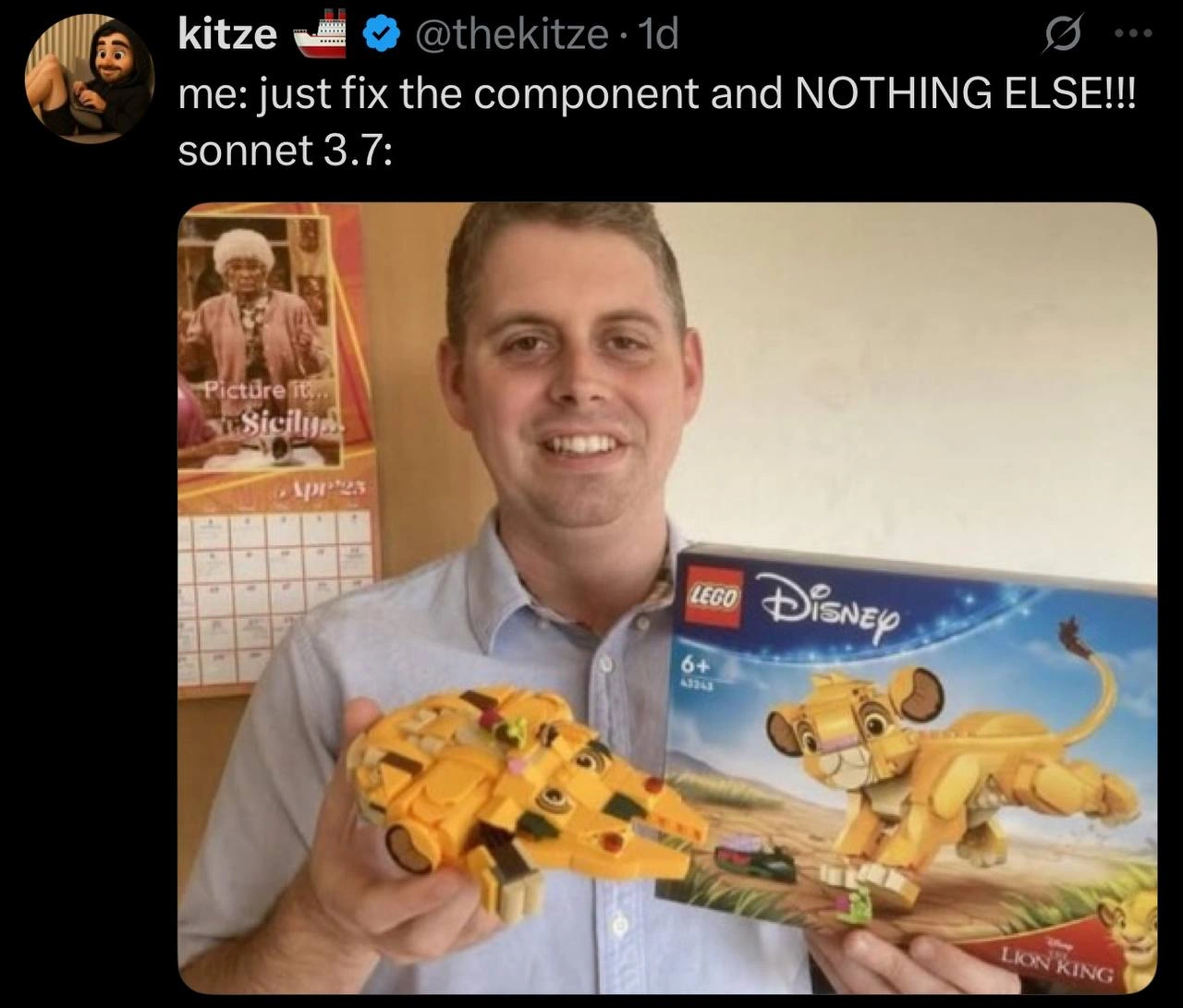
Imagine you built a cool LEGO lion and you notice its tail is a bit loose. You ask your friend to help fix just the tail. But when your friend gives it back, the whole lion has been taken apart and rebuilt into a weird-looking spaceship creature! It’s still kind of yellow and made of LEGO, but it doesn’t look like a lion at all anymore. You’d probably be shocked and say, “I only wanted the tail fixed, not a whole new toy!” The joke here is about expecting a small help and getting way more (and not in a good way). It’s funny (and a little silly) because the friend didn’t follow instructions – they changed everything instead of just the one thing you asked. The poor lion was supposed to stay a lion, but now it’s something completely different. This captures that feeling of, “I asked for one tiny fix, and you turned it into a big mess!” It’s a playful way to show why sometimes doing extra stuff when it’s not needed can lead to goofy results.

Level 2: Scope Creep 101

At its core, this meme highlights an overzealous code change. The manager or lead (tweet author) said “just fix the component and nothing else,” meaning they wanted a small bug fixed in an existing UI piece without any other surprises. A component in front-end development is like a building block of the user interface – for example, a button or a menu widget in a React or Angular app. Here, a specific component had a minor issue. A bug fix should ideally be a focused change that solves that issue while leaving everything else the same to the user. Instead, the developer delivered a totally revamped component. This is comparable to receiving a product that doesn’t match its specs or design: in the meme, the LEGO Simba on the box (what was expected) versus the bizarre LEGO creation in hand (what was delivered). The term UI parity refers to the new version looking and behaving the same as the old version from the user’s perspective. That parity was clearly broken – the “fixed” component looks nothing like the original Simba.

Let’s break down some terms and concepts shown in this humorous scenario:

  • Refactoring: This means changing the code’s structure without changing its external behavior. It’s like reorganizing the code to be cleaner or more efficient but supposedly not altering what the user sees or how the feature works. In practice, refactoring is usually done to improve code quality (make the code easier to read, maintain, or extend) and should not introduce new features or bugs. In our meme’s case, however, the refactoring wasn’t transparent – it obviously changed the “look” (the LEGO result is different), which indicates the refactor wasn’t purely internal. Maybe the developer intended to refactor the component to make the fix easier, but they went too far and ended up changing how the component renders on screen.

  • Over-engineering: This is when a solution is far more complicated or grand than it needs to be. If someone asked for a simple fix and you rebuild the whole thing from scratch, that’s over-engineering. It’s like using a jet engine to power a bicycle – technically impressive, but unnecessary and likely problematic. In coding, over-engineering might mean writing a whole new module or adding layers of abstraction for a problem that required a much simpler fix. The meme’s developer turning a “just fix this small bug” task into a large rewrite is classic over-engineering. They might have thought, “I’ll make this component better and future-proof!” but ended up overshooting the target.

  • Feature creep (or scope creep): This refers to the gradual expansion of a project’s goals or features beyond what was originally planned. In a team setting, if you’re only supposed to fix a bug, but then you also slip in a few “improvements” or refactors that weren’t asked for, you’ve expanded the scope. The phrase “just one more thing…” turns into many things. Here, the developer not only fixed the bug (presumably) but may have added or changed other behaviors – hence the final product doesn’t match the original spec. New developers often hear warnings about scope creep: if the task is to add a door to a house, don’t also build a new wing onto the house. Fix the door, nothing more. In code, sticking to the scope avoids unintended side effects.

  • “Just one line change”: This is a famous ironic phrase in programming. Many bugs seem like they’ll be one line fixes. But as you change that line, you might discover the function is used elsewhere, or the fix requires altering a data structure, and suddenly you’re changing many lines. It’s a running joke that “there’s no such thing as a simple one-line fix.” In this meme, “just fix the component” was akin to “just a small change,” yet it ballooned into a bigger endeavor. New developers quickly learn that even a tiny tweak can have ripple effects in a codebase, especially in a fragile or tightly-coupled system. That’s why careful testing and code reviews are vital when you deliver even minor changes – to ensure you didn’t accidentally create a mutant Simba in the process.

In simpler terms, the meme is teaching a lesson wrapped in humor: keep your fixes focused. If you’re tasked with a bug fix, it’s usually best to only fix that bug in that commit or pull request. If you see code that’s messy or outdated (poor code quality), resist the urge to overhaul it at the same time unless it’s absolutely necessary to solve the bug. Otherwise, you risk what happened here: the software’s “before vs after” contrast becomes as absurd as the LEGO model comparison. Your team lead or client expects the component to behave the same (just without the bug), but they get something entirely different. That can lead to confusion, new bugs, or a very perplexed QA team wondering if they’re looking at the same feature anymore.

This particular meme coming from a tweet (by kitze, a developer known for coding humor) uses that format effectively. The tweet text is:

me: “just fix the component and NOTHING ELSE!!!”
sonnet 3.7: [image]

The “me:” is the person asking for the small fix, and “sonnet 3.7:” is presumably the developer or the name of the update that delivered the wacky result. The image is the punchline – showing the huge discrepancy between expectations and reality. Even without knowing the specifics of the project, any frontend developer (or anyone who’s been in a code review where the diff is much larger than expected) can relate. It’s both funny and a little painful because it’s a gentle roast of that one colleague (or maybe ourselves at times) who can’t just fix the one thing. They have to tinker with everything.

Bottom line for junior devs: This meme is a humorous reminder to avoid unintended refactoring and scope creep when it’s not asked for. It’s okay to improve code, but communicate and do it in a separate effort if possible. If someone just wants Simba’s tail fixed, don’t rebuild Simba from random bricks. Save the grand redesign for when everyone’s on board with it!

Level 3: From Patch to Patchwork

What starts as a minor bug fix can spiral into a full-blown overhaul – a phenomenon every senior engineer recognizes with equal parts horror and dark humor. In this meme, a developer was told "just fix the component and nothing else!" – essentially a mandate to apply a surgical code patch without altering any other behavior. But the maintainer (nicknamed “sonnet 3.7” in the tweet, hinting at an elaborate solution) delivered something unrecognizable: the software equivalent of a misshapen LEGO Simba spaceship 🦁🚀. The original design (the official Simba model on the LEGO box) represents the intended outcome or specification, while the blob of bricks in the guy’s hand is the delivered result – a refactor gone rogue that violates all expectations of design parity. It’s as if the developer proudly proclaimed, “I fixed the bug – and in the process, rewrote the whole frontend component because why not!”

This scenario is a textbook over-engineering misadventure. Instead of a quick tweak, the code was refactored beyond recognition. Refactoring, when done right, means improving internal code structure and code quality without changing what the code does externally. However, here the dev apparently got carried away, altering not just the internals but the outward behavior/UI. The meme nails this with the LEGO metaphor: the box shows Simba as he should look (the UI design or expected output), but the rebuilt version is a blocky monstrosity (the new UI that breaks parity with the original). It’s like a pull request labeled “bugfix” that ends up changing 20 files, swapping out frameworks, and redesigning the UI in the process. Feature creep sneaked in under the guise of a fix – the dev likely added “just a few improvements” that snowballed into a disfigured feature set, much like adding random LEGO pieces until Simba turned into a spaceship.

Why is this funny (or terrifying, if you’ve lived it)? Because it’s relatable. Any seasoned developer has seen a “simple” one-line change turn into a cascading refactor that nobody asked for. Perhaps the component had some technical debt or sloppy code, and our eager maintainer thought, “Might as well clean this up while I’m here.” It’s a noble intent – improving code quality – but doing it while fixing a bug is risky. We end up with a totally new beast: maybe the “fixed” component indeed squashed the original bug, but it also introduced new quirks and visual changes (i.e., our Simba now has spaceship wings). This undermines the trust in the change: stakeholders who expected a tiny patch are now staring at a full redesign wondering what went wrong.

In true Cynical Veteran fashion, one can imagine the code review comments: “This was supposed to be a hotfix. Why does it look like a version upgrade from 3.6 to 3.7 with breaking changes?” The tweet’s reference to “sonnet 3.7” underscores the dramatic flair of the rewrite – as if the developer wrote a whole Shakespearean sonnet of code for a one-line fix. The humor hits home because it satirizes that all-too-common disconnect between what was requested and what was delivered. It’s the software equivalent of telling someone to tighten a loose screw on a car, and they return with a rocket engine attached. Sure, it might run, but good luck recognizing it.

Let’s be clear: sometimes refactoring is necessary. Perhaps the bug truly couldn’t be fixed without reworking the component’s foundation. But the meme assumes this was unwarranted – a case of “if it ain’t broke (aside from that tiny bug), don’t rebuild it.” The end result? Code reviewers and project managers facepalm 🤦‍♂️, the product lead utters “This isn’t what I asked for…”, and the developer might be standing there grinning like the guy in the photo – oddly proud of the off-spec creation. In the Pride Lands of code, this is how a tiny request can disrupt the Circle of Life of a stable codebase, leaving everyone singing “no more Hakuna Matata.” It’s funny because it’s true: even a Lion King can turn into a Lego creature feature when scope creep runs wild.

// Pseudocode of what happened:
function fixBug(component) {
  // Developer's inner voice: "I'll just refactor the whole thing... that fixes it, right?"
  const newComponent = rebuildFromScratch(component);
  applyUnaskedStyleChanges(newComponent);
  return newComponent; // returns something technically "fixed", but entirely different
}

// Expected outcome: <= 5 lines changed
// Actual outcome: 200 lines changed, 1 new spaceship component introduced

Description

The image is a screenshot of a tweet from the user 'kitze'. The tweet expresses a developer's frustration with an AI model. The text reads, 'me: just fix the component and NOTHING ELSE!!! sonnet 3.7:'. Below this text is a photo of a man holding a LEGO Disney Lion King box, which shows a complete model of the character Simba. In his other hand, he holds a bizarre, mangled creation made of yellow LEGO bricks that looks nothing like Simba, perhaps resembling a spaceship. The joke is a commentary on the unpredictable nature of AI models, specifically Anthropic's 'Sonnet 3.7'. The developer gives a very specific, narrow instruction ('just fix the component'), but the AI model completely ignores it and produces something wildly different and incorrect, much like someone using the pieces from a Simba LEGO set to build something else entirely. This resonates with developers who have struggled with AI code assistants that 'hallucinate' or perform unwanted, large-scale refactors when asked to make a small, targeted change
Comments

12
Anonymous ★ Top Pick This is what happens when the model's temperature is set to 1.5. The component doesn't work, but the resulting PR is... avant-garde
  1. Anonymous ★ Top Pick

    This is what happens when the model's temperature is set to 1.5. The component doesn't work, but the resulting PR is... avant-garde

  2. Anonymous

    The PR says “one-line hotfix,” but the diffstat screams +1,274 −980 - Simba isn’t the only thing that got de-composed

  3. Anonymous

    Every senior engineer knows the pain: you ask the AI to change a button color and it refactors your entire architecture, adds three new design patterns, implements SOLID principles you didn't ask for, and somehow manages to introduce a dependency on a blockchain framework - all while the original bug remains untouched

  4. Anonymous

    Ah yes, the classic 'just change one line' ticket that somehow triggers Claude to refactor your entire component hierarchy, add comprehensive error boundaries, implement memoization strategies you didn't ask for, and throw in some accessibility improvements for good measure. It's like asking your senior architect to fix a typo and getting back a 47-page RFC proposing a complete system redesign. At least when junior devs over-engineer, you can blame inexperience - but when your AI pair programmer does it, you realize we've successfully automated the 'I'll just make a few improvements while I'm here' instinct that's haunted code reviews since the dawn of version control

  5. Anonymous

    Asked Sonnet to tweak Button.jsx; it opened a 58‑file PR, migrated the repo to a homegrown design system, reformatted everything, and somehow committed a yellow Millennium Falcon

  6. Anonymous

    Ask for a one-line fix in Card; get a PR migrating to React 18, introducing design tokens, Storybook, 47 touched files, and a component that no longer resembles the spec - Simba on the box, spaceship in hand

  7. Anonymous

    Sonnet 3.7: 'component fixed'. My PR: 500 files changed, now with SOLID pride lands

  8. Sure Not 1y

    Water? Coffee?

    1. dev_meme 1y

      Wdym?

  9. @CCZeroOne 1y

    Great, now it's a Go-Onger mech

  10. @patsany_horosh_mne_v_dm_pisat 1y

    real

  11. @NaNmber 1y

    this https://t.me/devs_chat/152006

Use J and K for navigation