Skip to content
DevMeme
6197 of 7435
The Senior Developer Realization that Tony Stark Was a Vibe Coder
DevCommunities Post #6795, on May 23, 2025 in TG

The Senior Developer Realization that Tony Stark Was a Vibe Coder

Why is this DevCommunities meme funny?

Level 1: Waving to Write Code

Imagine you have a big puzzle to solve or a model to build. There are two ways to do it. One way: you sit down with the pieces, read the instructions, and put it together carefully piece by piece. That’s like normal coding – using the proper tools (a keyboard and computer) and following logical steps. Now think of another way: you pretend you’re a wizard and just wave your hands in the air, hoping the puzzle pieces magically fly together because it looks super cool. 😄 Tony Stark in the movies is doing something a bit like that second way! He’s moving shiny images and gadgets around in the air with his hands. It looks amazing, like magic, and as kids we all thought, “Wow, he’s so advanced, he can code by just feeling it!” But here’s the funny part: in real life, building something (or coding) by just going with the flow or vibes usually doesn’t work.

We find this meme funny because it’s saying: when we grow up and become actual developers, we realize Tony wasn’t typing any real code at all – he was a “vibe coder,” kind of just improvising with those holograms. It’s like seeing a chef on TV tossing ingredients with flair versus actually cooking a meal yourself and getting messy in the kitchen. As kids, we see Tony and think he’s like a super-cool chef who doesn’t even need a stove. As adults with some cooking (coding) experience, we chuckle and think, “Actually, someone else (his computer AI friend) must be doing the real cooking while Tony just does the showy part.” In simple terms, the meme is joking that Tony’s fancy hand-wave coding is more for show than how things really get done.

So, it’s funny and relatable: it reminds us of when we believed in high-tech movie magic, and how we later learned the down-to-earth truth. Coding isn’t about flashy holograms; it’s usually a lot of typing and thinking. Tony’s way looks cool, but if you tried to write code by waving your hands around in real life, you’d probably just end up with tired arms and a very confused computer!

Level 2: Holographic IDE 101

Let’s break down the tech and humor for the less jaded among us. The image shows Tony Stark (aka Iron Man) using a high-tech holographic computer interface. This is a classic Iron Man reference to how Tony designs his suits and gadgets in the Marvel movies: he doesn’t sit at a normal laptop. Instead, he has an Augmented Reality (AR) workspace where digital objects (like 3D models of Iron Man armor or code schematics) float in the air. He can grab, swipe, and manipulate these projections with his hands – that’s a gesture-based programming interface, a kind of holographic UI.

In real-world terms, Augmented Reality (AR) means overlaying computer graphics onto your view of the real world (contrast with Virtual Reality (VR), which is a completely simulated environment). Tony’s setup is like AR on steroids: imagine wearing something like a Microsoft HoloLens or having a fancy hologram projector, so that instead of a physical keyboard and monitor, your code appears as glowing 3D shapes you can touch in mid-air. A developer’s User Interface (UI) usually consists of a screen, keyboard, and mouse, but here it’s transparent screens and floating menus you poke and pinch with your fingers. From a UX design (User Experience design) perspective, it looks amazing and super intuitive in the movie. This is part of the meme’s joke: the UX/UI is so slick that it implies Tony can code by instinct or vibe (i.e., by feel and visual intuition) rather than by typing precise commands. Hence calling Tony a “Vibe Coder” – someone who codes by vibe.

Now, what’s actually happening under the hood? In the films, Tony has an AI assistant named JARVIS. When Tony waves his hand through those translucent wireframes, JARVIS is doing the heavy lifting: interpreting gestures as commands, moving files or code modules around, maybe even writing code based on Tony’s visual manipulations. In essence, Tony’s Integrated Development Environment (IDE) is voice- and gesture-driven. If he wants to delete something, maybe he makes a flicking motion and JARVIS deletes a file. If he wants to create a new subroutine, perhaps he literally pulls out a copy of an existing code block in holographic space. It’s like the ultimate drag-and-drop coding environment. This is where the humor kicks in for developers: drag-and-drop or visual programming tools exist (think graphical languages or node-based editors), but real programming still heavily relies on typing out code because it’s far more precise.

Let’s clarify some terms from the meme text that developers chuckle at:

  • Developer Experience (DX): This refers to how pleasant and productive it is to code using certain tools or environments. Companies hype “improved DX” if they create a tool that supposedly makes developers’ lives easier. Tony’s holographic interface looks like a DX dream: no cumbersome keyboard, just natural hand movements. The meme jokes about the quest for “10x DX” – meaning tools that make developers ten times more effective. In reality, such claims are usually marketing exaggerations. Every new tool that promises to revolutionize coding still has to deal with the same old problems (bugs, learning curve, trade-offs).
  • Gesture tracking latency: This is the small delay between a physical action and the system’s response. If Tony moves his hand and the hologram follows 0.2 seconds later, that’s latency. In AR/VR systems, low latency is crucial; high latency makes controls feel unresponsive and can even cause motion sickness. For coding, latency can break your concentration. Developers are used to keyboards where letters appear almost instantly as you type. If you had to wait or see a lag when arranging code with your hands, it would be super frustrating.
  • Edge-case failure modes: An edge case is a situation that’s unusual or extreme. A failure mode is how a system fails when something goes wrong. So this phrase means “the weird ways Tony’s fancy setup could break or behave badly in odd situations.” For example, what if two holograms overlap and the system can’t tell which one Tony meant to grab? Or if the room’s lighting messes up the gesture sensor and JARVIS misinterprets a random hand scratch as a “delete all code” command – yikes! These are the kind of scenarios seasoned devs joke about because they always show up eventually. In traditional coding, an edge-case bug might be something like a specific input that crashes the program. In Tony’s interface, an edge-case bug could be a gesture that wasn’t planned for (like Tony crossing his arms or a cat wandering through the hologram and confusing the system).
  • Vibe coder: This isn’t a standard technical term; it’s a tongue-in-cheek concept. It suggests someone is coding by feeling it out rather than methodically. Think of a DJ “playing it by ear” versus a pianist reading sheet music. Tony, with his airy hand-waving approach, is like the DJ of coding, relying on intuition and interactive visuals. A real engineer might say, “Nope, that’s not how coding works!” — we usually need well-defined logic, syntax, and lots of careful typing. So calling Tony a vibe coder is a humorous way to say “he’s not literally writing code; he’s kind of freestyling it and letting his super-smart computer figure it out.”
  • Mid-air git ops: Git is a version control system that developers use to manage code. “Ops” stands for operations. The phrase suggests performing Git operations (like commit, push, or merge) with mid-air gestures. It’s a joke imagining how something mundane like saving your code changes would work in Tony’s interface. Instead of typing git commit -m "fixed bug" in a terminal, maybe Tony just gives a thumbs-up to commit, or physically pushes a hologram away to push to remote. It’s funny to devs because Git is notoriously tricky at times; doing it with hand gestures sounds both comically cool and error-prone. One accidental wave and you might merge the wrong branch or revert your codebase – scary stuff for those who know Git’s complexities!

To put it all together: Tony’s holographic futuristic dev experience is a perfect example of something that looks innovative and intuitive in theory (or on film), but is actually extremely hard to pull off reliably. There have been attempts in the real world to create AR coding environments and gesture-based UIs for developers. For instance, people have experimented with coding in VR or using devices like the Leap Motion (a sensor that tracks hand movements) to control a computer. While these demos are impressive, they haven’t replaced the regular monitor-and-keyboard setup. Why? Because when you actually try to write or debug a complex program, you need precision and endurance. It’s hard to scroll through hundreds of lines of code in a VR headset without feeling eye strain, and holding your arms up to drag code modules around leads to fatigue (a known problem called the “gorilla arm” effect in touch UIs).

The meme’s joke, “Growing up is realising Tony was a Vibe Coder,” speaks to that moment in a developer’s life when you transition from wow, cool tech! to wait a second… this wouldn’t really work. It’s a playful jibe at UX irony in our industry: sometimes the interfaces that look the most futuristic (and impress non-developers) would be impractical for the day-to-day work of actual coding. Tony’s rig works for him in the movies because he has essentially magical tech and an AI sidekick. For the rest of us, if we tried to code like that, we’d probably end up staring at a frozen hologram with a bug we can’t even touch, wishing we just had a normal keyboard to type on. This meme packs all those realizations into a one-liner that both celebrates Tony’s cool factor and pokes fun at the impracticality of gesture-based programming for real developers.

Level 3: Stark Reality Check

Tony Stark’s flashy holographic AR/VR coding setup in the Iron Man movies is every junior dev’s sci-fi dream—and every senior dev’s practical nightmare. Growing up is realising that Tony’s mid-air multitouch UI is basically an over-engineered light show masking outrageous complexity. Sure, it’s a futuristic developer experience (DX) on the surface: translucent code structures manipulated with grand hand gestures. But behind those pretty particle effects, a battle-scarred engineer can smell the latency and edge-case chaos.

Think about it: gesture tracking latency means every time Tony waves his hand, there’s a tiny delay before the system responds. In a life-or-death code deploy (or, say, building an Iron Man suit at 3 AM), a 200ms lag feels like eternity. Real devs rage when an IDE plugin introduces a 50ms keystroke lag—imagine your entire coding interface having the responsiveness of a laggy Zoom call. And those “multi-coloured holographic wireframes”? They look cool, but seasoned programmers know that rendering complex 3D graphs of your code is just asking for synchronization bugs and GPU driver crashes at the worst possible moment. The meme hits home because anyone who’s chased the latest 10x DX miracle has learned the hard way that more glowing UX/UI often means more ways for things to fall apart.

The industry loves to romanticize "10x developers" and revolutionary interfaces (hello, Minority Report-style gesture coding!). In reality, coding by waving your arms around is a one-way trip to pulled muscles and merge conflicts you can literally tangle yourself up in. Seasoned devs have seen this pattern: a hyped DevExperience innovation promises to make coding intuitive and visual, but underneath it’s just as strict and logical as ever, now with extra abstraction layers that can fail. Tony’s JARVIS AI undoubtedly auto-corrects his mistakes and handles all the grunt work. In real life, we don’t have a Jarvis—just Stack Overflow, copilot AIs, and coffee to save us from our own typos. The humor here is that Tony was a Vibe Coder: he’s basically coding by aesthetic intuition and relying on a genius AI to fill in the gaps. That’s the Stark reality for experienced devs: if you tried this vibe-driven development in a real codebase, you’d end up with something that only looks good in the demo but falls apart in production. It’s a tongue-in-cheek reminder that cool demos often hide outrageous complexity and edge-case failure modes—the very things that give veteran engineers those 3 AM PTSD flashbacks.

Finally, consider the unspoken truth: Tony’s holographic IDE never shows him compiling, debugging, or Git merging. Seasoned devs notice what Hollywood conveniently skips. Did Tony ever resolve a mid-air merge conflict? Did he git push his Iron Man suit code with a dramatic swipe, only for mid_air_git_ops to mis-register a gesture and force-push to the wrong branch? 😒 The meme’s adult epiphany—“Tony was a Vibe Coder”—wryly suggests that all that futuristic flair is basically coding by feel. And anyone who’s deployed real systems knows “coding by vibe” is a one-way ticket to prod outages. In short, this meme resonates with senior engineers because it playfully exposes the gulf between futuristic dev fantasies and the gritty reality we operate in. It’s a comedic industry irony: even a genius superhero would be a nightmare teammate if he insisted on a holographic IDE in your next sprint.

Description

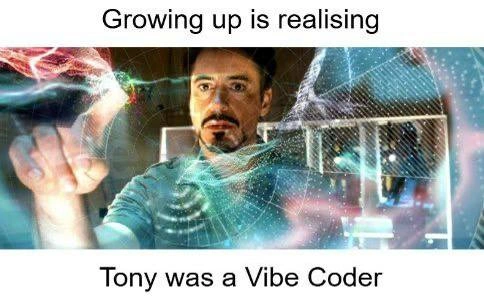
The image is a meme with a screenshot of Tony Stark from an 'Iron Man' movie. He is shown interacting with his signature futuristic, holographic 3D user interface, manipulating glowing blue and red data visualizations with his hands. The top text of the meme reads, 'Growing up is realising'. The bottom text completes the thought: 'Tony was a Vibe Coder'. The humor stems from re-evaluating the cinematic portrayal of genius-level engineering through the lens of modern developer terminology. A 'vibe coder' is a developer who works on intuition and feel rather than on structured, documented, and test-driven principles. The joke is that Tony Stark's on-screen process - waving his hands at holograms to instantly create world-changing technology - is the ultimate example of 'vibe coding'. For experienced developers, this is a humorous critique of how coding is unrealistically portrayed in media, contrasting it with the real-world need for rigor, planning, and maintainability
Comments

11
Anonymous ★ Top Pick Of course he was a vibe coder. His entire system had a single point of failure, was never documented, and the only person who understood it is dead. The bus factor was 1
  1. Anonymous ★ Top Pick

    Of course he was a vibe coder. His entire system had a single point of failure, was never documented, and the only person who understood it is dead. The bus factor was 1

  2. Anonymous

    Great until the hand-tracking jitter converts your polite ‘git push --force-with-lease’ into a raw ‘git push --force’ - now the whole org is *really* feeling the vibe

  3. Anonymous

    After 20 years in the industry, I've finally accepted that my most impressive debugging technique is still 'commenting out random blocks until it works' - basically the same vibe-based engineering Tony was doing, just with less dramatic hand gestures and more Stack Overflow tabs

  4. Anonymous

    The harsh truth every senior engineer eventually faces: Tony Stark's holographic gesture-driven development workflow is just production debugging at 3 AM with extra steps and better lighting. No unit tests, no code review, no documentation - just vibes, a particle accelerator in the basement, and the confidence that comes from having an AI assistant who never asks 'why didn't you just use the standard library?' The real superpower isn't the arc reactor; it's shipping to production without a staging environment and somehow having it work

  5. Anonymous

    Vibe-driven development demos like magic - right up until CI asks for a reproducible build

  6. Anonymous

    Vibe-driven development scales perfectly until audit asks for a reproducible build and all you have is a slow‑mo hand swipe over a hologram

  7. Anonymous

    Vibe coding pro tip: If it compiles and flies, ship it - arc reactor not included

  8. Sure Not 1y

    I am meme Friday

    1. Sure Not 1y

      NOT LIKE THAT

  9. @TheresnoKNOWLEDGEthatISnotPOWER 1y

    This means that everyone is a vibe coder deep down inside.

  10. @freadam 1y

    He wrote jarvis. Don't compare him to people who use AI without understanding it.

Use J and K for navigation