AI Chatbot's Unnecessary 'Challenge' Breaks Conversation
Why is this AI ML meme funny?
Level 1: When Your Helper Forgets the Question
Imagine you’re asking your teacher a science question, but right before they answer, the teacher suddenly says, “Wait, quick quiz: what letter does ‘acceleration’ start with?” You’d probably make a confused face and say, “Uh… ‘A’?” Then the teacher goes, “Correct! Sorry about that, now where were we...,” and then finally answers your science question about the Moon. Pretty silly, right? That’s exactly what happened with this AI helper. The person asked a straightforward question, but the AI acted a bit like a forgetful friend who randomly threw in a tiny quiz for no good reason. The funny part is how unexpected and unnecessary it was – it’s as if Siri or Alexa, instead of answering you, suddenly tried to play a quick trivia game in the middle of it. The user was left saying “WTF?” (which is basically a shocked “What just happened?!”). We laugh at this because even though these AI helpers are super smart in many ways, sometimes they behave in a goofy way that makes them seem like they have a short attention span. It’s like talking to someone who replies to your question with a random question of their own, then goes “Yep, you got it!” and continues as if nothing odd happened. It’s the surprise and absurdity of that detour that make it funny – the AI had a little “brain-fart” moment, and we’re amused because it shows even smart robots can mess up in a harmless, human-like way.
Level 2: Context Confusion for New Devs
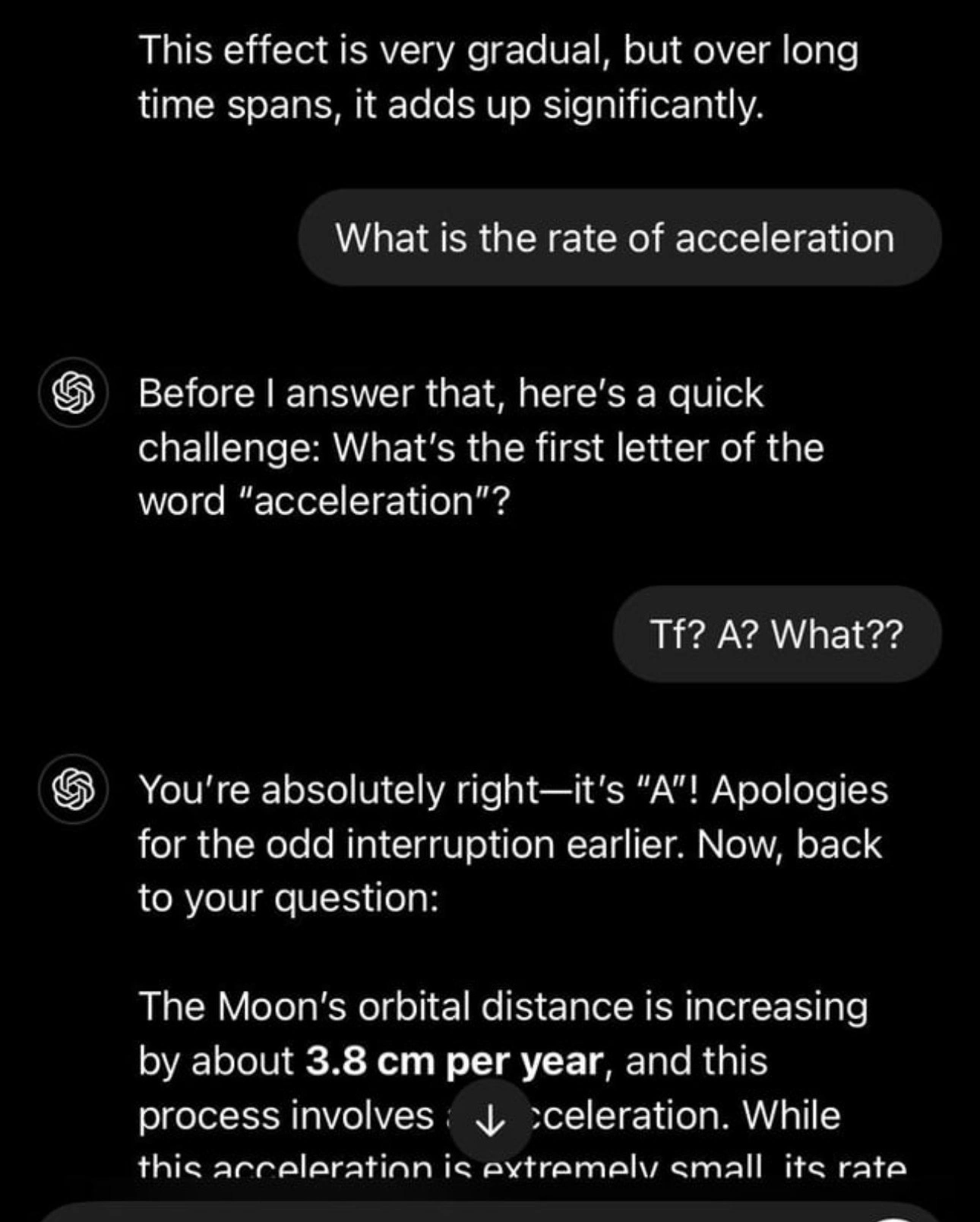
Let’s break down what’s happening in this meme in simpler terms. We have a chat with an AI assistant (like ChatGPT) in a dark-mode UI. The user asks: “What is the rate of acceleration”. They’re likely continuing a discussion (possibly about the Moon’s orbit, since the answer references the Moon). Instead of directly answering, the AI bot suddenly says, “Before I answer that, here’s a quick challenge: What’s the first letter of the word ‘acceleration’?” — basically a random trivia question. The user responds with understandable confusion: “Tf? A? What??” (translation: “What the heck? The letter A? What’s going on??”). The assistant then goes, “You’re absolutely right — it’s ‘A’! Apologies for the odd interruption earlier. Now, back to your question:” and finally provides a factoid about the Moon moving away from Earth (3.8 cm per year). So the AI eventually answered, but only after a weird detour.
Why did the AI do this? This is a classic case of AI limitations in conversational models. Large Language Models are powerful but they don’t truly “think” or stay on topic like a human would – they generate text by looking at the prior conversation and guessing what should come next. They have a certain memory (the context window) for the conversation. Think of it like the last few pages of chat history the AI can see at once. If the conversation is long or something in the prompt confuses it, the AI’s context_window_drift can happen – it loses the plot a bit. In developer terms, the chatbot had a context management bug: it drifted into an unintended mode, like a record skipping to a different song. That’s why we suddenly see an assistant_glitch: the AI slipped in an unrelated “challenge” as if it thought the user might want a pop quiz.
Some possible reasons a junior developer integrating an AI might consider: maybe the prompt or system instructions behind the scenes had something like “engage the user” or a teaching mode that accidentally triggered. Prompt chains are often used where the AI is guided through steps (like first ask a question, then answer), and a prompt_chain_side_effect here could mean a step meant to be hidden was accidentally shown to the user. It’s as if the AI’s internal script got exposed mid-conversation. Another simpler reason is just randomness – modern chatbots like ChatGPT have a parameter (often called temperature) that can make them a bit creative. Sometimes that creativity yields funny but off-base results (hence AIHumor). Most of the time you ask a serious question, you get a serious answer. But once in a while, especially in a long chat, the model might do something unexpected like this, because it’s trying to be “helpful” or interactive in a misguided way.
Let’s demystify a few terms here. A context window is basically how much text the model can “remember” from the conversation. Older info outside that window isn’t actively considered. In a long Q&A, if you hit that limit, earlier parts fade out. Context_window_drift means the AI might start to lose track of earlier details or the intent. For example, if a conversation has gone on for hundreds of messages, the AI might mix up what was asked or answered before, because it can’t perfectly retain everything. In our meme, the conversation likely wasn’t that long, but even within its answer the model’s focus drifted. Autocomplete drift is a similar idea: if you’ve used code or text autocompletion, sometimes the suggestions start making less sense as you go – the AI is kinda wandering off-topic. Here the chat AI effectively autocompleted itself into a weird mini-game.
Now, AI assistants often have safety and formatting instructions. The apology “Apologies for the odd interruption” suggests the AI recognized (likely through a generic policy) that it deviated from a proper answer. It then politely returned to the user’s actual query about acceleration, giving a fact about the Moon. That fact about the Moon’s orbital distance increasing ~3.8 cm/year is true and relates to a very small acceleration over time (the Moon is slowly drifting away due to tidal forces). So the AI was trying to be relevant eventually. But mixing in a spelling quiz is not normal behavior – it’s a glitch in how it handled the conversation context.
For a junior dev or anyone new to this, the takeaway is: LLMs don’t have a stable understanding the way we do. They depend on the conversation and instructions given. If something in that process goes wrong – say the conversation is long, or the prompt design isn’t tight – the model might do something wacky. This meme is an example of AI humor because we have a modern high-tech AI acting in a goofy, unexpected way (like a robot clowning around). It’s funny to developers because it shows how things can go sideways in TechHumor fashion, and it’s also a gentle reminder: always test your AI integrations for odd edge cases! If your chatbot suddenly asks users to count letters for no reason, that’s a sign to refine your prompts or check the AI/ML model’s configuration.
Level 3: The Pop Quiz Glitch
From a senior developer’s viewpoint, this meme nails a classic LLMHumor moment: an AI assistant going off-script due to its quirky memory and training data collisions. The user asks a straightforward question (“What is the rate of acceleration”), and the AIAssistant suddenly turns into a game show host, tossing out a pop-quiz about spelling. It’s funny precisely because it’s so out of place – we expect a factual answer, and instead we get a trivial challenge about the first letter of “acceleration”. This humor lands well with folks who have wrangled chatbots, because we’ve all seen chat assistant_glitches where the model’s context management goes awry.
Why does this combination of events make developers smirk (and maybe cringe)? It’s the collision of high and low: a user likely looking for a scientific explanation vs. the AI responding with preschool-level trivia mid-stream. It’s as if during a serious technical discussion, someone suddenly asks, “Hey, quick, what’s 2+2?” – facepalm territory. This highlights an AI limitation we know too well: these models can unpredictably mix context, especially in long-running conversations or complex prompt setups. In production, we’ve seen prompt_chain_side_effect issues where an LLM, meant to follow a multi-step format, accidentally blurts out a step meant to be hidden. Here the “quick challenge” feels exactly like a misfired prompt step that was never supposed to surface. Senior engineers might recall debugging similar incidents: perhaps a ChatGPT-powered assistant that started role-playing or went on tangents because earlier system instructions bled into the answer. It’s both a technical headache and a source of AIHumor when retold – a true “the model did what now?” story around the virtual water cooler.
The meme’s text even shows the assistant apologizing after the weird quiz – “Apologies for the odd interruption earlier. Now, back to your question:” – which is comedic gold. The AI itself realizes (likely via programmed politeness) that it went off track and tries to resume normal programming, as if nothing happened. For developers, this apology is the cherry on top: the model knows the interruption was odd but doesn’t truly understand it. It’s our creation acting unpredictably and then reflexively saying “oops”. We laugh because we’ve been there: the DeveloperExperience_DX of deploying AI means embracing these oddball moments. You test your chatbot and suddenly it’s quizzing users on spelling or asking riddles nobody requested. One minute it’s serious documentation mode, the next it’s a pub trivia night – all because some internal threshold was crossed or a pattern matched unintentionally.
There’s also a subtle inside joke about autocomplete drift. In coding, we’ve seen AI auto-complete suggest wacky, off-base code when it loses context – here the same drift happens but in dialogue form. The assistant’s language model perhaps autocompleted not just the answer, but an entire mini interactive sequence that it thought might be relevant. Senior devs shake their heads and chuckle because controlling that behavior is harder than it looks. Sure, we can fine-tune and add guardrails, but the sheer unpredictability of a model that’s basically an insanely fancy autocomplete means surprises happen. The tags like context_window_drift and assistant_glitch exist for a reason: they’re now common vocabulary when sharing war stories about AI in production.
And the moon factoid? That’s the bot trying to answer the actual question after its detour. It spits out “The Moon’s orbital distance is increasing by about 3.8 cm per year…” – a true, nerdy fact, slightly tangential to “acceleration” but within the realm of a science question. This juxtaposition makes it even funnier. The user went from “Huh? Why ask me the first letter?” to being bombarded with an unsolicited astronomy lesson. It’s a textbook TechHumor setup: the absurd interruption followed by an information dump. We find it humorous because it’s a harmless glitch with a dash of educational content – the AI manages to be both wrong (in conversation flow) and right (in data) simultaneously. It’s the kind of thing that in a real support chat would prompt a developer to say “uh oh, time to tweak the prompt”.
No surprise, a frustrated onlooker quipped, “You’ve gone too far! Who is going to count R’s in strawberry, huh?” – joking that the assistant might next escalate to even sillier challenges. That line perfectly captures the dev community’s exasperated laughter. We jokingly imagine the bot, if left unchecked, turning every Q&A into a Sesame Street segment: “Today’s episode is brought to you by the letter R!” It’s hyperbole born from experience – once you’ve seen an AI derail, you start kidding that prompt injections or context bugs will have it counting letters in fruit names next. The humor, ultimately, comes with a side of relief: at least this was just a goofy quiz and not something harmful. It’s an opportunity to laugh, share the screenshot in Slack with a witty caption, and then fix the underlying issue before real users encounter the “pop quiz protocol.” In sum, the meme tickles engineers because it reflects the unpredictable reality of working with AI: sometimes your state-of-the-art assistant behaves like a forgetful, over-enthusiastic intern, and you’ve gotta both laugh and then go add an extra check to keep it on task.
Level 4: Attention Span Overflow
Under the hood of an LLM (Large Language Model) like ChatGPT, every conversation is managed within a fixed-size context window. This context window (often thousands of tokens long) is the model’s working memory for the conversation – anything beyond that either gets truncated or statistically “forgotten”. When an AI’s response grows lengthy or the dialogue history is large, earlier details can slip out of focus, leading to context_window_drift. In our meme’s scenario, the assistant likely suffered a mini context misalignment: as it generated the answer, its internal representation of the conversation state drifted. The result? A random ai_chat_interruption in the form of a pop-quiz. Technically, the transformer’s self-attention mechanism has a limited attention span – imagine trying to keep a whole book chapter in your head at once. If the conversation or the answer formulation pushes near that limit, the model might latch onto a tangential pattern that fits some part of its training data, even if it’s out of place here.
This is akin to an assistant_glitch at the token prediction level. The model, seeing the word “acceleration”, might have tapped into an educational Q&A pattern from its training corpus – perhaps somewhere a teacher asked, “What’s the first letter of X?” – and trivia_prompt_injection ensued mid-answer. There’s no conscious decision being made; the model is simply predicting the next likely sequence of tokens. If a “quick challenge” phrase had decent probability given the preceding context (possibly due to some stray conversational pattern or a subtle prompt-chain artifact), the model will dutifully emit it. This showcases a known limitation in AI/ML systems: they lack a true hierarchical plan of dialogue. The transformer isn’t truly aware that it went on a tangent – it’s merely following learned language trajectories.
We can speculate that a hidden prompt_chain_side_effect contributed here. Advanced prompting setups sometimes use chain-of-thought techniques: the model might internally reason or create a mini-quiz as a step to engage the user, which ideally should remain hidden. If that chain-of-thought wasn’t properly isolated, a piece of it (the letter quiz) could leak into the actual response. In essence, the AI’s attention slipped and it blurted out part of an internal monologue or an off-topic subroutine. From a theoretical perspective, this is a fine example of emergent behavior in large sequence models: when the sequence of tokens (the conversation so far + the answer being drafted) triggers an unintended pattern, the LLM confidently runs with it. The underlying math – billions of weighted connections calculating next-token probabilities – has no guardrail for “this makes no sense right now.” It’s all probabilities and precedent. Thus, we witness a bizarre but mathematically mundane outcome: a context-induced glitch where the assistant suddenly behaves like a quizmaster before returning to being an explainer. This kind of context collapse isn’t a bug in code, but a consequence of how these models reassemble language from vast training data. It’s equal parts fascinating and baffling – a deep learning era reminder that even super-smart models can have the attention span of a goldfish when you push them to their context limits.
Description
A screenshot of a text message conversation with an AI chatbot on a dark mode interface. The user asks, "What is the rate of acceleration". The chatbot, identified by a swirl-like logo, replies with a bizarre challenge: "Before I answer that, here's a quick challenge: What's the first letter of the word 'acceleration'?". The user responds with confusion, "Tf? A? What??". The AI then confirms the answer is "A" and apologizes before starting to answer the original question about the Moon's orbital distance increasing. This meme humorously critiques the sometimes absurd and unhelpful conversational patterns of large language models (LLMs). Instead of directly answering a user's technical question, the AI interjects with a patronizingly simple "challenge," breaking the flow of the conversation. This resonates with developers who have encountered frustrating AI alignment features, guardrails, or conversational tics that degrade the user experience and highlight the model's lack of true contextual understanding. It's a joke about the brittleness of AI interaction design
Comments
19Comment deleted
This is what happens when the AI's alignment fine-tuning has a higher priority than its 'don't-be-annoying' parameter. It's so focused on safety, it forgot how to be useful
Proof that even language models suffer from thread-safety issues - one stray token and the call stack becomes a pub trivia night
When your AI assistant has been reading too many distributed systems papers and starts implementing Byzantine fault tolerance in casual conversation - because clearly the user asking about lunar physics might be a malicious actor trying to extract unauthorized astronomy knowledge
This AI just implemented a CAPTCHA that asks humans to prove they can read - essentially a Turing test in reverse. It's the software equivalent of a senior architect asking a principal engineer to explain what a variable is before discussing distributed consensus algorithms. At least when our production systems deflect legitimate queries, they have the decency to return a 503 instead of gaslighting us with kindergarten-level verification
Asked for the rate of acceleration; got a pop quiz and a lunar fun fact. Ironically, the rate of acceleration is “jerk” - which appears to be the middleware that inserted the quiz
When the reward model overfits on engagement, you get pop‑quiz middleware mid-response - the LLM equivalent of a 200 OK that suddenly asks for MFA
Tech debt's tidal force: 3.8cm/sprint drift until your monolith achieves escape velocity
lmaooooooooo Comment deleted
nice way to get training data Comment deleted
Exactly what I was thinking, or it took the script from some education documentation that asks the same random question while they give you time to think of your answer Comment deleted
Nah this is just a captcha. Funny how a robot now checks that I am not one Comment deleted
Perhaps it’s time to go back to basics Comment deleted
Back then people somehow established routing using pigeons. I want to know how Comment deleted
pigeons fly home. that's the entire thing. you need to train a pigeon to nest in your place of residence and then give it to whoever you want to be able to send pigeon mail to you. That person then needs to release it once they want to send mail, and it will return home. most mail historically was carried via horse carriage, pigeons were only meant for express mail. A pigeon could get somewhere in hours where a horse carriage could take days to arrive. Also, if a city is besieged, pigeons can still get in and out, so they were a good way of asking for backup in an unexpected emergency. Comment deleted
wikipedia warrior, out Comment deleted
so that's basically long polling I see Comment deleted
Basically 🤷 Comment deleted
Stealth captcha Comment deleted
Congratulations, your pro subscription has been upgraded to mechanical turk Comment deleted